Skip to content
You may be sitting in your car after work, lying awake at midnight, or staring at your phone, asking yourself one hard question: Should you tell your spouse before filing for divorce?
My answer is direct. Sometimes yes. Sometimes absolutely not. In Texas, this is not just an emotional choice. It's a legal and financial strategy decision that can affect your property, your children, your safety, and the tone of the entire case.
The Private Question That Demands a Strategic Answer
If you feel torn, that's normal. The struggle often isn't with paperwork first. It's with guilt, fear, and uncertainty. You may not want to blindside your spouse. You may also know, deep down, that giving advance warning could create chaos.
Both instincts can be valid.
The mistake is treating this like a moral quiz instead of a strategy call. Divorce in Texas has real moving parts. Community property rules, temporary court orders, custody concerns, and local court practices in places like Harris County and Dallas County all matter. The right move depends on who your spouse is, how conflict usually unfolds in your home, and how exposed your finances are.
One point is clear. Spouses who talk before filing often have a better shot at a calmer process. A Psychology Today analysis found that 68% of couples who had advance conversations achieved uncontested or mediated divorces, compared to 32% when the filing came as a surprise in this discussion of when to tell your spouse you want a divorce.
That does not mean advance notice is always smart.
What you should ask yourself first
Before you say one word, ask:
- Is your spouse generally reasonable? If they can hear painful news without exploding, a conversation may help.
- Do you share children? A respectful start can make future co-parenting easier.
- Are finances messy or unequal? If one spouse controls accounts, records, or business income, quiet preparation matters.
- Is debt part of the pressure? If financial stress is driving the breakup, it helps to understand related issues like debt relief for one spouse before you make any move.
Bottom line: The best timing is the timing that protects your future, not the timing that simply feels less uncomfortable today.
The Collaborative Path When You Tell Your Spouse First
For many couples, telling a spouse before filing is the better move. If your marriage is ending but communication is still possible, a direct conversation can prevent the case from turning into a legal street fight.

Texas law gives divorcing spouses room to resolve disputes by agreement. Texas Family Code Section 6.602 addresses mediated settlement agreements. In plain English, if you and your spouse can reach a proper written agreement in mediation, that agreement can carry serious force in court. Judges generally prefer families to resolve their own issues where possible, especially on property, parenting schedules, and support.
Why advance notice can help
A spouse who isn't blindsided is often less defensive. That matters. Once someone feels ambushed, they may stop listening and start reacting. If you want an uncontested divorce, a mediated resolution, or a workable parenting relationship after the marriage ends, the opening move matters a lot.
Collaborative law benchmarks cited by a divorce law source report that mediation success rates rise 70% when spouses are not “blindsided” in this discussion of talking to your spouse before filing.
That lines up with what experienced family lawyers see every day. A calm first conversation can preserve options.
What this looks like in practice
If you choose this path, the early process often looks like this:
- You consult privately first. You still need legal advice before the talk.
- You have the conversation. Keep it brief, clear, and forward-looking.
- You propose structure. Mediation, temporary agreements, or a joint plan for the children.
- One spouse files. The filing formalizes the case.
- The other spouse answers or signs a waiver.
- You exchange information and negotiate terms.
- You finalize a decree.
For some families, this is the least destructive route.
Here's a helpful overview of divorce strategy and communication:
The biggest benefit for parents
If you have children, don't underestimate the value of a respectful beginning. Texas courts decide conservatorship and possession based on the best interest of the child. Judges notice when one parent fuels conflict. They also notice when parents can act like adults and build a workable parenting plan.
A cooperative start can help you discuss:
- Conservatorship terms under Texas rules for decision-making rights
- Possession schedules for weekdays, weekends, holidays, and summers
- Child support issues that may later follow guideline calculations
- School and medical routines that need stability from day one
Some divorces don't need a dramatic opening. They need a controlled one.
If your spouse is capable of hearing hard news without trying to punish you, telling them first may be the strongest move you can make.
Why You Might Need to File for Divorce Before Telling Your Spouse
Now the hard truth. If your spouse is controlling, vindictive, impulsive, or financially secretive, telling them first can be a serious mistake.
In that situation, filing first is not cruel. It's disciplined.

Why advance warning can backfire
Once a spouse knows divorce is coming, they may start moving money, deleting records, changing passwords, pressuring the kids, or creating a fake story about what happened. High-conflict people often use the time between announcement and filing as a weapon.
Observed case outcomes cited in legal advisory content indicate a 40-60% increased risk of immediate asset dissipation or financial maneuvers when a spouse is informed before legal preparation in this legal discussion of filing strategy.
That's why strategy matters in Texas.
What filing first does for you in Texas
Filing first can give you immediate access to court protections. In many counties, your attorney can request a Temporary Restraining Order, often called a TRO, along with the divorce petition. A TRO can seek to stop both spouses from:
- hiding or transferring property
- draining bank accounts outside ordinary living expenses
- changing insurance coverage
- destroying records
- threatening or harassing the other spouse
- removing children in violation of court expectations
A TRO is not the final result. It's an early shield while the case gets organized.
Texas also has a waiting period in most divorces. In general, a divorce can't be finalized immediately after filing. That means your opening move matters because the case will live for a while before a final decree is signed. The first orders often shape the whole fight.
Harris County and Dallas County realities
In large urban counties, judges and associate judges move quickly on emergency and temporary matters when the facts support it. If your spouse controls the books, owns a business, manages all online accounts, or has a history of intimidation, your lawyer may tell you to gather records discreetly, file first, and then have your spouse formally served.
That approach often maintains an advantage.
If you're weighing timing and court advantage, review this guidance on whether it is best to file for divorce first in Texas.
When I would tell a client to stay quiet
I would lean toward filing first if any of these are true:
- Your spouse has threatened you before
- They've hidden money or lied about finances
- They run a business with unclear books
- They control your access to cash, credit, or records
- They monitor your phone, email, or location
- They use the children to punish you
- You expect retaliation the moment divorce is mentioned
Practical rule: If giving notice creates a real chance your spouse will damage your finances, your access to the kids, or your safety, prepare first and talk second.
That isn't cold. That's how you protect yourself.
Your Pre-Divorce Financial and Digital Preparation Checklist
Before you tell your spouse anything, or before you file, do your homework. Preparation is not paranoia. It is basic self-protection.
A 2018 study found that 62% of individuals who secretly consulted attorneys before telling their spouse about divorce reported better financial outcomes, securing 18% higher asset divisions on average in this discussion of what to consider before announcing divorce.
That result makes sense. The spouse who understands the situation usually makes better decisions.
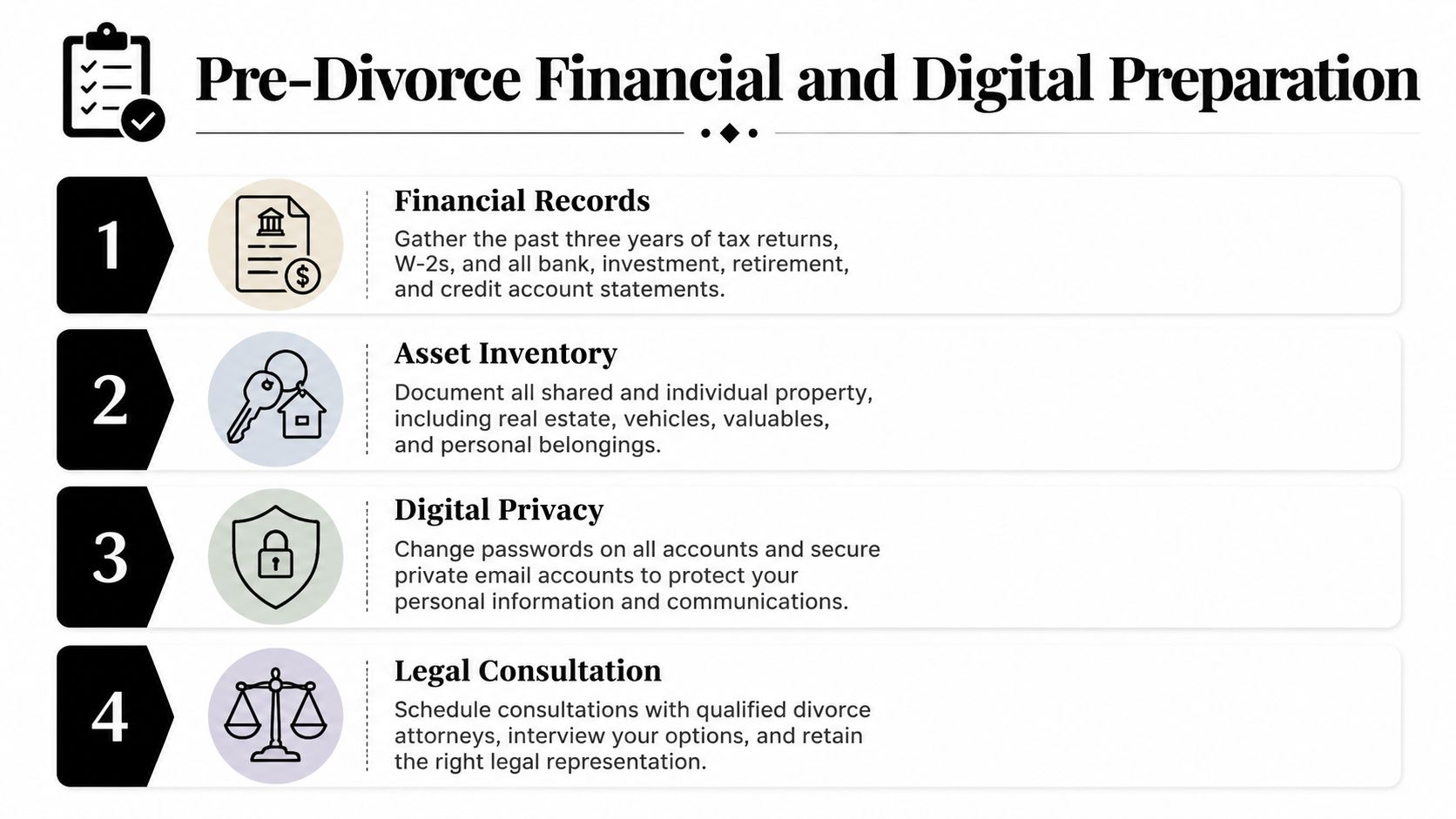
Build your file before conflict starts
Start gathering clean copies of the records your lawyer will need. Think in categories, not random piles.
- Income records. Tax returns, W-2s, 1099s, pay stubs, bonus statements, and any proof of side income.
- Banking and credit. Monthly statements for checking, savings, joint accounts, personal accounts, and credit cards.
- Property records. Deeds, mortgage statements, refinance papers, vehicle titles, and loan documents.
- Retirement and investments. 401(k), IRA, pension, brokerage, stock plan, and crypto account statements if they exist.
- Business documents. Formation papers, K-1s, profit and loss statements, QuickBooks reports, payroll summaries, and ownership agreements.
- Insurance information. Health, auto, homeowners, life, disability, and umbrella policies.
If paper records are scattered everywhere, use practical smart paperwork storage solutions so you can organize them securely and find them quickly.
Secure your digital life
Divorce today is partly a digital case. If your spouse knows your passwords, has access to your devices, or can read your messages, fix that now.
Take these steps:
- Change passwords on personal email, cloud storage, banking apps, and social media.
- Create a new private email account used only for attorney communication and case planning.
- Turn off location sharing on phones, apps, and family account settings if it is safe to do so.
- Review backups on shared tablets, laptops, and home computers.
- Use secure storage for scanned documents and attorney notes.
Do this legally. Don't guess your spouse's passwords. Don't install tracking software. Don't take private communications you have no right to access. Texas courts care about evidence, but they also care how you got it.
Know what to inventory
Texas divides marital property under community property principles. Your lawyer needs a map of the estate before they can protect it.
Create a list that includes:
| Category | What to note |
|---|---|
| Real estate | Address, mortgage, equity, who uses it |
| Accounts | Institution, account type, current balance |
| Debts | Whose name is on it, purpose, monthly payment |
| Personal property | Jewelry, firearms, collectibles, tools, furniture |
| Business interests | Ownership share, revenue records, key contracts |
For a more detailed planning guide, review this Texas-focused checklist on how to prepare financially for divorce in Texas.
Quiet preparation is often the difference between reacting to divorce and managing it.
How to Have the Divorce Conversation with Your Spouse
If you've decided that telling your spouse first is the right move, don't wing it. This conversation can set the tone for everything that follows.
Choose the right setting
Have the conversation in a place that is private, calm, and easy to leave if emotions rise. For many people, home works only if there's no history of intimidation. If tension tends to escalate, choose a neutral setting or have the discussion when the children are not present and you have your own transportation.
Avoid major holidays, your child's birthday, or the night before a school event. Don't do it in the middle of an active fight. Don't do it by text unless safety requires distance.
Keep the message short and clear
You do not need a long opening statement. In fact, long speeches usually create more openings for argument.
A better script sounds like this:
I've given this a lot of thought. I believe our marriage needs to end. I want to handle this respectfully and in a way that protects the children and our finances. I'm asking that we work through the process in a structured way, ideally through lawyers and mediation.
That kind of statement does three things. It is direct. It avoids blame. It points toward a process.
What to avoid
Don't turn the conversation into a trial about the marriage. That never goes well.
Avoid:
- Listing every past grievance
- Arguing about who is at fault
- Making promises about money or custody
- Threatening to take the house, the kids, or the bank accounts
- Telling the children before a plan is in place
If your spouse presses for details, keep returning to the same point. The marriage is ending, and the next step should be a structured legal process.
Give one constructive next step
People handle bad news better when they can see the next rung on the ladder. Offer one practical move.
You might say:
- let's each speak with a lawyer this week
- let's schedule mediation
- let's agree not to discuss this with the kids until we have a plan
- let's exchange basic financial information calmly
End the conversation before it turns ugly
You are not required to stay in the room for an endless emotional spiral. If voices rise or threats begin, end the discussion.
“I'm not going to fight with you about this tonight. We can talk again after we've both had legal advice.”
That is not avoidance. That is control.
Special Cases That Require a Different Strategy
Some situations change the answer completely. In these cases, generic advice can hurt you.

Domestic violence and coercive control
If there has been violence, threats, stalking, forced sex, strangulation, intimidation, or severe coercive control, do not treat this like a normal marriage ending. Your first priority is safety.
In Texas, you may need a divorce filing and a protective order strategy at the same time. A protective order can address safety boundaries, residence issues, and contact restrictions. If this is your reality, read about seeking a protective order during divorce in Texas, then get legal help immediately.
Don't announce your plans in advance if you fear retaliation.
Business owners and high-value estates
If one or both spouses own a company, professional practice, rental portfolio, or substantial investment holdings, silence and preparation usually matter more. Texas is a community property state. All marital property acquired during marriage is presumed community property under Texas Family Code § 3.003, and this discussion of whether to tell your spouse you are thinking of divorce notes that contested divorces with surprise service averaged 28% higher litigation costs.
That number doesn't mean surprise filing is always wrong. It means high-conflict service often gets expensive. For high-asset cases, the central question is whether disclosure before preparation gives your spouse time to manipulate records, compensation, distributions, inventory, or debt.
If you own a business, gather:
- Entity records such as operating agreements and shareholder documents
- Accounting records from QuickBooks, payroll providers, and tax preparers
- Compensation records including draws, bonuses, deferred compensation, and reimbursements
- Asset details for equipment, receivables, and real estate tied to the business
Military families
Military divorces carry extra layers. Jurisdiction can be complicated. Service members may live in one state, claim residence in another, and be stationed somewhere else entirely. Retirement division, service of process, and parenting logistics can also be more difficult when deployment is involved.
If you are in a military family, get Texas-specific advice before you announce anything. Timing can affect filing location, temporary orders, and how practical a parenting plan will be.
In special-case divorces, the safest choice is usually not the most emotionally satisfying choice. It's the one that preserves options before conflict starts.
What to Do Next Protecting Yourself and Your Future
If you remember nothing else, remember this. You should tell your spouse before filing for divorce only when doing so is safe and strategically smart. If it will promote cooperation, good. If it will trigger financial damage, intimidation, or chaos, don't do it.
Use this quick framework.
Ask yourself these three questions
- Safety. Will this conversation put you or your children at risk?
- Stability. Does your spouse usually respond with reason, or retaliation?
- Complexity. Are there accounts, businesses, debt, real estate, or parenting issues that need legal planning first?
If your answer to the first question is yes, stop and get legal help before disclosure.
If your spouse is volatile or secretive, prepare and likely file first.
If your case is low conflict and both of you are capable of acting like adults, a direct conversation may save enormous stress.
What to do in the next few days
- Schedule a confidential consultation with a Texas family law attorney
- Gather financial records and secure your digital accounts
- Write down concerns about children, property, debt, and safety
- Avoid threats, withdrawals, and emotional social media posts
- Do not rely on your spouse's verbal promises
- Do not move money or hide assets without legal advice
Key takeaway
The decision about timing is not the divorce. It is the first strategic move in the divorce. A good first move can protect your relationship with your children, preserve your access to money and records, and keep the case from becoming harder than it needs to be.
You do not have to guess your way through this.
If you're facing this decision in Texas, the Law Office of Bryan Fagan, PLLC can help you make a clear plan before anything is said or filed. You can schedule a free, confidential consultation to talk through your safety concerns, property issues, child custody questions, and filing strategy. When the stakes are this high, getting informed early is one of the smartest decisions you can make.