 Skip to content
Facing the end of a marriage is a deeply personal journey, and the legal road ahead can feel overwhelming. Deciding to file for divorce is a major step, and in Harris County, it begins with understanding the specific legal requirements that open the door to a new chapter in your life.
Understanding the Legal Requirements to File in Harris County
The thought of navigating the legal system can be intimidating, but the initial steps are more straightforward than you might think. The Texas Family Code sets clear rules about where you can file for divorce. This isn't just about paperwork; it's how the court establishes its jurisdiction—the legal authority to make decisions about your family and property that will stand the test of time.
Think of it like proving residency for a school district; you must show you belong there. The same principle applies to divorce.
Texas Residency Rules: The First Step
Before a Harris County judge can hear your case, you must meet two residency requirements outlined in Texas Family Code Section 6.301. These rules prevent "forum shopping," where someone might try to file in a county with laws they think are more favorable.
To file for divorce in Texas, you or your spouse must have:
- Lived in Texas for the last six months.
- Lived in the specific county where you are filing—in this case, Harris County—for the last 90 days.
It’s important to know that only one of you needs to meet these requirements. For example, if you've lived in Harris County for years but your spouse recently moved to another county, you can still file your divorce right here. For a deeper look at these rules, our guide on Texas divorce residency requirements provides more detail.
The Roles of Petitioner and Respondent
Once you start the process, you and your spouse will have specific titles. The person who files the first document, the Original Petition for Divorce, is the Petitioner. The other spouse, who receives the lawsuit papers and must file a response, is the Respondent.
Being the Petitioner doesn't give you a legal advantage in court. However, it does give you control over when the process begins and when the state's mandatory waiting period starts.
Key Insight: Texas has a mandatory 60-day waiting period that starts the day after the divorce petition is filed. No matter how quickly you and your spouse agree on everything, a judge cannot finalize your divorce until this period is over.
This waiting period, combined with the residency rules, sets the minimum timeline for any divorce. Since most long-term Harris County residents easily meet the residency requirements, the 60-day waiting period often becomes the main timing factor to watch. You can learn more about these Texas divorce findings to understand timelines better.
Grounds for Divorce: No-Fault vs. Fault
Your petition must also state the legal reason, or "grounds," for the divorce. The good news is that Texas is a no-fault divorce state, which simplifies things for most couples. The most common ground is insupportability. As defined in the Texas Family Code, this simply means the marriage has become insufferable due to "discord or conflict of personalities" with no reasonable expectation of reconciliation. You don't have to prove anyone did anything wrong.
However, Texas law also allows for fault-based grounds, which can be a factor in how property is divided. These include:
- Cruelty
- Adultery
- Felony conviction and imprisonment
- Abandonment for at least one year
- Living apart for at least three years
- Confinement in a mental hospital
Choosing between no-fault and fault grounds is a strategic decision. While alleging fault could influence a judge’s property division, you must provide evidence to prove your claim. This can make the divorce more contentious, lengthy, and expensive. Understanding these options is the first step toward moving forward with confidence and clarity.
Preparing and Filing Your Divorce Petition
The paperwork required to start a divorce can seem like a mountain, but it’s really just a series of manageable steps. Think of it as following a clear map. Your journey begins with one critical document: the Original Petition for Divorce.
What Goes Into the Original Petition for Divorce?
The Original Petition for Divorce is the formal document that opens your case with the Harris County court system. Its purpose is to provide the court with the essential facts about your marriage and state what you are asking for in the divorce.
You will need to include fundamental details, such as:
- The full names and addresses of you and your spouse.
- The date and place of your marriage.
- The names and birthdates of any minor children.
- A statement confirming you meet Texas residency requirements.
- The legal grounds for the divorce (most often, "insupportability").
The petition also makes initial requests regarding property and children. While this isn't the final word, it tells the court what issues—like dividing community property or ensuring the children's best interests are met—need to be resolved. You can explore this document in more detail in our article on the Texas Original Petition for Divorce.
Before filing, you must have the right to do so in a Texas court. This is called establishing jurisdiction.
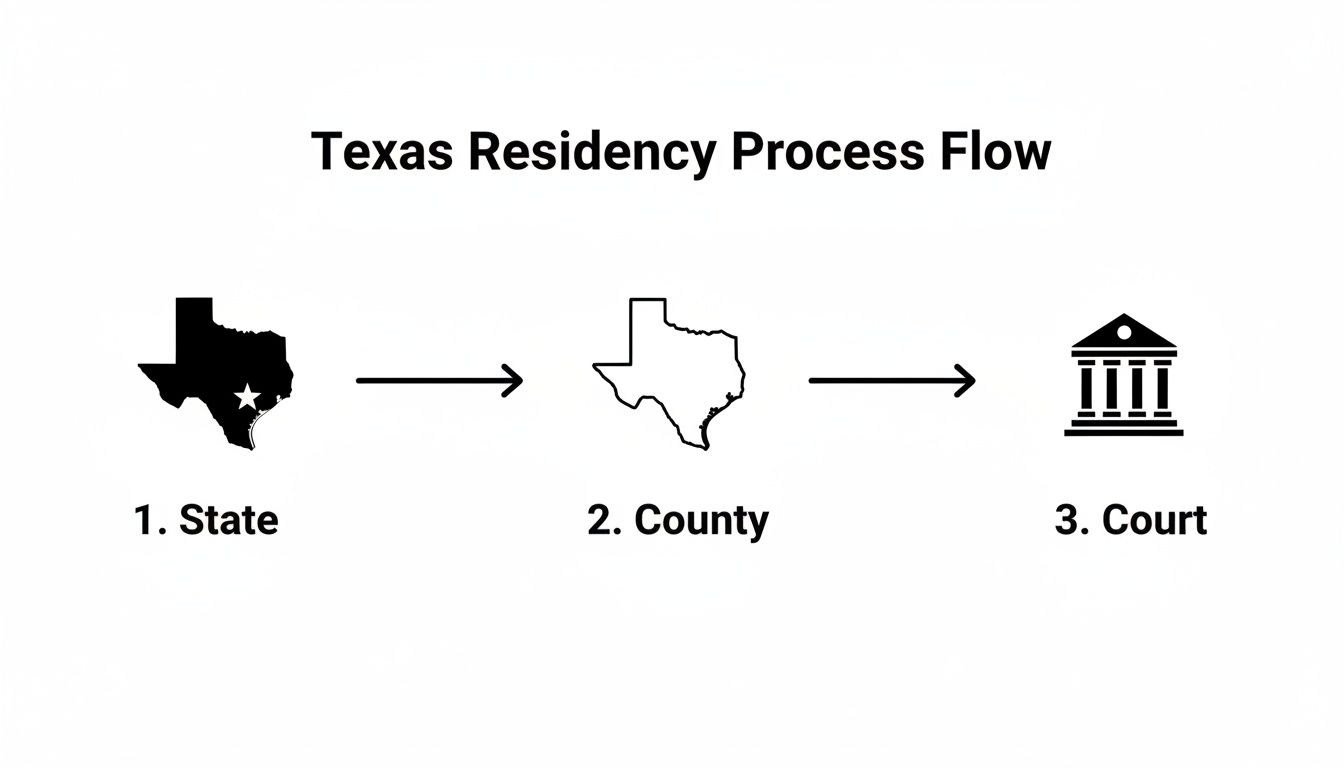
As you can see, you first meet the state's residency rules, then the county's, which determines the specific court where you'll file your petition.
The Harris County Divorce Filing Checklist
Filing for divorce involves more than just one form. Use this checklist to ensure you have everything organized from the start. Getting these details right helps prevent common mistakes that can delay your case.
| Task | What to Do | Expert Tip |
|---|---|---|
| Prepare the Petition | Complete the Original Petition for Divorce with all required personal, marriage, and child information. | Be thorough. Incomplete or inaccurate information is a top reason for filings to be rejected by the clerk's office. |
| Complete Other Forms | Fill out a Civil Case Information Sheet and any other forms required by the Harris County District Clerk. | Check the District Clerk's website for the most current list of required forms, as they can change. |
| Create E-Filing Account | Register for an account on the state's official e-filing portal, eFileTexas.gov. | This system is mandatory for attorneys but available to everyone. It's how all documents are submitted to the court. |
| Pay Filing Fees | Pay the court filing fee, which is typically between $300 and $350. | If you can't afford the fee, you can file a "Statement of Inability to Afford Payment of Court Costs" at the same time. |
| File and Serve | Upload your documents through the e-filing portal and arrange for your spouse to be formally served. | Don't forget service! Your case cannot move forward until your spouse has been officially notified. |
Once you've worked through this checklist, your case is officially underway. A strong start makes the rest of the process much smoother.
The Critical Step of Formal Notification
After the clerk accepts your petition, your case is open. However, nothing else can happen until your spouse is formally notified of the lawsuit. This is a constitutional right known as service of process, ensuring everyone has a fair opportunity to respond.
You cannot simply hand the papers to your spouse or email them. In Harris County, service must be done in a legally recognized way.
- Personal Service: The most common method. A sheriff, constable, or certified private process server physically delivers a copy of the citation and your filed petition to your spouse.
- Waiver of Service: If your divorce is amicable, your spouse can sign a Waiver of Service before a notary, acknowledging they received the lawsuit documents. This saves time, money, and avoids a potentially awkward confrontation.
- Substituted Service: If your spouse is avoiding service, your attorney can ask the judge for permission to serve them another way after several failed attempts. This could mean leaving the documents with someone over 16 at their home or, in rare cases, even through social media.
Proper service starts the clock. Your spouse (the Respondent) now has a strict deadline to file a formal Answer with the court. Ensuring they are served successfully is what moves your case forward toward a final resolution.
Establishing Stability with Temporary Orders
That phone call confirming your divorce petition has been filed can bring a strange mix of relief and anxiety. It’s a major step, but it also kicks off a period of major uncertainty. Your life doesn't just hit pause for the next 60+ days.
Who’s paying the mortgage this month? Where will the kids sleep on Friday night? Can your spouse just empty the joint savings account? These are urgent questions that can’t wait for a final decree. This is exactly why Temporary Orders exist. They are legally binding court orders that create a set of ground rules to get you from filing day to finalization without chaos.

Why Temporary Orders are Crucial
Think of Temporary Orders as the blueprint for your day-to-day life while the divorce is pending. Without them, you and your spouse are left to figure things out on your own, which often leads to conflict and financial damage. A Harris County judge can issue these orders to address the most pressing issues you're facing right now.
Some of the most common issues addressed in a Temporary Orders hearing include:
- Exclusive Use of the Marital Home: Deciding which spouse will live in the family house while the divorce is ongoing.
- Temporary Child Custody: Creating a temporary possession schedule (visitation) and clarifying each parent's rights and duties.
- Interim Child and Spousal Support: Figuring out who pays for the children’s needs and whether one spouse requires temporary financial support to get by.
- Bill Payments: Ordering how critical bills like the mortgage, car notes, and credit cards will be handled.
Protecting Your Assets with a TRO
In some divorces, there's a genuine fear that one spouse might act irrationally or maliciously right after being served with papers. You might be worried they’ll drain the bank accounts, sell off community property, or even take the kids and disappear. To stop this from happening, your attorney can ask for a Temporary Restraining Order (TRO) right when the case is filed.
A TRO is an emergency injunction that essentially freezes everything in place. It can forbid both parties from:
- Selling or transferring property.
- Taking on new debt in the other's name.
- Changing insurance beneficiaries.
- Removing children from their school or from Harris County.
The TRO is a short-term fix, typically lasting for 14 days. This gives you a window of protection leading up to the Temporary Orders hearing, where a judge will decide which rules should stay in place for the long haul.
A TRO is not just a piece of paper; it’s an enforceable court order. Violating it can result in serious penalties, including fines or even jail time for contempt of court. It provides an immediate shield for your family and finances when you need it most.
Preparing for Your Temporary Orders Hearing
This hearing is your first real chance to tell your side of the story to the judge. Preparation is everything. A Harris County judge won’t just take your word for it; they want to see evidence and a clear, reasonable plan for how things should work.
This is especially true for financial matters. Research shows that women initiate nearly 69% of divorces in Texas, often due to issues that directly relate to arguments for financial support. If you want to dive deeper, you can read the full research about Texas divorce statistics.
To build a strong case for the judge, you'll likely need to provide:
- A proposed parenting plan and possession schedule.
- A sworn inventory and appraisement listing all your assets and debts.
- Recent pay stubs, bank statements, and tax returns.
- A proposed budget showing your monthly living expenses.
The judge’s decisions at this hearing often set the tone for the entire divorce. By getting clear, court-ordered rules in place early, you can reduce conflict and start focusing on a final resolution.
What to Do Next
If you are worried about your financial stability or co-parenting while your divorce is pending, requesting a Temporary Orders hearing should be your first priority after filing. The decisions made here will directly impact your daily life and can set the stage for the final outcome of your case.
This isn’t a step to take lightly. The arguments you make and the evidence you present are absolutely critical. Our experienced attorneys at The Law Office of Bryan Fagan, PLLC, know what Harris County judges need to see to make decisions that protect your rights and your family’s well-being. If you are starting the process of filing a divorce in Harris County, don’t wait for a crisis to happen. Schedule a free consultation with us today to discuss how we can secure your stability with effective Temporary Orders.
Navigating Discovery, Mediation, and Your Final Agreement
Once the initial paperwork is filed and temporary orders are in place, your divorce moves into the phase where the real work begins. This is where you and your spouse will formally exchange financial information and start negotiating the terms that will shape your future. Think of it as building the framework for your final divorce decree, one piece at a time.

Getting the Full Financial Picture: The Discovery Process
You can't fairly divide your marital estate until you know exactly what’s in it. The legal process for uncovering this information is called discovery. It provides a structured, formal way for both sides to request and obtain information, ensuring all assets are on the table and all debts are accounted for.
While the term sounds intimidating, discovery simply uses a few key legal tools to get a complete financial picture. The two most common tools you'll see are:
- Interrogatories: These are written questions your spouse is required to answer under oath. For instance, you might ask for a list of all bank accounts, retirement plans, or credit cards held in their name.
- Requests for Production: These are formal requests for copies of actual documents. This is how you get things like tax returns, bank statements, property deeds, and business records.
This back-and-forth is mandatory and ensures total transparency. For anyone in Harris County with a business, complex investments, or a high-value estate, this process is absolutely critical for an accurate and fair valuation of your assets.
Why Mediation Is Almost Always Required in Harris County
After discovery is mostly complete, the next stop for virtually every couple is mediation. In fact, Harris County judges rely heavily on it. Under Texas Family Code Section 6.602, judges have the authority to order couples into mediation before they will even consider giving you a final trial date.
So, what is it? Mediation is a confidential negotiation session facilitated by a neutral third-party—the mediator. A mediator's job isn't to take sides or make rulings. Their sole purpose is to help you and your spouse find common ground and work toward your own agreement. To get a better sense of the specifics, you can check out our comprehensive guide to mediation in Texas divorce cases.
A successful mediation puts you in the driver's seat. It's your opportunity to negotiate a parenting plan that truly works for your family and a property division that feels fair, all outside the high-stress environment of a courtroom.
Turning Your Agreement into a Final Order
The ultimate goal of mediation is to create a Mediated Settlement Agreement (MSA). This document will spell out every single term you and your spouse have agreed on, from who keeps the house to which holidays the kids spend with each parent.
Once both of you sign the MSA, it becomes irrevocable. This is a powerful word in Texas law—it means neither of you can change your mind or back out. This signed agreement then becomes the blueprint your attorney will use to draft the Final Decree of Divorce.
The Final Decree of Divorce is the official court order, signed by the judge, that legally ends your marriage based on the exact terms you negotiated in your MSA. This entire path—from discovery to a signed decree—is the standard for resolving divorces in Harris County because it encourages settlement and gives you the best shot at a fair outcome.
Avoiding Common Pitfalls in Your Harris County Divorce
Filing for divorce in a place as big and busy as Harris County can feel like you're navigating a maze blindfolded. It's completely understandable to want to simplify the process, maybe by trying a DIY approach or downloading some generic forms online. But that path is often loaded with hidden traps that can put your financial future and your relationship with your kids at risk.
The best way to protect yourself is to learn where others have gone wrong. Most of these mistakes aren't made on purpose. They happen because Texas family law has specific nuances that a one-size-fits-all document just can’t account for.
The Dangers of a Vague Parenting Plan
One of the most frequent and damaging errors is an incomplete or vague parenting plan. On the surface, a plan that just says "parents will split holidays" or "share summer vacation" sounds perfectly agreeable. In reality, it's a recipe for future conflict.
What happens when you both want the kids for that same week in July? Who gets them for Thanksgiving this year versus next? A poorly drafted plan all but guarantees you'll end up back in court, asking a judge to sort out the mess. That means thousands more in legal fees and a mountain of stress for your children.
A solid parenting plan, as required under the Texas Family Code, has to be incredibly specific. It should clearly spell out:
- Holiday Schedules: Define exactly which parent has which holiday in odd and even years.
- Summer Possession: Outline the precise dates for summer visitation and include firm deadlines for when those dates must be chosen.
- Travel Permissions: Include clear rules for any out-of-state or international travel.
- Decision-Making Authority: Specify who gets the final say on major decisions, like education and non-emergency medical care.
Miscalculating Community Property
Another major pitfall is mishandling community property, especially when complex assets like a family business or retirement accounts are on the table. Texas is a community property state, which means almost everything acquired during the marriage belongs to both of you.
A common mistake is simply taking your spouse's word for what a business is worth or failing to properly separate out the pre-marriage portion of a 401(k). For instance, if your spouse had a 401(k) before you got married, that starting balance and its growth are their separate property. But every contribution made during the marriage—and all the growth on those contributions—is community property.
A professional valuation of a business isn't a luxury; it's a necessity. Without an expert opinion, you could be leaving tens or even hundreds of thousands of dollars on the table. That’s a mistake that is nearly impossible to fix once the divorce is final.
The sheer volume of cases here makes this a huge local issue. With a staggering 28,500 divorces filed annually, Harris County is the epicenter of marital dissolutions in Texas. Our local divorce rate sits at 3.4 per 1,000 residents, well above the statewide average of 2.6. With that many cases flooding the system, the courts depend on properly prepared documents. Simple errors can get your case lost in the shuffle. You can discover more insights about these divorce statistics in Texas to better understand the landscape.
What to Do Next
These pitfalls all point to one critical truth: when you're filing a divorce in Harris County, getting professional guidance isn’t just another expense—it's your best defense against life-altering mistakes. An experienced family law attorney is your strategist, making sure your parenting plan is airtight and that every dollar of your community estate is properly accounted for. This lets you focus on your family's emotional well-being, knowing your legal and financial future is in good hands.
You don't have to get through this complex process alone. The Law Office of Bryan Fagan, PLLC, is here to protect your interests and help you steer clear of these common errors. If you're ready to move forward with clarity and confidence, schedule a free, no-obligation consultation with our team today.
Your Harris County Divorce Questions Answered
When you’re thinking about divorce, your mind is probably swimming with questions. It's completely normal. The uncertainty can feel overwhelming, but getting clear, straightforward answers is the first step toward regaining control. We've compiled some of the most common questions we hear from people right here in Harris County to give you the clarity you need to move forward.
What Is the Difference Between a Contested and Uncontested Divorce?
The biggest difference boils down to a single word: agreement.
- An uncontested divorce is when you and your spouse have already agreed on every major issue. This means you see eye-to-eye on how to divide your property and debts, and if you have kids, you've worked out a complete parenting plan.
- A contested divorce means there's a disagreement on at least one of those key points. It could be a fight over who gets the house, how a 401(k) will be split, or what the visitation schedule should look like.
It's worth noting that most divorces in Harris County start out as contested. That's okay—it’s part of the process. Through legal tools like discovery and mediation, the vast majority of couples find a way to resolve their differences and settle the case long before a final trial becomes necessary.
How Long Does a Divorce Take in Harris County?
This is easily one of the most frequent questions we’re asked, and the honest answer is: it depends entirely on whether you and your spouse are in agreement.
Texas law includes a mandatory 60-day waiting period. This clock starts ticking the day after the Original Petition for Divorce is filed. A judge legally cannot finalize your divorce until those 60 days are up. If your divorce is completely uncontested, you could be officially divorced shortly after that period ends.
For a contested divorce, however, the timeline stretches out considerably. A moderately contested case right here in Harris County can take anywhere from six months to over a year to fully resolve. The final timeline really hinges on the complexity of your finances and, frankly, the level of conflict between you and your spouse.
Can I File for Divorce if My Spouse and I Agree on Everything?
Yes, absolutely. That’s the ideal scenario, known as an uncontested divorce. But even when you're in total agreement, you still have to go through the formal legal process to make it official. This involves filing the initial petition and, most importantly, preparing and submitting a Final Decree of Divorce for a judge to review and sign.
Key Takeaway: An agreed-upon divorce decree is a powerful, legally binding contract. It is absolutely critical to have an experienced attorney review your agreement before you sign it. This ensures the document is properly drafted, is enforceable, and fully protects your rights, helping you avoid very expensive legal headaches down the road.
Do I Really Need a Lawyer if My Divorce Seems Simple?
While you certainly have the legal right to represent yourself (this is called filing "pro se"), it’s a path loaded with significant risks—even in what appears to be a straightforward divorce.
Texas community property laws are notoriously complex. One small mistake in your Final Decree of Divorce can have permanent and financially devastating consequences. This could be something as simple as using vague language in your parenting plan or failing to include the specific "magic words" needed to properly divide a retirement account. For specific legal advice and representation regarding your divorce, consulting with specialized services from expert family law firms can be invaluable.
It’s an interesting side note that while divorce filings remain high in urban centers like Harris County, the overall state trend is downward. Divorce rates in Texas fell from 4.1 per 1,000 people in 1990 to 2.6 in 2019. This shift is often credited to people marrying later and placing more emphasis on premarital counseling. You can discover more insights about these divorce statistics in Texas for a bigger picture.
Hiring an attorney isn't just about handling paperwork; it’s about having a legal strategist on your side. They ensure your rights, your property, and your future with your children are protected exactly as the law intends. A free consultation can help you understand what’s truly at stake in your unique situation.
Key Takeaway: What to Do Next
Filing for divorce in Harris County is a step-by-step process that you can navigate with confidence. From meeting residency requirements and filing the initial petition to securing temporary orders and negotiating a final agreement, each step is a building block toward your future. The most common mistakes—like vague parenting plans or miscalculating property—can have long-lasting consequences, but they are avoidable.
The road ahead might seem foggy, but you don't have to navigate it alone. The legal team at The Law Office of Bryan Fagan, PLLC, has guided thousands of Harris County families toward solutions with compassion and skill. To protect your rights and build a secure future, schedule a free, no-obligation consultation with our team today. We are here to provide the clear answers and trusted guidance you deserve. Visit us at https://www.texasdivorcelawyer.us to take your first step.


