Skip to content
The moment you discover your spouse has been unfaithful is devastating. While the hurt and betrayal are overwhelming, there is a clear path forward—one that allows you to regain control and protect what matters most.
Although Texas is a no-fault divorce state, which means you don't have to prove wrongdoing to end your marriage, infidelity can still have a huge impact on your case. This guide will walk you through how adultery affects property, custody, and the divorce process itself, helping you make informed, confident decisions for your future.
Understanding Your Next Steps After Discovering Infidelity
The shock of discovering an affair can be paralyzing. It shatters your sense of security and trust. While your emotions are completely valid, the most powerful thing you can do right now is take calm, strategic steps to protect yourself, your children, and your financial future. The decisions you make in the coming days will lay the groundwork for the road ahead.
Texas law allows for a no-fault divorce on the grounds of "insupportability," meaning the marriage has simply become intolerable. But the law also recognizes specific "fault" grounds, and adultery is a significant one.
Under Texas Family Code Section 6.003, a court may grant a divorce in favor of one spouse if the other has committed adultery. This is more than just a label; a finding of fault can be a critical factor when the judge divides your marital property.
Why Filing on Fault Grounds Matters
Choosing to file for divorce based on adultery isn't about public punishment or revenge; it's a strategic legal tool to seek a fair and just outcome. When you can prove your spouse was unfaithful, a judge has the discretion to award you a disproportionate—or unequal—share of the community property.
This is especially true if your spouse used marital funds to support the affair. Money spent on gifts, trips, or other expenses for the affair partner came from the community estate. That was your money, too. The court can use a disproportionate division to help make you whole again.
As you process this discovery, focusing on these three core areas will help you move from a place of distress to one of empowered action.
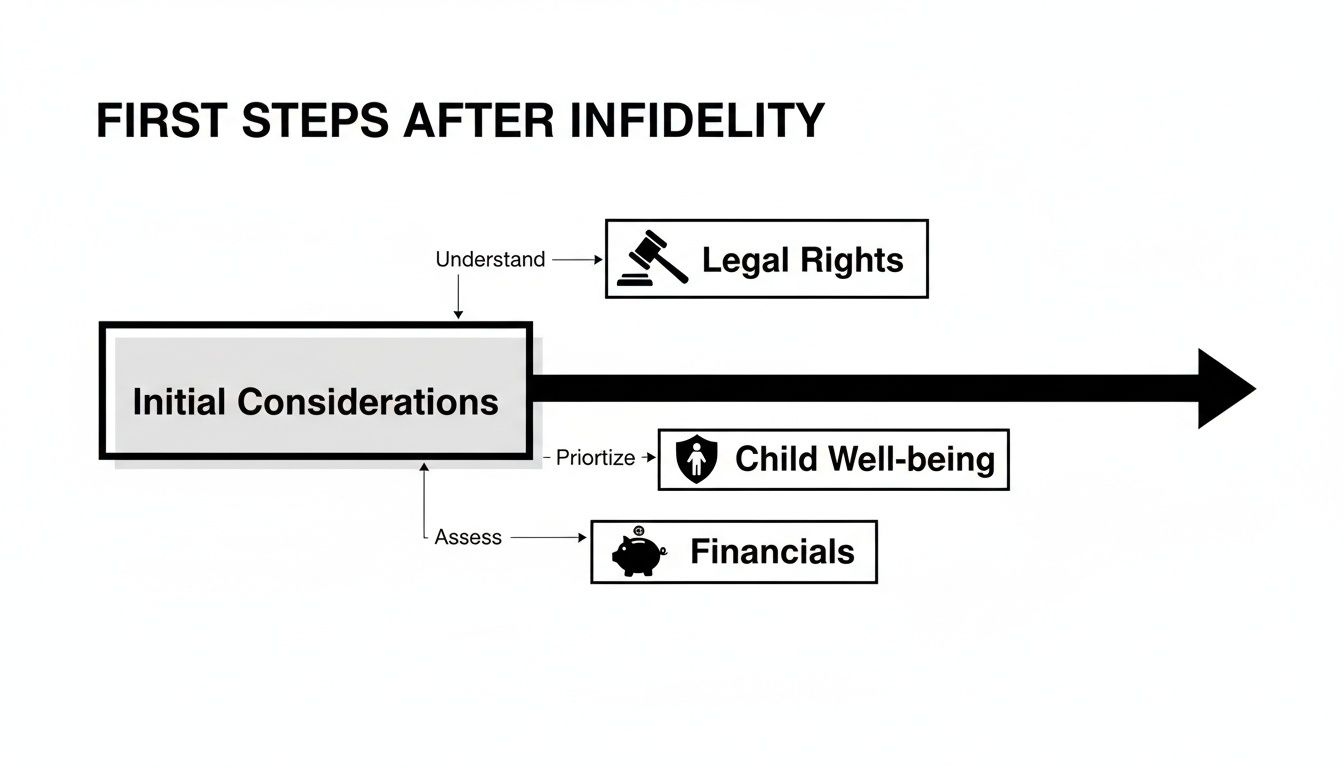
This flowchart breaks down the three pillars you need to secure right away: your legal rights, your children's well-being, and your financial stability.
The following table provides a clear overview of how adultery can, and cannot, influence the key aspects of a Texas divorce.
How Adultery Can Influence Your Texas Divorce
| Divorce Aspect | Potential Impact of Infidelity | What the Court Prioritizes |
|---|---|---|
| Property Division | A judge can award a disproportionate share (more than 50%) of community property to the non-cheating spouse, especially if marital funds were used on the affair. | A "just and right" division of the marital estate. Proving fault gives the judge a reason to see an unequal split as just and right. |
| Child Custody | Generally, adultery does not impact custody unless the affair exposed the children to harm, neglect, or an unstable environment. | The best interest of the child. The court focuses on which parent can provide a safe, stable, and nurturing home. |
| Spousal Support | Infidelity does not automatically qualify you for spousal maintenance. You must still meet the strict legal requirements, such as a 10-year marriage and an inability to provide for your own minimum needs. | The requesting spouse's proven needs and the other spouse's ability to pay, based on statutory eligibility rules. |
| Child Support | Cheating does not affect the amount of child support. The calculation is based on a statutory formula using the paying parent's income and the number of children. | The child's financial needs. The formula is applied regardless of parental conduct. |
Ultimately, proving adultery gives the judge a powerful reason to adjust the property division in your favor, but its influence on custody and support is far more limited.
What To Do Next
- Gather Evidence Carefully: Screenshot suspicious social media posts, save questionable text messages, and download bank statements showing unusual spending. For more insight, see this guide on how to catch a cheater legally.
- Secure Financial Information: Make copies of tax returns, deeds, investment account statements, and retirement plan summaries. A clear financial picture is vital.
- Schedule a Confidential Consultation: This is the most important step. An experienced family law attorney will explain your specific rights and help you build a strategy, giving you clarity before you make any binding decisions.
How Adultery Impacts Your Share of Community Property
Discovering your spouse has been unfaithful is a devastating gut punch. Beyond the emotional betrayal, a million questions race through your mind, and one of the biggest is almost always about money: “How is this going to affect our finances?” You’ve spent years building a life and a marital estate together, and your spouse's choices shouldn't cost you your financial security.
In Texas, the law provides a path to hold a cheating spouse financially accountable, and understanding how it works is the first step to protecting what you’ve built.

Think of your marital estate like a shared business. Nearly everything you and your spouse earned or acquired during the marriage—from paychecks to the house you live in—goes into this community pot. When your spouse secretly spends that money on an affair, it’s no different than them making an unauthorized withdrawal from a joint account.
The "Just and Right" Division Standard
Under the Texas Family Code, a judge is required to divide your community property in a way that is "just and right." Many people assume this means a clean 50/50 split, but that’s not the default. The law gives judges flexibility to weigh different factors, and one of the most significant is fault in the breakup of the marriage—including adultery.
When you can prove your spouse cheated, you give the judge a powerful reason to see an unequal split as "just and right." The court can award you a disproportionate share of the community estate—meaning more than 50%—to account for the harm done. This isn't about punishment; it's about financial fairness.
Fraud on the Community When Infidelity Occurs
When your spouse spends marital money to fund their affair, you may have a specific legal claim known as "fraud on the community," or "waste." This legal concept applies when one spouse uses community assets for a non-marital purpose without the other’s knowledge or consent.
Examples of spending that could be considered a waste of marital assets include:
- Lavish Gifts: Buying expensive jewelry, a new car, or other luxury items for an affair partner.
- Secret Trips: Paying for vacations, flights, nice hotels, and expensive dinners.
- Direct Financial Support: Giving the affair partner cash, paying their rent, or covering their personal bills.
These actions drain the resources that belong to both of you. By carefully documenting this spending, you can prove to the court that marital funds were wasted, strengthening your argument for receiving a larger share of what’s left.
Key Insight: A judge's goal is to make the community estate whole again. If your spouse blew $50,000 of marital funds on an affair, a judge could award you an extra $50,000 in assets before dividing the rest of the property.
Proving Your Claim for a Disproportionate Share
To convince a judge to award you a larger share of the property, you need more than just accusations. You have to come prepared with clear, documented evidence that proves not only the affair but also its financial impact.
This evidence could look like:
- Financial Records: Credit card statements that show charges for hotel rooms, airline tickets, or high-end gifts.
- Bank Statements: Records of large or frequent cash withdrawals, or wire transfers to unfamiliar individuals.
- Communications: Text messages or emails where your spouse admits to or discusses spending money on their affair partner.
It’s also critical to understand what is and isn't up for grabs. Texas law draws a hard line between the assets you own together and those you own individually. To make a strong case, you must have a firm grasp of what is considered separate property vs. community property in your marriage.
What to Do Next
- Stop Guessing and Start Documenting: If you have access, begin gathering any financial statements or records that show unusual or unexplained spending.
- Identify Marital vs. Separate Property: Try to make a list of your major assets (house, cars, bank accounts, retirement funds) and note when they were acquired to help clarify what’s part of the community estate.
- Consult an Attorney: An experienced family law attorney can review your unique situation, explain your rights, and map out a strategy to pursue a fair and just division of your assets.
Protecting Your Children in a Divorce Involving Adultery
For any parent going through a divorce, the first question is always, "What about the kids?" When infidelity is involved, the raw emotions of betrayal and anger can make it incredibly difficult to think clearly. But your children’s well-being has to stay front and center.
In Texas, the court’s perspective is firm and unwavering. Every decision a judge makes about custody boils down to one single principle.
That guiding principle is the “best interest of the child.” This is the legal yardstick judges use under the Texas Family Code to decide everything—from where the children will live to which parent gets to make important decisions for them. It's a common myth that proving your spouse cheated will automatically win you custody. That's just not how it works.

A Texas judge is far less interested in the act of cheating itself and much more concerned with the behaviors surrounding it. The real question is: did your spouse's actions tied to the affair create an environment that was unsafe, unstable, or emotionally damaging for your children?
When Infidelity Can Impact Custody
An affair only becomes relevant to custody when you can draw a straight line from the cheating to a negative impact on your children. The court won’t punish a parent for infidelity, but it will absolutely step in to protect a child from harm.
Here are a few real-world examples of behaviors a judge would take very seriously:
- Exposing Children to an Inappropriate Partner: Bringing the new partner around the kids, especially if that person has a criminal record, struggles with substance abuse, or behaves irresponsibly.
- Neglecting Parental Duties: Suddenly missing school pickups, parent-teacher meetings, or doctor’s appointments because they are prioritizing the affair partner.
- Creating Instability: Asking the children to lie to cover up the affair, or exposing them to constant fighting and emotional chaos related to the infidelity.
- Wasting Marital Funds: Spending community funds on the affair that should have gone toward the children’s needs, like school tuition, medical bills, or even just groceries.
What the Court Looks For: A judge evaluates whether a parent’s choices show poor judgment that puts a child's physical or emotional well-being at risk. It's not about morality; it's about parental fitness.
The Difference Between Custody and Child Support
It's crucial to understand that in a Texas divorce, custody and child support are two completely separate issues. While an affair can influence a custody decision in specific situations, it almost never affects the child support calculation.
Child support in Texas is determined by a strict formula set by law. It’s based almost entirely on the paying parent's net monthly income and the number of children they are obligated to support. The formula is applied mechanically, regardless of how the parents behaved. The reason your marriage ended—even a divorce for infidelity—doesn’t change the amount of child support owed.
Beyond the legal and emotional aspects, you should also think about how to protect your children's privacy online during this process, as sensitive family information can sometimes become public.
What To Do Next
- Document Everything: Keep a detailed log of every instance where your spouse’s affair negatively impacted your children. Note dates, times, specific events, and who else was there. For example: "October 15th, spouse was 45 minutes late for school pickup; admitted they were on the phone with the new partner."
- Gather Tangible Evidence: Collect screenshots of texts, social media posts, or emails that show parental neglect or prove your child was exposed to an inappropriate situation. Financial records showing community funds being spent on the affair can also be very powerful.
- Shield Your Children: Never discuss the affair or the details of the divorce with your children. Reassure them that they are loved by both parents and that you will both always be there for them. Try to maintain their normal routines as much as you can to give them a sense of stability.
How to Legally Prove Infidelity in a Texas Court

Knowing your spouse cheated is one thing. Proving it in a Texas courtroom is a completely different ballgame. If you want to use adultery as a fault-based ground for your divorce, you can’t just walk in and make an accusation. You need to back it up with solid, legally gathered proof.
Building your case isn’t about dramatic confrontations. It’s about calm, methodical documentation. You don't need a video of the act itself, but you do need to present enough evidence for a judge to logically conclude that an affair more than likely happened. This is usually done by piecing together different kinds of circumstantial evidence that paint a clear picture.
Gathering Admissible Evidence
The key to proving a divorce for infidelity is showing the court a pattern of behavior that can’t be easily explained away. Judges in Texas give the most weight to tangible proof that you have a legal right to access.
Think about collecting and preserving evidence like this:
- Financial Records: This is often where you'll find the most compelling proof. Look at joint bank account statements for large, unexplained cash withdrawals. Check credit card bills for charges at romantic restaurants, hotels, or expensive gifts you never saw. This is powerful because it ties community funds directly to the affair.
- Electronic Communications: Text messages, emails, or direct messages on social media where your spouse admits to or discusses the affair are gold. You need to screenshot these conversations immediately because they can be deleted in a heartbeat.
- Photos and Videos: A picture is worth a thousand words, especially if it shows your spouse and their affair partner in a romantic context—kissing in public, for example, or entering a hotel room together.
- Witness Testimony: Friends, family, or even neighbors who have seen things firsthand can provide compelling testimony. While it's often not as concrete as a paper trail, it can add another layer to your case.
What Not to Do: A Critical Warning
When you’re hurt and angry, it’s tempting to go to extremes to find that "smoking gun." But let me be clear: breaking the law to get evidence will backfire spectacularly. Not only will a judge throw that evidence out, but you could also face criminal charges and destroy your own credibility in court.
Crucial Warning: Under no circumstances should you ever hack your spouse’s email, install tracking software on their personal phone, or place a GPS tracker on their car without explicit legal guidance. Planting recording devices in their private spaces is also illegal. These actions will hurt your case far more than they could ever help.
Instead of taking those risks, focus on legal, strategic preservation. Download financial statements from shared accounts. Screenshot messages on a family computer or a phone you co-own. A lawful, methodical approach builds a strong case without putting you in legal jeopardy.
The Role of a Private Investigator
Sometimes, the evidence you need just isn't within your reach, especially if your spouse is being extra careful. In these situations, hiring a professional can be a smart, strategic move. A licensed private investigator knows exactly what they can and can’t do to gather evidence that will stand up in court.
An investigator can legally conduct surveillance, document your spouse's comings and goings, and provide unbiased, professional testimony. A judge is far more likely to be persuaded by a professional report from a neutral third party. To see if this is the right move for you, it helps to understand the role of private investigators in Texas divorce cases. This is especially true in high-asset divorces where you suspect marital funds are being spent on the affair.
What to Do Next
- Inventory Your Information: Take stock of the proof you can legally access right now.
- Create a Secure Folder: Store screenshots, bank statements, and other documents in a secure, private location.
- Act Methodically: By gathering your evidence legally and carefully, you put yourself in the strongest possible position to present a clear, fact-based argument to the court.
Making Smart Strategic Decisions When Filing for Divorce
The first few moves you make after deciding to end your marriage can set the tone for the entire divorce. This is where you have to shift from reacting emotionally to thinking strategically. By making smart, informed decisions from the very beginning, you protect your rights, your finances, and your future.
The first major decision you and your attorney will tackle is how to file the divorce petition.
Step 1: Choosing to File on Fault or No-Fault Grounds
In Texas, you have two main ways to start a divorce:
- No-Fault (Insupportability): This is the most common approach. You’re simply telling the court that the marriage has broken down because of conflict and there's no reasonable chance of getting back together. It’s a neutral, less confrontational way to begin.
- Fault (Adultery): This means you are formally alleging that your spouse’s affair is the reason for the divorce. Filing on fault grounds immediately puts the infidelity front and center, signaling that you intend to ask for a disproportionate share of the community property.
Which path to take is a purely strategic choice. Understanding the nuances of whether it is best to file for divorce first can give you a real advantage in these critical early stages.
Strategic Consideration: The decision to file on fault or no-fault grounds isn't just a legal box to check; it's a strategic move that shapes the tone and direction of your entire divorce. An experienced attorney can help you weigh the pros and cons based on your specific situation, the evidence you have, and what you hope to achieve.
Step 2: Protecting Your Assets with a TRO
The second your spouse finds out you’re filing for divorce, the risk of them hiding or wasting marital assets goes through the roof. This is why one of your first and most urgent steps should be to talk with an attorney to lock down your financial position.
An attorney can help you put protective measures in place immediately by asking the court for a Temporary Restraining Order (TRO). A TRO is a court order that effectively freezes your marital assets and stops both you and your spouse from doing things like:
- Selling or transferring property
- Emptying out bank accounts
- Changing beneficiaries on life insurance policies
- Racking up unusual new debts
A TRO acts as a financial ceasefire, preserving the marital estate so it can be divided fairly down the road.
Step 3: Deciding Between Mediation vs. Litigation
Even in a divorce for infidelity, a full-blown court battle is not your only option. Many couples are able to resolve everything successfully through other methods, most often mediation.
Mediation: In this process, you, your spouse, and your lawyers meet with a neutral third-party mediator. The mediator's job isn't to take sides but to help facilitate a productive conversation and guide you both toward a settlement you can agree on. Mediation is private, less expensive, and gives you more control over the outcome.
Litigation: If you just can't reach an agreement, your case will head to court. In litigation, a judge will hear evidence from both sides and then make binding decisions about your property, your money, and your kids.
Even when adultery is involved, mediation is often a smarter, more efficient path. It gives you a controlled environment to address the financial impact of the affair—like wasted community funds—and work toward a settlement that avoids a long, public, and costly court battle.
What to Do Next
- Consult an Attorney Immediately: Before you say another word to your spouse about divorce, schedule a confidential consultation to talk through your situation and map out a strategy.
- Decide on Filing Grounds: Work with your lawyer to figure out if a fault or no-fault filing is the best opening move for your case.
- Secure Your Assets: Take immediate steps to protect your finances, which may include petitioning for a TRO if it makes sense for you.
Your Action Plan for Moving Forward with Confidence
Feeling overwhelmed right now is completely understandable, but this is the moment to start taking clear, decisive steps. It’s time to shift from reacting to the pain of infidelity to taking deliberate action to protect your future. This checklist is designed to help you regain a sense of control and move forward with the confidence you deserve.
This isn’t about starting a fight. It's about getting clarity on your situation, understanding your rights under Texas law, and making sure you have a compassionate advocate on your side.
Your Immediate Action Checklist
- Secure All Financial Records: Immediately gather and copy at least two years' worth of financial documents. This means tax returns, bank statements (for both joint and individual accounts), credit card bills, investment summaries, and retirement plan statements. This evidence is crucial for mapping out your community estate and spotting any wasted assets.
- Update Passwords and Secure Accounts: Change the passwords to your personal email, social media, and any financial accounts that are solely in your name. This is a simple but vital step to protect your privacy and prevent your spouse from deleting potential evidence or accessing your personal funds.
- Methodically Document Key Events: Start a private journal on a secure device or in a notebook your spouse cannot access. Log specific instances of suspicious behavior, dates of conversations about the affair, and any impact you've observed on your children. Stick to the facts—this log will be invaluable for your attorney.
- Preserve All Communications: Don't delete those angry texts or revealing emails. Screenshot everything and back it up to a secure cloud drive your spouse can't get into. These communications often serve as direct proof of adultery or attempts to hide assets.
Prepare for the Legal Process
- Create a Household Budget: Outline your current monthly income and all your expenses. This will be absolutely essential for any discussions about spousal support, child support, and figuring out what you’ll need to live on after the divorce.
- Inventory Your Assets and Debts: Make a comprehensive list of everything you and your spouse own and owe together. Include the house, cars, furniture, bank accounts, 401(k)s, and any outstanding loans or credit card debt.
- Define Your Goals: Before you even talk to an attorney, take some time to think about what a successful outcome looks like for you. Do you want to keep the house? Is your primary concern about the custody schedule? Having clear goals helps your legal team build the most effective strategy from day one.
Remember, the Texas Family Code gives judges significant discretion when dividing property. Proving infidelity and showing that community funds were wasted on an affair can directly influence the court to grant a "just and right" division that is weighted in your favor. Your careful preparation is what makes this possible.
What to Do Next
The single most important step you can take right now is to get professional legal guidance. You don't have to navigate this complicated and emotional journey by yourself. A confidential consultation with an experienced family law attorney will give you a clear understanding of your rights and a personalized strategy for what comes next.
Making that first call is an act of empowerment. It’s your first step toward closing this painful chapter and starting a new one with security and peace of mind.
The compassionate attorneys at The Law Office of Bryan Fagan, PLLC, are here to help you understand your options. We will listen to your story, answer your questions, and provide the clear, authoritative guidance you need to protect your family and your future. Schedule a free, confidential consultation with us today to take control of your situation.
Frequently Asked Questions About Infidelity and Divorce
When infidelity is the reason your marriage is ending, the questions can feel endless and overwhelming. You’re not just dealing with the emotional fallout—you’re trying to understand what it means for your future. We’ve answered some of the most pressing questions we hear from clients in your shoes.
Can I Get More Alimony Because My Spouse Cheated?
It's one of the first questions we hear, and while it seems like the answer should be a simple 'yes,' Texas law is surprisingly strict. In Texas, what most people call alimony is legally known as spousal maintenance, and the rules to qualify are tough. Cheating, by itself, won’t get you there.
First, you have to prove you can't meet your own "minimum reasonable needs." Then, you must also meet another requirement, like having been married for 10 years or more or being a victim of family violence.
If you clear those initial hurdles, then yes—a judge can absolutely consider your spouse's affair when deciding the amount and length of the maintenance payments. Proving adultery gives the judge a reason to rule more in your favor, but it doesn't unlock the door to spousal maintenance on its own.
Does It Matter Who Cheated First If We Both Had Affairs?
When both spouses have been unfaithful, things can get complicated. A judge might see it as a case of "mutual fault," where both parties share some blame. The court will look at the behavior of both of you when deciding on a "just and right" division of your property.
More often than not, however, the focus shifts to the financial damage. For instance, if your spouse blew $50,000 of your shared money on their affair, while you spent $1,000 on yours, the court is going to pay much more attention to the larger financial waste. The goal is to address any "fraud on the community," and the spouse who drained more of the marital assets will likely see a bigger hit in the final property settlement.
Is There a Deadline to File for Divorce Based on Adultery?
Yes, and this is a critical point many people miss. Texas law includes a concept called "condonation." It’s a defense your cheating spouse can use to argue that you already forgave the affair, so you can no longer use it as a fault ground for the divorce.
Condonation occurs when you voluntarily resume your marital relationship after you learn about the affair. If you discover the infidelity and then continue living together as a married couple for a while, a judge might decide you’ve implicitly forgiven the act.
This doesn't mean you need to race to the courthouse the day you find out. But waiting too long can seriously weaken your legal position. That’s why it’s so important to get legal advice quickly to understand your options and protect your rights.
The path forward after infidelity can feel uncertain, but you don't have to walk it alone. The experienced attorneys at The Law Office of Bryan Fagan, PLLC are here to provide the compassionate support and clear legal strategy you need. We can help you understand your rights, protect your assets, and work toward a secure future. Schedule a free, confidential consultation with us today at https://texasdivorcelawyer.us to get the answers and advocacy you deserve.