Skip to content
Watching your child pull away because of the other parent's influence is one of the most painful things you can go through. But in a Texas courtroom, proving parental alienation requires more than just your word against theirs; it demands a strategic, evidence-based approach that a dedicated family law attorney can help you build.
To succeed, you must document a consistent pattern of harmful behaviors, collect tangible proof like texts and emails, and often bring in expert testimony to show the court exactly how these actions are damaging your child and violating their right to a healthy relationship with both parents.
The Painful Reality of Parental Alienation
Simply put, parental alienation is a pattern of behavior one parent uses to intentionally sabotage a child's relationship with the other parent. This isn't just about lingering hurt feelings from a tough divorce; it's a form of emotional manipulation that Texas courts take very seriously because it harms children.
Under the Texas Family Code, every single decision in a custody case comes down to one guiding principle: the "best interest of the child." Any action that actively harms a child's bond with a loving parent runs completely contrary to this standard.
But recognizing what's happening and proving it in court are two very different things. A judge can't act on suspicion alone. Your feelings of being pushed away, while completely valid, have to be backed up by a clear, organized presentation of facts. This is where a methodical approach becomes your greatest ally in protecting your relationship with your child.
Building Your Case Methodically
The journey to prove parental alienation isn't a single event but a process of careful collection and presentation. You need to shift your mindset from simply experiencing the hurt to meticulously documenting its cause. Your goal is to create a compelling narrative for the court, one that's supported by undeniable proof of a pattern of interference.
This infographic breaks down the foundational steps for building that strong case.
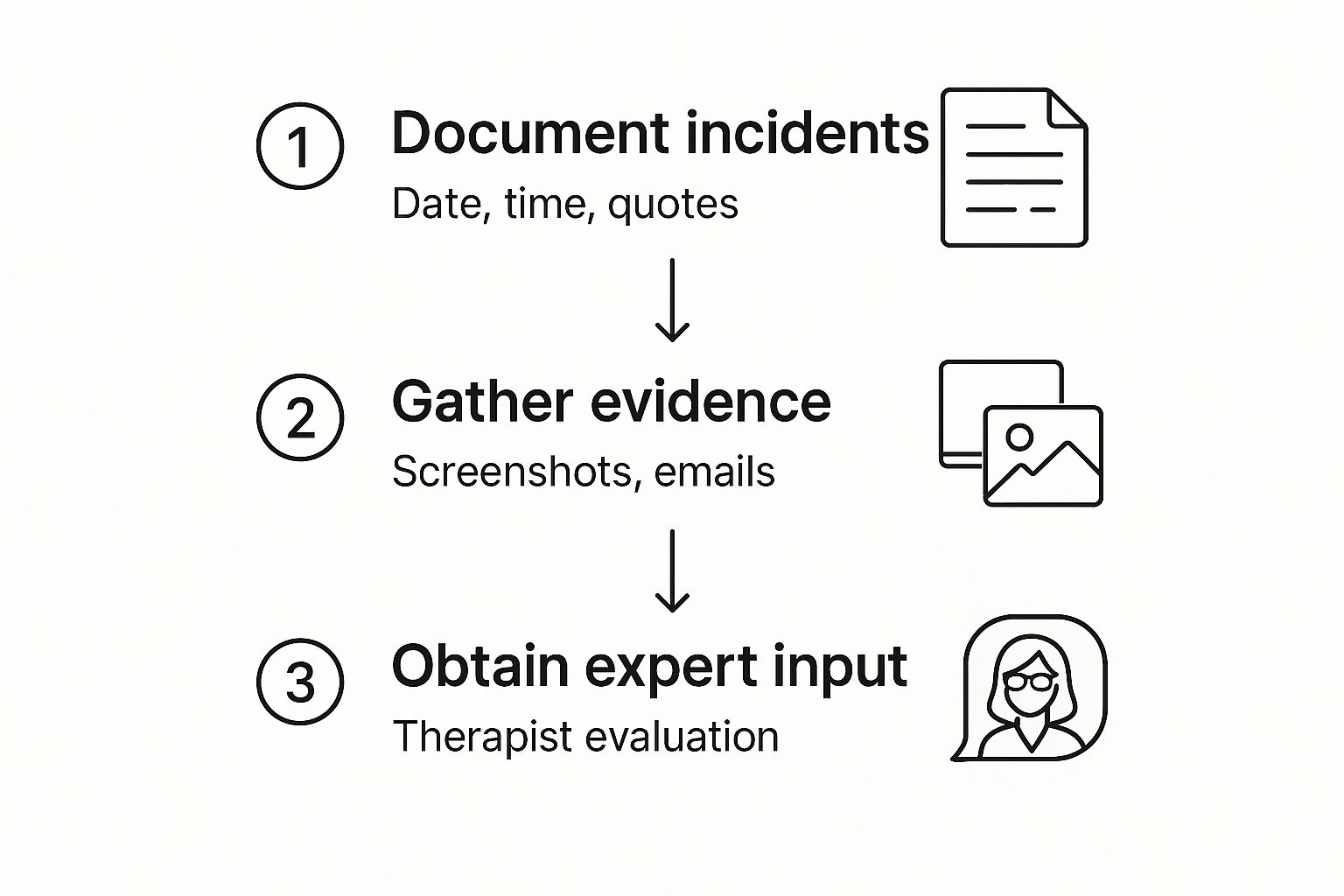
As you can see, each step builds on the last, turning what might seem like isolated incidents into a powerful legal argument. Your detailed log provides the context, the digital evidence offers concrete proof, and expert opinions connect these facts to the emotional damage your child is suffering.
Spotting and Recording Alienating Behaviors

It’s often the small things at first. A "forgotten" phone call. A last-minute scheduling conflict that cancels your weekend with your child. A casual, cutting remark about you that your child repeats. You feel the sting, but proving it’s part of a deliberate pattern feels almost impossible. This is where the work begins.
Recognizing these behaviors for what they are is the first, most critical step in building your case. These aren't just isolated incidents—they're pieces of a larger, damaging puzzle. A Texas court needs to see the complete picture, and it’s up to you to assemble it.
From Subtle Slights to Overt Sabotage
Alienating behaviors aren't always loud and obvious. They can range from quiet manipulation to outright interference with your relationship. Maybe your child starts echoing the other parent's negative opinions about you, or suddenly resists coming over for your scheduled time without giving a real reason.
Here are some of the classic signs we see in our cases:
- Restricting Contact: The other parent consistently fails to pass on your messages, claims your child is always "too busy" to talk, or schedules activities that conflict with your court-ordered possession time.
- Disparaging Remarks: You hear from your child that the other parent blames you for the divorce, criticizes your job or financial situation, or makes fun of your new partner.
- Creating Loyalty Conflicts: Your child is made to feel guilty for having fun with you or is asked to keep secrets. Suddenly, they feel like they have to choose a side.
- Undermining Your Authority: The other parent openly dismisses your rules, telling your child they don't have to listen to you. This positions you as the "bad guy" or the unreasonable parent.
These actions are far more common than many people think. Many parents report experiencing these alienating behaviors, but the true number is likely much higher. Without meticulous documentation, most of these incidents just fade away, unrecognized and unreported.
The Power of a Detailed Journal
Your single most powerful tool in this fight is a detailed, factual journal. We can't stress this enough. This isn't a diary for venting your frustrations; it's an evidence log that translates your experiences into a format a judge can understand. Start today and be disciplined about it.
Keep in mind, much of the information you gather—your child’s comments, text messages, canceled plans—is qualitative. Understanding the essential methods for analyzing qualitative data can help you and your attorney organize these narratives into a compelling story for the court.
Key Takeaway: Your journal must be objective. Instead of writing, "My ex was manipulative again," write, "On October 26 at 7 PM, I called to speak with our son. My ex said he was busy with homework. Our son later told me he was playing video games and that his dad never mentioned I had called." See the difference? Facts, not feelings.
Your Evidence Log: What to Record for a Stronger Case
A detailed log is what demonstrates a clear pattern over time—and a pattern is exactly what a judge needs to see. Random complaints can be easily dismissed, but a consistent, dated record becomes compelling evidence.
Use this checklist to ensure your journal contains the specific details needed to build a powerful case for parental alienation in Texas.
| Your Evidence Log: What to Record for a Stronger Case | |
|---|---|
| Information to Record | Why It Matters to the Court |
| Date and Time of Incident | Establishes a clear, chronological timeline of events. |
| Specific Quotes (Verbatim) | Provides direct evidence of what was said, avoiding your interpretation. |
| Your Child's Reaction/Comments | Shows the direct, real-world impact of the behavior on your child. |
| Location and Witnesses Present | Adds credibility and identifies potential people who can back up your story. |
| Your Factual, Calm Response | Demonstrates that you are the reasonable, stable parent focused on solutions. |
This methodical documentation becomes the bedrock of your entire case. It allows your attorney to connect the dots and present a clear, undeniable pattern of alienating behavior—conduct that violates the "best interest of the child" standard at the heart of the Texas Family Code.
Gathering Concrete Evidence for Your Case

Once you've started documenting the patterns of behavior, it's time to shift your focus to collecting tangible proof. Your detailed journal is the foundation, but to truly prove parental alienation in a Texas court, you need concrete evidence that backs up your log. This is where you build the structure of your case, piece by piece, with proof a judge can see, read, and understand.
Your goal is to organize this proof into a clear, chronological narrative that tells a compelling story. It’s about transforming your personal experience into an evidence-based argument that leaves no room for doubt.
Harnessing the Power of Digital Communication
So much of co-parenting happens digitally these days. While the constant pings can be a source of stress, they also create an invaluable evidence trail. Texts, emails, and even social media posts can provide undeniable proof of manipulation, false statements, or direct interference with your parenting time.
These digital records often capture the alienating parent’s behavior in their own words. An email where they refuse to let you speak to your child for a flimsy reason or a text message where they disparage you can be incredibly powerful in court.
It's absolutely critical to preserve this evidence correctly. A simple screenshot is a good start, but make sure it clearly shows the date and timestamp. For emails, printing them to a PDF with the full header information is the best practice. Whatever you do, avoid getting drawn into emotional, reactive text battles—your calm, factual responses will speak volumes about your stability to the court.
Identifying Credible Third-Party Witnesses
Your perspective is vital, but the testimony of neutral, third-party witnesses can dramatically strengthen your case. We're talking about people with no personal stake in your custody dispute who have observed the alienating behavior or its impact on your child firsthand. Their objective observations can corroborate your claims and lend immense credibility to your case.
Think about the adults in your child's life who see them on a regular basis.
- Teachers or School Counselors: They might notice a sudden change in your child's behavior, a drop in grades, or hear your child parroting negative things about you.
- Coaches or Extracurricular Leaders: Maybe they've witnessed the other parent making disparaging comments on the sidelines or seen your child become withdrawn and anxious around them.
- Family Friends or Neighbors: A trusted friend who has seen the other parent consistently block your phone calls or interfere with scheduled visits can offer a powerful account.
- Therapists or Pediatricians: These professionals can provide expert insight into your child's emotional state and the potential sources of their distress.
When you identify a potential witness, it's important to approach the situation carefully. You aren't asking them to "take your side," but simply to share what they have personally seen or heard. Your attorney can advise you on the best way to gather statements or prepare these individuals to testify if needed.
A teacher's testimony about a child who suddenly started calling their father by his first name after returning from mom's house can be a powerful piece of evidence. It's a small detail that speaks volumes about the influence of the alienating parent.
Compiling Physical and Financial Documentation
Beyond digital messages and witness accounts, other documents can help paint a fuller picture for the court. This kind of evidence demonstrates your consistent involvement in your child's life and can expose the other parent's attempts to erase you from it.
Start gathering documents that show your active participation and the other parent’s interference.
- Attendance Records: Collect proof that you were at parent-teacher conferences, school plays, and sporting events.
- Medical Records: Show that you have been involved in your child’s healthcare, attending doctor's appointments and managing their well-being.
- Financial Receipts: Keep records of expenses you've covered for your child—from school supplies to extracurricular fees—especially if the other parent claims you are financially uninvolved.
In some situations, tracking the other parent's actions may require more specialized help. For instance, if you suspect they are taking your child to meet inappropriate individuals during their possession time and lying about it, you need more than just your own suspicions. In these complex scenarios, learning about what a private investigator can do for your Texas child custody case can reveal options for gathering evidence that would otherwise be impossible to obtain.
Each piece of evidence, whether it's a simple text message or a witness statement, serves as a building block. By methodically gathering and organizing this proof, you create a solid, fact-based case that an attorney can effectively argue and a judge can clearly understand.
Using Expert Testimony to Strengthen Your Claim

Sometimes, even with a mountain of texts and a detailed journal, your evidence doesn't paint the whole picture. A Texas judge needs to understand not just what is happening, but why it's happening and the profound emotional toll it's taking on your child. This is where an expert's objective, professional opinion becomes one of the most powerful tools in your legal strategy.
These professionals connect the dots for the court in a way you simply can't. They offer an unbiased assessment of the family dynamic, break down the psychological impact of the alienating behaviors, and provide recommendations grounded in your child's best interests. Their testimony can elevate your claims from a messy "he said, she said" dispute to a clear diagnosis of a problem that demands the court's intervention.
The Role of Therapists and Counselors
If your child is already in therapy, their counselor can offer invaluable insights. While their conversations are confidential, a therapist can often testify about observable changes in your child’s behavior, their emotional state, and the source of their anxiety or distress. They might describe the loyalty conflicts your child is clearly struggling with or explain how hearing constant disparaging remarks has damaged their self-esteem.
This kind of testimony is incredibly persuasive because it comes from a neutral party whose only focus is your child's well-being. A therapist helps the court see the difference between a child's genuine feelings and opinions that have been spoon-fed to them by an alienating parent.
Court-Appointed Professionals in Texas
In high-conflict custody cases, a Texas judge often needs their own set of eyes and ears to figure out what's really going on. The court has the authority under the Texas Family Code to appoint neutral professionals to serve this exact purpose. Understanding who they are and what they do is key to leveraging their findings to support your case.
- Amicus Attorney or Guardian Ad Litem (GAL): This is an attorney appointed to represent the child's best interests—not either parent. They act as the court's investigator, interviewing everyone involved: you, the other parent, the child, teachers, and therapists. They will review your evidence, conduct home visits, and ultimately make a recommendation to the judge about custody and possession schedules.
- Child Custody Evaluator: This is usually a licensed psychologist or mental health professional who conducts a deep-dive investigation into the family. This is an exhaustive process that often involves psychological testing, in-depth interviews with the entire family, and observation of parent-child interactions.
The evaluator’s final report is a formal, detailed document submitted directly to the court. It provides a professional opinion on the family dynamics, parenting capabilities, and whether alienating behaviors are present. A strong, favorable custody evaluation can be the single most persuasive piece of evidence in your case. You can learn more by exploring our guide on how parent psychological evaluations impact custody decisions in Texas.
What to Expect During an Evaluation
Be prepared, be honest, and just be yourself. An evaluator's goal is to see the real you, not a polished performance. Keep your focus on your child's needs, provide the documentation you've carefully gathered, and resist the temptation to badmouth the other parent. Let the evidence and your consistent, loving actions speak for themselves.
Presenting Your Parental Alienation Case in Court
All your painstaking work—the detailed journal, the saved text messages, the witness interviews—has led to this moment. The idea of walking into a courtroom can feel overwhelming, but this is where your strategy and preparation truly pay off. Your family law attorney will take the mountain of evidence you've gathered and weave it into a powerful, clear narrative for the judge.
This isn't about airing grievances or trying to "win" a battle of wills. It’s about calmly and clearly showing the court how the other parent's actions are actively harming your child.
Connecting Alienation to the Best Interest Standard
In Texas, every single custody decision hinges on one critical principle found in the Texas Family Code: the "best interest of the child." Your entire case must be framed through this lens. The job isn’t just to tell the judge the other parent is being difficult; it's to demonstrate that their alienating behavior is fundamentally against your child's well-being.
We have to show how their actions directly damage your child’s emotional health and sabotage their right to have a loving relationship with both parents.
Here’s how the evidence you’ve worked so hard to collect builds that argument:
- Your detailed log moves beyond isolated incidents to reveal a consistent, undeniable pattern of interference.
- Witness statements from teachers, coaches, or counselors provide objective, third-party proof of the negative impact on your child's behavior and mental state.
- Expert reports from a custody evaluator or therapist give the court a professional, unbiased analysis of the psychological manipulation at play.
Each piece of evidence helps prove that stopping the alienation and restoring your relationship is absolutely essential for your child's healthy development.
Step-by-Step: The Texas Court Process
Your case will likely move through several stages, and it's helpful to know what to expect. While a full-blown trial is always a possibility, many issues can be addressed much sooner through temporary hearings or mediation.
Temporary Orders Hearing
This is often the first real stop in court after a case is filed. A judge will make initial, temporary rulings on things like custody and visitation that stay in place while your case proceeds. Here, your attorney will present the most critical evidence to show the immediate need for the court to step in. This could mean ordering reunification therapy to begin right away or setting firm rules for communication between you and the other parent.
Mediation
Before you ever get to trial, Texas courts will almost always require you to attend mediation. A neutral third-party mediator will try to help you and the other parent find common ground and reach a settlement. It might sound impossible to negotiate with someone who is actively alienating you, but a skilled mediator can sometimes help create agreements that protect your time with your child and avoid a costly trial.
Trial
If you can't reach an agreement in mediation, your case will head to a final trial. This is a much more formal process where you and your attorney will present all the evidence, question witnesses on the stand, and make legal arguments directly to the judge. This is where your calm, credible testimony becomes absolutely crucial. Understanding the broader strategies for how to prepare for trial and win your case will give you a major advantage and a boost of confidence.
Your demeanor in court matters more than you can imagine. The judge needs to see a stable, child-focused parent who is seeking a solution, not revenge. Let the evidence do the heavy lifting—your job is to remain the calm, reasonable adult in the room.
Maintaining Credibility Under Pressure
Your credibility is your most important asset in court. You can bet the other parent will try to provoke you, to paint you as unstable or unreasonable. Do not fall for it.
Stick to the facts. When you testify, speak clearly and directly. Answer only the question that was asked, and resist the urge to get emotional.
Your goal is to show the judge that your only motivation is your child's well-being. By presenting a well-documented, fact-based case while maintaining your composure, you give the judge the clarity they need to see the truth and make the right orders to protect your child.
Unpacking Parental Alienation: Your Questions Answered
When you're in the thick of a parental alienation case, it’s easy to feel overwhelmed. The situation is charged with emotion, and you're bound to have a lot of questions running through your mind. Getting clear answers is the first step toward regaining your peace of mind and building a solid legal strategy.
Let’s walk through some of the most common questions we hear from parents who are in your exact position.
How Can I Prove Alienation If My Child Refuses to See Me?
It’s one of the most gut-wrenching experiences a parent can have: your own child tells you they don't want to see you. But in court, the key isn't just what your child is saying—it's proving why they're saying it.
Your evidence needs to be laser-focused on the source of these feelings. A judge isn't just listening to your child's words; they're looking for the influence behind them. This is where your meticulous evidence log, testimony from your child's therapist, and statements from neutral parties like teachers all come together. They help paint a clear, undeniable picture showing that your child’s feelings are a direct result of the other parent’s manipulation, not a true reflection of your relationship.
Can a Texas Court Order Reunification Therapy?
Yes, absolutely. When a court finds there's enough evidence of parental alienation, it has the power—and the duty—to step in and protect your child. Under the Texas Family Code, a judge can order specific therapeutic interventions as part of a modified custody order.
This is most often done through reunification therapy. It's a highly specialized process designed to repair and rebuild the damaged parent-child bond in a safe, structured setting with a trained mental health professional. It is one of the most powerful tools a court has to begin healing the damage.
What Is the Biggest Mistake to Avoid?
Without a doubt, the single biggest mistake you can make is reacting emotionally. Of course you're going to feel angry, hurt, and betrayed—that's a completely human response. But lashing out at the other parent in texts, emails, or in front of your kids will only sabotage your case.
Those emotional outbursts can, and will, be twisted and used against you in court. The other side will try to paint you as unstable, angry, or difficult.
Your best defense is a calm offense. Be disciplined in your documentation, stick to the facts, and let your attorney handle the legal fight. Your composure is one of your greatest assets and shows the court that you are the stable, child-focused parent in the equation.
What to Do Next
Feeling overwhelmed by the fight ahead is completely normal. When you're dealing with parental alienation, it's easy to feel powerless. But this is the moment to channel that energy into a clear, focused strategy. The path forward is challenging, but you have more control than you think.
Your immediate priority is to shift from a defensive posture to a proactive one. You can start today by focusing on these essential steps:
- Document Everything: Start and maintain your detailed log immediately. Record every canceled visit, every disparaging remark your ex makes, and every single instance of interference. Be factual, be precise, and be consistent.
- Model Stability: Your child needs one parent to be their rock. Be the calm, loving, and consistent parent they can depend on. Your stable behavior isn't just good for your child—it's also powerful evidence of your fitness in court.
- Gather Your Proof: Methodically collect every piece of evidence you can find. This means texts, emails, social media posts, and statements from credible witnesses who have seen the alienation firsthand. Think teachers, coaches, or family friends.
- Consult an Expert: Don't go it alone. Partner with an experienced Texas family law attorney who truly understands the nuances of proving parental alienation. This isn't something you want to leave to chance.
The most important relationship in your life is worth fighting for. When one parent obstructs your court-ordered time, it's not just a violation of your rights; it's a direct threat to your child's well-being. Ignoring these issues only allows the damage to deepen. If your ex is actively undermining your relationship and preventing you from seeing your child, it's critical to know what to do if your ex is withholding visitation in Texas.
We understand the emotional toll this takes on a parent. At The Law Office of Bryan Fagan, PLLC, we are here to help you build a powerful strategy to fight back and protect the bond you share with your child.
Schedule a free, confidential consultation with our team today. We’ll listen to your story, discuss your rights, and start building a strategy to protect your relationship with your child.