Skip to content
Navigating the legal decisions about a child's care can feel overwhelming, especially when you're already under incredible stress. You're hearing words like custody and guardianship thrown around, but in Texas, they mean very different things and are not interchangeable.
Understanding the difference is the first step toward securing your child's future. Simply put, custody—which Texas law officially calls "conservatorship"—is about defining the roles and responsibilities of parents, usually after a divorce or separation. Guardianship, on the other hand, is a critical legal tool used when a non-parent, like a grandparent, needs to step in because the child's parents are unable to provide care.
Defining Your Role in a Child's Life
When your family’s structure is changing, clarity is everything. You need to understand your rights, your responsibilities, and the specific legal path that will best protect the child you love. The Texas Family Code lays out two very distinct frameworks for this: conservatorship and guardianship.
The right choice depends entirely on your relationship with the child and the unique circumstances your family is facing.
Think of it like this: conservatorship is the playbook for parents to co-parent effectively after a separation, while guardianship is the safety net when a child needs a responsible adult to step up because their parents cannot. Both are designed with one primary goal in mind: ensuring the child’s well-being.
Conservatorship vs. Guardianship at a Glance
To truly understand the difference, it helps to see these two legal concepts side-by-side. While both address who cares for a child, they are triggered by completely different life events and grant different kinds of authority.
Here is a quick breakdown of how they compare under Texas law:
| Legal Area | Conservatorship (Custody) | Guardianship |
|---|---|---|
| Who's Involved? | Almost always the child's legal parents. | Typically a non-parent (grandparent, aunt, uncle, family friend). |
| Why is it Needed? | A standard part of a divorce or separation involving children. | Necessary when parents are unavailable due to death, incapacitation, abandonment, etc. |
| Parental Rights | Defines and allocates existing parental rights between the parents. | Temporarily or permanently suspends parental rights and grants them to the guardian. |
| Legal Framework | Governed by the Texas Family Code. | Governed by the Texas Estates Code. |
As you can see, these are not just different words for the same thing—they operate in different legal worlds for very different reasons.
The core principle guiding every Texas court in these matters is the "best interest of the child." This standard, found in the Texas Family Code, is the foundation upon which all decisions about custody and guardianship are built.
This guide will walk you through the specifics of both conservatorship and guardianship in plain English. We'll explore the step-by-step procedures, common scenarios, and practical advice you need to feel confident about the road ahead. Our goal is to empower you with knowledge so you can focus on what truly matters: your family.
Navigating Child Custody in Texas: Conservatorship Explained
Feeling lost in a sea of legal terms is the last thing you need when you're worried about your children's future. Let's clear one thing up right away: in Texas, what most people call "custody" is legally known as conservatorship.
Think of it as the detailed rulebook—the official game plan—that you and the other parent will follow to raise your child after a separation or divorce. It's all laid out in the Texas Family Code, and its number one goal is to make sure your child maintains a stable, loving relationship with both parents.
This framework defines who makes the big decisions and outlines exactly when each parent spends time with the children. It's designed to provide a clear, predictable path forward for your new family structure.

Joint Managing Conservatorship: The Standard Approach in Texas
Here in Texas, the law starts with a simple presumption: it's in a child's best interest for both parents to stay actively involved in their life. This is why the most common arrangement by far is a Joint Managing Conservatorship (JMC).
A JMC means you and the other parent share the rights and responsibilities of raising your child. This doesn't automatically mean a 50/50 split of time, but it absolutely means you both have a say in crucial decisions regarding your child's education, healthcare, and general welfare.
Under a JMC, the court will typically name one parent as the "primary" conservator. This is the parent who has the exclusive right to decide where the child lives (usually within a specific geographic area) and who receives child support payments. The other parent is known as the "possessory" conservator.
Even with shared rights, the court order will clearly spell out each parent’s specific duties to head off future conflicts. To see how this plays out in the real world, you can explore what a Texas joint custody arrangement looks like in our detailed guide.
Sole Managing Conservatorship: When One Parent Must Take the Lead
While a JMC is the standard, there are difficult situations where it simply isn't in the child’s best interest. In these cases, a court might order a Sole Managing Conservatorship (SMC), giving one parent the exclusive authority to make most decisions for the child.
This is a much less common outcome. It's reserved for serious circumstances where one parent's behavior could endanger the child's physical or emotional well-being. A court will only go down this path if there is clear evidence of issues like:
- Family violence
- Child abuse or neglect
- Serious substance or alcohol abuse
- A history of extreme conflict or putting the child in danger
In an SMC, the Sole Managing Conservator has the exclusive right to make decisions about the child's education, medical care, and general upbringing. The other parent is named the "Possessory Conservator" and has very limited rights, which are primarily focused on their scheduled time with the child.
Understanding Possession and Access
Another critical piece of any custody order is the calendar that dictates when each parent will have the child. In legal terms, this is called "possession and access."
To provide consistency and predictability for families, Texas law includes a default schedule known as the Standard Possession Order (SPO). The SPO is presumed by the Texas Family Code to be in the child’s best interest and is the foundation for the vast majority of cases.
It lays out a clear schedule for weekends, holidays, and summer vacation, creating a reliable routine for both you and your children. While the SPO is the default, you and the other parent are always free to agree to a custom possession schedule that works better for your family—as long as a judge agrees it's in the child's best interest.
When Guardianship Becomes the Necessary Safety Net
Sometimes, a child's world is turned upside down because their parents simply can't be there for them anymore. In these heartbreaking situations, the legal system needs to step in with a strong, immediate solution. This is where guardianship comes in—it’s a powerful legal tool designed to protect a child during their most vulnerable moments.
Unlike conservatorship, which is about parents sharing responsibilities, guardianship is reserved for times when parents are completely out of the picture. This could be due to a parent's death, a severe illness or incapacitation, or other tragic circumstances that make it impossible for them to care for their child. Think of it as the court appointing a legal "guardian angel" to step directly into a parent's shoes.
The process is handled under the Texas Estates Code, not the Family Code, and the bar is set high. You must prove to a judge with clear and convincing evidence that appointing a guardian is absolutely in the child’s best interest. This crucial role often falls to a trusted relative, like a grandparent or an aunt, or even a close family friend who can provide the stable, loving home the child desperately needs.
The Two Pillars of Guardianship
When you ask a court to create a guardianship, you have to be specific about what kind of authority is needed. Texas law smartly divides these responsibilities into two distinct roles to make sure every aspect of the child’s life is covered.
A single person can certainly be appointed to both roles. However, the court also has the flexibility to split the duties between two qualified people if that’s what will serve the child's needs best.
Here’s how the two types of guardians break down:
- Guardian of the Person: This person is responsible for the child’s day-to-day physical and emotional well-being. They make all the decisions a parent normally would, like choosing where the child lives, what school they attend, and what kind of medical care they receive.
- Guardian of the Estate: This individual is put in charge of the child’s finances. Their job is to manage any property, money, or other assets the child might own or inherit—things like life insurance proceeds or a settlement from a lawsuit.
Understanding these roles is vital, particularly when a child has significant financial assets to protect. If you ever find yourself in a situation where a child's safety is at immediate risk, it's critical to know you can act fast. Our guide on filing an emergency petition for custody offers valuable insight into taking urgent legal action.
A guardian is more than just a caretaker; they are a legally recognized steward of a child’s entire well-being, from their daily routine to their financial future. The court takes this appointment very seriously, always prioritizing the child's stability and safety above all else.
The Financial Side of Guardianship
Managing a child's estate is a massive responsibility that comes with strict legal duties and requires careful oversight. The Guardian of the Estate acts as a fiduciary, which is a legal term meaning they must manage the child's assets with the utmost care, steer clear of any conflicts of interest, and always act in the child’s best financial interest.
This role has only gotten more complex as financial markets have evolved. The global custody service market, a key part of managing institutional financial assets, has seen incredible growth, expanding from $45.19 billion in 2024 to an estimated $48.84 billion in 2025. This trend highlights the increasing complexity of managing assets, which trickles down to individual guardianships where a child might inherit a diverse portfolio. You can find more insights on this growing market over at Globenewswire.com.
The bottom line is this: whether you're responsible for a child’s daily care or their financial security, the legal and personal obligations are immense. Guardianship provides the legal authority needed to fully protect a child when their parents can't, ensuring they have the support and resources required to thrive.
The Legal Roadmaps for Custody and Guardianship Cases
Stepping into the Texas court system to sort out a child's future can feel like trying to read a map in a foreign language. But once you get a handle on the key landmarks and turn-by-turn directions, the journey starts to make a lot more sense. Both conservatorship (custody) and guardianship cases follow their own distinct legal roadmaps, each with specific steps, timelines, and goals.
Getting a clear picture of these procedures from the very beginning helps you prepare, both emotionally and practically, for what’s ahead. It removes the mystery from the process, giving you the confidence to take the right steps to protect your family.
The Path to a Custody Order (Conservatorship)
A conservatorship case in Texas is almost always started by a parent as part of a divorce or as a standalone case for parents who were never married. The entire purpose is to get a court-ordered parenting plan in place that clearly lays out everyone's rights, duties, and possession schedule.
The process typically unfolds in these key stages:
- Filing the Original Petition: The case officially begins when one parent files an Original Petition in Suit Affecting the Parent-Child Relationship. This document tells the court what you're asking for regarding conservatorship, child support, and possession.
- Serving the Other Parent: After filing, the other parent must be formally notified of the lawsuit through a legal process called "service," which ensures they have an opportunity to respond.
- Temporary Orders Hearing: Since a final resolution can take months, the court holds a hearing early on to establish temporary orders. These orders cover custody, child support, and use of the family home while the case is pending.
- Discovery and Mediation: This is the information-gathering phase where both sides exchange documents and evidence. Texas courts require parents to attend mediation to try and reach a settlement before going to trial.
- Final Orders: If you reach an agreement in mediation, your attorneys will draft a Final Decree for the judge to sign. If you can't agree, your case will be set for a final trial, where a judge will make the final decisions.
For a more detailed breakdown of that critical first step, our guide on how to file for custody in Texas is an excellent resource.
The Journey to a Guardianship Appointment
The path to guardianship is entirely different. It’s handled under the Texas Estates Code, and the focus is on proving to a judge that a child genuinely needs a court-appointed guardian. Think of it as a protective action, not a dispute between two parents.
Here’s what the roadmap for guardianship typically looks like:
- Filing the Application: It begins with filing an Application for Appointment of Guardian with the court. This document explains in detail why a guardianship is necessary and names the person proposed to serve as guardian.
- Court Investigation: The court then launches a thorough investigation. A court-appointed investigator will likely visit the child's home and interview relevant people to assess the situation.
- Appointment of an Ad Litem: The court must appoint an attorney ad litem whose sole job is to represent the child's best interests. This attorney acts as the child's advocate, conducting their own investigation and making a recommendation to the judge.
- The Court Hearing: A formal hearing is held where the applicant must present clear and convincing evidence showing the parents are unavailable and that the guardianship is truly in the child's best interest.
- Issuance of Letters of Guardianship: If the judge grants the guardianship, they will sign an official order. The court clerk then issues Letters of Guardianship—the legal document giving the guardian authority to act.
When putting your case together, you'll often need to combine various legal documents like application forms, evidence, and prior court orders into a single, organized file for the court.
As we touched on earlier, a guardian can be appointed for the "person" (handling daily care) or the "estate" (managing finances). This flowchart breaks down those two core responsibilities.
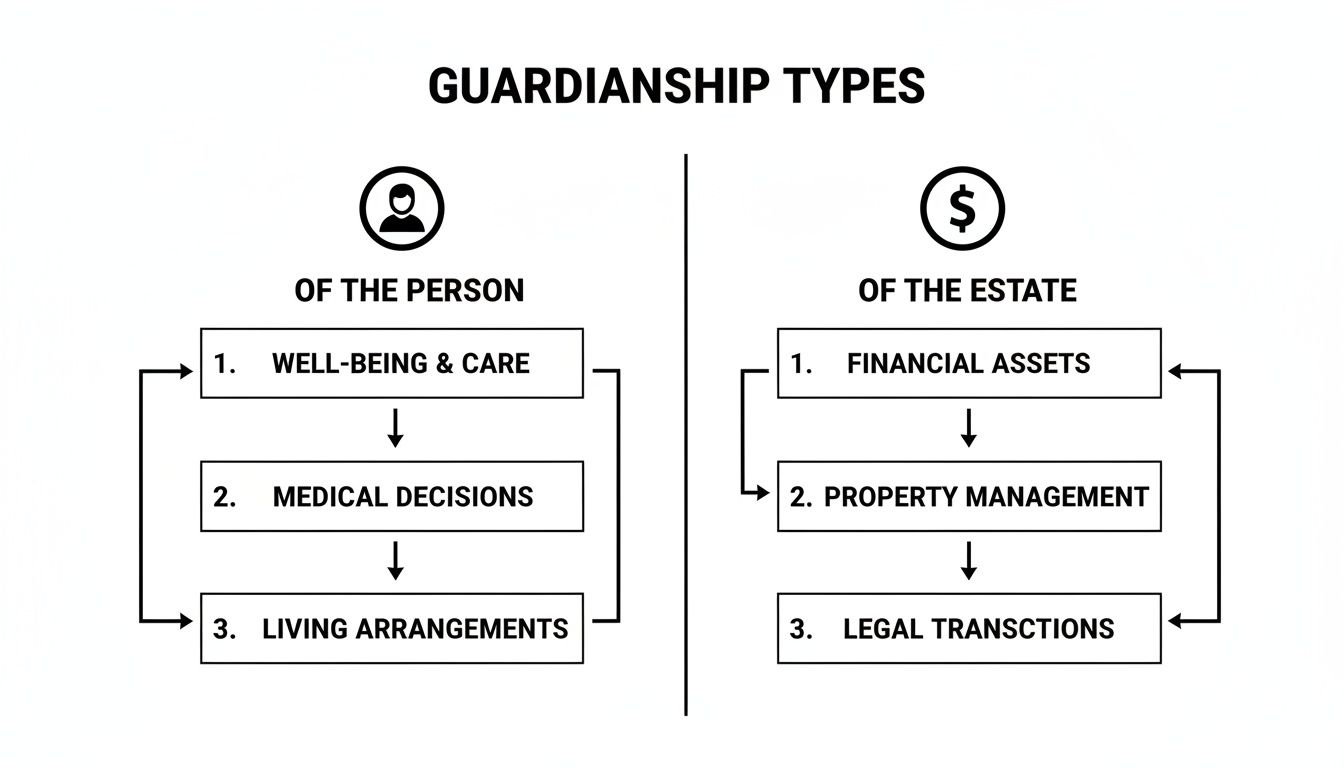
This visual really drives home the difference between being in charge of a child’s personal well-being versus overseeing their financial assets.
Knowing which path you need to be on is the first and most critical step. Each one involves different forms, strict deadlines, and a different standard of proof. A mistake in either process can lead to serious delays and complications, which is why getting experienced legal guidance right from the start is so important.
Real-Life Scenarios: Choosing the Right Legal Path
Legal concepts like custody and guardianship can feel abstract until you see how they apply to real families. To make these ideas clearer, let’s walk through a few common situations we see every day. Seeing these legal tools in action will help you identify the right path for your family.

Scenario 1: Divorcing Parents
Mark and Sarah have decided to divorce. They both love their two young children and are committed to staying deeply involved in their lives. Their main goal is to create a stable, predictable co-parenting plan that works for everyone.
For Mark and Sarah, the solution is a conservatorship order from a Texas Family Court. This process is designed specifically for parents to define their rights and responsibilities after a split. They'll work to establish a Joint Managing Conservatorship, name a primary parent, and agree on a possession schedule—likely using the Texas Standard Possession Order as their foundation. Guardianship is not relevant here because both parents are fit, willing, and able to care for their kids.
Scenario 2: Grandparents Stepping In
Now, imagine a single mother is battling a severe, long-term illness that requires extensive hospitalization, leaving her completely unable to care for her 10-year-old son. The child's maternal grandparents are ready and willing to provide a stable home for him.
This is a classic case for guardianship. Since the parent is incapacitated, the grandparents would petition the court under the Texas Estates Code to be appointed as guardians of the person. This grants them the legal authority to enroll him in school, consent to medical treatment, and manage his daily life. Conservatorship doesn't fit because this isn't a dispute between parents; it's about a non-parent needing to step into a parental role.
The core question is always: are fit parents available? If yes, the path is almost always conservatorship. If no, guardianship becomes the necessary safety net.
Scenario 3: Military Deployment
What happens when a parent’s duty calls them away? Imagine a single father in the U.S. Army receives orders for a one-year overseas deployment. He needs to make sure his sister—the child’s aunt—can legally make decisions for his daughter while he's gone.
He wouldn't need a full guardianship. A better route would be to seek Temporary Orders through the court or use another legal tool, like a temporary authorization for care of a minor child. This grants the aunt specific, limited authority for a defined period without permanently altering his parental rights. It's a flexible solution designed for temporary situations.
The need to manage assets for others, whether for a child or on a global scale, is only growing. A recent PwC forecast projects that global assets under management will climb to $171 trillion by 2028, highlighting the increasing importance of reliable custody and guardianship solutions. You can learn more about these trends by exploring the future of global securities services.
Scenario 4: A Child with Special Needs Turns 18
Finally, consider parents whose child has significant developmental disabilities and is about to turn 18. The moment he becomes a legal adult, his parents’ automatic authority to make medical and financial decisions for him vanishes, even though he cannot manage his own affairs.
To continue providing the care he needs, they would have to seek an adult guardianship. This is a specific type of guardianship for an adult who is legally incapacitated. It would allow them to continue making critical decisions about his healthcare, living arrangements, and finances, ensuring he remains protected as he moves into adulthood.
What to Do Next to Protect Your Family
Making these decisions for a child you love is never easy. It carries an immense emotional weight, but understanding your options is the first real step toward finding peace of mind. By learning the difference between custody and guardianship in Texas, you've already taken a crucial step forward.
Let's recap: Conservatorship (custody) is the legal framework that defines the roles of parents when they separate. Guardianship, on the other hand, acts as a vital safety net, putting a legal caregiver in place for a child when their parents cannot be there.
Your Family's Unique Path
There is no one-size-fits-all answer here. The right legal path for your family depends entirely on your specific situation—whether you're a parent working out a co-parenting plan or a grandparent who needs to step in to provide care.
The broader field of custody and trust services is growing fast, projected to become an approximately $25 billion industry by 2025. This isn't just a random statistic; it shows how complex managing assets has become and underscores the need for skilled legal oversight to protect a child's estate. You can explore more about these market trends and their drivers if you're interested.
Your child's future is too important to leave to chance. The most critical step you can take right now is to get clear, compassionate legal guidance tailored to your family's needs.
Take Action with Confidence
You don't have to figure this all out on your own. Trying to navigate the Texas Family Code or the Estates Code without an experienced guide can lead to missteps that cause costly delays and emotional strain. Your child's future needs to be protected, and your rights need to be upheld.
The team at The Law Office of Bryan Fagan, PLLC, is here to give you the clarity and confidence you need. We’ll sit down with you, listen to your story, explain your options in plain English, and help you build a strategy that truly serves your child’s best interests.
We invite you to schedule a free, confidential consultation with one of our experienced family law attorneys. Let us help you protect what matters most.
Common Questions About Custody and Guardianship in Texas
When you're trying to figure out the best way to care for a child, it's easy to get overwhelmed by legal terms and processes. You're not alone. Below, we've answered some of the most common questions our attorneys hear about custody and guardianship from families just like yours.
Can I get guardianship of my grandchild if their parents are still alive?
Yes, this is possible in Texas, but it's not a simple process. A court will only grant guardianship to a grandparent if you can prove with clear and convincing evidence that both parents are unfit or unable to provide a safe, stable home for the child.
This usually happens in heartbreaking situations involving parental drug abuse, incapacitation, abandonment, or other circumstances that put the child's well-being at risk. The court's one and only focus is the child's best interest. A judge has to be completely convinced that appointing you as guardian is the only way to ensure the child’s physical and emotional safety.
What is the difference between temporary and permanent guardianship?
Think of a temporary guardianship as an emergency measure. It's a short-term solution, typically granted quickly to protect a child from an immediate threat and usually doesn't last more than 60 days. It gives a guardian the power to step in and make critical decisions right away.
A permanent guardianship, on the other hand, is a long-term arrangement. It’s designed to last until the child turns 18 or until a court decides it’s no longer needed. This type of guardianship is only established after a full court hearing where everyone involved has a chance to present their side of the story.
How long does a child custody case usually take in Texas?
Honestly, the timeline for a Texas custody case—what we call a conservatorship suit—can vary dramatically. If you and the other parent agree on everything from the start, you might get it finalized in as little as 60 to 90 days.
However, most cases aren't that simple. If there's disagreement over who makes decisions, where the child lives, or how much child support is paid, things can get complicated. A contested case can easily stretch from six months to well over a year. The court's current schedule, the complexity of your family's situation, and the level of conflict between the parents all play a huge role in how long it will take.
Navigating the specifics of custody and guardianship requires a clear head and a solid legal strategy. The team at The Law Office of Bryan Fagan, PLLC is here to provide the answers and support you need to protect your family's future. Schedule a free, confidential consultation with us today to talk through your specific situation.