Skip to content
Facing a custody case can feel like standing at the foot of a mountain, completely overwhelmed and unsure of where to even begin. The legal journey starts by filing a lawsuit called a Suit Affecting the Parent-Child Relationship (SAPCR). This is the official action that asks a Texas court to create formal, enforceable orders about your child's future. It's the first step in setting up a legal framework for parental rights, duties, and the time you'll each spend with your child.
Understanding Your First Steps in a Texas Custody Case

Stepping into a Texas custody case is like learning a new language. The court doesn't really use the word "custody" the way most people do. Instead, the Texas Family Code has its own specific terms that define your legal relationship with your child. Understanding these concepts from day one will empower you to move through the process with much more clarity and confidence.
Decoding Key Legal Terms
Right away, you'll encounter two critical terms: conservatorship and possession and access. Think of conservatorship as the bundle of legal rights and responsibilities you hold as a parent. This covers the big decisions—things like your child's education, healthcare, and religious upbringing.
Possession and access, on the other hand, is all about the physical time you spend with your child. It’s what most people would call a visitation schedule. A court order will spell out a detailed calendar that specifies when your child will be with each parent, including holidays, birthdays, and summer vacations.
The Guiding Principle: The Best Interest of the Child
Every single decision a Texas judge makes in a custody case comes down to one guiding standard: the best interest of the child. This isn't just a friendly suggestion; it's the law. The court has to weigh numerous factors to figure out what arrangement will best support your child's emotional and physical well-being.
Some of the things a judge will look at include:
- The child's emotional and physical needs now and in the future.
- The stability of each parent's home environment.
- Any history of family violence, substance abuse, or neglect.
- The child's own wishes, if they are old enough to express them (usually age 12 or older).
Your entire case needs to be built around showing the judge how your proposed plan serves your child's best interest. This shifts the focus from what you want as a parent to what your child needs to thrive.
Your Role in the Case: Petitioner vs. Respondent
Every lawsuit has two primary roles. The Petitioner is the parent who starts the legal process by filing the initial paperwork with the court. The Respondent is the other parent who is then served with the lawsuit and is required to file a formal response, called an Answer.
Being the Petitioner or the Respondent doesn't give either parent a legal advantage. It just establishes who is responsible for setting the initial timeline and handling certain procedural steps. Whether you are married or were never married to the other parent, the process for getting custody orders is largely the same. Filing first simply means you are the one putting the legal wheels in motion.
Gathering the Essential Paperwork for Your Case

The thought of tackling legal paperwork can be a huge source of anxiety, but this is one step you can absolutely get through with the right game plan. A Texas custody case officially kicks off with a specific set of documents that introduce the court to you, your child, and what you’re asking for.
Getting this right from the very beginning is crucial. It helps you avoid frustrating delays and sets a competent, professional tone for your entire case.
The Original Petition (SAPCR)
The key document that starts everything is the Original Petition in a Suit Affecting the Parent-Child Relationship. It's a mouthful, so lawyers and courts usually just call it a "SAPCR Petition." This is what formally opens your case and lays out the essential facts for the judge. Think of it as the introduction to your family’s story and your formal request for the court’s help.
This isn’t a form you can fill out casually; it requires precision. Before you even start writing, pull together these details to make sure everything is accurate:
- Full Legal Names: For you, the other parent, and every child involved. No nicknames or shortened versions here—the names must match their birth certificates.
- Dates of Birth: For everyone named in the petition.
- Addresses: You'll need the last known address for the other parent and, critically, the county where your child has lived for the past six months. This detail is what establishes the court's jurisdiction.
- Social Security Numbers: The last four digits are generally required for all parties, including the children.
The petition will ask you to state what you want from the court. This is where you’ll ask for orders on conservatorship (parental rights), possession and access (the visitation schedule), and child support. You don't need a perfectly detailed parenting plan at this stage, but you do need to officially ask the court to make these orders.
As you gather this highly sensitive information, remember that strong legal data security is vital. It’s your responsibility to protect your family's privacy throughout this process.
Additional Required Forms
Along with the main petition, you’ll also need to file a Civil Case Information Sheet. This is a simple, one-page administrative form that gives the court clerk basic data about your case, like the type of lawsuit and the names of the parties.
It’s an easy but mandatory step that people often overlook. Forgetting to include it can get your entire filing kicked back by the clerk, forcing you to start the whole process over.
Filing a custody case involves more than just one form. It's a package of documents that work together to initiate the legal process. Accuracy and completeness are your best tools for a smooth start.
Addressing Financial Concerns and Court Costs
The reality is that filing a lawsuit costs money. Every county in Texas has its own schedule of filing fees that you have to pay when you submit your petition. These fees typically run between $300 to $400, depending on where you file.
If you can't afford these costs, you have an important option. You can file a Statement of Inability to Afford Payment of Court Costs. This form, sometimes called a pauper's affidavit, is a request for the court to waive the upfront fees.
To qualify, you'll need to provide detailed information about your income, expenses, and any government benefits you receive. A judge reviews your statement and decides if you meet the criteria. This provision in the Texas Family Code exists to make sure that access to the courts isn't denied simply because of financial hardship. If you plan to use it, be sure to prepare the document honestly and thoroughly.
Filing with the Court and Serving the Other Parent
Holding the finished paperwork in your hands can feel like a major victory, and in many ways, it is. But now it’s time for the next crucial step: making your custody case official. This phase is all about filing your petition with the right Texas court and then formally notifying the other parent through a legal process called "service of process."
Getting these steps right isn’t just about checking boxes on a list. It's about setting your case up on solid legal ground from day one. A simple mistake here can cause frustrating delays and headaches you just don't need, so it’s worth taking the time to do it correctly.
Finding the Right Courthouse and Filing Your Petition
First things first, you need to file your Original Petition in a Suit Affecting the Parent-Child Relationship with the correct District Clerk's office. This part isn’t really a choice. In Texas, the proper court is almost always in the county where your child has lived for the last six consecutive months. This is a legal rule called "venue," and it’s non-negotiable.
Once you know which county, you'll take your completed petition and any other required forms to the courthouse. The clerk will stamp your documents, assign your case a unique cause number, and officially open your file. This is also when you'll need to pay the county's filing fees, which usually run between $300 to $400. If you've been approved for a Statement of Inability to Afford Payment of Court Costs, you’ll present that form instead of payment.
This initial filing is a powerful moment. It's the action that transforms your private family matter into a formal legal proceeding and sets the entire court process in motion.
The Critical Step of Serving the Other Parent
After the clerk accepts your petition, your next legal duty is to formally notify the other parent that you've filed a lawsuit. And no, sending a text message or an email doesn't count. Texas law requires a very specific procedure called service of process to guarantee the other party gets proper legal notice.
If you don't serve the other parent correctly, your case will grind to a halt. The court simply cannot make any decisions or issue any orders until it has proof that the other parent (the Respondent) was properly notified of the lawsuit.
You have a few ways to get this done:
- Personal Service by a Sheriff or Constable: For a small fee, you can have a deputy from the local sheriff's or constable’s office deliver the paperwork directly to the other parent.
- Personal Service by a Private Process Server: These are certified professionals you hire to locate and serve the other parent. They often have more flexibility than law enforcement and can be incredibly effective, especially in tricky situations.
Whichever route you take, the person who serves the papers has to complete and file a document called a Return of Service with the court. This is the official proof that the job was done right.
What If the Other Parent Is Hard to Find?
Sometimes, serving the other parent feels impossible. Maybe they're actively dodging service, or you genuinely have no idea where they are. Don't worry, you aren't out of options. You can ask the court for permission to use an alternative method, known as substituted service.
This could mean leaving the paperwork with anyone over 16 at a specific location the judge approves, or in some rare cases, even serving them through social media. To do this, however, you first have to prove to the judge that you’ve made a real, diligent effort to find and serve them personally. In urgent situations where a child's safety is at immediate risk, you might need faster court intervention. You can learn more by reading about filing an emergency petition for custody.
Filing for custody is a significant step. While the process feels formal and intimidating, it's worth remembering that the vast majority of cases—around 90%—are ultimately settled through negotiation or mediation, not a full-blown trial. This just goes to show how critical it is to start your case correctly to build a strong foundation for productive conversations down the road.
What Happens Immediately After You File
You've filed the petition, and the clock officially starts ticking on your case. This waiting period can be incredibly nerve-wracking. You’ve taken a massive step, and now you’re left wondering what the other parent will do and what comes next.
This isn't a passive waiting game. The next few weeks are when the initial ground rules for your family will be set, often shaping the entire landscape of your case for months to come.
The visual guide below breaks down these first critical actions. It all starts with preparing your documents, officially filing them with the court, and then making sure the other parent is properly served.
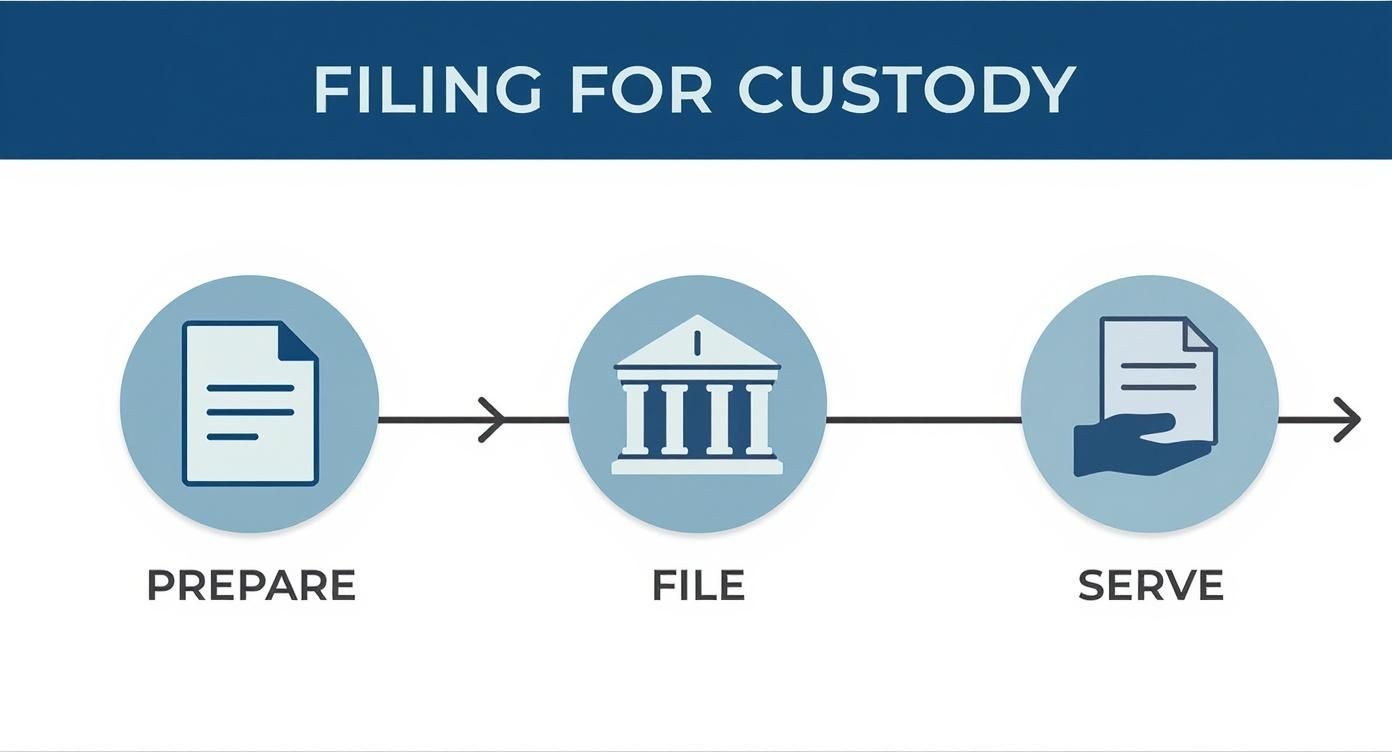
Think of these steps as building a legal foundation. Each one has to be completed correctly before any court hearings can even be scheduled.
The Respondent’s Answer and Default Judgments
Once the other parent has been officially served with the lawsuit, a specific deadline kicks in for them to file a formal response, known as an Answer. In Texas, that deadline is sharp: 10:00 AM on the first Monday after 20 days have passed since they were served.
The Answer is a straightforward legal document. Its purpose is to formally acknowledge the lawsuit and prevent the court from moving forward without their involvement.
But what if they just ignore it? If that deadline passes and the other parent hasn't responded, you have the right to ask the judge for a default judgment. This means the court can proceed and make orders based solely on what you requested in your petition. Essentially, the other parent has legally forfeited their right to contest it.
However, a word of caution: courts are often hesitant to grant default judgments in custody cases where children are involved. It's not uncommon for a judge to give the other parent a little extra time to respond.
The Critical Temporary Orders Hearing
In the early stages of a custody case, the single most significant event is often the Temporary Orders Hearing. This is basically a mini-trial. You and the other parent will present evidence and arguments to a judge, who then issues temporary orders that will remain in place while the case moves forward.
These orders are a huge deal because they establish the immediate reality for your family. The judge will decide on things like:
- A temporary possession and access (visitation) schedule.
- Who gets the temporary right to decide where the child lives.
- Temporary child support and medical support payments.
- Other rules, like communication protocols between you and the other parent.
Because these orders can create a precedent, preparing thoroughly for this hearing is absolutely essential. The judge's initial decisions can and often do heavily influence the final outcome of your case down the road.
To give you a better sense of the post-filing timeline, here’s a breakdown of the key stages you can expect.
Key Stages After Filing Your Texas Custody Petition
| Event | Typical Timeframe | What You Need to Do | Purpose |
|---|---|---|---|
| Service of Process | Immediately after filing | Hire a process server or constable to deliver the lawsuit papers to the other parent. | To officially notify the other parent of the lawsuit and start the clock for their response. |
| Respondent's Answer | Due by 10 AM on the Monday after 20 days from service | Nothing, unless you are filing for a default judgment if they fail to answer. | For the other parent to formally respond to the lawsuit and participate in the case. |
| Temporary Orders Hearing | 2-6 weeks after filing | Gather evidence (texts, emails, photos), line up witnesses, and prepare your testimony. | To establish temporary rules for custody, visitation, and support while the case is pending. This sets the "status quo." |
| Discovery | Begins after initial hearing | Respond to requests for information and documents; send your own requests to the other side. | To formally exchange evidence and information relevant to the case, preventing surprises at trial. |
| Mediation | Often court-ordered before trial | Participate in good faith with a neutral mediator to try and reach a settlement on all or some of the contested issues. | To give parents a chance to resolve their disputes outside of court, saving time, money, and emotional stress. |
| Final Trial | 6-18 months after filing | Prepare all evidence and witness testimony for presentation to the judge. | For the judge to hear all evidence and make a final, binding ruling on all custody matters if no settlement was reached. |
This table provides a roadmap, but remember that every case is unique and timelines can shift based on court availability and the complexity of your situation.
A Temporary Orders Hearing isn't just a preliminary step; it's the hearing that defines your day-to-day reality until a final agreement or trial. Strong preparation here can protect your child's stability and your parental rights from the outset.
Preparing to Make Your Case to the Judge
To get ready for your hearing, you need to gather concrete evidence that proves your requests are in your child's best interest. You can't just walk in and tell the judge what you want; you have to show them why it's the right call.
This evidence could be a mix of things:
- Your own testimony: Be prepared to take the stand and answer questions from your attorney and, yes, the other parent’s attorney.
- Witnesses: This might be a teacher, a daycare provider, or a family member who can speak to your parenting skills and the child's routine.
- Documents: Get your hands on anything that backs up your claims. Think text messages, emails, photos, school report cards, or financial records.
The judge has a packed schedule. Your presentation needs to be clear, organized, and laser-focused on the best interest of your child.
Introducing Mediation as a Path Forward
Even as you're gearing up for a contested hearing, it’s good to know that Texas courts strongly encourage parents to work things out themselves. In fact, most judges will require you and the other parent to attend mediation before they'll even consider letting your case go to a final trial.
Mediation is a confidential process where a neutral, third-party mediator helps you and the other parent negotiate a parenting plan you can both live with. It’s your chance to create solutions tailored specifically to your family, rather than having a judge who doesn't know you impose a one-size-fits-all order. Successfully navigating this next phase is often the key to resolving your case efficiently and with far less conflict.
Preparing for Mediation and a Potential Trial

Most people imagine child custody disputes playing out in a dramatic courtroom battle. The reality? The vast majority of Texas custody cases get resolved long before a judge ever bangs a gavel.
The two main avenues for resolution are mediation and, if that doesn't work out, a trial. Your best bet is to prepare for both possibilities right from the start. That way, you'll be ready to navigate either path with confidence.
Even if you and the other parent are completely at odds, Texas courts will almost certainly require you to attend mediation. This isn't just a friendly suggestion—it's a mandatory step in most counties. The whole point is to give you a structured, confidential setting to work through your disagreements with a neutral third party, saving everyone the emotional and financial drain of a full-blown trial.
Succeeding in Mediation
Let's get one thing straight: mediation isn't about "winning." It's about shifting your mindset from fighting to problem-solving. A mediator doesn't pick sides or make decisions for you. Their job is simply to guide the conversation and help you both find some common ground.
Success in mediation really boils down to preparation. You need to walk in with a crystal-clear idea of what you believe is in your child's best interest and have the documents to back it up.
Key Documents to Bring:
- A Proposed Parenting Plan: This is your detailed roadmap for conservatorship and a possession schedule. Having it written down shows you’ve thought everything through.
- Communication Records: Bring printouts of key emails or text messages that demonstrate your communication style and co-parenting efforts.
- Your Child’s Records: Things like report cards, attendance records, or notes from teachers offer an objective, third-party look at how your child is doing.
- A Financial Information Statement: If child support is on the table, you'll need your pay stubs and a breakdown of your child's expenses. It’s non-negotiable.
Your goal is to present your case calmly and logically, always framing your requests around what benefits your child. For example, instead of saying, "I want more time," try something like, "I believe a consistent week-on, week-off schedule will give our son more stability during the school year."
Even if you only agree on a few small things, that's still progress. It narrows down the issues a judge will have to decide later.
Mediation is your best opportunity to craft a customized parenting plan that truly fits your family’s unique needs. An agreement you create together is almost always more sustainable and effective than one imposed by a judge.
With many court functions now happening online, it’s a good idea to get familiar with the essential guidelines on remote legal proceedings, as many mediations are held virtually.
When Mediation Does Not Result in an Agreement
If you just can't reach a full agreement in mediation, your case will be set for a final trial. This is where a judge will listen to the evidence from both sides and make the final, binding decisions on every disputed issue—from who gets to be the primary parent to the exact possession schedule and child support amount.
Preparing for a trial is a much more intense process than getting ready for mediation. It involves strict deadlines and a rigid adherence to court rules.
You and your attorney will need to:
- Finalize Your Witness List: Decide who will testify for you. This might include teachers, family friends, or counselors who have firsthand knowledge of your parenting and your child's life.
- Organize Your Evidence: All your documents, photos, and text messages need to be compiled into a formal trial exhibit list and shared with the other parent's attorney by the court's deadline.
- Craft Your Narrative: Work closely with your attorney to build a clear and compelling story for the judge, one that consistently shows why your proposed orders are truly in your child's best interest.
It's also vital to understand the different types of custody arrangements a judge can order. You can learn more about the specifics of joint custody in Texas to see how courts typically structure these orders. A trial demands that you present your case with clarity and confidence, proving to the court that you're the parent best equipped to provide a stable, loving future for your child.
Key Takeaway: What to Do Next
You've made it through the nuts and bolts of the Texas custody process, and that's a huge step. But knowing the path and walking it are two different things. Now is the time to turn information into confident, decisive action.
The journey from filing that first petition to getting a final order really boils down to a few core principles. Keep these in mind, and they'll serve you well. Always frame your requests and arguments around what is truly best for your child. Be obsessive about the details on every single form you file. And treat every deadline like it’s written in stone—because in the eyes of the court, it is.
The Best Move You Can Make Right Now
While this guide gives you a solid map, your family's situation has its own unique landscape. That’s why the single most powerful step you can take is to get legal advice built specifically for you.
- Define Your Goals: Before you talk to anyone, get clear on what a stable, happy future looks like for your child. Write it down. This isn't just an exercise; it will become the compass for every decision you make.
- Get Your Ducks in a Row: Start gathering all the documents and information you've collected so far. Put it all in one place. When you do speak with an attorney, you'll be organized and ready to make the most of that time.
- Don't Go It Alone: Trying to handle a custody case by yourself is a massive risk. The Texas Family Code is complex, and a small procedural mistake can lead to major setbacks, putting your parental rights and your child's stability in jeopardy.
The bottom line is this: You are not expected to figure all this out on your own. Getting professional guidance can turn a process that feels confusing and overwhelming into something you can manage, one step at a time.
Let's Talk About Protecting Your Family
You've done the hard work of educating yourself. Now, let us help you finish the job. The family law attorneys at The Law Office of Bryan Fagan, PLLC, have been through this with countless Texas families. We're here to listen, lay out your options in plain English, and build a strategy to protect what matters most: your child's future.
We invite you to schedule a confidential, no-cost consultation with our team today. Let’s work together to bring your family the security and peace of mind you deserve.
Common Questions About Filing for Custody in Texas
When you're facing a custody case, your mind starts racing with practical questions that can keep you up at night. Getting straight answers to these common concerns is one of the best ways to find some peace of mind and set realistic expectations for the road ahead.
How Much Does It Cost to File for Custody?
This is usually the first thing people ask, and for good reason. The initial court filing fees in Texas will typically run you between $300 and $400, though this can vary a bit depending on which county you're in.
But that's just the starting line. The total cost really depends on how much conflict there is between you and the other parent. If you can hash out an agreement fairly quickly, your costs will stay on the lower end. If the case involves deep dives into evidence (what we call "discovery"), multiple court hearings, or even a full-blown trial, the legal fees will climb.
An investment in experienced legal guidance isn't just another bill—it's a critical step toward protecting your parental rights and securing a stable, predictable future for your child.
Does My Child Get to Choose Who They Live With?
In Texas, a child can't legally make the final call on where they live until they turn 18. That said, the law does give children who are 12 or older the right to speak with the judge in private to express their wishes.
A judge is required to hear what the child has to say, but it's important to understand that their preference is just one of many factors. The court's decision will always come down to the "best interest of the child" standard, which includes weighing the child's maturity, their reasons for the preference, and all the other circumstances of the case.
Can a Custody Order Be Changed Later On?
Absolutely. Custody orders in Texas are not set in stone forever. To modify an existing order, you have to go back to court and prove two key things.
First, you must show there has been a "material and substantial change" in the circumstances of the child or one of the parents since the last order was made. Second, you have to prove that changing the order is actually in your child's best interest.
The journey through a custody case is complex, but you don't have to navigate it alone. The experienced team at The Law Office of Bryan Fagan, PLLC is here to provide the compassionate guidance and strategic advocacy you need to protect your family. We invite you to contact us for a free, confidential consultation to discuss your specific situation and learn how we can help. Your family's future is worth protecting. Schedule your free consultation with us today.