Skip to content
When you're facing a custody decision, it can feel like you're standing at a crossroads, totally unsure which path is the right one for your family. In Texas, what most people call "joint custody" has a legal name: Joint Managing Conservatorship (JMC). This is the starting point for almost every custody case in the state because courts firmly believe that keeping both parents actively involved is what’s best for your children.
What Joint Custody Really Means in Texas

When you hear "joint custody" in Texas, it’s critical to understand it’s not just about splitting up your child's time. It's a legal framework for sharing the profound responsibility of raising them. Think of it less like dividing a pie and more like co-captaining a ship. Both you and your co-parent have a hand on the wheel, making the big decisions together.
The Texas Family Code creates a strong presumption that naming parents as Joint Managing Conservators is in a child's best interest. This legal default is built on the powerful idea that children thrive when they have the love, support, and guidance of both parents. It’s the arrangement Texas courts prefer because it keeps both of you at the center of your child’s life.
Core Components of Joint Managing Conservatorship
So, what does this actually look like day-to-day? A JMC order lays out the specific rights and duties you and your co-parent will share. This framework is designed to create stability and consistency for your child, even though you no longer live under the same roof.
Here’s a practical rundown of what Joint Managing Conservators typically decide on together:
- Education: This includes everything from choosing a school to being involved in parent-teacher conferences and extracurriculars.
- Healthcare: You'll both have a say in making non-emergency medical and dental decisions for your child.
- Psychological and Psychiatric Care: If your child needs mental health support, you’ll agree on the path forward together.
- Religious Upbringing: You’ll jointly determine your child’s moral and spiritual guidance.
It's important to remember that while decision-making is shared, the physical possession schedule—how your parenting time is actually divided—is a separate issue. Being named a Joint Managing Conservator does not automatically mean you get a 50/50 split of time. We offer a thorough guide to help you better understand the different custody arrangements in a Texas divorce and how they are determined. The goal of this structure is to ensure you both remain central, authoritative figures in your child’s life.
Joint Managing Conservatorship at a Glance
To make it even clearer, here’s a summary of the key rights and responsibilities that come with a standard Texas Joint Managing Conservatorship. Think of this as your cheat sheet for understanding your role as a co-parent.
| Parental Right or Responsibility | What It Means for You |
|---|---|
| Medical Decisions | You have the right to consent to non-invasive medical and dental care for your child. |
| Psychological Decisions | You can consent to psychological and psychiatric treatment for your child. |
| Legal Representation | You have the right to represent your child in legal actions and make other legal decisions on their behalf. |
| Access to Records | You have the right to access your child’s medical, dental, psychological, and educational records. |
| School Consultation | You can consult with school officials concerning your child’s welfare and educational status. |
| Extracurriculars | You have the right to attend school activities, including lunches, performances, and sporting events. |
| Child's Services | You can consent to your child's marriage and enlistment in the armed forces. |
| Managing Finances | You have the right to manage your child’s estate, if one has been created by or for them. |
This table shows how JMC is designed to keep both parents involved in the crucial aspects of a child's upbringing, ensuring collaboration continues long after your divorce is final.
What Texas Courts Consider When Deciding Custody
It’s a tough thing to watch a judge make decisions about your children’s future. Every ruling, every agreement, and every order in a Texas custody case is guided by one powerful principle: the best interest of the child.
But what does this legal phrase actually mean for you and your family? It's not just a vague concept. It’s a specific set of factors a judge is required to weigh to ensure your child's well-being always comes first. Getting a handle on this standard is crucial because it gives you the power to build a case that clearly demonstrates your commitment to your child’s health, happiness, and future.
The "best interest" standard isn't just one thing; it's a collection of many different puzzle pieces. A judge has to look at the complete picture of your child's life to figure out what kind of arrangement will truly help them thrive.
While the Texas Family Code doesn't provide an exhaustive checklist, the courts have established key factors they consider in every decision. These are often called the "Holley Factors," and they provide a framework for the court's analysis. Think of them as the questions a judge is trying to answer about your family's situation.
Key Factors in the Best Interest Analysis
A judge evaluates both parents' abilities and the child's needs through this specific lens. Presenting your case effectively means showing how you meet these criteria and provide a stable, loving environment.
The court will look at things like:
- The child's emotional and physical needs, both now and in the future.
- Any emotional or physical danger the child might face.
- The parental abilities of each person seeking custody.
- The stability of the home each parent can provide.
- The plans each parent has for the child's future.
This comprehensive approach is why understanding the court's perspective is so important. For a deeper dive, you can learn more about the guiding principles for custody decisions in Texas and how they apply directly to your case.
This following infographic breaks down four of the most critical factors a judge will consider when evaluating a joint custody arrangement.
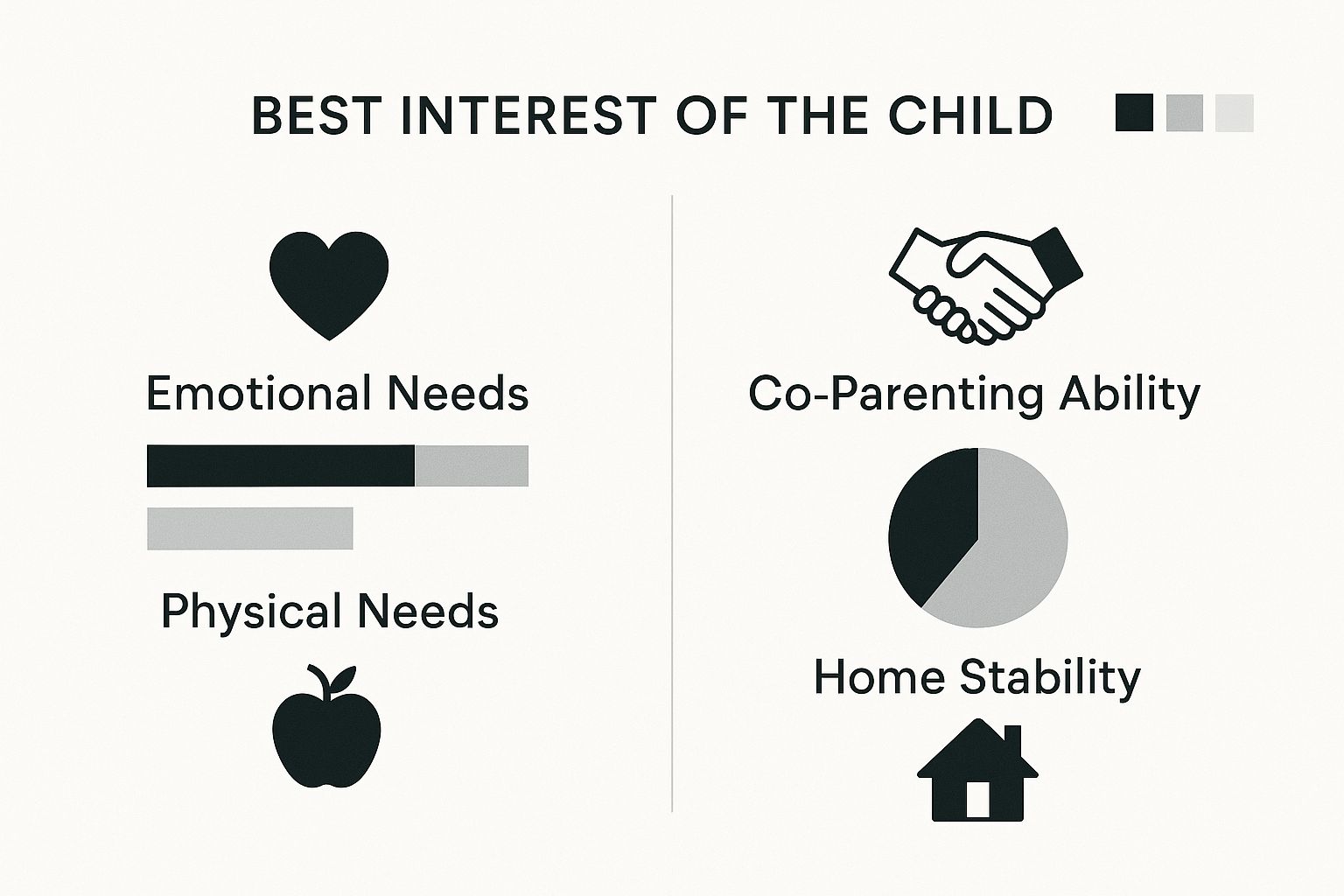
As you can see, the court has to balance a child's tangible needs, like a safe home, with intangible ones, like emotional support and parents who can actually work together for their child's benefit.
The Presumption of Joint Managing Conservatorship
Here’s a critical piece of the puzzle: Texas law starts with the assumption that naming both parents as Joint Managing Conservators is in the child's best interest. This is the default setting for every custody case. The court wants to see both of you actively involved, sharing the rights and responsibilities of raising your child.
As stated in Section 153.002 of the Texas Family Code, "the best interest of the child shall always be the primary consideration of the court in determining the issues of conservatorship and possession of and access to the child."
This legal preference for joint custody isn't just a tradition; it reflects a modern understanding of parenting. Courts recognize that with the evolving roles of fathers and mothers in our society, shared parenting is often the most beneficial model for a child's development, except in specific cases involving family violence or neglect. To overcome this presumption, a parent must present clear, convincing evidence that a joint arrangement would be harmful to the child.
Crafting Your Parenting Plan: The Roadmap for Co-Parenting
Thinking through all the moving parts of co-parenting after a divorce can feel overwhelming. The single most important tool you'll create to bring stability and predictability for your kids is the Parenting Plan. This is your family’s roadmap—a legally binding document spelling out exactly how you and your co-parent will navigate the years ahead.
Think of it like a detailed instruction manual for raising your kids across two separate homes. A well-crafted plan cuts down on future conflict by getting the tough issues sorted out upfront. This allows you and your children to settle into a new, stable routine with confidence. In Texas, this plan gets incorporated into your final decree of divorce, which means its terms are enforceable by law.
Crafting this document is all about negotiation and compromise. Whether you hammer out the details directly with your co-parent, work through attorneys, or sit down in a formal mediation session, the goal is the same: create a clear, comprehensive guide that puts your child's best interests first.
Defining Roles: Primary and Possessory Conservators
Before you start sketching out schedules, it’s crucial to understand the two main roles in a Texas Parenting Plan. Even when you have a Joint Managing Conservatorship and share decision-making, the court will name one parent the primary conservator and the other the possessory conservator.
Let's be clear: this isn't about deciding who's a "better" parent. It’s a practical label meant to create a stable home base for the child.
- Primary Conservator: This is the parent who gets to decide where the child lives, usually within a specific geographic area. They are also the parent who receives child support payments.
- Possessory Conservator: This is the parent who has visitation rights (what the law calls "possession and access") and is typically the one ordered to pay child support.
It's a common myth that the "primary" parent holds all the power. In reality, both parents keep most of their shared rights and responsibilities. This designation is mainly about logistics—establishing the child's home base and making child support straightforward.
Getting a handle on these roles is the first real step in building the framework of your plan. From here, you can start mapping out the nitty-gritty of your co-parenting life.
The Core Components of Your Plan
A solid Parenting Plan leaves very little room for misinterpretation. The more detail you include now, the fewer arguments you'll have later. Your plan needs to clearly define the rights and duties of each parent.
Here are the key elements every plan must have:
- Possession Schedule: This is the calendar. It details exactly when the child will be with each of you during the school year, spelling out weekday and weekend arrangements with specific times and locations for exchanges.
- Holiday and Vacation Schedules: Your plan needs to specify how you'll handle major holidays like Thanksgiving and Christmas—will you alternate each year? It also has to lay out clear rules for summer vacation, spring break, and other school holidays.
- Decision-Making Authority: While most decisions are made together, the plan will state which parent has the final say on certain critical choices. The biggest one is the exclusive right to decide the child's primary residence.
- Child Support and Medical Expenses: The plan incorporates the formal child support order, including who pays, how much, and when. It also spells out how medical, dental, and vision insurance will be handled and how you'll split any uninsured medical costs.
This structure provides the predictable and consistent environment that is absolutely essential for a child’s emotional well-being during and after a divorce.
Standard vs. Custom Possession Schedules
When it comes to the actual possession schedule, Texas gives you two main paths: the Standard Possession Order (SPO) or a completely customized schedule. The SPO is the default schedule written into the Texas Family Code, and courts automatically assume it's in a child's best interest. However, you and your co-parent are free to agree on any schedule that works for your family, as long as a judge signs off on it.
Thinking about which path is right for you? This table breaks down the key differences.
| Feature | Standard Possession Order (SPO) | Customized Schedule |
|---|---|---|
| Structure | Follows a fixed calendar (e.g., first, third, and fifth weekends). | Flexible and can be tailored to your unique needs (e.g., parents' work schedules, child's activities). |
| Predictability | Highly predictable and easy for parents and children to follow. | May require more communication and coordination to manage. |
| Court Approval | Presumed to be in the child's best interest, making it easy to get approved. | Must be proven to be in the child's best interest; requires your agreement or compelling evidence. |
| Best For | Families living within 100 miles of each other with traditional work schedules. | Parents with non-traditional jobs (like first responders or medical professionals), families who want a 50/50 split, or those who live far apart. |
Choosing the right schedule is one of the most important decisions you'll make in this process. Getting the right legal guidance can help you weigh your options and negotiate a plan that truly works for your child and your family’s unique situation.
How Possession Schedules and Parenting Time Work
It's one of the biggest myths in Texas family law: joint custody automatically means a 50/50 split. This is a huge misunderstanding that can set you up for unnecessary conflict and false expectations. Let's clear the air.
Joint Managing Conservatorship is all about who gets to make the big decisions for your child. The actual time you spend with them is dictated by a completely separate possession schedule.
Think of it like this: you and your ex are co-CEOs of a company (your child's life). You both have a say in major decisions, but your day-to-day work schedules might be totally different. A court looks at parental rights and responsibilities separately from the physical calendar of where your child lays their head at night. For most families in Texas, the starting point for that calendar is the Standard Possession Order.
Demystifying the Texas Standard Possession Order
The Texas Family Code provides a default schedule that the law presumes is in the best interest of the child. This is the Standard Possession Order (SPO). It’s a detailed, predictable calendar built to make sure kids have regular, ongoing contact with both of their parents.
Unless you and your co-parent create a custom plan together—or a judge finds a powerful reason to do something different—the SPO is likely the schedule you'll get. It's most often used when parents live less than 100 miles apart.
So, what does a typical SPO look like?
- Non-Primary Parent's Weekends: This parent usually has the children on the first, third, and fifth weekends of any given month.
- Holidays: Major holidays like Thanksgiving and Christmas are typically split and alternated every year, so both parents get a chance to build those special memories.
- Summer Vacation: The non-primary parent generally gets the kids for 30 days during the summer. This can be taken all at once or broken up into shorter visits.
The whole point of the SPO is to provide consistency. It gives you, your co-parent, and most importantly, your child a clear and predictable routine, which cuts down on future arguments over scheduling.

Moving Beyond the Standard Schedule
The SPO might be the default, but it’s definitely not your only choice. Texas courts know that no two families are the same. You are absolutely allowed to create a custom possession schedule that fits your unique situation, whether that’s accommodating a non-traditional work schedule or a child's intense extracurriculars.
The key here is proving that any custom schedule is truly in your child's best interest. If you and the other parent agree on a plan, a judge will almost always sign off on it. If you can't agree, the parent who wants the non-standard schedule has to convince the court with solid evidence.
Many custom schedules aim for a more equal split of time. For example, exploring how the 5-2 custody schedule works under Texas Family Law can show you one popular alternative that works well for many families. Other arrangements, like a week-on/week-off schedule, are also gaining traction as co-parenting norms change.
The Reality of Parenting Time in Texas
So, what does this all mean in the real world? When you look at the data, you see a clear picture. Fathers in Texas get about 33% of the parenting time, which is right in line with the national average of 35%.
These numbers show that while joint custody is the legal standard, the day-to-day reality often results in one parent—traditionally the mother—having the kids more often. Still, the trend is definitely shifting toward more balanced, truly shared parenting plans. Knowing these realities helps you walk into negotiations with a clear-eyed view of what's possible. It empowers you to fight for a schedule—whether it’s the SPO or a custom one—that genuinely serves your child and your family.
Calculating Child Support with Joint Custody

Let’s be honest—figuring out the financial side of co-parenting can be a huge source of anxiety. Even when you have a joint custody arrangement, Texas law still requires a clear child support plan. It’s a common myth that if parenting time is split, nobody has to pay. The reality is, child support is almost always part of the equation in joint custody in Texas.
The court system doesn’t see child support as a payment to your ex. It’s a right that belongs to your child, designed to ensure they have a similar standard of living no matter which parent’s home they’re in. The whole process is laid out in the Texas Family Code, which gives us specific guidelines to make the calculations fair and predictable.
How Texas Determines Child Support
In most joint managing conservatorship cases, the judge will name one parent the "primary conservator"—the parent who gets to decide where the child lives. Because of this, the primary parent is usually the one who receives child support payments.
The parent who makes the payments is called the obligor. The amount they owe is calculated as a percentage of their net monthly resources. It’s a pretty straightforward formula.
Here’s a step-by-step breakdown of how the guideline calculation works:
- Calculate Gross Income: The court starts by adding up all your sources of income—wages, commissions, self-employment earnings, rental income, and investments.
- Determine Net Resources: From that gross number, the court subtracts social security taxes, federal income tax (calculated for a single person with one exemption), state income tax, union dues, and what you pay for the child's health insurance.
- Apply the Percentage: The final step is to apply a specific percentage to your net resources based on how many children you have.
The Texas Family Code puts a ceiling on the income used for this calculation. Right now, that cap is $9,200 in net monthly resources. If the paying parent earns more than that, a judge can order additional support, but only if it's proven to be in the child's best interest.
Child Support Percentages in Texas
The percentage applied to the non-primary parent's net income is simple and consistent. These guidelines are in place to make sure children in similar situations receive similar levels of financial support across the board.
- 1 Child: 20% of Net Resources
- 2 Children: 25% of Net Resources
- 3 Children: 30% of Net Resources
- 4 Children: 35% of Net Resources
- 5 or more Children: At least 40% of Net Resources
So, for example, if you're the possessory conservator with one child and your net monthly resources are $5,000, your guideline child support would be $1,000 per month (20% of $5,000).
What About 50/50 Schedules and Special Circumstances?
So what happens if you have a true 50/50 possession schedule? It’s not the most common arrangement, but it definitely happens. This is where child support can get a little more complicated.
A judge might order the parent with the higher income to pay a smaller amount to the other parent to help equalize the financial resources between the two homes. Another approach is called the "offset method," where the court calculates what each of you would owe the other and then orders the parent with the higher obligation to simply pay the difference.
There’s no automatic formula for 50/50 splits in the Texas Family Code. At the end of the day, the judge will make a decision based on what they believe is in the child’s best interest. This is one of those situations where having a skilled family law attorney is absolutely critical. They can present a clear argument on your behalf to ensure the financial outcome is fair and sustainable for your family's new chapter.
Next Steps for Texas Joint Custody: Your Action Plan
Knowing the law is one thing; putting that knowledge into action is how you build a stable, secure future for your kids. The path forward doesn't have to be a confusing maze. It's about moving from uncertainty to confidence with a clear, actionable game plan. This is your moment to shift from just learning about joint custody in Texas to actively shaping a positive outcome. It all starts with getting organized, thinking strategically, and finding the right professional support.
Your Actionable Checklist
To get you started, here is a simple checklist. Following these steps will put you in a strong position, whether you're heading into negotiations, mediation, or the courtroom.
- Gather Your Documents: Start pulling together the essentials. This means financial records like pay stubs and tax returns, your child's school and medical records, and any evidence that shows you're a responsible, involved parent.
- Outline Your Ideal Parenting Plan: Before you talk to anyone, think through what you want. What does your preferred possession schedule look like? How will you handle holidays? Who makes the major decisions? Having a clear vision helps your attorney fight for your goals.
- Prepare for Mediation: Most Texas courts will require you and the other parent to try mediation first. Go into it with an open mind and a willingness to find common ground, but stay firm on what's truly best for your child.
As you move through the legal process, you might find yourself in a situation where you need to communicate directly with the court. Understanding the right way to approach writing a letter to a judge can be an incredibly useful skill to have in your back pocket.
Take the First Step
The single most important step you can take right now is to partner with an experienced family law attorney. A good lawyer isn't just an advocate; they're your strategist. They protect your parental rights and make sure your child’s future is the absolute top priority, translating complicated legal standards into a clear path forward.
Going through a custody case alone is like trying to navigate a dense forest without a map or compass. An attorney provides the direction you need to reach a secure future for you and your children.
You've already taken a huge step by educating yourself. Now, it’s time to take the next one. We invite you to schedule a free, confidential consultation with our team at The Law Office of Bryan Fagan, PLLC. Let's talk about your unique situation and start building a personalized strategy to protect what matters most to you.
Frequently Asked Questions About Joint Custody
When you're facing a custody case, the unknowns can be overwhelming. It's easy to feel like you're the only one with these questions, but trust us, you're not. Here are some straightforward answers to the questions we hear most often from Texas parents trying to understand joint custody.
Does Joint Custody Mean 50/50 Parenting Time in Texas?
Not at all, and this is probably the biggest misconception in Texas family law. The term Joint Managing Conservatorship sounds like it should mean equal time, but it doesn't. It's all about sharing the rights and responsibilities to make big decisions for your child—think education, medical care, and religious upbringing.
The actual time each parent spends with the child is laid out in what's called a possession schedule. While you and the other parent can certainly agree to a 50/50 split, it's not the default. The far more common outcome is the Texas Standard Possession Order, which almost always results in one parent having the kids more often than the other.
Can I Refuse to Agree to Joint Custody?
You can, but get ready for a serious uphill battle. Texas law operates on a powerful presumption: that having both parents involved in decision-making is in the child’s best interest. A judge won't toss that standard aside lightly.
To successfully argue against joint custody, you have to do more than just disagree with the other parent. You need to present compelling evidence that a joint arrangement would be actively harmful to your child. This usually involves proving things like:
- A documented history of family violence
- Serious neglect or child endangerment
- Significant substance abuse problems
- Conflict so extreme that co-parenting is truly impossible
Without that kind of evidence, the court is almost certain to order a joint managing conservatorship.
Who Pays Child Support in a Joint Custody Case?
Even when parents share decision-making, child support is almost always part of the equation. The court will name one parent the primary conservator—this is the parent who gets to decide where the child lives. The other parent is named the possessory conservator.
As a general rule, the possessory conservator is the parent who pays child support. The amount isn't arbitrary; it's calculated using the Texas child support guidelines, which are based on a percentage of the paying parent's net monthly income. The whole point is to make sure the child's financial needs are met consistently, no matter which home they're in.
Navigating the specifics of joint custody in Texas requires a clear strategy and an advocate who understands your family's needs. The experienced attorneys at The Law Office of Bryan Fagan, PLLC are here to provide the compassionate guidance you deserve. Schedule your free consultation today to protect your parental rights and secure your child's future. Visit us at https://texasdivorcelawyer.us.