Skip to content
When you’re a parent, making decisions about your child's future can feel like carrying the weight of the world on your shoulders. The choice between joint and sole custody is more than just a legal matter—it’s deeply personal, and Texas law has a specific framework designed to protect what matters most: your child. While joint custody is the standard in Texas, courts will award sole custody when it's necessary to ensure a child's safety and well-being.
Navigating Your Most Important Decision as a Parent
Facing a custody dispute can be overwhelming, filled with confusing legal terms and anxiety about the future. The first thing to understand is that in Texas, what most people call "custody" is legally known as "conservatorship." This single word covers all the rights and responsibilities you have as a parent.
The entire process is guided by one core principle from the Texas Family Code: the "best interest of the child." This isn’t just a legal phrase; it's the standard judges use to make every single decision about your family's future.
This guide is here to replace that anxiety with clarity. We’ll walk you through the critical differences between the two main types of conservatorship in Texas so you can understand what each one really means for you and your child.
- Joint Managing Conservatorship: This is where both parents share the rights and duties of raising their child.
- Sole Managing Conservatorship: This arrangement gives one parent the exclusive right to make most of the major decisions for the child.

Joint vs. Sole Conservatorship At a Glance
Getting a handle on the fundamental differences is the first step toward making an informed choice. As you begin this process, it's vital to focus on supporting children through significant life transitions that these family changes bring.
| Feature | Joint Managing Conservatorship (JMC) | Sole Managing Conservatorship (SMC) |
|---|---|---|
| Decision-Making | Rights are shared, though one parent may have the final say on specific issues. | One parent holds the exclusive right to make most major decisions. |
| Court Preference | This is the presumed best option for children under Texas law. | Awarded only when joint custody would be harmful or unsafe for the child. |
| Parental Roles | Both parents are named "Joint Managing Conservators." | One is the "Sole Managing Conservator," and the other is the "Possessory Conservator." |
A clear understanding of each arrangement empowers you to advocate effectively for your child's future.
Understanding Texas Legal Terms: Conservatorship Explained
When you first step into the family court system, it’s easy to feel lost in a sea of legal jargon. In Texas, the word you’ll hear most isn’t “custody,” but “conservatorship.” Getting a handle on this term is the first step toward taking control of your situation, because it defines your fundamental rights and responsibilities as a parent moving forward.
Conservatorship goes way beyond just deciding where your child lives. It’s about who has the legal authority to make the big life decisions for them—everything from choosing their school and consenting to medical procedures to guiding their religious upbringing. The court's final order will spell out exactly which parent holds these powers and how they get to use them.

Joint Managing Conservatorship: The Texas Standard
When people talk about joint custody in Texas, what they’re really referring to is Joint Managing Conservatorship (JMC). This is the starting point for nearly every case because Texas courts operate on the presumption that it’s in a child’s best interest to have both parents deeply involved in their life.
Under a JMC, both you and your ex-spouse are named "Joint Managing Conservators," and you share the rights and duties of raising your child. But don’t let the word "joint" fool you—it doesn't always mean "equal" in every single respect.
Key Insight: Even in a Joint Managing Conservatorship, the court will designate one parent as the "primary" conservator. This is the parent who has the exclusive right to decide where the child lives (usually within a set geographic area) and who receives child support payments.
This setup strikes a balance. It encourages shared decision-making while still creating a stable home base for your child. It definitely requires cooperation and communication, but it’s the path most Texas families end up taking.
Sole Managing Conservatorship: When One Parent Decides
On the other hand, Sole Managing Conservatorship (SMC) is a much rarer outcome. It’s typically granted only when a joint arrangement would be damaging, unstable, or unsafe for the child. This is a major legal move reserved for serious situations, such as family violence, substance abuse, or extreme conflict.
If a judge names you the "Sole Managing Conservator," you are given the exclusive right to make almost all major decisions for your child without needing to consult the other parent.
These decisions usually include:
- Medical and Dental Care: You alone can consent to non-emergency medical treatments.
- Education: You have the final say on school enrollment and other educational choices.
- Legal Rights: You can represent your child in legal actions and make decisions on their behalf.
In an SMC order, the other parent is named the "Possessory Conservator." This parent still has rights—like the right to visitation (or "possession") and the right to be kept in the loop about the child's well-being—but they lose their seat at the decision-making table. This distinction is the core of the joint vs. sole custody debate in Texas.
At-a-Glance Comparison: Joint vs Sole Managing Conservatorship
This table breaks down the fundamental differences between the two main types of conservatorship in Texas, helping you see how parental rights and responsibilities are allocated in each scenario.
| Key Aspect | Joint Managing Conservatorship (JMC) | Sole Managing Conservatorship (SMC) |
|---|---|---|
| Decision-Making | Shared rights; parents must consult on major decisions. | One parent has exclusive rights to make most major decisions. |
| Court Presumption | Presumed to be in the child's best interest (the default). | Awarded only in specific, often high-conflict situations. |
| Parental Titles | Both are "Joint Managing Conservators"; one is "Primary." | One is "Sole Managing Conservator," the other is "Possessory Conservator." |
| Child's Residence | The "primary" JMC has the exclusive right to determine. | The SMC has the exclusive right to determine. |
| Child Support | The non-primary parent pays child support to the primary. | The Possessory Conservator pays child support to the SMC. |
| Common Scenarios | Most Texas custody cases. | Cases involving family violence, neglect, or substance abuse. |
Ultimately, whether your case ends in a JMC or SMC will depend entirely on your family’s specific circumstances and what a judge determines is truly in the best interest of your child. Understanding these foundational terms is absolutely essential, as they are the building blocks of your custody order and will shape your family's future for years to come.
How Texas Courts Determine the Child's Best Interest
When you and your co-parent can’t see eye-to-eye on a custody plan, the decision ultimately falls to a judge. That can be a terrifying thought—placing your family’s entire future into a stranger's hands. But Texas courts don't make these calls on a whim. Every decision is guided by a single, powerful principle: the best interest of the child.
This isn't some fuzzy, abstract idea. It's a concrete legal standard that was cemented by the Texas Supreme Court in a landmark 1976 case. The criteria that emerged are known as the “Holley Factors,” and they serve as a detailed roadmap for judges. Getting familiar with these factors is non-negotiable, as they reveal exactly what the court is looking for when it weighs joint vs. sole custody.
Breaking Down the Holley Factors
The court’s main goal is to ensure your child has a safe, stable, and nurturing environment to grow up in. To do that, a judge will weigh several factors to get a complete picture of your family's dynamic. There's no magic formula here; it's about a careful and holistic evaluation of your situation.
Key considerations include:
- The child's emotional and physical needs, both now and in the future.
- Any emotional or physical danger the child might face, now or down the road.
- The parental abilities of each person seeking custody.
- The stability of the home environment each parent can offer.
- The plans each parent has for the child's upbringing.
- Any actions or failures to act by a parent that suggest an unhealthy parent-child relationship.
A judge wants to see parents who are engaged, emotionally supportive, and capable of providing a consistent and secure home. You can learn more about how these guiding principles shape custody decisions in our detailed article.
The Child’s Preference and Parental Stability
One of the most common questions you might have is whether your child gets to choose where they live. Under Texas Family Code Section 153.009, once a child is 12 years or older, they have the right to speak with the judge in private to share their wishes. The judge must listen, but the child's preference is just one piece of the puzzle—it's not the final vote.
What the Court Looks For: The judge will try to gauge the child's maturity and the real reasons behind their preference. A choice based on one parent being "more fun" or having fewer rules won't carry much weight. A preference rooted in feeling safer or more emotionally supported, however, will be taken very seriously.
Beyond the child's input, the court looks very closely at each parent’s stability. This covers everything from your financial security and emotional maturity to your ability to maintain a consistent daily routine. A parent who consistently shows a child-focused attitude and a willingness to work with the other parent almost always makes a better impression.
Proving Your Case in Court
While Texas law starts with the presumption that a joint managing conservatorship is in the child's best interest, that presumption can be challenged. If you are fighting for sole custody, the burden is on you to provide clear and convincing evidence that a joint arrangement would be harmful to your child.
This kind of evidence might include:
- A history of family violence or neglect.
- Proof of ongoing substance abuse issues.
- Evidence of an unstable or dangerous living situation.
- Testimony from teachers, counselors, or other professionals who know the family.
At the end of the day, a judge's decision in a joint vs. sole custody case comes down to one thing: which parent can prove they are best equipped to provide the environment the child needs to thrive.
The Realities of Co-Parenting with Joint Custody
Choosing a custody arrangement is one thing; living it day-to-day is another beast entirely. While a Joint Managing Conservatorship (JMC) is the default starting point in Texas, making it work takes more than a judge’s signature. It demands a genuine commitment from both you and your co-parent to put your child’s needs first, every single day.
This setup is designed to keep both parents in the game, but that shared responsibility means you’ll be making decisions together long after the divorce is final. From picking a pediatrician to agreeing on summer camps, JMC requires solid communication, mutual respect, and a lot of flexibility. When it works, it gives children a powerful sense of stability and the unwavering support of two parents who have their back.

Defining Roles: The Primary Conservator
Even in a joint custody world, Texas law provides structure by naming one parent as the "primary" conservator. This doesn't make the other parent less important, but it does clarify one critical role.
The primary parent has the exclusive right to decide where the child lives, usually within a specific geographic area set by the court. This is the parent who establishes the child's home base and, in most cases, receives child support payments. This setup ensures your child has a stable home while still getting to spend significant time with both parents.
Navigating the Possession Schedule
The "possession schedule" is just a legal term for the calendar that lays out when your child is with each parent. While you and your co-parent can always agree on a custom schedule, if you can’t, the court will likely implement the Texas Standard Possession Order (SPO).
The SPO is a detailed schedule that typically gives the non-primary parent possession on:
- The first, third, and fifth weekends of a month.
- Alternating major holidays, like Thanksgiving and Christmas.
- An extended period during the summer, usually 30 days.
This standard framework is meant to create consistency and predictability for your child, which is crucial for their well-being. But it still requires careful coordination to avoid mix-ups over pick-up times, holiday plans, and travel. For many families, mastering strategies for effective communication after divorce is the secret to making the SPO run smoothly.
When Co-Parenting Gets Complicated
Let's be honest—joint custody isn't always easy. Disagreements are going to happen, and how you handle them will make or break your co-parenting relationship. A simple dispute over bedtime can snowball, and bigger decisions about education or medical care can ignite serious conflict.
For some families, especially those navigating the complexities of a child with special needs like ADHD, professional help can make all the difference. Seeking guidance on family therapy for ADHD isn't a sign of failure; it's a smart strategy. Mediation can also be a fantastic tool for resolving arguments before they land you back in court. The goal is to build a problem-solving partnership, not an adversarial one.
When Sole Custody Becomes a Necessity
The thought of raising your child without the other parent’s input often feels like a last resort, reserved for only the most extreme situations. The Texas legal system sees it the same way. While the law always starts with a strong preference for keeping both parents involved through a Joint Managing Conservatorship, its ultimate duty is to protect your child from harm.
When a joint arrangement would clearly put a child's physical or emotional well-being at risk, a judge won't hesitate to order a Sole Managing Conservatorship (SMC). This isn't meant to be a punishment; it's a protective shield, designed to create a stable and safe home when one parent is either unable or unwilling to provide one.
Grounds for Awarding Sole Custody
A court won’t strip a parent of their legal rights lightly. To award sole custody, a judge needs to see compelling, undeniable evidence that it’s in the child’s best interest. The Texas Family Code clearly outlines the specific circumstances that can override the default assumption of joint custody.
These situations are serious and almost always involve a pattern of behavior that endangers a child. They include:
- A History of Family Violence: Any credible evidence of physical, sexual, or emotional abuse toward the child or another family member is the most common reason a judge will award sole custody.
- Substance Abuse: If a parent has a current and ongoing problem with alcohol or drugs that gets in the way of their ability to care for the child, a court will step in to protect them.
- Child Neglect or Abandonment: This can mean failing to provide basic needs like food, shelter, and medical care, or it can mean a parent has simply been absent from the child's life for a long time.
- Extreme Parental Conflict: When parents are so hostile that they truly cannot communicate or make decisions together—and this conflict is causing obvious harm to the child—a judge may decide one parent needs to be in charge.
- Incarceration: If a parent is locked up or will be for a significant amount of time, they simply can't fulfill their parental duties, which often leads to an SMC order.
It's critical to understand the difference between being a "bad spouse" and being a "dangerous parent." A judge's focus is locked squarely on behaviors that directly impact the child's safety and well-being.
Proving Your Case for Sole Custody
If you're convinced that a sole managing conservatorship is necessary to protect your child, the burden of proof is on you. You can't just tell the judge the other parent is unfit; you have to show them with clear, credible evidence. This is where your attorney becomes essential in helping you gather and present this information effectively.
Legal Standard: To overcome the joint custody presumption, you must prove that appointing the parents as joint managing conservators would "significantly impair the child's physical health or emotional development." This is a high bar, requiring much more than evidence of disagreements or poor communication.
Evidence is the backbone of your entire case, and it can come in many forms. The court will look at a wide range of documents and testimony to get the full picture.
Types of Evidence Often Used:
- Official Records: Police reports, criminal records, and restraining orders provide objective, third-party proof of past incidents.
- Medical and School Records: These can reveal signs of neglect or show the emotional toll a toxic home environment is taking on a child.
- Professional Testimony: Testimony from counselors, therapists, or Child Protective Services (CPS) caseworkers can carry enormous weight with a judge.
- Court-Ordered Evaluations: A judge might order a formal custody evaluation or a psychological assessment of the parents and child to get an expert's unbiased opinion.
- Witness Testimony: Friends, family members, or teachers who have personally witnessed a parent's dangerous behavior can provide crucial, firsthand accounts.
Building a compelling case for sole custody demands a careful, strategic approach. It’s all about presenting a factual, non-emotional argument focused entirely on one thing: protecting your child’s best interests. This is one of the most serious decisions a family court can make, and it absolutely must be supported by a solid foundation of proof.
Your Strategic Path Forward
Knowing the difference between joint and sole custody is a good start, but what really matters is having a clear, strategic plan to protect your family’s future. Moving forward with confidence means being prepared, organized, and proactive from this point on. Your child’s well-being is simply too important to leave anything to chance.
The single most powerful tool you have at your disposal right now is documentation. Starting today, you should keep a detailed, factual record of everything related to your child and your co-parenting relationship.
Building Your Case with Diligence
You need to meticulously track all communication with the other parent, keep a log of important dates, and note any events that could be relevant in court. Think of it as creating a factual timeline that speaks for itself.
- Log Communication: Keep a dedicated calendar or journal for calls, texts, and emails. Note the date, time, and a brief, objective summary of what was discussed.
- Track Events: Document every school meeting, doctor’s appointment, and extracurricular activity. Make a note of who attended and what the outcome was.
- Save Everything: Keep copies of receipts for child-related expenses, school report cards, and any other paperwork that tells the story.
This detailed log creates a factual record that can be invaluable, whether you're trying to negotiate a settlement or presenting your case to a judge. It pulls the conversation away from emotional arguments and grounds it in concrete evidence.
This decision tree gives you a visual of the fundamental question a Texas court will consider: is there a risk of harm to the child?
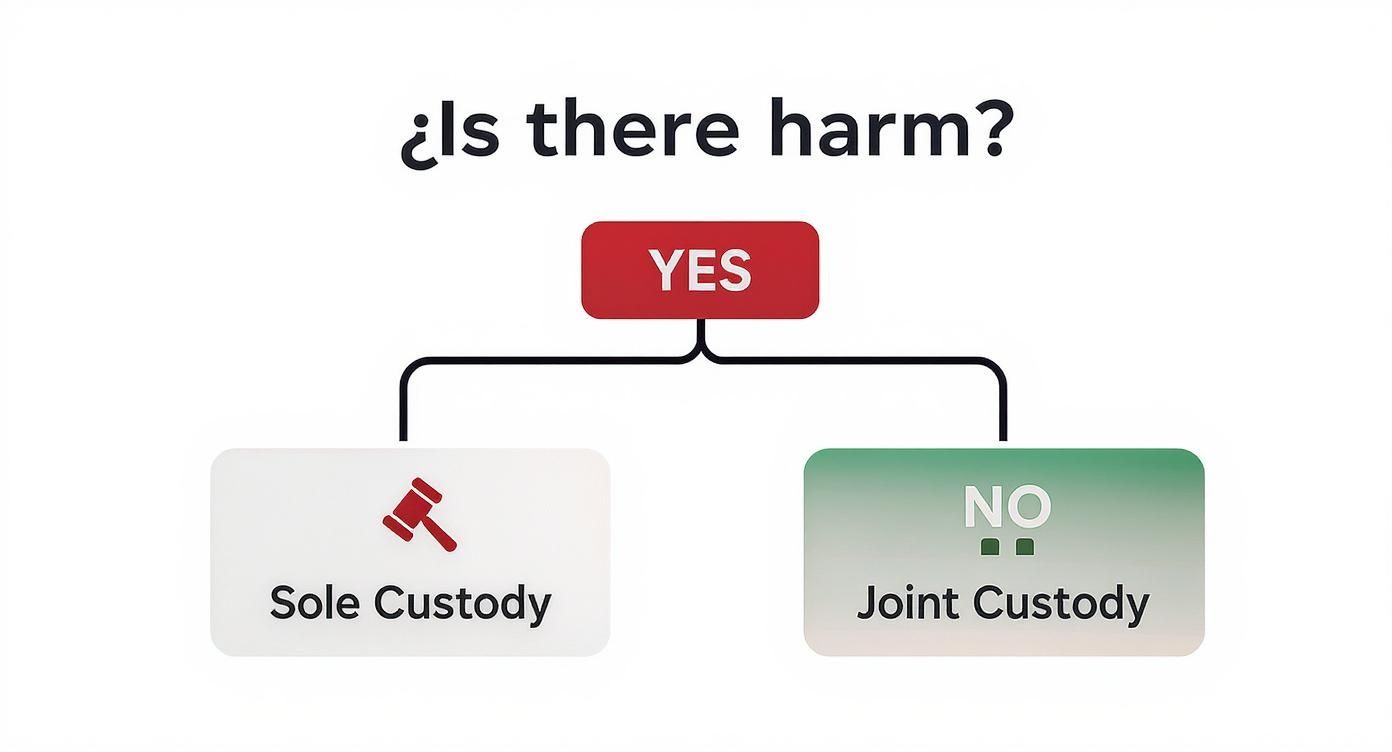
As you can see, the path to sole custody is almost always paved with clear evidence that a joint arrangement would be detrimental to the child.
Frequently Asked Questions About Texas Custody
When you're facing a custody case in Texas, the legal jargon can feel overwhelming. But beyond the courtroom terms, you're really just trying to figure out what life is going to look like for you and your kids. It’s completely normal to have a ton of specific, practical questions.
Let’s cut through the noise and get you some clear, straightforward answers to the questions we hear most often from parents in your exact situation.
Does Joint Custody Mean a 50/50 Schedule?
This is probably the biggest point of confusion for parents. The short answer is no, Joint Managing Conservatorship does not automatically equal a 50/50 possession schedule. It’s easy to see why people think "joint" means "equal time," but in Texas law, these are two separate things.
The term "joint" actually refers to how you and the other parent will share the rights and duties of raising your child—things like making decisions about school, healthcare, and religion. The calendar that dictates when your child is with each parent is called the possession schedule.
While you and the other parent are free to agree on a true 50/50 split, the default order in Texas is the Standard Possession Order (SPO). This schedule usually looks more like a 60/40 split, where the non-primary parent has the kids on the first, third, and fifth weekends of a month, plus time over the summer and alternating holidays.
Can My Child Decide Who to Live With?
This is one of the most sensitive and emotionally charged questions in any custody case. The answer isn't a simple yes or no. Under the Texas Family Code, Section 153.009, once a child reaches the age of 12, they have the right to speak with the judge in private to state their preference.
However, the child's preference is not the final word. A judge is required to listen to a child who is 12 or older, but that's just one piece of the puzzle. The judge will weigh the child's wishes against all the other "Holley Factors" to figure out what is truly in their best interest. The child's maturity level and the reasons behind their choice matter a great deal. Their voice is influential, but it doesn't override the judge's final decision.
How Does Child Support Work in Each Scenario?
Child support is calculated the exact same way whether you have a joint or sole conservatorship. The fundamental obligation to financially support your child doesn't change just because the custody label does.
In Texas, support is typically paid by the non-primary parent (in a joint setup) or the Possessory Conservator (in a sole setup) to the parent who has the right to decide where the child lives. The amount is determined by state guidelines, which are based on the paying parent's net monthly income and how many children they are responsible for supporting.
Key Takeaway: The legal structure for decision-making rights (conservatorship) is completely separate from the formula used to calculate financial support. Your duty to provide for your child financially is locked in under both joint and sole custody orders.
Getting a handle on these details is crucial as you prepare for what’s ahead. Each of these questions shows how Texas law tries to balance parental rights with the single most important goal: protecting the child’s best interests and shaping the new reality for your family.
Your Next Steps: Legal Counsel & Mediation for Texas Custody Cases
While documentation is absolutely crucial, you don't have to navigate this alone. Seeking legal counsel early on gives you a significant advantage, allowing you to build a smart strategy from a position of strength, not desperation.
Another powerful tool is mediation. This is a process where a neutral third party helps you and your co-parent hash out an agreement outside of the courtroom. It’s often faster, less expensive, and gives you far more control over the final outcome than letting a judge decide.
Your Action Plan:
- Start documenting everything—today. Keep detailed, factual records of communication and events.
- Explore mediation. Consider it a constructive path toward an agreement you both can live with.
- Schedule a free consultation. Understanding your legal rights and options is the first step to protecting your family's future.
Your family's future is the most important thing, and you don’t have to face these complex decisions alone. The attorneys at The Law Office of Bryan Fagan, PLLC are here to provide the compassionate guidance and authoritative representation you need. Contact The Law Office of Bryan Fagan, PLLC for a free, no-obligation consultation to discuss your case and build a personalized strategy that protects your child and your rights. Visit us at https://texasdivorcelawyer.us to get started.