 Skip to content
Facing a divorce is overwhelming, and when military service is involved, it adds layers of complexity that can make you feel lost. Your search for a "military divorce lawyer near me" is the most critical first step you can take, because a general divorce attorney often lacks the specific, nuanced knowledge needed to protect your rights, your benefits, and your family's future.
The truth is, military divorce is governed by a unique intersection of Texas Family Code and federal military regulations. Understanding how to navigate both is essential for a fair outcome.
Why Military Divorce Requires a Specialized Lawyer
When you or your spouse is in the armed forces, your divorce isn't just a private family matter. It's a legal process tangled in federal acts, Department of Defense policies, and specific interpretations of Texas law. An attorney without direct experience in this arena can easily make critical mistakes—mistakes that can have lifelong financial and personal consequences for you and your children.
A true military divorce lawyer understands your world. They don’t just see a divorce case; they see the entire picture of a military family’s life and the complex web of laws that govern it.
Jurisdiction and Filing The Right Way
One of the first hurdles is often just figuring out where to file for divorce. For military families, this is rarely a simple question. You might be stationed at Fort Cavazos right here in Texas, but your legal state of residence (your domicile) could be Florida, while your spouse is living in California.
An experienced lawyer knows how to analyze your family's unique situation to pinpoint the correct jurisdiction. According to the Texas Family Code § 6.301, at least one spouse must have resided in Texas for six months and in the specific county of filing for 90 days. An expert will ensure you meet these requirements to prevent your case from being dismissed after you've already invested significant time and money.
Protections Under the Servicemembers Civil Relief Act (SCRA)
The Servicemembers Civil Relief Act (SCRA) is a federal law designed to protect active-duty service members from being put at a disadvantage in legal proceedings because of their service. If you're deployed or otherwise unable to participate in your divorce case due to active duty, the SCRA allows for a "stay," or postponement, of the case for at least 90 days.
However, invoking these protections isn't automatic; it requires precise legal action. An attorney who truly understands the SCRA can ensure it's used correctly to protect your rights without needlessly dragging out the process, providing a solution-focused path forward even when deployment complicates matters.
You are not just a civilian going through a divorce; you are a service member or a military spouse whose life is shaped by a unique set of rules. Your attorney must be fluent in both Texas family law and federal military regulations to effectively represent you.
Dividing Military Retirement and Benefits
For many long-term military families, the biggest asset on the table is the military retired pay. Dividing this is not as simple as splitting a 401(k). The process is governed by the Uniformed Services Former Spouses’ Protection Act (USFSPA), which gives Texas courts the authority to treat disposable retired pay earned during the marriage as community property.
Your lawyer absolutely must understand critical concepts like:
- The 10/10 Rule: This rule dictates whether a former spouse can receive payments directly from the Defense Finance and Accounting Service (DFAS). It does not determine if they are entitled to a share in the first place—a common and costly misunderstanding.
- The 20/20/20 Rule: This determines a former spouse's eligibility for continued benefits after the divorce, such as lifetime TRICARE and access to the commissary and exchange.
- Survivor Benefit Plan (SBP): Designating a former spouse as the SBP beneficiary is a crucial, irreversible decision that provides an annuity after the service member’s death. It must be handled perfectly in the divorce decree, or the benefit could be lost forever.
Navigating these unique challenges and procedures in a military divorce demands an attorney who has been down this road many times before. A single mistake in these areas can cost you dearly for years to come.
Where to Begin Your Search for the Right Attorney

Knowing you need a specialist is the easy part. Actually finding one can feel like another mission entirely. A quick search for a "military divorce lawyer near me" will flood your screen with options, but how do you cut through the noise to find a genuine expert?
The key is to have a clear plan. You're looking for an attorney who doesn't just list "military divorce" on their website but has a verifiable history of successfully navigating these specific cases. This means looking in the right places and knowing exactly what to look for.
Start with Trusted Professional Resources
Forget about trusting a simple web search alone. Your search should begin with organizations that vet legal professionals. This approach gives you a much more reliable list of potential attorneys from the start.
A great first stop is the State Bar of Texas. Their attorney search tool lets you find local lawyers and, most importantly, confirm they are licensed and in good standing. Think of this as a mandatory background check for anyone you consider hiring.
Another invaluable resource is your local military legal assistance office, or JAG (Judge Advocate General's Corps). While JAG attorneys can't represent you in a Texas divorce court, they are on the front lines and often know which local civilian attorneys have a solid reputation for handling military family law cases with competence and respect.
Non-Negotiable Qualifications for Your Lawyer
Once you start identifying potential lawyers, you need a checklist of non-negotiables. This is how you'll filter out the general practitioners from the specialists who can truly protect your rights.
Any attorney you consider must have deep, practical experience with:
- The Uniformed Services Former Spouses’ Protection Act (USFSPA): They need to clearly explain how this complex federal law intersects with Texas community property rules to divide military retired pay.
- The Servicemembers Civil Relief Act (SCRA): They must know precisely when and how to use its protections to pause proceedings if your active duty orders interfere with the case.
- Military Benefits: This goes beyond the basics. They should have a thorough command of the Survivor Benefit Plan (SBP), TRICARE, and the specific rules for a former spouse’s access to benefits, like the 20/20/20 rule.
- Texas Family Code: Federal law is only half the battle. They must also be experts in Texas-specific divorce procedures, from initial filing requirements to the state's mandatory 60-day waiting period after filing.
The unique pressures of military life—frequent moves, long deployments, and constant uncertainty—contribute to a higher divorce rate compared to the civilian world. Active-duty service members have seen an annual divorce rate of about 3%, a statistic that highlights why specialized legal support is so critical for families navigating these challenges.
Leveraging Online Legal Directories and Reviews
After you've gathered a few names from professional sources, you can turn to credible online legal directories to dig deeper. Websites like Avvo, Justia, and FindLaw often have detailed attorney profiles that cover their experience, specializations, and client reviews.
When reading reviews, look for patterns. Do clients consistently praise the attorney’s communication, their command of military legal issues, or their compassionate approach during a tough time? A single bad review might be an outlier, but a pattern is telling. For a more detailed look at vetting lawyers, check out our comprehensive guide on how to choose a divorce lawyer.
What to Do Next
With a solid, well-researched shortlist, your next step is to start scheduling initial consultations. This is your chance to interview them, ask tough questions, and see who you feel most comfortable with. You aren't just hiring a lawyer; you're choosing a partner to guide you through one of life's most challenging transitions.
Your search should be empowering. It’s about shifting from feeling overwhelmed to taking confident, informed steps to protect your future. If you're ready to talk to a firm that checks all these boxes, the Law Office of Bryan Fagan, PLLC is here to help. We invite you to schedule a free, confidential consultation to discuss your case with one of our experienced Texas military divorce attorneys.
Vetting a Lawyer for Your Military Divorce Case
You've done the research and narrowed down your options. This final decision can feel daunting, but you can reframe it: an initial consultation isn’t a sales pitch. It’s your opportunity to interview a potential partner for one of the most critical journeys of your life.
This is where you separate the attorneys who talk a good game from those who truly understand the unique stakes of a Texas military divorce. The key is to walk into that meeting prepared with specific, military-focused questions. The quality of their answers—or lack thereof—will tell you everything you need to know.
Asking the Right Questions
A general divorce lawyer might know the basics of Texas community property, but your situation demands a much deeper level of knowledge. Your questions need to probe their real-world familiarity with the intersection of federal military regulations and the Texas Family Code.
During your consultation, get to the heart of the complexities. Instead of a generic, "Do you handle military divorces?" try asking something pointed that forces them to show their expertise.
For instance:
- "Can you explain how the 20/20/20 Rule might affect my eligibility for TRICARE and other benefits once the divorce is final?"
- "What's your strategy for handling discovery and communication when my spouse is deployed overseas or has an unpredictable training schedule?"
- "How do you approach valuing and dividing a military pension versus a civilian 401(k), and what's your experience dealing directly with the Defense Finance and Accounting Service (DFAS)?"
These types of questions force an attorney to demonstrate their experience, not just claim it. To help you prepare, our firm has put together a list of essential questions to ask a divorce attorney during your consultation.
The initial consultation is your best chance to size up an attorney's true experience. The table below offers a checklist to help you ask targeted questions and evaluate whether a lawyer has the specific skills your military divorce requires.
Key Questions for Your Lawyer Consultation
Use this checklist during your initial consultations to assess an attorney's experience with the unique aspects of a Texas military divorce.
| Area of Concern | Specific Question to Ask | What a Good Answer Looks Like |
|---|---|---|
| Military Pension Division | "How do you calculate the marital portion of a military pension under the USFSPA and Texas law?" | A confident explanation of the time-based formula, mentioning "disposable retired pay" and DFAS requirements for direct payment. |
| Survivor Benefit Plan (SBP) | "What are my options regarding the Survivor Benefit Plan (SBP), and how do you ensure it's properly handled in the decree?" | They should explain that SBP is a separate election from the pension itself and discuss the importance of specific language in the divorce decree to bind the service member. |
| SCRA Protections | "My spouse is currently deployed. How does the Servicemembers Civil Relief Act (SCRA) affect the timeline of our divorce?" | The attorney should clearly explain how the SCRA can be used to "stay" or pause proceedings and discuss the process for waiving those protections if both parties agree. |
| Child Custody & Relocation | "What's your experience with creating possession schedules for service members who have frequent PCS moves or unpredictable deployments?" | A good answer involves discussing long-distance possession plans, creative communication schedules (video calls), and the legal standards for modifying custody due to a military relocation. |
| Military Benefits | "Can you explain the difference between base privileges (commissary/exchange) and TRICARE eligibility for a former spouse?" | They should be able to articulate the requirements for the 20/20/20 and 20/20/15 rules without hesitation and explain what benefits, if any, are available outside of those rules. |
Going into a consultation armed with these questions changes the dynamic. You're no longer just a potential client; you're an informed consumer looking for a true specialist.
Interpreting the Answers and Spotting Red Flags
The answers you get are just as important as the questions you ask. You’re listening for confidence, clarity, and a real command of the subject matter. An expert military divorce lawyer won't hesitate or give you vague, generic responses.
A truly experienced attorney will be able to discuss DFAS procedures, the Survivor Benefit Plan (SBP), and the Uniformed Services Former Spouses’ Protection Act (USFSPA) with the same fluency they discuss the Texas Family Code.
Listen carefully for red flags. If a lawyer seems unfamiliar with a term like "disposable retired pay" or dismisses the importance of the SCRA, that’s a clear sign they lack the specialized experience your case demands. Vague answers or an over-reliance on "we'll figure that out later" should give you serious pause.
This vetting process is universal when you're looking for skilled legal help. The core principles of finding a true specialist apply across different legal fields, as shown in this expert guide on how to choose a personal injury attorney, where managing complex rules and procedures is just as critical.
Beyond Legal Knowledge: A Personal Connection
Finally, don't underestimate your gut feeling. Does this attorney listen to you? Do you feel heard and understood? A military divorce is intensely personal, and you need an advocate who not only understands the law but also grasps the unique realities of military life.
You are looking for a lawyer who can offer both compassionate counsel and aggressive representation when needed. They should make you feel more confident and less anxious, providing clear, actionable advice that empowers you to make the best decisions for yourself and your family.
Choosing the right lawyer is about finding someone who instills trust. You need a steady hand to guide you through this legal maze, backed by the kind of knowledge that only comes from direct, repeated experience in this specific field.
The Core Issues of a Texas Military Divorce
When you search for a "military divorce lawyer near me," you're really looking for someone who can translate complex military regulations into a solid legal plan for your Texas divorce. This is where we move from theory to reality and focus on the specific legal pillars that will shape your future. These are the core issues where an experienced attorney’s guidance isn't just helpful; it's absolutely essential.

Where to File: The Jurisdiction Puzzle
One of the first hurdles is figuring out jurisdiction—which court has the legal power to hear your case. This gets tricky for military families on the move. Texas has specific residency rules you must meet before you can file here.
Under the Texas Family Code § 6.301, one of you must have:
- Lived in Texas for the last six months.
- Lived in the specific county where you plan to file for the last 90 days.
The catch for a service member is that your "domicile" (your legal home state) might be different from where you're currently stationed. A good lawyer will immediately analyze your family's history of residence to confirm Texas is the right place to file. Getting this wrong can lead to costly delays or your case being dismissed entirely.
Protecting Those on Active Duty: The Servicemembers Civil Relief Act (SCRA)
The Servicemembers Civil Relief Act (SCRA) is a federal shield designed to protect active-duty members from being railroaded in a legal action, like a divorce, when their service makes it impossible for them to respond. If you’re deployed or away at training, the SCRA allows you to request a "stay," which is a temporary pause on the court proceedings.
This protection isn't automatic. Your lawyer has to formally request it from the court and prove that your military duties are genuinely preventing you from defending your rights. The court typically grants an initial stay for 90 days, which can be extended. It's a critical tool for ensuring a fair process, not a loophole to avoid the divorce forever.
The stress of deployment takes a toll, and studies show that long separations can increase the risk of divorce. Protections like the SCRA are vital for our service members facing legal battles back home.
The Big One: Dividing Military Retired Pay in Texas
For most career military families, the retired pay is the single largest asset. Its division is governed by the Uniformed Services Former Spouses’ Protection Act (USFSPA). This act gives Texas courts the green light to treat "disposable retired pay" earned during the marriage as community property. In Texas, community property is divided in a "just and right" manner.
A huge point of confusion is the "10-Year Rule." Many people think you have to be married for 10 years for the spouse to get anything. That is false. The rule has nothing to do with whether a former spouse is entitled to a share. It only determines if the Defense Finance and Accounting Service (DFAS) can pay the former spouse directly. You can be awarded a portion of the pension even if you were married for less than 10 years.
Your lawyer’s job here is critical. They must draft the Final Decree of Divorce with the precise language DFAS requires to process the division. One small mistake can cause DFAS to reject the order, creating a legal nightmare years after you thought everything was settled. Property division in military divorces can also get complex when dealing with things like a VA home loan and understanding loan assumption during divorce.
Crafting Workable Custody and Support Plans for Military Families
Creating a possession order (the Texas term for a custody schedule) that can withstand the realities of military life is paramount. A standard Texas schedule often won't work for a parent who faces deployments, temporary duty assignments (TDY), or frequent Permanent Change of Station (PCS) moves.
An attorney who knows military divorce will help you build a flexible and highly detailed parenting plan that anticipates these challenges. This should include practical advice and clear terms on:
- Long-Distance Parenting Plans: Specific rules for communication (video calls, texts, emails) and clear plans for travel arrangements when visitation happens.
- Designation of Rights: Clear instructions on who makes critical decisions for the children if one parent is deployed and cannot be reached.
- Relocation Clauses: A step-by-step process for what happens when the military parent gets PCS orders to move.
Calculating child support also has military-specific quirks. A service member’s income isn't just base pay. For child support purposes, it also includes non-taxable income like Basic Allowance for Housing (BAH) and Basic Allowance for Subsistence (BAS). Your lawyer must know how to properly calculate this total income under the Texas Family Code to ensure the child support order is fair and accurate.
Key Takeaway
These core issues—jurisdiction, SCRA protections, retirement division, and parenting plans—are where the outcome of your divorce is decided. Each one is a minefield of interconnected state and federal laws. Trying to navigate this on your own is a huge risk to your finances and your future relationship with your children.
Your next step is to talk to an attorney who can apply these laws to the unique facts of your life. The Law Office of Bryan Fagan, PLLC, is here to help Texas military families find clarity and confidence. We invite you to schedule a free, no-obligation consultation to talk through your case with an attorney who gets these complex issues and is ready to fight for your interests.
Making Sense of the Texas Divorce Process for Military Families
The path through a divorce can feel like navigating a maze in the dark, and military life adds its own unexpected turns. When you're facing this journey, having a clear roadmap of the Texas divorce process can give you back a sense of control.
Let's walk through a step-by-step breakdown of what you can expect, from the first filing to the final decree.
The process begins when one spouse, the Petitioner, files an Original Petition for Divorce with the court. This legal document officially starts the case and outlines what the Petitioner is asking the court to decide regarding property, children, and financial support.
Once filed, the other spouse, the Respondent, must be formally notified through service of process. This can be tricky if the Respondent is deployed. An experienced attorney will know how to handle service on a deployed service member correctly and without violating federal law.
The Mandatory Waiting Period and Discovery Phase
After the Respondent has been served, Texas law requires a mandatory 60-day waiting period before a judge can finalize any divorce. This "cooling-off" period applies to every divorce in the state, with very few exceptions.
During this time, you’ll enter the discovery phase. This is the formal process where you and your spouse exchange all relevant information and documents. For military families, this includes specific items like:
- Leave and Earning Statements (LES) for calculating child support.
- Service records and promotion histories to value the military pension.
- Financial statements for all assets and debts acquired during the marriage.
Why Mediation is a Game-Changer
Most Texas courts will require you and your spouse to try mediation before a final trial. Mediation is a confidential meeting where a neutral third-party mediator helps you negotiate a settlement on all issues, from property division to the parenting plan.
For military families, this is often the best path forward. It gives you the power to create flexible, custom-fit solutions that a judge, bound by strict legal rules, might not be able to order.
The unique stresses of military life can make finding common ground tough. It's a hard truth that female service members often face unique pressures, with divorce rates approximately 2.5 times higher than their male counterparts. This reality is often compounded by issues like infidelity during long deployments, which can erode trust and make negotiations feel impossible.
A sharp attorney understands these dynamics and knows how to use protections like the SCRA to ensure the process is fair for everyone. To dig deeper into these statistics, you can learn more about the complexities of military divorce rates.
Reaching the Final Decree of Divorce
If you successfully reach an agreement in mediation, your attorney will draft the Final Decree of Divorce. This is the legally binding court order that contains every single term of your settlement. It will detail everything:
- The division of your community property, including the military pension.
- The specific rights and duties of each parent.
- A possession order (your custody schedule) and child support terms.
Once you both sign the decree, you'll have a brief, uncontested hearing where a judge will review the agreement, ensure it’s in the best interest of the children, and sign it into law. At that moment, your divorce is officially final.
What to Do Next
This step-by-step breakdown is meant to demystify the legal road ahead. While every family’s situation is unique, these core stages are the same for everyone. The key is having a guide who knows the terrain and can anticipate the specific roadblocks military families often face.
Your next move is to talk through these steps with a legal professional who can apply them to your life. The Law Office of Bryan Fagan, PLLC, is here to provide that clarity and guidance. We invite you to schedule a free, no-obligation consultation to discuss your case with an attorney who truly understands both the Texas legal system and the realities of military life.
Your Action Plan for Moving Forward
You've gathered the information and understand the road ahead. Now, it’s time to shift from learning to doing. This is about taking clear, deliberate steps to protect your future and regain a sense of control.
The divorce process, while complex, follows a predictable path. This timeline gives you a bird's-eye view of what a typical Texas divorce looks like, from the day you file to the moment it's finalized.
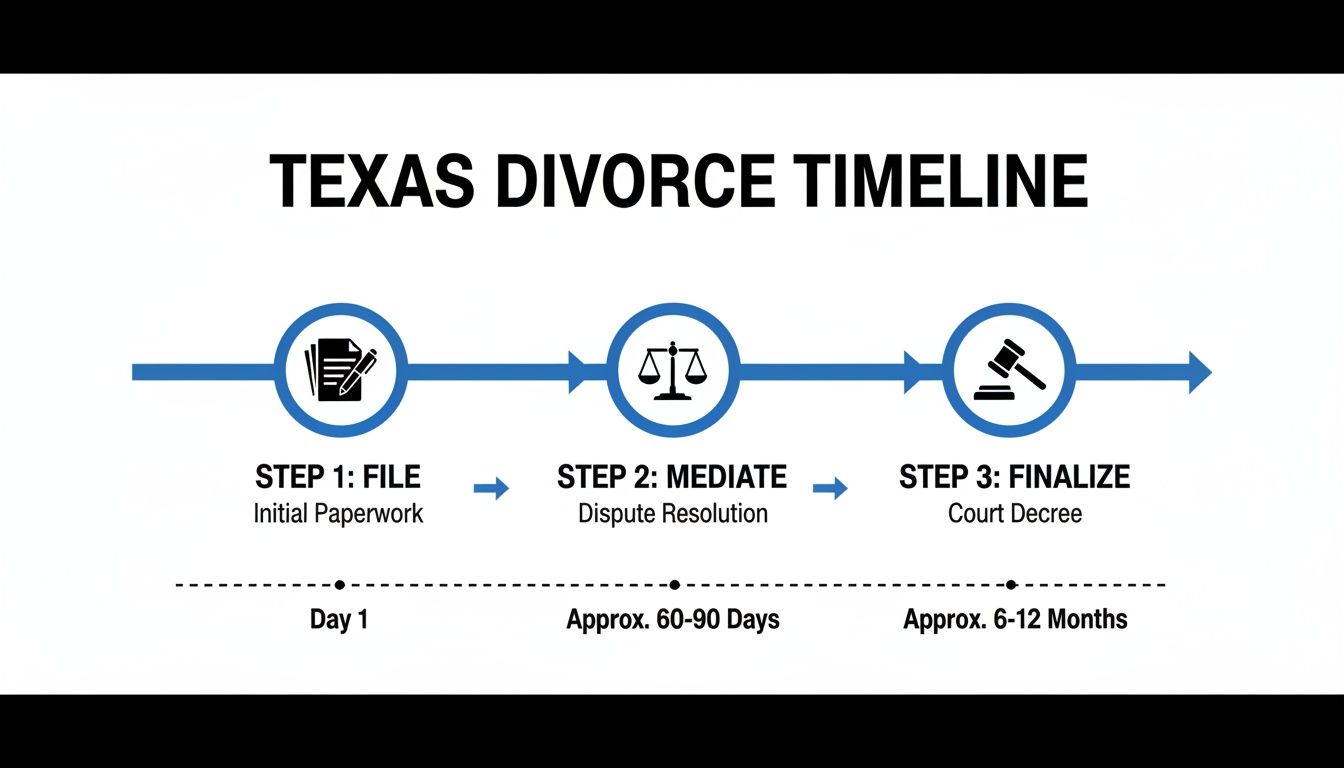
Notice that while there's a mandatory 60-day waiting period, the real work happens in stages. Mediation is often where cases are resolved efficiently and with less conflict, providing a solution-focused outcome.
Key Takeaway: What to Do Next
Here is your practical, step-by-step plan to move forward with confidence.
1. Get Your Paperwork in Order: Walking into a consultation prepared is a game-changer. It allows an attorney to give you concrete advice from the start. Start gathering:
- Your Leave and Earning Statements (LES) for the last year.
- Any service records showing promotion history.
- Recent financial statements from all accounts (checking, savings, investments, debts).
- Your federal tax returns from the past three years.
2. Schedule Confidential Consultations: Now that you're organized, find that "military divorce lawyer near me" and set up a few confidential meetings. Speaking with at least two different attorneys with demonstrated experience in military cases is a wise move. You need to feel confident in their ability to lead the way.
3. Prepare for Your Meetings: Before you go, review the checklist of questions we covered earlier. An informed client is an empowered client. When you ask specific, targeted questions about the USFSPA, the SCRA, and military-specific parenting plans, you will quickly identify who truly has the expertise you need. This is how you make a decision you can trust.
You’ve done the hard work of educating yourself. You now have the tools to protect your rights and build your future with confidence. The most important step you can take now is the very first one.
You don't have to take that step alone. The compassionate, experienced attorneys at The Law Office of Bryan Fagan, PLLC understand what you're going through and are ready to stand by your side with professional and personal guidance. We invite you to schedule a free, no-obligation consultation to discuss your case with a team that knows Texas family law and the unique challenges of military life. Protect your family and your future by contacting us today at https://www.texasdivorcelawyer.us.


