Skip to content
When your life's work is on the line, the thought of dividing a business during a divorce can be overwhelming. Valuing a business in a Texas divorce isn't just about numbers; it's about a deep financial dive to determine its fair market value so that the community property portion is divided in a just and right manner. This is the cornerstone of protecting your legacy and securing your financial future.
Why a Business Valuation Is Your First Line of Defense
Facing a divorce when you own a business can feel like you're fighting a battle on two fronts: one for your family and one for your livelihood. In Texas, any business you started or grew during your marriage is presumed to be community property. Now, this doesn't mean you automatically lose half your company. What it does mean is that its value is on the table for division.
This is why a professional, accurate valuation isn't just a formality—it's a critical strategic tool that empowers you to negotiate with confidence.
Understanding Community Property in Texas
The Texas Family Code is built on a community property system. Simply put, this means most assets acquired by either spouse during the marriage belong to both of you. For a business owner, this concept extends beyond just profits and physical assets; it includes the increase in the business's value over the years of your marriage.
Here’s why getting this right is so important for you:
- Fair Division: You can't have a fair property division without an accurate value. It's that simple. You could end up overpaying your spouse in a buyout or giving up other assets that are worth far more than their actual share of the business.
- Strategic Negotiations: A credible valuation report from a financial expert gives you serious leverage in mediation and settlement talks. It shifts the conversation from emotional arguments to fact-based negotiations, putting you in a stronger position.
- Protecting Your Future: Ultimately, this entire process is about securing your financial stability after the divorce is final. A proper valuation is a foundational step in the broader strategy of how to protect assets during your divorce.
With divorce rates climbing, especially among older couples who have built significant assets, the scrutiny on business valuations has never been higher. It's a complex process, but you don't have to face it alone. Understanding the tax implications of major life changes, including divorce is also crucial, as these can have a major impact on your final settlement.
The Three Core Methods for Valuing a Business in Texas
Figuring out how your business will be valued during a divorce can feel intimidating, but it doesn't have to be. Just like a real estate appraiser uses different approaches to price a house, a forensic accountant uses specific, court-accepted methods to determine what your business is worth.
Getting a handle on these methods helps you understand the language the experts are speaking and, more importantly, advocate for a fair outcome for yourself. Let's break down the three main valuation methods so you can see which one makes the most sense for your situation.
The Asset Approach: What Does the Business Own?
Think of the Asset Approach as a detailed inventory. For a business, this method calculates its worth by tallying up all its assets—cash, equipment, real estate, inventory—and then subtracting all its liabilities, like loans and accounts payable.
This straightforward method is often the go-to for:
- Holding companies that exist primarily to own other assets, like real estate.
- Manufacturing businesses with significant investments in heavy machinery and physical plants.
- Situations where a business is no longer profitable, and its true value lies in liquidating what it owns.
While simple, this approach has a big blind spot: it often misses the most valuable part of a thriving business—its ability to generate future profits.
The Market Approach: What Are Similar Businesses Worth?
The Market Approach is a lot like checking "comps" before you sell your house. You look at what similar homes in your neighborhood have sold for recently to get a realistic asking price.
In a business valuation, an expert does the same thing, analyzing the sale prices of comparable businesses in your industry and region. This method works best when there's a healthy market of buyers and sellers, making it a great fit for businesses like:
- Restaurants or retail stores.
- Franchises.
- Medical or dental practices in a large metropolitan area.
The biggest challenge here is finding businesses that are truly comparable. A family-owned BBQ joint in Austin is a world away from a national chain restaurant, even if they both sell brisket. A skilled expert has to make careful, defensible adjustments to ensure the comparison is fair.
The Income Approach: What Will the Business Earn in the Future?
Many experts consider the Income Approach the most insightful because it focuses on the future, not just the past. It values your business based on its power to generate future income and cash flow.
Think of it like buying an investment property. You’re not just buying the bricks and mortar; you’re buying the stream of rental income it will produce for years to come.
This approach is highly favored for service-based businesses or companies with strong, predictable earnings. A forensic accountant will project future earnings and then discount them to a "present value." When it comes to this method, mastering cash flow projection is the foundational skill needed to paint an accurate picture of a business's future.
The ultimate goal in a Texas divorce is to determine the business's "Fair Market Value." This isn't a fire-sale price or an optimistic, pie-in-the-sky number. It's the price a willing buyer would pay a willing seller, with neither being under pressure to make a deal. Each of these three valuation methods is just a different path to estimating that all-important number.
To give you a clearer picture, here’s a breakdown of how these three valuation methods stack up against each other.
Comparing the Three Business Valuation Methods
This table breaks down the primary methods for valuing a business in a Texas divorce, showing what each measures and where it is most effectively applied.
| Valuation Method | What It Measures | Best For These Texas Businesses |
|---|---|---|
| Asset Approach | The net value of tangible and intangible assets minus liabilities. (Assets – Liabilities = Value) | Real estate holding companies, capital-intensive businesses (e.g., manufacturing), or businesses facing liquidation. |
| Market Approach | The value based on the selling price of similar, comparable businesses. (Compares to "comps" in the market) | Restaurants, retail shops, franchises, professional practices (medical, dental) in active markets. |
| Income Approach | The present value of the business's expected future earnings and cash flow. (Focuses on future profitability) | Service businesses, tech companies, and any business with a strong, consistent history of earnings. |
Each method provides a unique lens for viewing a business's value. The right one—or a combination—depends entirely on the nature of your specific business.
A divorce can introduce serious risks for a business owner, affecting not only its current operations but also its future growth and the personal legacy you've built.
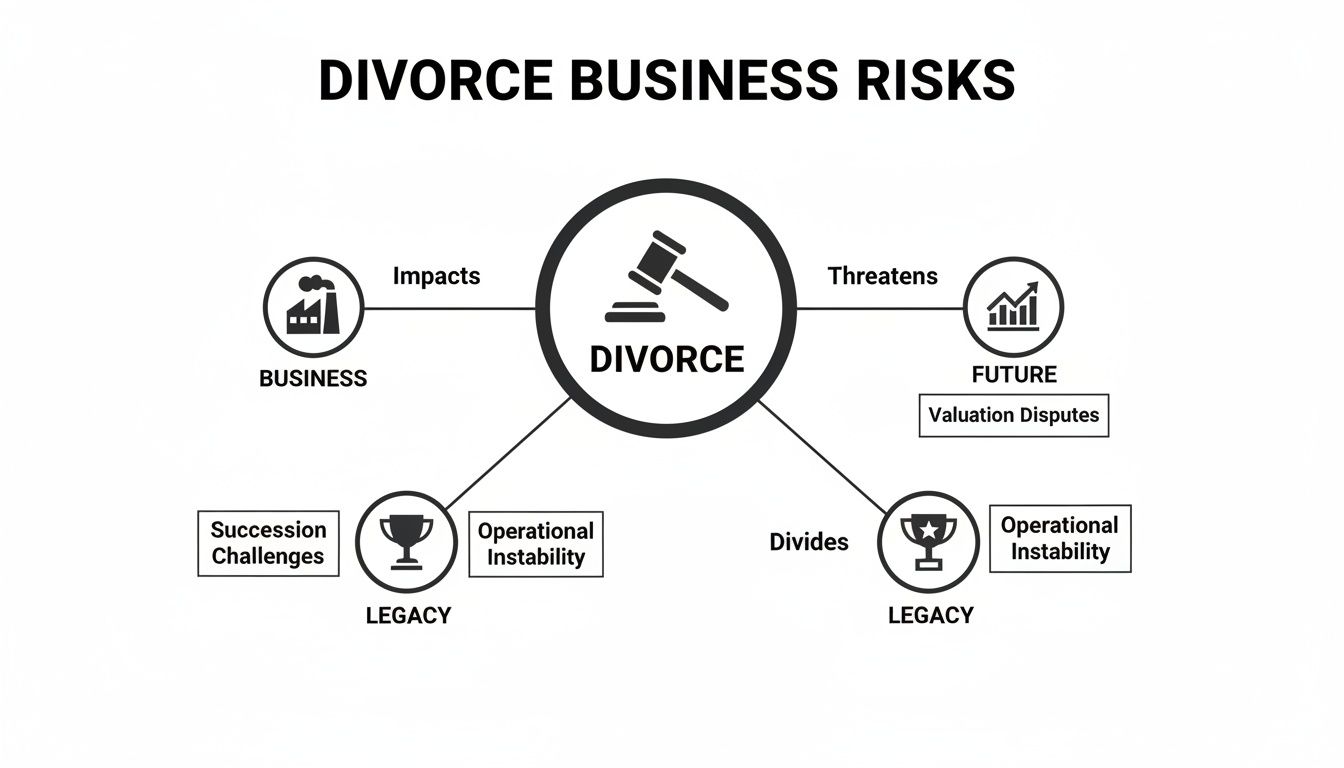
As you can see, the ripple effects of a divorce touch every part of your business, which is why a precise and fair valuation is so critical.
In practice, a good valuation expert rarely relies on just one method. More often, they will use two or even all three approaches to cross-check their findings. This creates a well-supported, defensible value that can stand up to scrutiny in negotiations or in court. The right blend depends on the unique facts of your business, your industry, and your specific circumstances.
Assembling Your Team and Financial Documents
Trying to navigate a business valuation during a divorce on your own is a recipe for disaster. Your success really boils down to two things: the expertise of the people you bring on board and the quality of the information you give them.

The process starts by building the right team and then arming them with the right documents. When you take these steps methodically, you don't just save time and money. You build credibility, which puts you in a much stronger position whether you're heading to mediation or a courtroom.
Choosing Your Financial Expert
Your family law attorney is the captain of your team, but a financial expert is your navigator through the complex waters of business valuation. You need a specialist who can dive into financial data, make sense of industry trends, and present their findings in a way a judge can understand. Simply asking your regular accountant to handle this is often a mistake; this is a highly specialized field.
You should look for a professional with specific credentials that show they know what they're doing, such as:
- Certified Valuation Analyst (CVA): An expert who is specifically trained and certified in the art and science of business valuation.
- Accredited in Business Valuation (ABV): This is a credential for CPAs who specialize in this niche area.
- Forensic Accountant: This is the person you want if you have any concerns about hidden assets or income. They are skilled at digging deep into financial records to uncover the complete, unvarnished truth.
When you hire an expert, you’re not just paying for a number. You’re paying for a defensible, credible analysis that can withstand intense scrutiny from the other side. This expert opinion becomes the factual bedrock for every negotiation about your business.
Gathering the Essential Financial Documents
Once your expert is on board, their first move will be a deep dive into your company’s financial history. One of the most powerful things you can do to help your own case is to provide complete and organized records right from the start. It signals transparency and confidence, which can dramatically streamline the entire process.
Your attorney and valuation expert will need a comprehensive stack of documents. The core requirements almost always include:
- Business Tax Returns: At least five years of federal income tax returns for the business (e.g., Form 1120, 1120-S, 1065).
- Financial Statements: Five years of profit and loss statements, balance sheets, and cash flow statements.
- General Ledger: A detailed record of every single financial transaction over the past several years.
- Key Legal Documents: This includes your articles of incorporation, partnership agreements, shareholder agreements, and any buy-sell agreements.
- Loan Documents and Debt Schedules: A complete list of all business debts, loans, and liabilities.
- Payroll Records and Employee Information: Details about employee compensation, including your own salary and benefits.
This list might feel overwhelming, but it's a non-negotiable part of the process. For a wider view of what's often required in a divorce, you can check out our guide on the essential documents for filing for divorce in Texas.
By assembling a strong team and being diligent about your financial disclosures, you take control of the narrative. You’re no longer just reacting to demands; you are proactively building a case based on solid facts and expert analysis.
Navigating Common Valuation Challenges and Red Flags
Watching an expert pick apart the finances of a business you poured your life into can feel incredibly personal. Valuing a business is almost never a simple matter of punching numbers into a calculator; it’s loaded with complexities that can dramatically swing the final figure. You need to be ready for the common hurdles that pop up during this critical phase of your divorce.

The process often means digging much deeper than the numbers on the surface. A seasoned forensic accountant knows exactly where to look for everything from subtle accounting quirks to blatant attempts to manipulate the company's worth.
Goodwill: What Is It and Why Does It Matter?
One of the most fiercely debated concepts in a Texas divorce involving a business is goodwill. The easiest way to think about goodwill is as the value of your business's reputation—that intangible quality that keeps customers coming back, completely separate from your physical assets or inventory.
Texas courts draw a bright line between two types of goodwill:
- Enterprise Goodwill: This belongs to the business itself. It’s tied to the company’s brand name, prime location, or established operational systems. This type of goodwill is a divisible community asset.
- Personal Goodwill: This is attached directly to you as the owner—your unique skills, personal reputation, and client relationships. Under Texas law, personal goodwill is typically considered your separate property and is not divisible in a divorce.
For professionals like doctors, lawyers, or specialized consultants, a huge chunk of their practice’s value might be personal goodwill. A sharp valuation expert has to carefully separate the two. Getting this wrong could mean your spouse walks away with a piece of your future earning capacity, which is not what the law intends.
Uncovering Hidden Value Through Add-Backs
It’s an unfortunate reality, but some business owners may try to make a business's value look lower during a divorce by running personal errands on the company dime or conveniently delaying major client invoices. A forensic accountant is trained to spot these discrepancies.
The process of "normalization" or creating "add-backs" is all about painting a true, realistic picture of the business's profitability. An expert will comb through the financial statements and adjust for any personal expenses run through the business, revealing its actual cash flow and value.
Some of the most common add-backs include:
- Personal Vehicle Expenses: Car payments, gas, and insurance for a family car being paid by the business.
- Excessive Owner Salaries: An owner paying themselves a salary far above the market rate for a similar job.
- Family Member Salaries: Paying a child or relative who does little to no real work for the company.
- Personal Travel and Entertainment: Disguising family vacations or personal meals as "business trips" or "client dinners."
By adding these expenses back to the company’s bottom line, the expert gives the court a much more accurate valuation, ensuring a fair split based on the business’s true performance.
Critical Adjustments: Minority and Marketability Discounts
Not all business ownership is clean-cut. If you only own a piece of the business, your stake might be worth less per share than if you owned the whole thing. This is where discounts enter the picture.
A minority discount is an adjustment made because owning a minority interest (less than 50%) means you can’t call the shots. You can't control the company's big decisions, and that lack of control makes the shares less valuable to a potential buyer.
In the same vein, a marketability discount might be applied if the shares are hard to sell, which is often the case with privately held family businesses. These adjustments are complex but absolutely essential for landing on a fair market value for your specific share of the company. Whether these discounts are applied can significantly change the final number assigned to your portion of the business in the divorce.
In high-net-worth divorces, businesses often represent the largest marital asset. This reality demands specialized forensic accounting to capture intangible elements like goodwill, which can be valued at 20-40% of a professional practice's worth. With divorce rates on the rise, particularly among older entrepreneurs splitting empires built over decades, the scrutiny on these valuations has intensified. Discover more insights about navigating the financial maze of divorce from JGL Law.
Why the Valuation Date Is a Critical Strategic Decision
Timing is everything in a divorce, especially when a business is on the table. The specific date chosen for a business valuation can add or subtract huge sums from the marital estate. What seems like a minor detail can quickly become a major point of contention.
This isn’t about just picking a day on the calendar. It’s a strategic decision that can dramatically shape your financial future.
Texas law is surprisingly flexible here. There's no single, mandated date for valuing a business. Courts often lean toward a date "at or near the time of trial," but that’s not set in stone. Your attorney can argue for a different date if it leads to a more "just and right" division of the property, which opens the door for serious negotiation.
Two Key Dates and Their Impact
The two most common valuation dates you’ll hear about are the date of separation and the date of trial. The gap between these two can be months, sometimes years—a period where a business's value can either skyrocket or plummet. Deciding which date to push for is one of the first tactical decisions you and your attorney will need to make.
Here’s why it matters so much:
- Date of Separation: This can be a huge advantage if your solo efforts after the split caused the business to grow. The argument is simple: any increase in value after separation is your separate property, created by your labor alone, and shouldn't be divided.
- Date of Trial: This is often seen as the default. It captures every change in the business's value right up to the very end of the divorce. This can feel fairer in cases where both spouses' efforts before the split contributed to ongoing growth.
The Strategic Arguments Behind Each Date
Let's play this out. Imagine you own a tech startup. You and your spouse separate. Six months later, you land a massive contract that instantly doubles the company's value. If the valuation is set at the date of separation, that huge bump in value is arguably yours alone. But if it's valued at the date of trial, that new value gets tossed into the marital pot to be divided.
Now, flip the scenario. What if an economic downturn hammers your business after the separation? A valuation closer to the trial date would reflect that lower, more current value, which could work in your favor.
The bottom line is that the valuation date can alter the final number by tens or even hundreds of thousands of dollars. Service businesses in Texas, for example, often push for an earlier separation date to wall off one spouse's post-split solo contributions from the marital estate—a critical nuance in high-asset cases. You can learn more about the key insights for family law from Towne Advisory.
The valuation date is not just an administrative detail—it is a battleground where significant financial gains and losses are determined. An experienced attorney knows how to build a compelling case for the date that best protects your interests and aligns with Texas law's goal of a "just and right" division.
Your Strategic Path Forward
Knowing how a business is valued in a divorce is one thing, but turning that knowledge into action is what truly protects you. The process can feel overwhelming, but your path forward can be broken down into clear, manageable steps. Getting ahead of this with a proactive plan is your best defense against an unfair outcome and the surest way to protect the business you’ve worked so hard to build.
Making informed decisions right now is the key. It’s about taking control of the process instead of letting it control you.
What to Do Next
To shift from a position of uncertainty to one of strength, focus on these critical actions right away. Each one builds on the last, creating a solid foundation for your case and putting you in a position to negotiate from a place of confidence.
- Gather Key Documents Now: Don’t wait to be asked. Start pulling together the essential financial records today, including at least five years of tax returns, profit and loss statements, balance sheets, and any shareholder agreements. Having this organized and ready will speed up the valuation process, save you money on expert fees, and show that you are being transparent.
- Understand Your Legal Rights: Before you make any moves, you need a clear picture of how Texas community property laws apply to your specific situation. Every business and every marriage is different. A confidential consultation with an experienced family law attorney will clarify your rights and lay out the potential paths forward.
- Identify a Valuation Expert: The credibility of your business valuation depends entirely on the expert who performs it. Your attorney can help you find a qualified professional, like a Certified Valuation Analyst (CVA) or a forensic accountant, whose experience matches your industry and the unique complexities of your business.
The journey through a high-asset divorce involving a business requires careful navigation and expert guidance. By understanding the valuation process, you can better advocate for your interests and work toward a settlement that is both just and right. For a deeper look into the specific legal strategies involved, you can learn more about protecting business assets in high-net-worth Texas divorces in our detailed guide.
Your business is more than just an asset on a balance sheet; it's a testament to your hard work and vision. We invite you to schedule a free, confidential consultation with our experienced Texas family law attorneys. Together, we can create a strategy that safeguards your legacy and secures your financial future.
Frequently Asked Questions About Business Valuation and Divorce
When you own a business, the thought of divorce brings a wave of uncertainty. You likely have many questions about the future of what you’ve built. Let's clear up some of the most common concerns Texas business owners have when facing divorce.
Does My Spouse Automatically Get Half of My Business in a Texas Divorce?
Not necessarily. People often assume Texas is a strict 50/50 state, but the law actually calls for a "just and right" division of community property. While that might end up being half, it's not a hard-and-fast rule.
More importantly, only the value of the business created during the marriage is on the table. The goal is rarely to slice the company in half and give your spouse a key. Instead, the focus is on dividing its value. This usually happens in one of three ways:
- You buy out your spouse’s interest in the business.
- You trade other assets—like equity in the home or a retirement account—to offset their share.
- In very rare situations, the business is sold and the profits are divided.
What Happens If I Started My Business Before We Got Married?
This is a critical point. If you were the founder before the wedding, the original business is considered your separate property. But that doesn't mean it's completely protected. Any growth in the business's value that happened during the marriage is typically considered community property.
Think of it like a tree you planted. You owned the sapling (separate property), but the fruit it produced over the years belongs to the community.
This is exactly why you need a forensic accountant. They perform a detailed "tracing" analysis to untangle the separate property roots from the community property growth. It’s a complex but essential process to protect what was yours from the start.
Should My Spouse and I Use the Same Valuation Expert?
Using a single, neutral expert can be the smartest move you make. It's often faster, cheaper, and takes a lot of the conflict out of the equation. When you both agree to trust one professional, you get an objective number that can pave the way for a quicker settlement.
But this only works if there's a foundation of trust. If your business is highly complex, if you have any reason to believe assets are being hidden, or if the divorce is just too hostile, then you'll each need to hire your own expert. From there, the attorneys will either negotiate to find a middle ground between the two valuations or prepare to argue their expert's findings in court.
How Can I Protect My Business If I Know a Divorce Is Coming?
The best defense is a good offense. Start getting your financial house in order now. Make sure your bookkeeping is spotless, current, and transparent. The last thing you want is to look like you're hiding something.
Avoid any sudden or unusual financial moves. Don't take on massive debt, sell off major assets, or give yourself a huge, uncharacteristic bonus. A judge will see right through that.
Most importantly, talk to a lawyer early. A seasoned family law attorney can look at any prenuptial or postnuptial agreements you have and help you build a solid game plan long before a divorce petition is ever filed.
Protecting the business you've worked so hard to build requires a smart strategy and the right team. At The Law Office of Bryan Fagan, PLLC, we’ve guided countless Texas business owners through the complexities of property division. We understand what's at stake for you and your family.
Schedule a free, confidential consultation with us today to start building a plan that protects your legacy and secures your financial future. Contact us now.