Skip to content
Figuring out how to raise your children in two separate homes can feel like the biggest challenge of all. In Texas, you'll often hear about two main approaches: co-parenting, a collaborative model where you work together, and parallel parenting, a structured, disengaged approach designed for high-conflict situations. The goal of parallel parenting is simple but crucial: to protect your children from parental disputes. Ultimately, your ability to communicate and cooperate with your ex-spouse will be the deciding factor in which path is right for your family.
Navigating Parenthood After a Texas Divorce
When you're going through a divorce, your number one priority is protecting your kids from the emotional fallout. The way you and your ex choose to parent moving forward will be one of the most significant factors in their long-term well-being.
Texas law recognizes this, always prioritizing the "best interest of the child" in any custody decision. This isn't just a suggestion; it's a legal standard written into the Texas Family Code § 153.002. This section of the law guides every decision a judge makes about where your children will live and how you will make decisions for them.
This guide is here to help you understand the two main parenting models used after a Texas divorce so you can make informed decisions. We'll break down the key differences, how Texas courts view each approach, and what it really means for your family on a day-to-day basis.

Comparing the Two Parenting Models
Getting a handle on the fundamental differences is the first step toward creating a stable, predictable environment for your children. For many families trying to find their footing post-divorce, seeking outside support through virtual family therapy options can be an invaluable step toward healing and learning to communicate more effectively.
Let's look at how these two models stack up in the real world.
| Feature | Co-Parenting | Parallel Parenting |
|---|---|---|
| Communication | Frequent, open, and collaborative. You might text, call, or talk in person about issues as they come up. | Minimal and structured. Communication is strictly business-like, written, and often required to go through a court-ordered app. |
| Decision-Making | Joint and cooperative. You consult each other on everything from major medical decisions to smaller things like haircuts or extracurriculars. | Independent. You each make day-to-day decisions on your own time. Major decisions may require notification but not necessarily agreement. |
| Flexibility | High. Schedules can be shifted with a simple conversation to accommodate a special event, vacation, or your child's needs. | Low. Schedules are rigid and spelled out in detail in the court order to minimize interaction and potential arguments. |
| Conflict Level | Low to minimal. You have found a way to resolve disagreements respectfully, keeping the kids out of the middle. | High and consistent. This model is specifically for parents who simply cannot communicate without it turning into a significant dispute. |
At the end of the day, co-parenting is the gold standard that Texas courts prefer when parents can maintain a respectful, amicable relationship. But that's not always possible. When constant conflict makes working together impossible, parallel parenting serves as a crucial legal tool. It builds boundaries that allow you both to stay involved in your child's life while shielding the child from harmful, ongoing arguments.
Understanding Co-Parenting: The Collaborative Model
When your marriage ends, the family structure changes, but your core goal of raising happy, secure children doesn't. Co-parenting is the approach that makes this happen when you and your ex can still function as a respectful team. Think of it as a collaborative model built on open communication, mutual respect, and a shared commitment to putting your kids first.
This isn't just about sticking to a possession schedule; it's a completely different mindset. It means you're still a unified parenting team, making joint decisions about your children's lives—both big and small—even though you live in separate homes.

How Co-Parenting Works in Real Life
In a healthy co-parenting relationship, information flows freely, and you make decisions together. For instance, if your child is struggling in math, you might both attend the parent-teacher conference. Afterward, you’d discuss the teacher's feedback and agree on a plan, like hiring a tutor. When it's time to choose a summer camp, you talk through the options, costs, and schedules before deciding.
This approach demands flexibility. If your ex has a last-minute work trip, you’re willing to swap weekends without an argument because you trust they’d do the same for you. This spirit of cooperation is the heart of co-parenting. For more practical strategies, you can explore our guide on the dynamics of effective communication and collaboration post-divorce.
Aligning With Texas Law and Child Well-Being
The Texas Family Code strongly prefers arrangements that give children "frequent and continuing contact" with both parents, provided those parents can act in the child's best interest. Co-parenting fits this legal standard perfectly by creating a stable and supportive environment.
The benefits for a child's emotional stability are profound. When children see their parents cooperating, it significantly reduces the loyalty binds, stress, and anxiety that often accompany a divorce. Presenting a united front shows them they are more important than any lingering conflict.
Research consistently backs this up. A systematic review of multiple studies found that children in shared custody arrangements where parents cooperate generally have better outcomes across nearly every metric, from academic achievement to emotional health. These benefits held true even after accounting for parental conflict and family income.
To keep things organized, using a complete guide to co-parenting calendars can be invaluable. This approach requires effort, but the payoff for your children is immeasurable. When done right, co-parenting allows your kids to feel loved and supported by a cohesive team, giving them the security they need to thrive.
Defining Parallel Parenting: A Strategy for High-Conflict Situations
When the emotional dust from a divorce just won't settle, and every conversation with your ex feels like walking through a minefield, "co-parenting" can feel like an impossible fantasy. If your post-divorce reality is defined by constant arguments, hostility, and an inability to find common ground, parallel parenting offers a structured, court-supported alternative designed to shield your children from the crossfire. It's a disengaged model that essentially builds a firewall between you and the other parent to stop the conflict.
Think of it less as teamwork and more as two separate businesses operating with the same end goal: raising a healthy, happy child. You don't coordinate on daily issues. Instead, you each operate independently when your child is in your care, following a highly detailed and rigid parenting plan ordered by a Texas court.

Core Components of a Parallel Parenting Plan
A Texas judge will craft a parallel parenting plan to be as specific as humanly possible, leaving zero room for interpretation or negotiation that could spark another fight. The entire objective is to eliminate the daily friction that exposes your child to stress.
Key elements often include:
- Structured Communication: All non-emergency communication is strictly limited to written, business-like exchanges. A judge will often order parents to use a secure co-parenting app like OurFamilyWizard, which logs every message and prevents them from being altered or deleted. No more heated phone calls or angry texts.
- Rigid Schedules: The possession schedule is set in stone. Pickups and drop-offs happen at exact times and frequently at neutral, public locations like your child’s school or even a local police station to avoid direct contact and the potential for conflict at home.
- Independent Decision-Making: For day-to-day matters, you each have full authority when the child is with you. You decide on meals, homework routines, and daily activities in your household without needing to check in with the other parent.
This isn't to say you never have to communicate. Per your custody order, you will still need to confer on major decisions like school enrollment or significant medical procedures. Parallel parenting just ensures these essential discussions happen in a controlled, low-conflict environment.
When Texas Courts Order Parallel Parenting
A judge’s primary duty is always to protect your child's well-being. When the evidence shows that you and the other parent are simply incapable of communicating civilly, a court will step in to impose the strict boundaries of parallel parenting.
This model is specifically for high-conflict families where ongoing disputes threaten the child's emotional and psychological stability. It creates distance not to punish you, but to give your child a much-needed break from the tension.
Family research backs this up, confirming that chronic conflict between parents—marked by hostile exchanges and inconsistent rules—is a significant predictor of adolescent maladjustment. Studies show that a parallel parenting approach can effectively reduce a child's exposure to this damaging acrimony by minimizing parental contact and implementing a strictly scripted schedule.
Situations where a Texas judge might order this include:
- A documented history of verbal or emotional abuse.
- A complete and total breakdown of civil communication.
- Repeated failures to follow a less structured co-parenting plan.
- One parent consistently undermining the other's authority in front of the child.
Parallel parenting is not a life sentence. If, over time, the conflict subsides and you and the other parent can learn to communicate more effectively, you can petition the court to modify the order to a more collaborative, co-parenting arrangement. For now, it serves as a critical tool to ensure your child can have a meaningful relationship with both of you—without being caught in the middle of a war.
Comparing Parenting Models: A Side-by-Side Analysis
Deciding between co-parenting and parallel parenting isn't so much a choice as it is a reaction to your family's current emotional reality. To really figure out which model fits, you have to look past the textbook definitions and see how they actually play out day-to-day. This side-by-side analysis will break down the practical differences so you can see what each approach truly looks like.
Getting these distinctions right is vital, whether you're heading into a mediation session or preparing for a courtroom battle. The details written into your parenting plan will dictate your life for years, making clarity non-negotiable right now.
Communication Style: The Foundation of Your Interaction
The single biggest difference between co-parenting and parallel parenting is how you and the other parent communicate—or, in some cases, how you don't. This one element sets the tone for everything else in your post-divorce parenting world.
In a co-parenting relationship, communication is open, frequent, and collaborative. You might text about a last-minute change to soccer practice or hop on a quick call to talk about a note from a teacher. The idea is to share information freely and operate like partners with a common goal: raising a happy kid.
On the flip side, parallel parenting demands minimal and highly structured communication. Spontaneous, direct contact is cut out entirely to remove any chance for conflict to ignite. All non-emergency communication is typically required by the court to be in writing through a secure platform like OurFamilyWizard, which keeps the tone factual and business-like.
Decision-Making Authority: Who Calls the Shots?
How you make choices about your child's life is another massive dividing line. In Texas, the law makes a clear distinction between everyday decisions and major, long-term ones.
- Co-Parenting: This approach is all about joint decision-making. You consult each other on everything from medical care and school choices to smaller things like haircuts or sleepovers. It’s a philosophy built on teamwork and shared authority.
- Parallel Parenting: Here, day-to-day decisions are made independently by whoever has the child. If your child is with you, you're the one in charge of routine matters. Major decisions about health or education still legally require both parents' input, but the conversation happens through those strict, court-ordered channels. In some high-conflict cases, a judge will give one parent the exclusive right to make certain decisions just to prevent a permanent stalemate.
Schedule Flexibility: Predictability vs. Adaptability
Your child's possession schedule can be a source of stability or a constant battlefield. Each parenting model handles flexibility in completely different ways, and it directly shapes your family’s rhythm.
A co-parenting plan is usually quite adaptable. If a special family event pops up, you can agree to swap weekends with a simple conversation. The schedule acts as a guideline, but you both have the trust and communication skills to adjust it when it’s in the child's best interest.
A parallel parenting plan is rigid and non-negotiable by design. The possession schedule laid out in your Texas court order is meant to be followed to the letter. This inflexibility is a feature, not a bug—it eliminates arguments by removing the need to negotiate in the first place.
The core purpose of a rigid schedule in parallel parenting is to create predictability and reduce a child's anxiety. When children know exactly what to expect, they feel more secure, even in a high-conflict family dynamic.
Co-Parenting vs. Parallel Parenting: A Practical Comparison
To make these differences crystal clear, let's lay them out in a simple table. This chart breaks down the fundamental distinctions across the most critical areas of parenting after a divorce in Texas.
| Feature | Co-Parenting (Low-Conflict) | Parallel Parenting (High-Conflict) |
|---|---|---|
| Communication Style | Collaborative, frequent, and flexible. You may use phone, text, or in-person conversations. | Minimal, structured, and business-like. Mandated through court-ordered apps (e.g., OurFamilyWizard). |
| Decision-Making | Joint and cooperative. You consult on both major and minor issues affecting the child. | Independent on day-to-day matters. Major decisions require formal, written communication as per court order. |
| Schedule Flexibility | High. You can mutually agree to adjust the possession schedule for special events or needs. | Low to none. The court-ordered schedule is strictly followed to minimize contact and prevent disputes. |
| Conflict Resolution | You resolve disagreements directly through respectful discussion, compromise, or mediation. | Disagreements are handled via the court-ordered process, often involving a Parenting Coordinator or returning to court. |
| Parental Interaction | You may attend school events, extracurriculars, or doctor's appointments together. | You attend events separately and avoid direct interaction. Exchanges occur at neutral locations. |
At the end of the day, a Texas court will favor the model that serves the "best interest of the child." If you and your ex can genuinely work together, co-parenting is the gold standard. But if the constant conflict is hurting your child, parallel parenting provides the necessary guardrails to protect their peace of mind.
How Texas Courts Determine the Best Interest of the Child
When you walk into a Texas family courtroom for a custody case, every single decision a judge makes boils down to one guiding principle: the best interest of the child. This isn't just a vague concept; it's the law, spelled out in Texas Family Code § 153.002. It is the ultimate standard against which every argument, piece of evidence, and parenting plan is judged.
Frankly, your personal feelings about your ex-spouse don't carry much weight. The court’s primary focus is on one thing: creating a safe, stable, and nurturing environment for your child, free from the toxic stress of parental conflict. This is why a judge will almost always lean toward a possession order that encourages collaborative co-parenting if you and the other parent can handle it.
But if the evidence shows that ongoing disputes are harming your child, a judge won't hesitate to enforce the strict, disengaged boundaries of parallel parenting to act as a buffer.
Understanding the Holley Factors
So, how does a judge determine what's truly in a child's best interest? They use a set of criteria known as the "Holley Factors." Think of these not as a simple checklist but as a comprehensive framework that helps a judge look at the complete picture of your family's unique situation.
A judge will evaluate several key factors, including:
- Emotional & Physical Needs: The court will look at your child's immediate and future needs, from emotional support and stability to their physical safety and overall well-being.
- Parental Abilities: This involves a hard look at each of your capacities to provide a stable home, offer sound guidance, and give consistent care.
- Stability of the Home: The court examines the stability and security of each parent's proposed home environment. Is it a safe place for a child to thrive?
- Child’s Wishes: For children aged 12 or older, the judge may interview them privately in chambers to hear their preferences. It’s important to know this isn't the sole deciding factor, but it is given serious consideration.
- Any Danger to the Child: The court will meticulously examine any evidence of physical or emotional danger to the child, both now and in the future.
The ultimate goal is to craft a parenting plan that fosters a positive parent-child relationship while shielding the child from any potential harm.
This decision tree shows how the level of parental conflict often points the court toward one parenting model or the other.
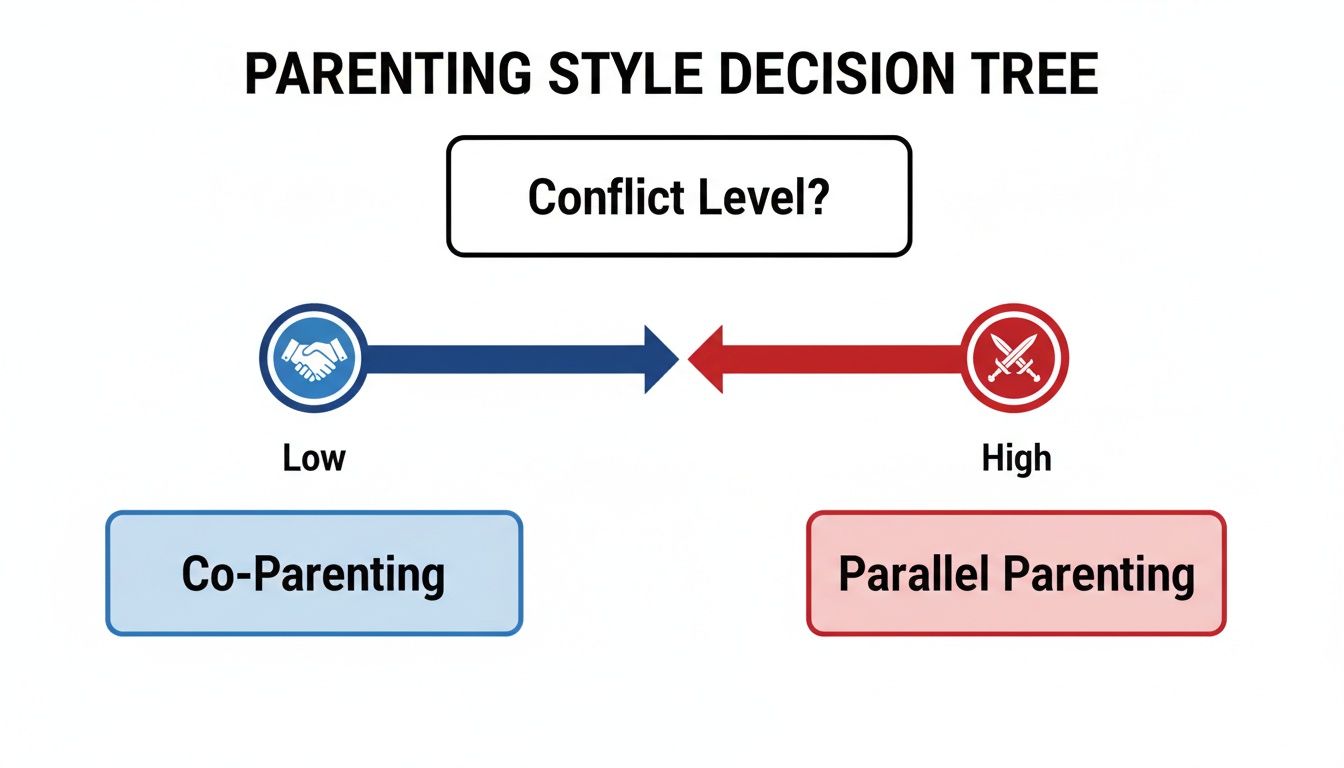
The visual makes it pretty clear: when conflict is low, cooperation is possible, making co-parenting the natural fit. When conflict is high, the court will prioritize protection and structure, which almost always leads to a parallel parenting order.
The Role of Court Professionals
Judges don't make these critical decisions in a vacuum. They often rely on trained, neutral professionals to gather unbiased information and provide expert recommendations.
In high-conflict cases, an amicus attorney is often appointed to represent your child’s best interests directly to the court. This attorney essentially acts as the "eyes and ears" of the judge, interviewing you, the other parent, the child, teachers, and anyone else necessary to get a clear, unbiased view of the situation.
A judge might also order a custody evaluation, where a psychologist or licensed professional conducts a deep-dive investigation into the family dynamics. This process is intensive, involving interviews, psychological testing, and home visits to provide the court with a thorough report and recommendation. Mediation is also a required step in most Texas custody cases, giving you a chance to reach an agreement before a judge has to decide for you.
For a deeper dive into this legal standard, you can learn more about the guiding principles for custody decisions in Texas.
Key Takeaway
A Texas court's decision on parallel parenting vs. co-parenting will always come back to the Holley Factors and the level of conflict between you and the other parent. The most effective way to make your case is to present clear, compelling evidence that your proposed plan genuinely serves your child’s emotional and physical well-being.
What to Do Next to Protect Your Children and Your Rights
It can be a tough pill to swallow when you realize the dream of a friendly, collaborative co-parenting relationship just isn't in the cards. But getting clear on the difference between co-parenting and parallel parenting is the first, most crucial step toward building the stable, low-conflict home life your children need to thrive. While co-parenting is always the goal after an amicable split, parallel parenting is a powerful legal strategy designed specifically to shield children from the fallout of high-conflict situations.
The path forward isn't about rehashing old arguments. It's about building a clear, strategic case that puts your child's best interests front and center.
Your Action Plan for Moving Forward
Protecting your kids and your parental rights begins right now, with careful preparation. While your attorney will be your guide, taking these initial steps will build the solid foundation you need for a successful outcome.
- Step 1: Document Everything Meticulously: Start a detailed log of every single interaction you have with your ex. This means saving every text message, email, and communication through parenting apps. Note the date, time, and what was discussed, but keep it strictly factual. Emotions don't belong here; this log is potential evidence for court.
- Step 2: Gather Evidence of Conflict (or Cooperation): Your communication log is a huge part of this, but you should also collect any other proof that shows the level of conflict. This could be anything from police reports and messages showing a refusal to follow the court order to, on the flip side, proof that you have consistently tried to cooperate.
- Step 3: Understand Your Texas Possession Order: Pull out your current or proposed possession order and read it until you know it by heart. You need to be crystal clear on your exact rights and responsibilities for pickup times, holiday schedules, and who has the authority to make certain decisions. Knowing the rules inside and out prevents you from making accidental mistakes and empowers you to enforce your rights.
You can get a better handle on creating an effective plan by reviewing the best practices for parenting plans and co-parenting agreements in Texas. Having this knowledge allows you to advocate for the specific terms that will truly protect your child.
The single most important thing you can do right now is get expert legal guidance. Trying to navigate a high-conflict custody case on your own can put your child’s stability and your own parental rights at serious risk.
An experienced Texas family law attorney can look at the specifics of your situation, explain how a judge is likely to interpret your case under the Texas Family Code, and help you build a precise, enforceable parenting plan. Whether that means fighting for a collaborative co-parenting agreement or putting the protective boundaries of a parallel parenting order in place, we are here to create a strategy that puts your child's well-being first.
Your family’s future peace of mind is far too important to leave to chance. We invite you to schedule a free, confidential consultation with the experienced attorneys at The Law Office of Bryan Fagan, PLLC. Let us help you take the right next steps to protect what matters most.
Frequently Asked Questions
When you're trying to figure out a Texas custody order, it's easy to get lost in the details. Let's clear up some of the most common questions you might have about putting a co-parenting or parallel parenting plan into action.
Can We Switch From Parallel Parenting to Co-Parenting Later?
Absolutely, and in many cases, that's the ultimate goal. If the intense conflict that made parallel parenting necessary starts to fade over time, you can ask the court to modify your custody order. In Texas, a judge will almost always sign off on a modification if you both agree it’s what’s best for your child.
To make that happen, you'll need to show the court that there has been a significant and positive change in your circumstances. This usually means proving you've established a history of improved, business-like communication and have successfully lowered the temperature on your disagreements. A judge might even suggest co-parenting classes or a new round of mediation to help you formalize the new, more cooperative arrangement.
What Specific Language Should My Parallel Parenting Order Include?
A rock-solid parallel parenting order lives and dies by its details. The more specific you are, the better, because vague language is just an invitation for conflict.
Your order needs to spell everything out, including things like:
- Mandated Communication: Name a single, secure online platform (like OurFamilyWizard) for all non-emergency communication. The order should also include penalties for trying to communicate through other channels.
- Airtight Possession Schedule: Lock down the exact exchange times, neutral drop-off/pick-up spots (like your child's school or a supervised center), and a clear holiday schedule that leaves no room for debate.
- Dispute Resolution Method: Create a clear process for handling big disagreements. Appointing a Parenting Coordinator or Parenting Facilitator to act as a tie-breaker is a smart move that keeps you from having to run back to court for every single issue.
The idea is to build a comprehensive rulebook that cuts down on the need for direct, and potentially explosive, negotiations between you and the other parent.
Does Parallel Parenting Mean We Never Communicate?
Not at all, but it completely changes how you communicate. Parallel parenting is designed to put a stop to destructive, emotional fights, not to eliminate necessary conversations about your child. You are still legally obligated to discuss major decisions outlined in your order, like non-emergency medical procedures or changing schools.
The key difference is that these conversations must be strictly factual, business-like, and happen only through the court-ordered channels. All the emotion gets stripped away, leaving just the essential information needed to make a sound decision for your child.
Your family’s peace of mind is too important to leave to chance. At The Law Office of Bryan Fagan, PLLC, our experienced attorneys are here to help you build a parenting plan that protects your children and your rights.
Schedule Your Free Consultation today to discuss your case and find the right path forward.