Skip to content
Staring down the barrel of a divorce, the financial unknowns can feel overwhelming. You're probably asking yourself, "how much spousal support can I expect in Texas?" Thankfully, the answer isn’t just a vague "it depends." Texas law provides a clear, concrete starting point to help you plan your next steps.
Court-ordered support is capped at the lesser of $5,000 per month or 20% of the paying spouse's average monthly gross income. This isn't a suggestion or a guideline; it's a firm legal ceiling that gives you a realistic financial baseline.
Understanding the Hard Limits on Texas Spousal Support
When it comes to the financial side of your Texas divorce, a judge doesn’t just pull numbers out of thin air. They must operate within strict boundaries set by the Texas Family Code. This structure is designed to provide necessary, temporary support to help you get back on your feet—not to create a new, permanent income stream.
At the heart of this system is a statutory cap on what's officially called "spousal maintenance." This cap is a straightforward, two-part rule that sets the absolute maximum amount a judge can order one spouse to pay the other.
The Two-Pronged Cap Explained
The rule is simple: the maximum monthly payment is the lesser of these two amounts:
- $5,000 per month: This is a fixed dollar amount that acts as a hard ceiling, no matter how high your spouse's income might be.
- 20% of the paying spouse's average monthly gross income: This is a percentage-based calculation that scales with the payer's earnings.
A judge will calculate both of these figures and is legally required to order the lower of the two. For example, if your spouse brings in a gross monthly income of $30,000, the 20% calculation comes out to $6,000. But since the law requires the court to choose the lesser amount, the highest possible support order would be capped at $5,000 per month. To learn more about how this works in practice, you can find more insights about Texas spousal support calculations and statutory limits.
The purpose of these caps is to keep support orders reasonable. They ensure the paying spouse isn't crushed by an excessive burden while still providing meaningful assistance to you during your transition.
To see how these caps play out in different financial situations, let's look at a simple table that breaks it down.
Texas Spousal Maintenance Caps at a Glance
This table shows how the statutory cap works based on the paying spouse's income, making it clear whether the $5,000 or 20% limit will apply.
| Paying Spouse's Monthly Gross Income | 20% of Gross Income | Statutory Cap ($5,000) | Maximum Possible Monthly Support Order |
|---|---|---|---|
| $10,000 | $2,000 | $5,000 | $2,000 |
| $15,000 | $3,000 | $5,000 | $3,000 |
| $25,000 | $5,000 | $5,000 | $5,000 |
| $40,000 | $8,000 | $5,000 | $5,000 |
| $60,000 | $12,000 | $5,000 | $5,000 |
As you can see, once the paying spouse's income hits $25,000 per month, the flat $5,000 cap kicks in and becomes the maximum possible award, no matter how much higher their income goes.
Seeing the Cap in Action
Let's break this down with a couple of real-world scenarios. The cap that applies depends entirely on your spouse's income.
- Scenario 1: Lower to Mid-Range Income: Your spouse earns $10,000 in gross monthly income. 20% of that is $2,000. Since $2,000 is less than $5,000, the maximum possible support award is $2,000 per month.
- Scenario 2: Higher Income: Now, let's say your spouse earns $40,000 in gross monthly income. 20% of that is $8,000. In this case, the $5,000 fixed cap is the lower amount, so the maximum possible award is $5,000 per month.
This cap is the first and most critical piece of the puzzle. But it's absolutely crucial to remember this is the maximum possible award. A judge is not required to order the max and could award less—or even nothing at all—based on other factors, which we'll get into next.
Do You Qualify for Spousal Maintenance in Texas?
Knowing the maximum payment amount is one thing, but figuring out if you even qualify is the real first step. The idea of starting over financially can be terrifying, but understanding where you stand legally is the best way to regain control of your future.
Here in Texas, spousal maintenance isn't a given in every divorce. Far from it. The law actually sets a high bar for who can receive it, treating it as a temporary safety net for spouses who genuinely can't support themselves. To even be considered, you first have to prove that after all the marital property is divided, you will still lack enough property to cover your “minimum reasonable needs.”
The First Hurdle: Meeting Your “Minimum Reasonable Needs”
So, what exactly does "minimum reasonable needs" mean? It’s not a hard and fast number. Instead, it’s a flexible standard that a judge looks at on a case-by-case basis. This isn't about maintaining the lifestyle you had during the marriage; it’s about covering your essential living expenses.
Think of it as your baseline survival budget:
- Housing and utilities
- Food and transportation
- Basic clothing and healthcare
A judge will scrutinize your monthly budget, the assets you're receiving from the divorce, and your ability to earn an income. If you can't cover these core expenses on your own, you've cleared the initial hurdle. But that's not the end of it—you also have to meet at least one more specific condition.
The Four Paths to Qualification
Once you’ve shown that you can’t meet your basic needs, the Texas Family Code says you must prove that one of the following situations applies to your marriage:
1. The 10-Year Marriage Rule
This is the most common path. You have to show two things:
- You were married for 10 years or longer.
- You've tried your best to earn enough money or get the skills you need to be self-sufficient, but you still fall short of meeting your minimum needs.
2. The Family Violence Exception
The 10-year requirement is waived if you were a victim of family violence. You can qualify for support if:
- Your spouse was convicted of (or received deferred adjudication for) an act of family violence against you or your child.
- The violent act happened within two years of filing for divorce or while the divorce was ongoing.
3. The Disability Exception
If you have an incapacitating physical or mental disability that keeps you from earning enough to support yourself, you may qualify regardless of how long you were married.
4. The Child's Disability Exception
Similarly, if you're the primary caregiver for a child of the marriage (of any age) who has a disability that requires substantial care and supervision, preventing you from working, you may be eligible.
Because Texas courts demand such specific proof, spousal maintenance is awarded far less often here than in many other states. This strict approach makes it absolutely critical to build a solid, evidence-based case.
A Texas judge starts with the assumption that spousal maintenance is not necessary. The burden of proof is entirely on you, the requesting spouse, to present clear and convincing evidence that you meet these tough legal requirements.
This decision tree breaks down the two main factors a court uses to determine the absolute maximum amount of spousal support allowed.
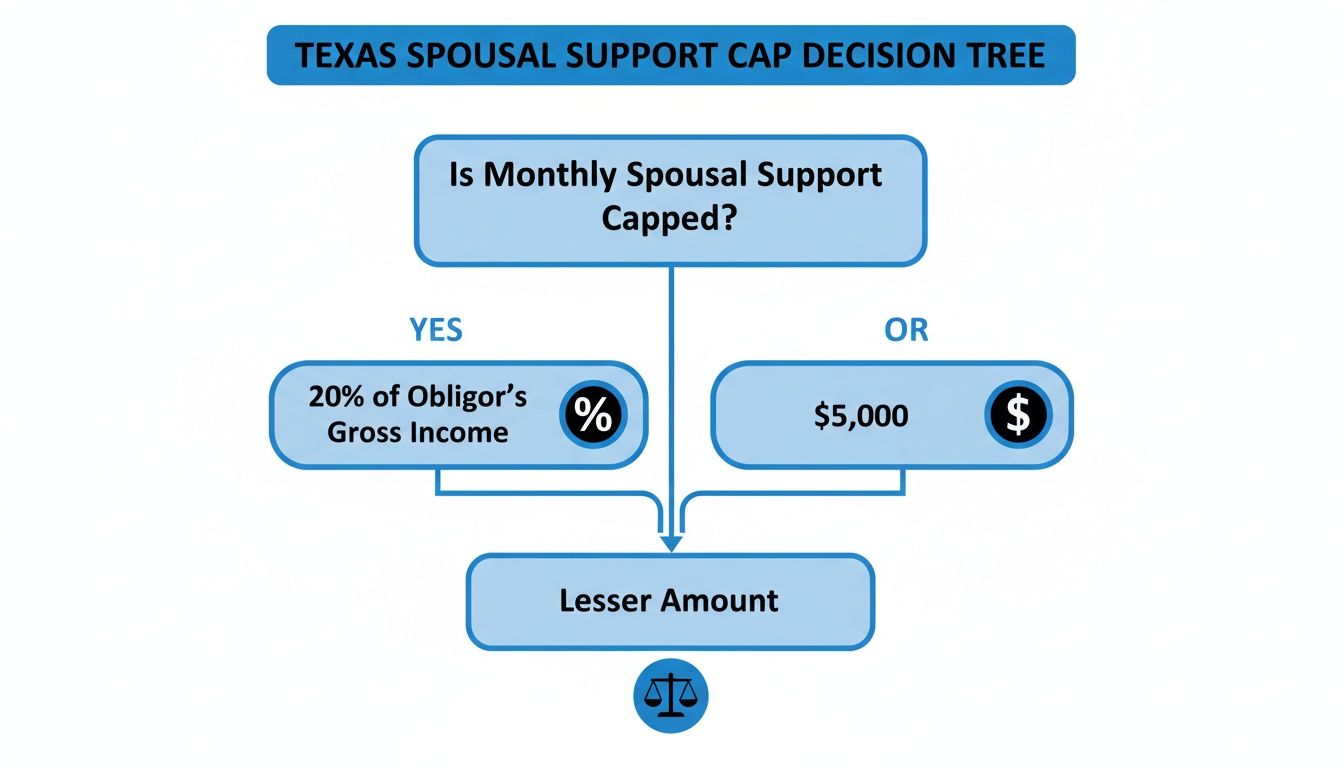
As the visual shows, the award can never exceed the lower of two figures: 20% of the paying spouse's gross monthly income or the hard cap of $5,000.
What to Do Next
Getting a handle on these rules is the first step toward creating a realistic financial plan for your post-divorce life. While many people use the terms "alimony" and "spousal maintenance" interchangeably, there are key legal distinctions you need to know, and you can learn more about whether Texas is an alimony state in our article.
Your next move should be to gather financial documents and create a detailed budget that clearly outlines your necessary expenses. This information will be the foundation of your case, whether you're negotiating a settlement or arguing in front of a judge.
Navigating these requirements isn't something you should attempt alone. A skilled family law attorney can help you assess your eligibility, collect the right proof, and advocate for the financial support you need to move forward with security and confidence.
How Long You Can Expect to Receive Support Payments
Figuring out the monthly payment amount is a huge piece of the puzzle, but understanding how long you'll receive that support is what really shapes your financial future after a divorce.
In Texas, spousal maintenance is designed to be a temporary bridge, not a permanent destination. The law sets up a predictable system that ties the maximum length of support directly to how long you were married. This framework gives both you and your ex-spouse a clear timeline to start planning your separate financial lives.
The Tiered System for Support Duration
The Texas Family Code puts specific time limits on court-ordered spousal maintenance. The goal is to give you the shortest possible runway to become financially independent.
This tiered system is based on one simple factor: the length of your marriage.
- Marriages Lasting 10 to 20 Years: You may be eligible for up to five years of spousal maintenance.
- Marriages Lasting 20 to 30 Years: You may be eligible for up to seven years of spousal maintenance.
- Marriages Lasting More Than 30 Years: You may be eligible for up to ten years of spousal maintenance.
Keep in mind, these are the absolute maximums a judge can order. The court can—and often does—award support for a shorter time if it believes you can get back on your feet sooner. For instance, if you were awarded the statutory maximum of $5,000 per month after a 22‑year marriage, you could receive up to $420,000 over seven years (7 years × 12 months × $5,000 = $420,000).
Exceptions to the Standard Timelines
While that tiered system covers most situations, there are a couple of major exceptions for cases involving disability or family violence.
If you qualify for spousal maintenance because you have an incapacitating physical or mental disability—or you're caring for a child with a similar disability—the court can order support to continue for as long as that condition exists. This could potentially stretch well beyond the standard 5, 7, or 10-year limits.
Similarly, if you qualify for maintenance because of family violence in a marriage that lasted less than 10 years, the maximum duration of support is capped at five years.
It's crucial to understand that these timelines represent the longest possible duration. A judge will always order maintenance for the "shortest reasonable period" that allows you to meet your minimum reasonable needs by finding a job or developing the skills to do so.
When Spousal Support Payments End Early
Even if you're awarded support for a specific number of years, certain life events will automatically cut those payments off ahead of schedule. Knowing what these triggers are is essential for any long-term planning.
Spousal maintenance obligations end if any of the following happen:
- The death of either you or your former spouse.
- Your remarriage.
- You cohabit with a new partner. The law is specific here: you must be living permanently with another person with whom you have a dating or romantic relationship.
That last point often catches people by surprise. If your ex-spouse can prove you've moved in with a new romantic partner, they can go back to court and have the support order terminated.
These rules provide certainty and clear end-dates for support, helping everyone involved move forward. For a deeper dive into these specifics, explore our detailed guide to spousal support duration and modification considerations in Texas.
What to Do Next
The duration of your spousal support is a key piece of your post-divorce financial puzzle. Knowing the legal time limits allows you to create a realistic budget and a concrete plan for achieving financial independence. Whether your marriage lasted 11 years or 31 years, these statutory guidelines provide the framework for your future.
The next step is to understand that the amount and duration are not just based on math—they are also influenced by a set of human factors a judge must consider.
The Human Factors a Judge Considers Beyond the Math

The legal caps on spousal support—how much can be paid and for how long—give us a starting point, but they don't tell the whole story. The final decision rests with a judge who looks at the complete picture of your life, not just the numbers on a spreadsheet.
The Texas Family Code gives judges a specific list of factors to weigh, and this is where your personal story becomes the most important part of your case. It’s how you move from being a statistic to a person with a genuine need for support to get back on your feet.
Your Financial Reality and Earning Potential
A judge's first job is to understand the financial landscape of your marriage and what it will take for you to become self-sufficient. They'll carefully examine several key areas to land on a fair and just amount.
- Each Spouse's Financial Resources: The court will look at the property you'll each walk away with, including separate property, to see what resources are available to meet your basic needs.
- Education and Employment Skills: A judge will assess your education level and work history against your spouse's. They’ll consider whether you need more education or job training to re-enter the workforce and earn a living wage.
- Age, Health, and Employment History: Your age and physical and emotional health play a huge role. A 55-year-old spouse with chronic health issues faces a much tougher road than a healthy 35-year-old, and a judge will absolutely take that reality into account.
Contributions and Sacrifices Within the Marriage
Texas courts also recognize that contributions to a marriage aren't always financial. The law specifically directs judges to look at the non-monetary ways each spouse supported the family and helped the other succeed.
Under Texas law, a judge must consider "the contribution by one spouse to the education, training, or increased earning power of the other spouse." This means if you put your own career on the back burner to support your partner's dream of getting a degree or starting a business, the court will weigh that sacrifice.
This is especially critical for stay-at-home parents or spouses who managed the entire household so the other could climb the professional ladder. The judge will also look at things like:
- Homemaking Contributions: The value you provided by running the home and raising the children is a real, legally recognized contribution to the marriage.
- Acts of Marital Misconduct: A judge can consider evidence of adultery or cruel treatment by either spouse. This doesn't guarantee a higher award, but it is one of the many factors a court is allowed to weigh.
- Concealment or Fraud: If one spouse tried to hide, waste, or fraudulently get rid of community property, a judge can consider that bad behavior when determining spousal support.
Understanding how your personal journey fits into these legal factors is essential. This isn't just about math; it's about presenting a clear, honest narrative of your marriage and explaining why you need temporary support to build a stable, independent future.
When you're navigating a divorce, the financial path forward can feel like it’s set in stone. But what many people don't realize is that you often have the power to write your own script, especially when it comes to spousal support. In Texas, you aren't just stuck with what a judge can order; there’s another, far more flexible option on the table.
It’s absolutely critical to understand that Texas law splits spousal support into two very different categories: court-ordered spousal maintenance and privately negotiated contractual alimony. They might sound similar, but the difference between them can fundamentally reshape your financial reality after the divorce is final.

The Limits of Court-Ordered Spousal Maintenance
Court-ordered maintenance is what we've been covering so far in this guide. It’s the support a judge legally compels one spouse to pay the other after they've proven they meet the tough eligibility requirements outlined in the Texas Family Code.
This type of support is defined by its limitations. A judge simply doesn’t have the authority to color outside the legal lines drawn by the state legislature.
- Strict Caps: The judge cannot order payments that exceed the $5,000 / 20% monthly cap. No exceptions.
- Fixed Durations: The timeline for payments is locked in based on the length of your marriage (5, 7, or 10 years). The judge can't extend it.
- High Eligibility Bar: You have to clear a very high hurdle just to prove you qualify for an award in the first place.
Think of court-ordered maintenance as a standard, off-the-shelf solution. It serves a very specific purpose, but it’s rigid, lacks customization, and is only an option in very specific situations.
The Power of Contractual Alimony
Contractual alimony is a whole different ballgame. This is a voluntary financial agreement that you and your spouse create together, usually with the guidance of your attorneys or a mediator. It's a private contract that gets incorporated into your final divorce decree.
The true power of contractual alimony is its flexibility. Because you and your spouse are writing the rules, you aren’t constrained by the strict statutory limits that tie a judge's hands.
Contractual alimony allows you and your spouse to craft a customized financial arrangement that truly fits your unique circumstances, especially in cases involving complex assets, business ownership, or long-term financial planning.
This approach lets you design an agreement that a judge legally could not order on their own. For instance, you can agree to:
- Payments that go well beyond the $5,000 / 20% statutory cap.
- A payment schedule that extends past the standard 5, 7, or 10-year limits.
- Support payments even if you don't technically meet the high legal bar for court-ordered maintenance.
Enforcement and Modification Differences
How these two types of support are handled down the road also differs. Court-ordered maintenance is enforceable by contempt of court. This means a non-paying spouse could be hit with fines or even face jail time for failing to pay.
Contractual alimony, however, is enforced just like any other private contract. If your ex-spouse stops making payments, your remedy is to file a lawsuit for breach of contract. Another key difference is that contractual alimony can typically only be modified if your original agreement specifically says it can be. In fact, many couples intentionally make it non-modifiable to lock in financial certainty for everyone involved.
Understanding these two powerful options is the key to securing your financial stability and taking control of your post-divorce future.
Key Takeaway: Your Next Steps for Securing Financial Stability
Understanding the law is your first victory, but now it’s time to act. The road to financial independence after a divorce can feel intimidating, but you can walk it with confidence by taking clear, deliberate steps. You now know that eligibility for spousal support in Texas is strict, payments have firm legal caps, and the unique circumstances of your life matter greatly to a judge.
With this knowledge in hand, your immediate focus should be on building the strongest possible case for your financial future.
What to Do Next
- Gather Financial Records: Pull together everything you can find—bank statements, tax returns, pay stubs, and records of major assets and debts. The more comprehensive your documentation, the clearer your financial needs will be.
- Create a Post-Divorce Budget: This is a critical tool. Detail your expected "minimum reasonable needs"—housing, utilities, food, transportation, and healthcare. This budget becomes a foundational piece of evidence demonstrating your need for support.
- Secure Your Assets: During a divorce, it's vital to protect what's yours. Learning more about how to protect assets during divorce can give you essential strategies to safeguard your financial well-being through the process.
- Explore All Financial Options: As you plan your financial life after the divorce, securing all available income streams is crucial. This includes exploring every option, like looking into various strategies for maximizing Social Security benefits, including spousal benefits to ensure you aren't leaving any money on the table.
- Seek Experienced Legal Counsel: The path ahead may seem complex, but you absolutely do not have to walk it alone. This is your moment to shift from understanding the law to using it to secure your future. The information you've learned here is powerful, but applying it to your unique situation requires experience and dedicated advocacy.
The most important step you can take is to get a professional evaluation of your case. We invite you to schedule a free, confidential consultation with our compassionate family law team. Let's discuss your specific circumstances and build a clear, strategic plan to protect your family and your financial stability.
Common Questions About Texas Spousal Support
When you're trying to figure out your financial future post-divorce, a lot of specific questions pop up. You need straightforward answers, not legal jargon. Here are some of the most common concerns we hear about spousal support in Texas.
Are Spousal Support Payments Taxable in Texas?
This is a huge one for financial planning. Thanks to a major federal tax law change, for any divorce decree finalized after December 31, 2018, court-ordered spousal maintenance payments are no longer tax-deductible for the person paying.
On the flip side, this means the payments are not considered taxable income for you if you are receiving them. What you get is what you keep, which makes budgeting a whole lot simpler. Keep in mind, this applies to court-ordered maintenance. If you negotiate contractual alimony, you and your spouse might be able to agree on a different tax treatment, but that requires very specific language in your divorce decree.
Can Spousal Support Be Changed After the Divorce?
Yes, but it only applies to court-ordered maintenance. If you or your ex-spouse has a "material and substantial change" in circumstances—think an involuntary job loss or a major promotion—you can go back to court and ask to modify the support order.
There's a catch, though. You can only ask the court to lower or stop the payments. The law does not allow you to extend the duration of the support period. Contractual alimony is a different beast entirely. It can only be changed if your original agreement specifically says it's modifiable. Many couples intentionally make these agreements non-modifiable to lock in financial certainty for both sides.
What Happens If My Ex-Spouse Stops Paying Support?
If your ex-spouse ignores a court order for spousal maintenance, you have powerful legal options. The first step is to file an enforcement action with the same court that issued the original order.
A judge can hold your ex in contempt of court for failing to pay, which can trigger serious consequences:
- Financial penalties and hefty fines.
- An order forcing them to pay your attorney's fees.
- In serious cases, they could even face jail time until they comply with the order.
It’s critical to act quickly to enforce your rights and get the financial support you were awarded.
Figuring out the complexities of spousal support requires more than just reading articles—it takes a dedicated advocate who knows how to apply the law to your specific situation. At the Law Office of Bryan Fagan, PLLC, our team is committed to providing the compassionate guidance and strategic representation you need to protect your financial future. If you are facing a divorce and have questions about spousal support, contact us today to schedule a free, confidential consultation. Let us help you move forward with confidence and clarity.