Skip to content
When you’re facing the financial unknown of divorce, getting clear answers is the first step toward feeling in control. So, is Texas an alimony state? The simple answer is yes, but it comes with a Texas-sized catch. What our state law allows is called spousal maintenance, and frankly, it's one of the toughest forms of post-divorce support to get in the entire country.
Your First Look at Spousal Maintenance in Texas

Worrying about how you’ll pay the bills after your marriage ends is completely normal, and the idea of alimony can feel like a lifeline. But it’s critical to understand the Texas mindset here. Our laws are built to encourage financial independence, not long-term dependency on an ex-spouse.
Because of this philosophy, court-ordered spousal maintenance is treated as a temporary, rehabilitative tool—not an automatic entitlement. A judge can’t just order support because one of you made more money. The spouse asking for help has to prove a genuine need and meet some very strict legal hurdles.
The Presumption Against Maintenance
In a Texas courtroom, the judge starts with the assumption that spousal maintenance is not needed. This is a huge point that catches many people off guard. The burden is entirely on you—the person requesting support—to present clear and compelling evidence to overcome that initial "no."
This legal starting point is why Texas has a reputation for being one of the most difficult states to obtain post-divorce support. The law reflects a strong public policy favoring self-sufficiency.
Even if you succeed, the Texas Family Code puts firm limits on what a judge can award. The amount is capped at the lesser of $5,000 per month or 20% of the paying spouse's average gross monthly income. That's it. This isn't a state where you'll see massive, open-ended alimony awards.
To get a judge to even consider it, you have to prove two fundamental things:
- You will not have enough property or assets after the divorce to provide for your "minimum reasonable needs."
- You meet at least one of four very specific situations, like being married for over 10 years or being a victim of family violence.
Getting your head around these foundational rules is the first step in managing your expectations and building a realistic strategy. You can find a deeper analysis of the specific factors that influence these decisions in our comprehensive guide to spousal support in Texas divorce cases.
Court-Ordered Maintenance vs. Contractual Alimony
When you’re worried about your financial stability after a divorce, understanding your options is the first step toward regaining a sense of control. In Texas, you'll hear two key terms when it comes to post-divorce support: spousal maintenance and contractual alimony. They might sound interchangeable, but they are two completely different paths with huge consequences for your future.
Think of it this way: court-ordered maintenance is a rigid, public road a judge can force upon you. Contractual alimony, on the other hand, is a private path that you and your spouse build together. The one you end up on will determine just how much say you have in the final outcome.
The Strict Path of Court-Ordered Spousal Maintenance
Court-ordered spousal maintenance is what the Texas Family Code allows a judge to award. Let's be clear: this type of support is incredibly difficult to get. It’s governed by strict, unforgiving rules. A judge can't award maintenance just because one spouse made more money; you have to meet a very high legal bar to even be considered.
This is the state's system of last resort. It means going to court and proving your case to a judge who doesn't know you, and who will make life-altering financial decisions based on a rigid set of statutes.
As laid out in Chapter 8 of the Texas Family Code, a court can only order maintenance if a spouse proves they won't have enough property after the divorce to meet their “minimum reasonable needs” and they meet at least one of four very specific legal conditions.
The process is public and often turns adversarial. Worse, the outcome is capped by law. A judge can only award up to the lesser of $5,000 per month or 20% of the paying spouse’s gross monthly income, and only for a very limited time. This route offers almost no flexibility.
The Flexible Path of Contractual Alimony
In complete contrast, contractual alimony is a private agreement negotiated between you and your spouse. It's a powerful tool often used during the mediation process, which Texas law strongly encourages as a way to avoid messy courtroom battles.
With contractual alimony, you and your spouse—not a judge—call the shots. This means you have the freedom to agree to things a court could never order, like:
- Payment amounts that exceed the legal caps. You are not stuck with the restrictive $5,000/20% rule.
- A payment duration that actually fits your unique situation. Support can last for a longer or shorter time than a court would ever allow.
- Specific triggers for ending the support. You get to decide if things like remarriage or moving in with a new partner will terminate the payments.
- Built-in rules for making changes. You can create your own process for how and when the agreement can be modified down the road.
This approach gives you privacy, control, and the ability to craft a solution that truly works for your family's financial reality. It transforms a potential courtroom brawl into a collaborative problem-solving session, protecting both your assets and your peace of mind.
Who Actually Qualifies for Spousal Maintenance in Texas?
Thinking you might need some financial help after your divorce is one thing, but proving it to a Texas judge is a whole other ballgame. The law sets a very high bar for court-ordered spousal maintenance. Simply earning less than your spouse isn't nearly enough.
To even have a chance, you have to pass a tough, two-part test laid out in the Texas Family Code.
First, you must prove that after all the marital property is divided, you will still lack enough assets to cover your “minimum reasonable needs.” This is the absolute starting point. It means showing the judge that even with your share of the bank accounts, the house, and retirement funds, you can't make ends meet for basic living expenses.
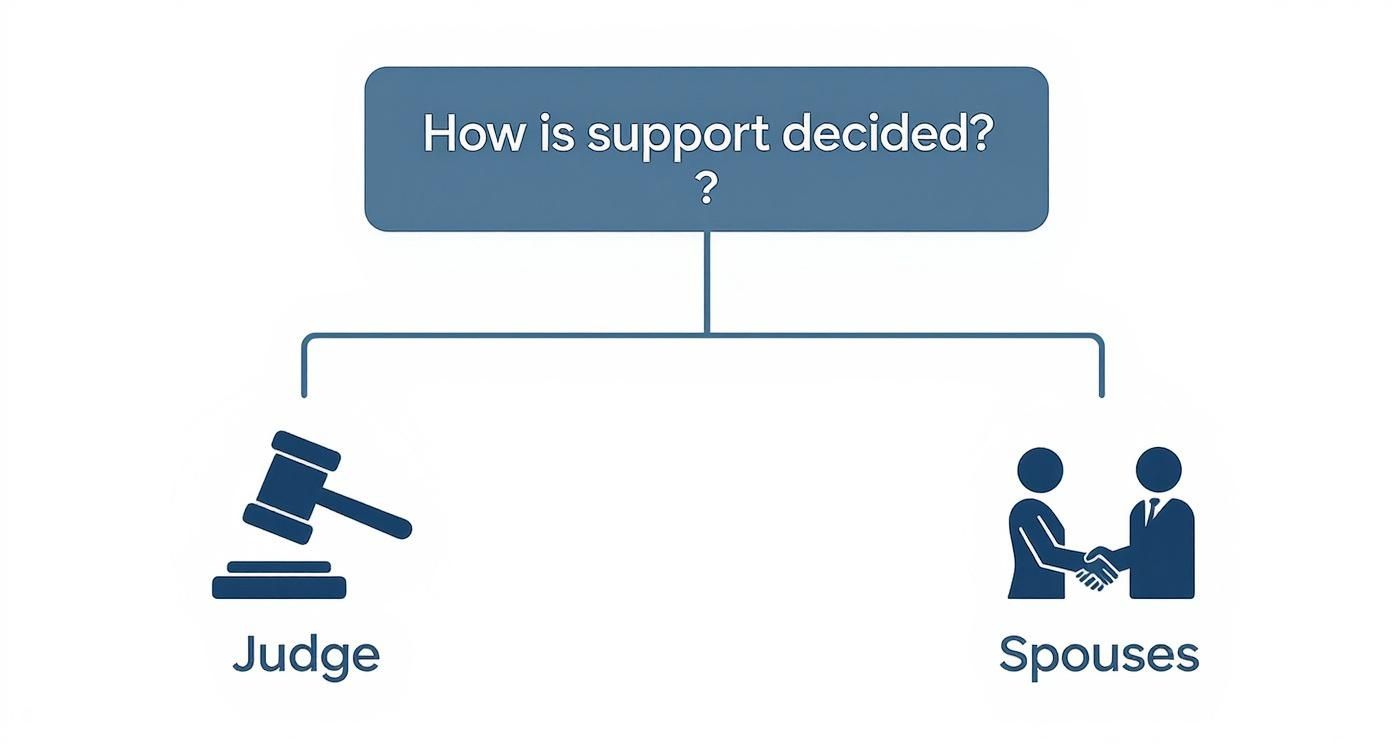
This flowchart breaks it down simply: spousal support in Texas comes from a judge's ruling based on strict laws, or it comes from a private agreement that you and your spouse control.
The Four Gateways to Eligibility
Okay, so let's say you've shown the court you can't meet your basic needs. You're only halfway there. Next, you have to prove that your situation fits into one of four very specific scenarios. Think of these as the only legal gateways a judge can use to award you maintenance.
-
The 10-Year Marriage Rule: This is the most common path. You must have been married for 10 years or longer and show that you’ve tried your best to earn enough money or get the skills you need, but you still can't support yourself.
-
The Family Violence Exception: If your spouse was convicted of (or got deferred adjudication for) an act of family violence against you or your child, you might be eligible. The act had to happen within two years of filing for divorce or while the divorce was ongoing.
-
The Disabling Condition of the Requesting Spouse: You could qualify if you have a physical or mental disability that's so incapacitating it prevents you from earning enough to cover your basic needs.
-
Caring for a Disabled Child: You may also qualify if you're the primary caregiver for a child of the marriage (any age) who has a disability requiring such substantial, personal care that it keeps you from being able to work and earn a sufficient income.
If you can't check at least one of these boxes, a judge’s hands are tied. They are legally blocked from ordering spousal maintenance, no matter how wide the income gap is between you and your spouse. The court starts with the assumption that support isn't needed unless you bring clear and compelling evidence to prove otherwise. Our attorneys are skilled at helping clients understand who typically pays for spousal maintenance in Texas divorces and how to build a powerful case around these specific factors.
What Does "Minimum Reasonable Needs" Really Mean?
That phrase, "minimum reasonable needs," is intentionally a bit vague and is one of the most argued-over points in these cases. The Texas Family Code doesn't give a specific dollar amount. Instead, the judge has to look at your unique life circumstances to decide what’s truly reasonable for you.
A judge evaluates your entire financial picture to determine this standard. It's not about maintaining the lavish lifestyle you may have had during the marriage; it’s about covering the essentials required to live.
This means you need to come prepared with a detailed budget that lays out your expected monthly expenses. We're talking about things like:
- Rent or mortgage payments
- Utilities (electricity, water, gas)
- Food and groceries
- Transportation costs (gas, car payment, insurance)
- Health insurance premiums and medical expenses
The court will then stack these necessary expenses up against your ability to earn an income and the property you're getting in the divorce. Only if there’s a clear shortfall will you pass the first part of the test.
How Texas Courts Calculate Maintenance Payments and Duration
Once you’ve confirmed you meet the tough eligibility rules for spousal maintenance, the next logical question is: what can I actually expect to get, and for how long? Texas law doesn’t leave this up to chance. It lays out a very clear, rigid framework that puts firm limits on both the amount of money and the length of time for payments, driving home the state’s view that maintenance is a temporary bridge to getting back on your feet.
If you’re trying to map out your financial future post-divorce, understanding these calculations is absolutely essential. A judge doesn’t just pull a number out of thin air; they have to follow specific formulas in the Texas Family Code designed to keep things predictable and prevent never-ending support payments.
The Strict Caps on Maintenance Payments
First, let's talk about the amount. Texas law slams a hard ceiling on how much a judge can order one spouse to pay the other. This isn't like some other states where alimony awards can eat up a huge chunk of someone's income. The rules here are meant to be restrictive.
A Texas judge can only order spousal maintenance up to the lesser of two amounts:
- $5,000 per month, or
- 20% of the paying spouse's average monthly gross income.
Let's break that down. Even if 20% of your spouse’s income comes out to $8,000 a month, the absolute most a court can order is $5,000. On the flip side, if your spouse earns $10,000 a month, the maximum award would be capped at $2,000 (20% of their income), not $5,000. This formula gives everyone a clear, predictable limit, which is a huge piece of the puzzle when figuring out your financial reality.
How Marriage Length Determines Maintenance Duration
Just like the payment amount is capped, so is the amount of time you can receive it. Texas law creates a direct link between how long you were married and the maximum duration of maintenance payments. The longer the marriage, the longer the potential support—but it's never indefinite.
Here's a simple breakdown of the maximum timeframes a judge can order for spousal maintenance payments.
Maximum Spousal Maintenance Duration in Texas
| Length of Marriage | Maximum Maintenance Period |
|---|---|
| 10 to 20 years | 5 years |
| 20 to 30 years | 7 years |
| 30 years or longer | 10 years |
It's critical to understand that these are maximums, not automatic guarantees. The law actually pushes judges to order payments for the shortest reasonable time possible.
A Texas judge is legally obligated to limit the duration of a maintenance order to the shortest reasonable time that allows the receiving spouse to earn sufficient income to provide for their minimum reasonable needs.
Their goal is to give you just enough time to get the skills or job you need to stand on your own two feet, and not a day longer.
Key Factors a Judge Considers
Even with these strict caps in place, a judge still has some wiggle room. To land on the final amount and duration, they’ll look at a specific list of factors laid out in the Texas Family Code. This is where the story of your marriage and your financial lives really comes into play.
A judge will carefully weigh things like:
- Each spouse’s financial resources after the divorce is final, including any separate property they own.
- Each spouse’s education and job skills, along with the time it would realistically take for the requesting spouse to get training and find work.
- The age, work history, and physical and emotional health of the spouse asking for maintenance.
- Whether one spouse helped the other get an education or advance their career during the marriage.
- Marital misconduct—think adultery or wasting community funds—by either spouse.
- Any history of family violence.
By balancing these factors, the judge lands on a final order that fits within the legal limits. This structured approach provides some predictability, but it also shows just how important it is to build a strong, evidence-based case that paints a clear picture of your financial reality for the court.
Building Your Case for Spousal Maintenance
Worrying about how you'll explain your financial needs to a judge is a heavy weight to carry. But building a strong case for spousal maintenance isn't about emotion—it’s about clear organization and solid proof. Whether you’re the one asking for support or the one who might have to pay it, your entire argument hinges on convincing evidence. A judge can only rule on the facts presented, so your job is to paint a crystal-clear picture of your financial reality.
This is where you and your attorney really become a team, methodically gathering the documents that tell your story. Vague statements like "I can't afford my bills" or "he can just get a job" simply won't cut it in court. You have to back up every single claim with hard evidence.

If You Are Requesting Maintenance
Your main goal is to prove two key things: that you don't have enough assets to meet your minimum reasonable needs, and that you’ve made a genuine effort to become financially independent. This requires some serious documentation.
Your evidence file should include:
- A Detailed Monthly Budget: This is absolutely non-negotiable. You need to list every single expense, from the mortgage and car payment to groceries, gas, and insurance. This document is the bedrock of your "minimum reasonable needs" argument.
- Proof of Job Search Efforts: Keep a running log of every job you apply for. Note the company, the date you applied, the position, and what happened. This shows the court you are being diligent.
- Evidence of Barriers to Employment: Are you unable to work due to a disability, or are you the primary caregiver for a child with special needs? Gather the medical records, doctor's notes, or any other paperwork that proves your ability to work is legitimately limited.
When putting your case together, it is sometimes helpful to consider how understanding challenging relationship dynamics may have impacted your financial independence, as this can provide important context for the court.
If You Might Be Asked to Pay Maintenance
If you’re the higher-earning spouse, your goal is to present an honest, transparent view of your own finances while also showing the other spouse's ability to earn an income. You aren't just defending yourself; you're helping the court see the complete financial picture for both of you.
The key evidence you'll likely need includes:
- A Comprehensive Income and Expense Report: Just like the person requesting support, you need a detailed budget. This is what proves your ability (or inability) to pay maintenance while still covering your own reasonable living expenses.
- Evidence of the Other Spouse's Earning Capacity: This is critical. You and your attorney will need to gather things like their resume, old pay stubs, educational background, and any professional licenses they hold. In some cases, you might even bring in a vocational expert to testify about their job prospects and potential salary in today's market.
Ultimately, both sides come out ahead when they present a clear, fact-based case. This approach not only helps the judge make a well-informed decision but also creates a better environment for productive negotiations. Properly documenting your finances is also a huge part of learning how to protect assets during your divorce, making sure the final property division is truly equitable. When you focus on the facts, you can navigate this difficult process with more confidence and clarity.
A Few More Questions We Hear All the Time
Even after getting the basics down, you probably have some specific "what if" scenarios running through your mind. That's completely normal when you’re navigating something as life-altering as a divorce. To give you some more clarity, we’ve put together answers to a few of the most common questions that come up with our clients.
Can I Get Temporary Support While My Divorce Is Pending?
Yes, you absolutely can. Texas courts have the power to order temporary spousal support to keep things stable while your divorce is in progress. Think of it as a financial bridge designed to help a lower-earning spouse cover necessary living expenses and legal fees until the divorce is final.
It's crucial to understand this isn't the same as the post-divorce spousal maintenance we’ve been discussing. Temporary orders are based on one spouse's immediate financial needs and the other's ability to pay. Once the judge signs your divorce decree, the temporary support order disappears, and any court-ordered spousal maintenance would kick in from that point forward.
How Does Adultery Affect Spousal Maintenance in Texas?
Marital fault, especially something like adultery, can definitely sway a judge's decision on spousal maintenance. While Texas is technically a no-fault divorce state, judges are allowed to consider a spouse's bad behavior when it comes to awarding support.
If you can show that your spouse's affair was a major reason the marriage fell apart, the judge might be more likely to award you maintenance. On the flip side, if you're the one who was unfaithful, it could be used as a reason to deny your request for support. Just remember, you'll need clear and convincing evidence to prove it, so this is a conversation you need to have with your attorney.
Key Insight: Marital misconduct is one of the factors spelled out in the Texas Family Code for a judge to consider. It can directly impact whether you get maintenance and, if so, how much you receive.
Can Spousal Maintenance Orders Be Changed or Stopped?
They can be, but only under specific circumstances. For a court to modify the amount of spousal maintenance, the person asking for the change has to prove there’s been a “material and substantial change” in either person's financial situation. This could be something like an involuntary job loss, a major promotion, or a new disability that prevents someone from working.
Payments will automatically terminate for a few key reasons:
- The death of either person.
- The receiving spouse gets remarried.
- The receiving spouse moves in and lives with a romantic partner on a long-term basis.
One final, critical point: this flexibility only applies to court-ordered maintenance. If you agreed to contractual alimony in a settlement, the rules for changing or stopping payments are dictated by whatever you both put in writing in that agreement.
Key Takeaway: What to Do Next
It’s completely normal to feel overwhelmed by the complex rules surrounding spousal maintenance in Texas. You’re not alone, and you have clear options. Think of the information you’ve just learned not as a collection of dry legal facts, but as the building blocks for a strategic plan to protect your financial future. Your path forward starts now, by turning that knowledge into action.
Without a doubt, the single most important step you can take is to consult with an experienced family law attorney. While understanding the law is powerful, only a legal professional can apply these specific rules to your unique family situation, helping you understand your rights and build a realistic strategy.
Take Control of Your Future
Remember, the restrictive nature of court-ordered maintenance is precisely why Texas law encourages people to find solutions outside of the courtroom. This is your opportunity to take control.
- Explore Mediation: This collaborative process allows you and your spouse to design your own financial arrangement through contractual alimony. Instead of a judge making the final call, mediation empowers you to create a fair, flexible agreement that actually works for your family.
- Gather Your Documents: Start organizing the financial paperwork we discussed—budgets, proof of income, and any evidence related to earning potential. Being prepared makes that first meeting with an attorney incredibly productive and saves you time and money.
- Define Your Goals: What do your "minimum reasonable needs" truly look like? What do you need to move forward with stability and confidence? Having clear goals will be the compass that guides your entire divorce strategy.
The strict legal framework in Texas isn't accidental; it’s designed to promote financial independence after a divorce. With a divorce rate of approximately 1.9 per 1,000 residents annually, many Texans find themselves navigating a swift path back to self-sufficiency. This reality, combined with the firm caps on maintenance, is exactly why proactive planning is so crucial. You can discover more insights about Texas divorce statistics to better understand the local context.
Your financial future after divorce isn't something that just happens to you; it's something you actively build. The choices you make today—from the evidence you gather to the legal counsel you choose—will shape the stability and security of your new beginning.
Your Invitation to Clarity and Confidence
You don’t have to figure this out on your own. At The Law Office of Bryan Fagan, PLLC, we help Texas families navigate these challenges every day with empathy, expertise, and a steady commitment to protecting what matters most. We’re here to listen to your story, answer your questions, and provide a clear, solution-focused path forward.
Schedule a free, confidential consultation with our team today. Let us help you take the first step toward securing your financial future and moving forward with the confidence you deserve. Visit us at https://texasdivorcelawyer.us to get the answers and support you deserve.