Skip to content
Going through a divorce is tough enough without the added worry of losing your family home. For many Texas families, that's where a mortgage assumption comes in. It's a powerful tool that allows one spouse to take over the existing home loan, keeping the same interest rate and terms you locked in years ago. In today's market, this can be a financial lifesaver compared to refinancing at a much higher rate.
Keeping Your Home in a Texas Divorce

The thought of leaving your home—the place filled with memories, the one constant for your kids—is often one of the most painful parts of a divorce. You've built a life there, and the idea of uprooting everything feels like another loss piled on top of an already gut-wrenching situation.
For Texas families, the house is rarely just a financial asset. It's the center of your world and, under the Texas Family Code, it's often your most significant piece of community property that must be divided. If you want to get into the nuts and bolts of how that works, you can read our guide on what is community property in Texas.
Why Mortgage Assumption Is a Critical Option Today
Not long ago, the spouse keeping the house would almost always refinance the mortgage. That meant getting a brand-new loan in their name alone to pay off the old joint loan. But the financial world has shifted dramatically, making mortgage assumption a much more critical strategy, especially with how much interest rates have climbed.
In 2022, about 53.4% of divorced couples in the U.S. co-owned their homes. While refinancing was once the go-to, the average mortgage rate shot up from around 3.50% in early 2022 to over 6.75% by late 2024. This spike has made refinancing prohibitively expensive for countless divorcing homeowners.
Assuming the mortgage after a divorce lets you hang onto that favorable interest rate you secured years ago. This one move could literally save you hundreds, or even thousands, of dollars every single month on your house payment. For many, it's the only way to afford staying in the home.
Mortgage Assumption vs. Refinancing: A Quick Comparison
When deciding how to handle the marital home in your divorce, it often boils down to two main choices: assuming the mortgage or refinancing it. Each path has its own set of pros, cons, and requirements. Understanding the key differences is the first step toward making a smart financial decision for your future.
| Factor | Mortgage Assumption | Refinancing |
|---|---|---|
| Interest Rate | Keeps the original, often lower, interest rate of the existing loan. | Requires a new loan at current market rates, which may be much higher. |
| Closing Costs | Generally lower, as you are not originating a brand-new loan. | Involves full closing costs, typically 2-5% of the new loan amount. |
| Lender Approval | Required for you as the assuming spouse; you must qualify based on your own income and credit. | Required for the spouse keeping the home, who must qualify for a new loan independently. |
| Loan Type | Only available for certain types of loans (e.g., FHA, VA, USDA). | Available for most conventional and government-backed loan types. |
| Equity Payout | May require a separate agreement or loan to pay your spouse their share of the equity. | Equity can be paid out to the departing spouse as part of the new loan (a "cash-out" refinance). |
| Process Speed | Can be faster than refinancing, but depends heavily on the lender's process. | Typically takes 30-60 days, similar to a standard home purchase loan process. |
Ultimately, the best choice depends on your original interest rate, your financial situation, and the type of loan you have. For many Texans with low-rate mortgages, assumption is a clear financial winner, but it isn't always an option.
What This Guide Will Do for You
This guide is your clear, no-nonsense roadmap through this entire process. We're going to walk you through every step, from figuring out if your loan is even assumable to making sure the final divorce decree protects you financially.
We'll break down:
- The types of loans in Texas that are actually assumable.
- How to talk to your lender and what they'll be looking for.
- The legal steps for transferring the title and getting your ex off the hook.
- The risks you need to watch out for and how to protect yourself.
Our goal is simple: to give you the knowledge and confidence to make the right call for you and your family.
Will a Mortgage Assumption Work for You?

The idea of keeping your low-interest mortgage sounds great on paper, but the real question is: can you actually pull it off? Before you invest too much time and energy, you need to take a hard, honest look at whether a mortgage assumption is even a realistic option for your situation.
It really boils down to two things: the kind of loan you have and whether your lender believes you can handle the payments all on your own.
Is Your Loan Even Assumable?
The first hurdle is figuring out if your mortgage agreement allows for an assumption in the first place. Different loans have different rules, and this is your starting point.
-
Government-Backed Loans (FHA, VA, USDA): If you have one of these, you’re in a good spot. These loans are generally designed to be assumable, as long as you can meet the lender's financial requirements.
-
Conventional Loans: This is where it gets interesting. Most conventional loans have a "due-on-sale" clause, which is the lender’s way of saying they can demand full payment if the property is sold or transferred. This clause usually stops assumptions cold.
However, there's a powerful federal law called the Garn-St. Germain Act of 1982 that creates a massive exception for divorce. This law explicitly prohibits lenders from triggering that due-on-sale clause when a house is transferred to a spouse as part of a divorce settlement.
What does that mean for you? Even with a conventional loan, your lender generally cannot block you from assuming the mortgage after a divorce. They still need to approve you financially, but they can't use the transfer as an excuse to call the loan due. This is a crucial protection for divorcing spouses in Texas.
The Lender’s Approval Process: What They Really Care About
Once you've confirmed your loan is potentially assumable, the spotlight turns to you. The lender's main concern is simple: can you manage the mortgage payments solo? They’re going to put your finances under a microscope, much like they did when you first applied for the loan together.
They'll zero in on three key metrics:
- Your Credit Score: They want to see a solid history of paying your bills on time. A strong credit score tells them you’re a reliable borrower.
- Income Stability: You have to prove you have a steady, dependable income that can cover the mortgage and your other bills. This can be your salary, but it can also include court-ordered spousal or child support.
- Debt-to-Income (DTI) Ratio: This is a big one. Your DTI compares your total monthly debt payments (car loans, credit cards, plus the mortgage you want to assume) against your gross monthly income. Lenders have very specific DTI limits, and you'll need to be within their acceptable range.
Qualifying for an assumption isn’t necessarily easier than getting a new loan; the standards are often very similar. The real win is the outcome: you get to lock in that incredible interest rate you secured years ago.
Real-World Scenarios in the Qualification Maze
Getting through the lender’s approval process can be tough, especially when your financial life is in flux because of the divorce.
Scenario 1: Relying on Spousal Support
Let's say you've been a stay-at-home parent and your primary income will now be spousal and child support. The lender will demand a copy of your final divorce decree to verify the amount and, more importantly, the duration of these payments. They need proof that the support is guaranteed for a certain period—often at least three years—to count it as stable income.
Scenario 2: Re-entering the Workforce
Maybe you're just getting back into your career after a long break. A lender might get nervous if you only have a few months of employment history. To build a stronger case, you'll need to gather everything you can: your employment contract, recent pay stubs, and any other documents showing your income is stable and likely to continue.
Before you commit to an assumption, it's smart to look at all your options for keeping the home. It’s worth learning how refinancing works, because it might offer different terms, even if the interest rate is higher. Understanding every angle is key when planning your property division in Texas divorce. Our attorneys can help you explore every path to find the one that best protects your financial future.
The Legal Process for a Texas Mortgage Assumption
https://www.youtube.com/embed/SU98veuXmd0
Getting a mortgage assumption handled correctly during your divorce is more than just a financial handshake—it’s a precise legal process that has to be woven into your divorce from the very beginning. It's one thing for you and your spouse to agree that one of you will keep the house and take over the loan. It's another thing entirely to make that agreement legally airtight and protect everyone from future liability.
This is where the details really matter. A missed step or a vaguely worded agreement can snowball into massive legal and financial headaches years from now. The goal is a clean break, where the person keeping the house has a clear title and the person leaving is completely and officially off the hook for that mortgage.
The Foundation: Your Final Divorce Decree
The Final Decree of Divorce is the single most important document in this entire process. Think of it as the legally binding blueprint that dictates exactly how the property and the loan will be handled. Just writing "Wife is awarded the house" is a recipe for disaster.
Your decree needs specific, actionable language that leaves zero room for interpretation. I’ve seen it happen time and again: vague agreements end up back in court, which is the last thing anyone wants.
A properly drafted decree must spell out:
- The Award of the Property: It needs to state clearly which spouse is being awarded the real estate.
- The Assumption Mandate: It must order the spouse keeping the house to formally assume the existing mortgage and get the other spouse's name removed from the loan.
- A Firm Deadline: You need a concrete timeframe for getting the assumption done (for instance, within 90 or 180 days after the divorce is final).
- Contingency Plans: It must outline what happens if the assumption falls through—most commonly, that the house must be sold.
This is where having an experienced family law attorney is non-negotiable. We know the exact language that Texas courts require to make these orders enforceable and protect our clients.
The Key Legal Documents You Will Need
Beyond the divorce decree, there are two other non-negotiable legal documents needed to officially transfer the property and secure the debt. These instruments work in tandem to legally sever your ties to this shared asset.
- Special Warranty Deed: This is the document that officially transfers ownership of the home from both of you to just the spouse who is keeping it. Once it's signed and filed with the county clerk, it changes the legal title to the property.
- Deed of Trust to Secure Assumption: This is your safety net. It’s a legal document giving the departing spouse the right to foreclose if the other spouse stops making payments or fails to complete the assumption on time. This is an absolutely critical step to protect the departing spouse's credit and financial future.
Without these two documents, your verbal agreement is legally meaningless, and the departing spouse remains dangerously exposed.
Navigating Lender Approval and Legal Timelines
While your divorce decree can order you to assume the mortgage, it can't force the lender to say yes. The lender has the final say, and they'll put the assuming spouse through a review process very similar to the mortgage underwriting process. You'll have to submit your final decree along with a mountain of financial paperwork.
It’s crucial to understand that even with a court order, the assumption is at the lender’s discretion. The spouse keeping the home has to qualify for the loan on their own, based on their individual credit, income, and debt-to-income ratio. This can be a huge hurdle for many people.
In Texas, a judge cannot force a lender to approve you. This is why having a backup plan, like an order to sell the home if the assumption is denied, is so critical in your divorce decree. It protects both you and your ex-spouse from being stuck in an impossible situation.
The process often runs on two parallel tracks: the legal one (your divorce case) and the financial one (the lender's application). Getting these timelines coordinated is vital. You don’t want to finalize your divorce only to get a denial letter from the lender weeks later, leaving you with a court order you can't possibly follow.
Why Mediation Can Be a Powerful Tool
Trying to negotiate these complex legal and financial details can get emotional and contentious. This is where mediation can be incredibly effective. In a mediated setting, you, your spouse, your attorneys, and a neutral mediator can work through every detail collaboratively.
Mediation gives you the space to:
- Discuss terms openly and explore creative solutions that work for both of you.
- Draft clear language for the decree that everyone understands and agrees to.
- Avoid a stressful and expensive court battle over who gets the house and how.
By working together in mediation, you can craft a legally sound agreement that sets both of you up for a stable financial future, turning a major point of conflict into a manageable solution.
Common Risks and How to Protect Yourself
The idea of keeping your home and that amazing low mortgage rate can feel like a huge win, but if the mortgage assumption isn't handled correctly, it can backfire in a devastating way. Knowing the risks—for both you and your ex-spouse—is the first step in building a legal shield around your financial future.
For so many couples, the stakes have never been higher. The pressure to assume a mortgage is especially sharp for anyone who locked in an ultra-low interest rate during the pandemic. Think about it: a couple divorcing now with a $400,000 mortgage at 2.25% would see their payment jump from about $1,528 to $2,594 a month if they had to refinance at today's 6.75% rate. That’s a staggering difference of over $1,000 every single month. This financial reality makes assumption almost a necessity, but it also means you have to manage the risks with extreme care.
Dangers for the Departing Spouse
If you're the one moving out, your single biggest risk is having your name stuck on that mortgage. Even if your divorce decree clearly states that your ex is responsible for every single payment, the lender doesn't care. As far as they're concerned, you are both equally on the hook.
This means if your ex-spouse misses a payment, it dings your credit score directly. Just one late payment can cause your score to plummet, making it much harder and more expensive to get a car loan, rent a new place, or even buy your own home down the road.
Even worse, if your ex defaults and the house goes into foreclosure, the lender can—and absolutely will—come after you for the remaining debt. This isn't just some theoretical problem; it’s a financial nightmare we help clients avoid every single day.
How to Shield Yourself as the Departing Spouse
You are not powerless here. Texas law gives you some powerful tools to protect yourself, but they have to be written into your divorce decree with absolute precision.
-
Deed of Trust to Secure Assumption: This is your most critical safeguard. It's a legal document that gives you the right to foreclose on the property yourself if your ex doesn't make payments or fails to complete the assumption by the deadline. It essentially turns you into a "lender" to your ex, securing their obligation to you.
-
Firm Deadlines and Consequences: Your decree must spell out a non-negotiable deadline (say, 120 days) for the assumption to be finalized. It also needs to state exactly what happens if that deadline is missed—typically, that the house must be listed for sale immediately.
Without this specific language, you're left relying on your ex-spouse's goodwill. A Deed of Trust to Secure Assumption and a sale contingency clause are non-negotiable protections that any experienced family law attorney will insist upon.
Risks for the Spouse Keeping the Home
If you're the one staying and assuming the mortgage, your challenges are mostly financial. First, you have to qualify for the entire loan on your own, which is a big hurdle when you’re transitioning from a two-income household to just one.
Second, you'll almost certainly need to buy out your ex-spouse's share of the home's equity. This often means taking out a separate loan, like a home equity line of credit (HELOC), which tacks on another monthly payment to your already tight budget.
You also have to think about the tax implications, especially around capital gains if you decide to sell the house later on. It is absolutely essential that you understand the full financial picture—the mortgage payment, property taxes, insurance, upkeep, and any new loans—before you commit. Overextending yourself financially can put the very home you fought so hard to keep at risk of foreclosure.
This is exactly why a comprehensive financial plan, something you’ll want to develop with your attorney and maybe a financial advisor, is such a crucial part of this process. It's about making sure you can confidently manage your new financial reality.
Your Action Plan for Mortgage Assumption
It’s completely normal to feel overwhelmed by all the legal and financial details that come with dividing a home. This is your chance to take a deep breath, get organized, and move forward with a clear plan that puts you back in control.
The journey from risk to resolution looks a little different for each spouse, but a structured legal approach is the key to getting it done right.
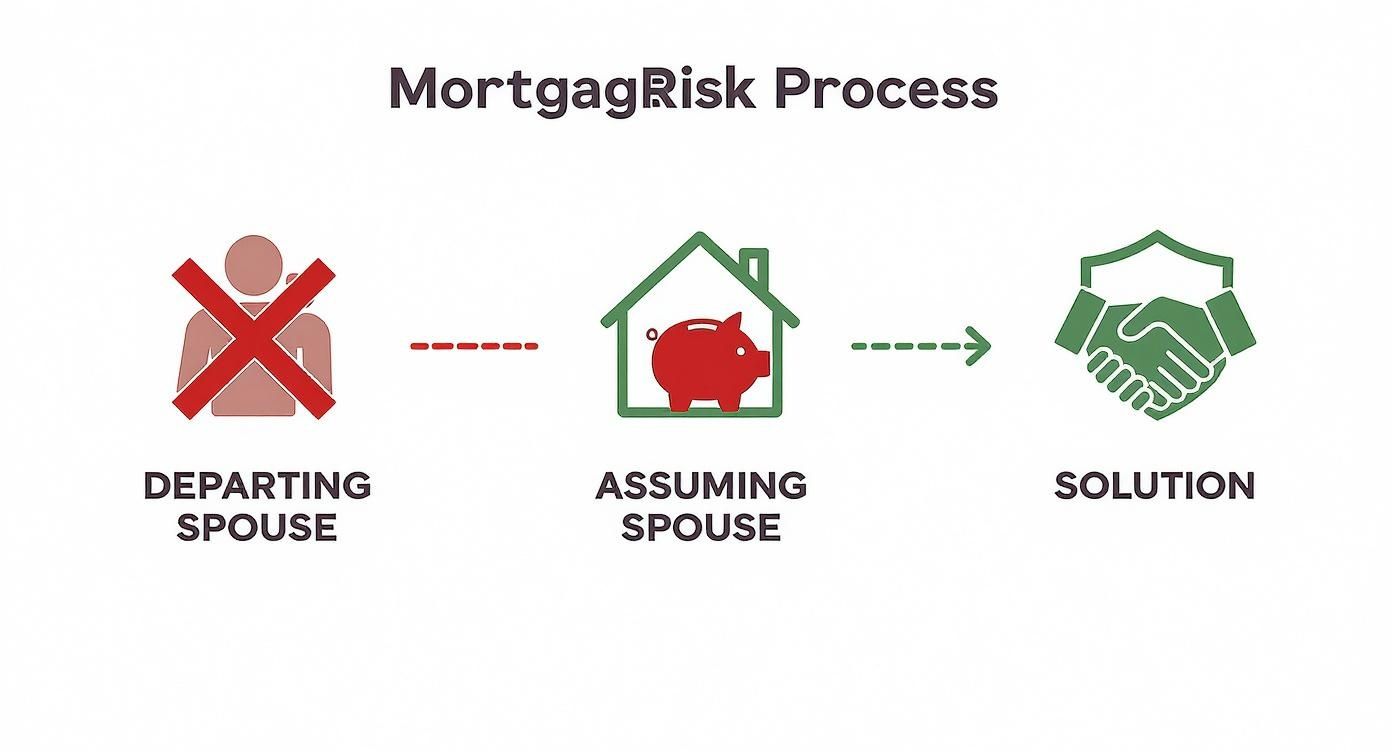
As you can see, both the departing and the assuming spouse face unique risks. The goal is to create a solution that offers security for everyone involved.
Step 1: Assess Your Financial Readiness
Before you do anything else, you need an honest picture of your finances. This isn’t the time for guesswork. Gather your recent pay stubs, tax returns, bank statements, and a complete list of your monthly debts.
With this information, calculate your debt-to-income (DTI) ratio. This number is a huge deal for lenders, and knowing it upfront gives you a realistic look at your chances of getting approved. If the numbers look a little tight, you can start working on a plan to strengthen your financial position now.
Step 2: Locate and Review Your Loan Documents
Next, dig out your original mortgage agreement and the promissory note. You're hunting for two specific pieces of information: the type of loan you have (FHA, VA, or Conventional) and any clauses related to "assumption" or "due-on-sale."
As we’ve discussed, the Garn-St. Germain Act gives you powerful protections during a divorce. But knowing your loan type is the essential first step before you even pick up the phone to call the lender. It's also one of the first things your attorney will ask for.
Step 3: Consult with Your Professional Team
You should never try to navigate an assumption of mortgage after divorce on your own. The stakes are simply too high. It's time to assemble your team of trusted advisors who can guide you through both the legal and financial maze.
Your plan absolutely must include consultations with:
- An Experienced Family Law Attorney: They will protect your rights, make sure the right language gets into your divorce decree, and ensure all legal documents like the Special Warranty Deed are handled correctly.
- A Mortgage Professional: A loan officer or mortgage broker can look at your financial profile and give you a straight-up assessment of whether you can qualify for the assumption.
This two-pronged approach makes sure your legal strategy lines up perfectly with your financial reality. Getting this right is critical for successfully untying real estate from your marriage. You can learn more by exploring our comprehensive guide to navigating real estate in divorce.
Taking these initial steps—gathering documents, assessing your finances, and building your team—transforms a daunting challenge into a manageable process. It’s about replacing uncertainty with a clear, actionable plan.
Common Questions About Divorce and Mortgages
Trying to untangle the finances of a divorce can feel overwhelming, especially when a house is involved. The questions and "what-ifs" about your mortgage can stack up fast. Here are the most common questions our clients ask about assuming a mortgage during a Texas divorce, with the straightforward answers you need.
Can my ex-spouse refuse to cooperate with the assumption?
Yes, unfortunately, a lack of cooperation can bring the whole process to a screeching halt. If your ex-spouse digs in their heels and refuses to sign critical documents, like the Special Warranty Deed, it creates a major roadblock.
This is exactly why your Final Decree of Divorce has to be drafted with ironclad, enforceable language. If the decree orders the transfer and your ex still won't comply, you're not powerless. Your family law attorney can file an enforcement action with the court. A Texas judge has the authority to hold your ex in contempt and compel them to follow the court's orders, making sure the process moves forward as it should.
What if the lender denies my application to assume the mortgage?
A lender denial is a very real possibility, and it's a scenario your divorce agreement absolutely must plan for. While a judge can order you to try to assume the loan, they have no power to force a private bank to approve your application. If the lender says no, you need a Plan B already written into your decree.
The most common safety net is a forced sale clause. This provision acts as a backstop, typically stating that if the mortgage assumption isn't completed by a hard deadline (say, 180 days after the divorce is final), the house must be listed for sale. This protects both you and your ex from being stuck with a joint debt that neither of you can get out of alone.
How do we handle the equity payout?
Assuming the mortgage only deals with the debt—it doesn't touch the equity you've built together in the home. The spouse who is leaving the home is still entitled to their share of that community property. The equity payout is a totally separate financial transaction that has to be negotiated.
There are a few ways this is typically handled:
- Cash Buyout: The spouse keeping the house pays the other their share of the equity directly from savings or other liquid assets.
- Home Equity Line of Credit (HELOC): The assuming spouse takes out a new, smaller loan against the home's equity to generate the cash needed to pay the other spouse.
- Asset Offset: You can get creative. The equity share can be balanced out by trading other assets of similar value, like a portion of a retirement account or an investment portfolio.
Figuring this out is a crucial part of your overall property division strategy.
Will assuming the mortgage affect my credit score?
Yes, but it's a double-edged sword that puts you in control. Once you successfully complete an assumption of mortgage after divorce, the loan will start reporting exclusively on your credit report. This is a great opportunity—making your payments on time, every time, will help you build a strong credit history as an independent borrower.
On the flip side, the full weight of that mortgage debt is now yours alone. It will be factored into your debt-to-income ratio, which could make it harder to qualify for other loans down the road. For the spouse who leaves, being officially released from the loan is a huge win for their credit, freeing up their borrowing capacity and protecting their score from any future late payments on the mortgage.
A recent report from the Consumer Financial Protection Bureau (CFPB) confirmed what we see all the time: many homeowners face unnecessary roadblocks from mortgage lenders after a divorce. It's critical to know your rights and have an advocate who can push back against delays and bad information.
Do I need a lawyer if my spouse and I agree on everything?
Even in the most amicable, "we agree on everything" divorces, having an attorney is non-negotiable when real estate is on the table. A good family lawyer does more than just fight for you; they act as your risk manager, protecting you from future problems you can't even see yet.
Your attorney will make sure that:
- Your divorce decree includes the precise, legally enforceable language Texas courts demand for a mortgage assumption.
- All the necessary legal documents, like the Special Warranty Deed and Deed of Trust to Secure Assumption, are drafted and filed correctly.
- Your rights are protected while you're dealing with the lender's application process.
- Clear consequences and backup plans are in place if something goes sideways.
Trying to handle a mortgage assumption with a DIY agreement is like trying to do your own dental work. It’s incredibly risky, and a single mistake can lead to devastating financial consequences for years to come.
What to Do Next
The path to securing your home and financial stability after a divorce is complex, but you don't have to walk it alone. The decisions you make right now will have a lasting impact on your future. We understand the weight of this moment and are here to provide the compassionate, knowledgeable guidance you deserve.
If you are facing a divorce in Texas and have questions about your home and mortgage, contact The Law Office of Bryan Fagan, PLLC today. Schedule a free, confidential consultation with our team to discuss your specific situation and create a strategy that protects you and your family. Contact us today to take the first step toward a secure financial future.