Skip to content
When you’re facing a divorce, figuring out how everything you’ve built together will be divided can feel like the most daunting task of all. So, let’s start with the simplest, most direct answer: Yes, Texas is a community property state. This one principle is the bedrock of property division here, and it means that nearly everything you and your spouse have acquired since your wedding day is likely considered jointly owned.
Understanding the Texas Community Property Standard
Before you can begin to think about dividing your assets, you have to understand how Texas law sees them. This isn't a new legal theory; it’s a framework with deep roots. Texas has been a community property state since its early days as a republic, with the foundational legal principles established way back in 1840. You can dig into the history of Texas property law to see just how these ideas have evolved.
This long-standing tradition is built on a crucial concept known as the “community presumption.”
What Is the Community Presumption?
In plain English, the community presumption means a Texas court starts with the assumption that any property acquired by you or your spouse during the marriage belongs to the marital estate—the "community." It doesn't matter whose paycheck bought it or whose name is on the title. If you acquired it after saying, "I do," the law’s default position is that it belongs to both of you.
Think of your marriage like a partnership. Everything that comes into the partnership through the time, effort, and talent of either partner belongs to the partnership itself. This shared pot includes things like:
- Income from employment earned by either of you.
- Real estate bought while you were married.
- Cars, furniture, and other personal items you acquired.
- Retirement accounts and pensions that grew in value during the marriage.
According to the Texas Family Code, this presumption is the default setting for all your assets. The burden of proof is squarely on the spouse who wants to claim something as their own separate property.
Why This Presumption Matters to You
This rule is the starting line for every negotiation, mediation, and court proceeding involving property division in Texas. It sets the stage for how your entire financial life together will be sorted out. Because of this powerful presumption, your first job is to be ready to identify and categorize every single asset you and your spouse own.
If you believe a particular asset—like money you inherited or a house you owned before the wedding—shouldn't be thrown into the community pot, it's up to you to prove it. This requires what the law calls “clear and convincing evidence,” a high standard we’ll explore next. Understanding this core concept is the first practical step toward protecting your financial future and moving forward with confidence.
Defining Your Separate and Community Property
Sorting out your finances during a divorce can feel like untangling a knotted ball of yarn. The most important first step is figuring out what’s legally "yours" versus what’s "ours" in the eyes of a Texas court. Getting this right is absolutely critical for protecting your financial future.
Texas law operates on that powerful community property presumption, but it also has clear rules for what qualifies as your separate property. This isn't just legal jargon—it's about taking a clear-eyed inventory of everything you own to make sure the final division is fair and just.
What Is Considered Your Separate Property
Think of separate property as anything you can prove belongs to you and you alone, free from any claim by your spouse. The Texas Family Code, Section 3.001, lays out exactly what fits into this category.
Generally, your separate property falls into one of three main buckets:
- Property Owned Before Marriage: Anything you had in your name before you said "I do" is yours. This could be a house, a car, a bank account, or investments you owned before the wedding.
- Gifts Received During Marriage: If a friend or family member gave you a gift that was clearly intended just for you—like heirloom jewelry from your grandmother—that asset remains your separate property.
- Inheritance Received During Marriage: Any money, real estate, or other assets you inherited from a loved one's will or trust during the marriage belongs solely to you.
But here’s where it gets tricky: any income earned from your separate property during the marriage is usually considered community property. For example, if you own a rental property (your separate asset), the rent checks you collected while married are typically part of the marital estate. It’s one of the many nuances you'll need to sort through. We get into more of these details in our guide on community property vs separate property.
This flowchart gives you a simple way to visualize how Texas courts determine property status. The big question is always: when was it acquired?
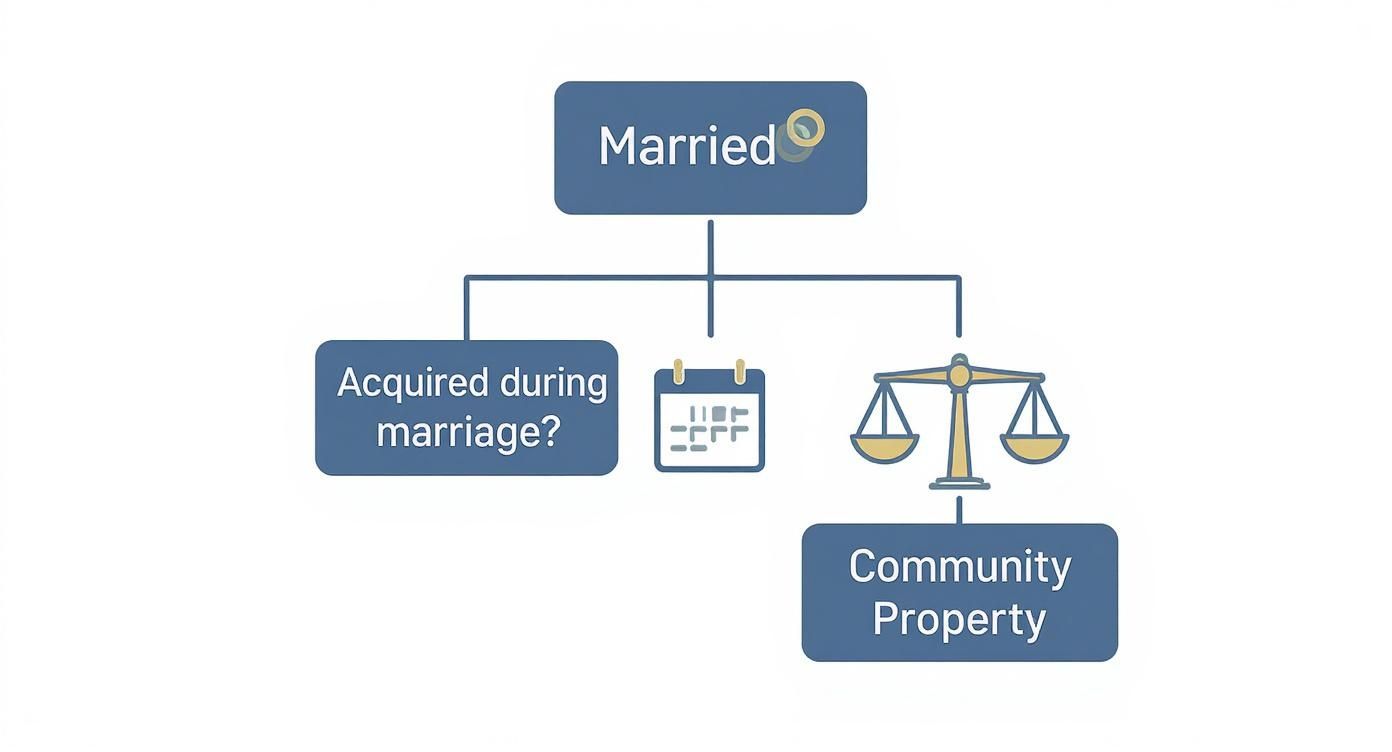
As you can see, the timing is everything. It all comes back to that strong legal presumption that if you got it during the marriage, it belongs to the community.
The Burden of Proof Rests on You
Because the court starts by assuming everything is community property, it's up to you to prove that a specific asset is separate. You can't just tell the judge a bank account is yours; you have to show them with undeniable proof.
The legal standard here is "clear and convincing evidence." This is a high bar, meaning your proof has to be so strong that it leaves no real doubt in the judge's mind.
To meet this standard, paperwork is your best friend. You'll need to create a paper trail that traces the asset from its origin to the present day. This often involves digging up documents like:
- Bank Statements: Showing the account existed with a specific balance before your wedding date.
- Deeds and Titles: Proving you owned real estate or a vehicle before you got married.
- Wills and Trust Documents: To verify that you received property through an inheritance.
- Gift Letters: A simple note from the person who gave you the gift, stating their intent was for it to be for you alone.
Just as important is what you did with the asset. When you mix, or "commingle," separate funds with community money—like dropping your inheritance into a joint checking account used for bills—you run a serious risk of the court classifying the whole thing as community property, ready to be divided.
Start gathering your documents now. Taking inventory of your assets and finding the proof to back up your claims is one of the most important things you can do to protect what is rightfully yours.
How Texas Courts Actually Divide Property
When people hear that Texas is a community property state, they often jump to one conclusion: everything gets split 50/50. It’s a common misconception, but it’s not how things actually work in a Texas divorce. The law is designed to be fair, not just mathematically equal.
When a couple can’t agree on how to divide their property, a judge makes the final call. But their goal isn’t a simple 50/50 split. Instead, they operate under a legal standard from the Texas Family Code known as a “just and right” division. This simple phrase gives the court flexibility to tailor an outcome that truly fits your family’s specific situation.
What does that mean for you? It means a judge could decide that a 55/45, 60/40, or some other variation is what’s actually fair. They don’t just look at a spreadsheet of assets; they look at the whole story of your marriage and what each of you will need to move forward.
Factors a Judge Considers for a Just and Right Division
So, what exactly does a court look at to figure out what's "just and right"? While every case has its own unique facts, Texas judges consistently look at a handful of well-established factors to get the full picture. These factors help the judge understand the dynamics of your marriage and what each of you will need to land on your feet after the divorce is final.
Key factors include:
- Each Spouse’s Earning Capacity: The court compares your current incomes, education levels, job skills, and future earning potential. If one of you stayed home to raise children, you might receive a larger share to help you get re-established financially.
- Fault in the Breakup of the Marriage: If one spouse's actions—like adultery, cruelty, or wasting community funds—caused the divorce, the judge can award a larger share of the property to the innocent spouse.
- Custody of the Children: The parent who will be the primary caregiver for your children often has greater financial needs. To create stability for the kids, the court might award the family home and a larger portion of the assets to that parent.
- Health of Each Spouse: A judge will take into account any significant health problems or disabilities that impact a spouse's ability to work and support themselves.
- Size of the Separate Estates: If one spouse has a massive separate estate (from a large inheritance, for example), the court might give a bigger slice of the community pie to the other spouse who has fewer personal resources.
A Texas judge’s primary mission isn’t to slice everything in half. It’s to ensure the final property division is equitable, taking into account the unique realities of your family’s past and, just as importantly, your future.
The Power of Mediation: Putting You in Control
Hearing that a judge has so much leeway can be nerve-wracking. It means putting some of the biggest financial decisions of your life into a stranger's hands. But you don't have to roll the dice in a courtroom. There's a powerful alternative that puts you and your spouse back in control: mediation.
Mediation is a structured, confidential negotiation process where a neutral third-party mediator helps you and your spouse find common ground. It's far less adversarial than a court battle and almost always more cost-effective.
Instead of having a decision handed down from a judge, you and your spouse get to create your own agreement. This lets you come up with creative, customized solutions that work for your family's unique needs—something a one-size-fits-all court order rarely can. To get a clearer picture of how these paths compare, you can explore our detailed overview of the property division process in Texas divorce.
A Step-by-Step Look at the Process
Whether you resolve your case in mediation or court, the process generally follows a clear path:
- Filing the Petition: One spouse files an Original Petition for Divorce with the court, which officially begins the case. Texas has a mandatory 60-day waiting period before a divorce can be finalized.
- Discovery: You and your spouse exchange financial information. This is where you'll gather all those bank statements, deeds, and retirement account details.
- Mediation: Most Texas courts require you to try mediation before you can go to a final trial. This is your best opportunity to reach an agreement on your own terms.
- Final Decree: Once you've reached an agreement (or a judge has made a ruling), all the terms are written into a Final Decree of Divorce. Once the judge signs it, your divorce is official.
Understanding that a "just and right" division is the Texas standard empowers you to build a smart, realistic strategy, whether you're heading to the negotiation table or, if necessary, to court.
Handling Complex Assets in a Texas Divorce
Your financial life isn't always simple, and neither is dividing it. Many Texas families have complex assets like a family business, retirement accounts, or high-value estates that require a more careful and strategic approach. When these assets are involved, the stakes get significantly higher.

Understanding how Texas community property law applies to these unique situations is essential for protecting what you've worked so hard to build. Let's walk through some of the most common complex scenarios and how they're addressed in a Texas divorce.
When You Own a Business
If you or your spouse started a business during your marriage, Texas law presumes it's a community asset. For the spouse who poured their heart and soul into building it, that can be a terrifying thought. But "dividing" a business doesn't always mean selling it off.
The first step is always getting an accurate business valuation. This process determines the company's fair market value and is usually done by a neutral financial expert. Once you have a value, you have a few options:
- Buyout: One spouse can buy out the other's interest in the business, often by trading other community assets of equal value.
- Co-ownership: Though rare, some former spouses with a solid working relationship decide to continue owning and operating the business together.
- Structured Payout: The spouse who keeps the business might agree to pay the other spouse their share over a set period of time.
The key here is finding a solution that preserves the business's value while ensuring the division is fair for both of you.
The Challenge of Commingled Assets
One of the thorniest issues, especially in high-net-worth divorces, is commingling. This happens when separate property gets mixed with community property, blurring the lines of ownership. For example, if you deposit a large inheritance (your separate property) into a joint checking account used for daily expenses, those funds have become commingled.
To reclaim the separate portion, you have to perform a process called tracing. This involves meticulously following the paper trail to prove, with clear and convincing evidence, exactly which funds came from the separate source.
Tracing is a highly detailed and often expensive process. It underscores the critical importance of keeping separate property—like inheritances or premarital savings—in entirely separate accounts to maintain their legal character.
Dividing Retirement and Investment Accounts
For many couples, retirement accounts like 401(k)s, pensions, and IRAs are their most valuable assets. The portion of these accounts earned or contributed during the marriage is community property and subject to division, even if the account is only in one spouse's name.
Dividing these accounts isn’t as simple as writing a check; it requires a special court order called a Qualified Domestic Relations Order (QDRO). A QDRO is a legal document that instructs the plan administrator to divide the account and pay a portion directly to the non-employee spouse without triggering early withdrawal penalties or taxes. Our attorneys can guide you through the complexities of dividing a 401(k) in a divorce to ensure it is handled correctly.
Of course, other financial instruments have their own specific rules. For insights into how things like home loans are managed, you can find valuable information on topics such as mortgage assumption during a divorce.
Military Divorce and Special Considerations
Military divorces bring another layer of complexity. Military retirement pay earned during the marriage is considered community property and is divisible in a Texas divorce. A federal law called the Uniformed Services Former Spouses’ Protection Act (USFSPA) governs how these benefits are divided.
To be eligible for a direct portion of the retirement pay, the marriage must have lasted for at least 10 years while the service member was on active duty. Disability pay, however, is generally not considered community property and isn't divisible.
How Common Complex Assets Are Treated in a Texas Divorce
| Complex Asset Type | Key Consideration | Typical Treatment |
|---|---|---|
| Family Business | Was the business started or did its value grow significantly during the marriage? | A business valuation is performed. Options include a buyout, co-ownership, or a structured payout of one spouse's share. |
| Retirement Accounts | The portion of the account earned or contributed during the marriage is community property. | A Qualified Domestic Relations Order (QDRO) is used to divide the asset without tax penalties. |
| Inheritance | Inheritances are separate property, but can become community property if commingled with marital funds. | If kept separate, it remains with the heir. If commingled, it requires tracing to prove the separate property portion. |
| Military Retirement | The portion of retirement pay earned during the marriage is divisible. | Divided under the USFSPA. The 10-year rule applies for direct payments from the Defense Finance and Accounting Service (DFAS). |
| Stock Options | The vesting schedule is critical. Options granted during the marriage are usually community property. | Divided based on when they were granted and when they vested, often requiring a specific formula to determine the community interest. |
This table is a general guide. Handling these complex assets requires more than just a basic understanding of community property; it demands specialized knowledge and a strategic approach.
Practical Steps to Protect Your Property

Knowing the law is one thing, but putting that knowledge into action is what will truly protect you. When you’re facing a divorce, getting organized is a huge step toward securing a fair outcome. This is your personal checklist for building a solid case and walking into negotiations from a position of strength.
Start with a Detailed Financial Inventory
Your first mission is to create a complete picture of your marital estate. This means gathering every single relevant financial document you can find. Don’t worry about labeling assets as community or separate just yet; for now, just focus on collection. This process gives both you and your attorney a clear snapshot of what’s on the table.
Start pulling together these documents:
- Bank and Investment Statements: Collect statements for every checking, savings, brokerage, and retirement account going back at least three to five years.
- Property Deeds and Vehicle Titles: Dig up the official documents for your home, any rental properties, and all vehicles.
- Tax Returns: Your joint tax returns are a goldmine of information. Gather at least the last five years' worth.
- Loan and Debt Documents: Compile all statements for your mortgage, car loans, credit cards, and student loans.
Consider a Prenuptial or Postnuptial Agreement
These legal agreements are powerful tools for defining property rights outside the standard Texas community property rules. A prenuptial agreement is a contract you and your spouse sign before getting married, spelling out exactly how assets and debts will be handled if you divorce.
A postnuptial agreement does the exact same thing, but it’s created during the marriage. Both are designed to give you clarity and predictability, letting you set your own rules for property division instead of leaving it all up to a court.
A well-drafted marital agreement can be your strongest defense in protecting separate property. It can explicitly state that certain assets, and any income they generate, will remain separate, overriding the community presumption.
These agreements aren't just for the ultra-wealthy. They can provide peace of mind for anyone bringing significant assets into a marriage, owning a business, or wanting to protect an inheritance for children from a previous relationship. When you're thinking about how to structure your life, especially if you're planning a relocation from Florida to Texas, understanding these agreements is a game-changer.
What to Do Next
The steps you take today can fundamentally change the course of your divorce. By getting organized and knowing your legal options, you switch from a reactive, defensive mindset to a proactive, strategic one.
- Create a Secure File: Make copies (both digital and physical) of all the financial documents you've gathered. Keep them somewhere safe where your spouse can't access them.
- Make a List: Start a simple spreadsheet that lists every asset (house, cars, bank accounts) and every debt (mortgage, credit cards). This inventory will be invaluable later.
- Think About Your Goals: What matters most to you? Is it staying in the family home? Protecting your retirement savings? Knowing your priorities will be the compass that guides your negotiation strategy.
Key Takeaway: You Can Take Control of Your Future
Understanding that Texas is a community property state is your first step toward navigating your divorce with clarity. The core principles are straightforward: what you acquired during marriage is presumed to be shared, but the final division must be "just and right," not just an even split. It's up to you to provide the proof needed to protect your separate assets.
This process can feel overwhelming, but you have the power to bring order to the chaos. By taking proactive steps, you can move from a place of uncertainty to one of confidence.
Here’s what you should do next:
- Gather Your Financials: Start pulling together statements for all your bank accounts, retirement funds, debts, and property deeds. A clear financial snapshot is your most powerful negotiating tool.
- Identify Your Separate Property: Make a list of any assets you owned before marriage or received as a gift or inheritance, and start looking for the documents to prove it.
- Define Your Goals: Think realistically about what you'll need to start your next chapter. Consider your housing, income, and the children's needs.
- Seek Expert Guidance: You don’t have to walk this complicated and emotional road alone. The next move is to get personalized advice from a team that understands what you're going through and knows how to safeguard your future.
Peace of mind is priceless. Having an experienced lawyer in your corner can make all the difference, turning uncertainty into a strategic plan for your next chapter.
We're here to help you turn what you've learned into a real, actionable strategy. By scheduling a free, confidential consultation with the experienced family law attorneys at The Law Office of Bryan Fagan, PLLC, you’re taking the most important step of all—the one that protects your family, your assets, and your future.
Got Questions About Community Property? We've Got Answers.
Going through a divorce opens up a floodgate of questions, and when it comes to your property, every detail counts. We've put together some straightforward answers to the questions we hear most often from our clients about Texas community property.
What happens to debt we took on during the marriage?
Debt gets divided right alongside assets. In Texas, any debts taken on by you or your spouse during the marriage are usually considered community debt. This means both of you are generally responsible for it, no matter whose name is on the credit card or loan. When you divorce, a judge will divide this debt in a way that is “just and right,” which may mean assigning more debt to the spouse with a higher income.
Is my inheritance considered community property?
No, it’s not. Under the Texas Family Code, anything you receive as a gift or inheritance is legally your separate property, even if you receive it during your marriage. But there's a catch—you have to keep it separate. If you deposit inherited cash into a joint checking account where it gets mixed with marital funds, it becomes "commingled," putting it at risk of being divided as community property.
How do we divide a house we bought before we were married?
A house bought together before you were legally married isn't community property. It's typically treated as jointly owned separate property. Dividing it can be complicated because a court has to determine each person’s ownership stake, which often comes down to who contributed what to the down payment and mortgage payments.
Does "community property" automatically mean a 50/50 split?
Not at all. This is one of the biggest misconceptions. While a 50/50 split is often the starting point, Texas law requires a “just and right” division. A judge has the authority to award a lopsided share—say, 60/40—based on factors like fault in the divorce, differences in earning power, and the needs of your children. The goal is fairness, not just simple math.
Figuring out how Texas community property laws will impact your specific situation is the first step toward securing your future. You don’t have to untangle this on your own. The dedicated attorneys at The Law Office of Bryan Fagan, PLLC are here to give you the clarity and guidance you need. Schedule a free, confidential consultation with us today to talk about your case and build a plan to move forward with confidence.