Skip to content
Facing a court battle can feel like you're at the bottom of a mountain you never wanted to climb. So, when you hear the term "family mediation court," it’s easy to imagine another intimidating legal setting.
But it’s actually the opposite. It isn't a separate courthouse at all—it's a process designed to help you and your spouse resolve divorce and custody issues together, keeping you out of a drawn-out, contested trial.
What Is the Family Mediation Court Process in Texas?
The thought of endless courtroom drama is exhausting for anyone. Mediation offers a more constructive and private path forward for your family. Instead of letting a judge make life-altering decisions for you, mediation puts the power to shape your future back in your own hands.
The process is essentially a structured, confidential negotiation session guided by a neutral third-party expert, known as the mediator.
Think of it this way: a court trial is like two teams playing a game where a referee declares a winner and a loser based on a rigid rulebook. Mediation, on the other hand, is like hiring a skilled architect to help you and your spouse design a blueprint for your family's new structure—one that actually works for everyone involved.
Court-Ordered vs. Private Mediation
In Texas, you'll typically enter mediation in one of two ways. Understanding the difference is key to knowing what to expect.
- Court-Ordered Mediation: Many Texas family court judges will require you to try mediation before they’ll even consider hearing your case at trial. It’s mandated under the Texas Family Code because courts have seen firsthand that families often get better, more durable results when they craft their own agreements. A judge's order makes your attendance mandatory, but reaching an agreement is still completely voluntary.
- Private Mediation: You and your spouse can also choose to go to mediation on your own at any point—even before a lawsuit is ever filed. Taking this proactive approach can save an incredible amount of time, money, and emotional stress by resolving disagreements before they have a chance to escalate in the court system.
The most important principle in mediation is self-determination. A judge can order you to the negotiating table, but no one can force you to sign an agreement. You and your attorney always keep full control over the final say.
The Goal of Mediation in a Divorce or Custody Case
The ultimate goal here is to create a Mediated Settlement Agreement (MSA). This is a legally binding contract that spells out every single term you and the other party have agreed on, from how property is divided to the specifics of a parenting plan.
Once signed, the MSA is filed with the court and becomes the foundation for your Final Decree of Divorce or Custody Order.
This process is all about finding common ground and building practical solutions that are custom-fit to your family’s unique needs. While the court system is there when you need it, you can navigate your Texas divorce mediation options to find a more peaceful way forward. By choosing family mediation, you’re picking a path that values communication and cooperation, giving you a powerful voice in the decisions that will define your future.
Walking into mediation can feel nerve-wracking, but knowing what to expect can replace that anxiety with a sense of control. The family mediation process in Texas isn't some chaotic free-for-all; it follows a clear, structured path designed to guide you from conflict toward a resolution. Once you understand each step, you can walk into your session feeling prepared and confident, ready to take an active role in shaping your family's future.
Navigating Each Step of Texas Family Mediation
The journey through mediation is a series of deliberate phases, each with a specific purpose. Think of it less as a single event and more as a well-orchestrated process designed to help you and the other party reach a lasting agreement you can both live with.
This visual guide shows the simple, solution-focused path from dispute to a signed agreement through the power of mediation.
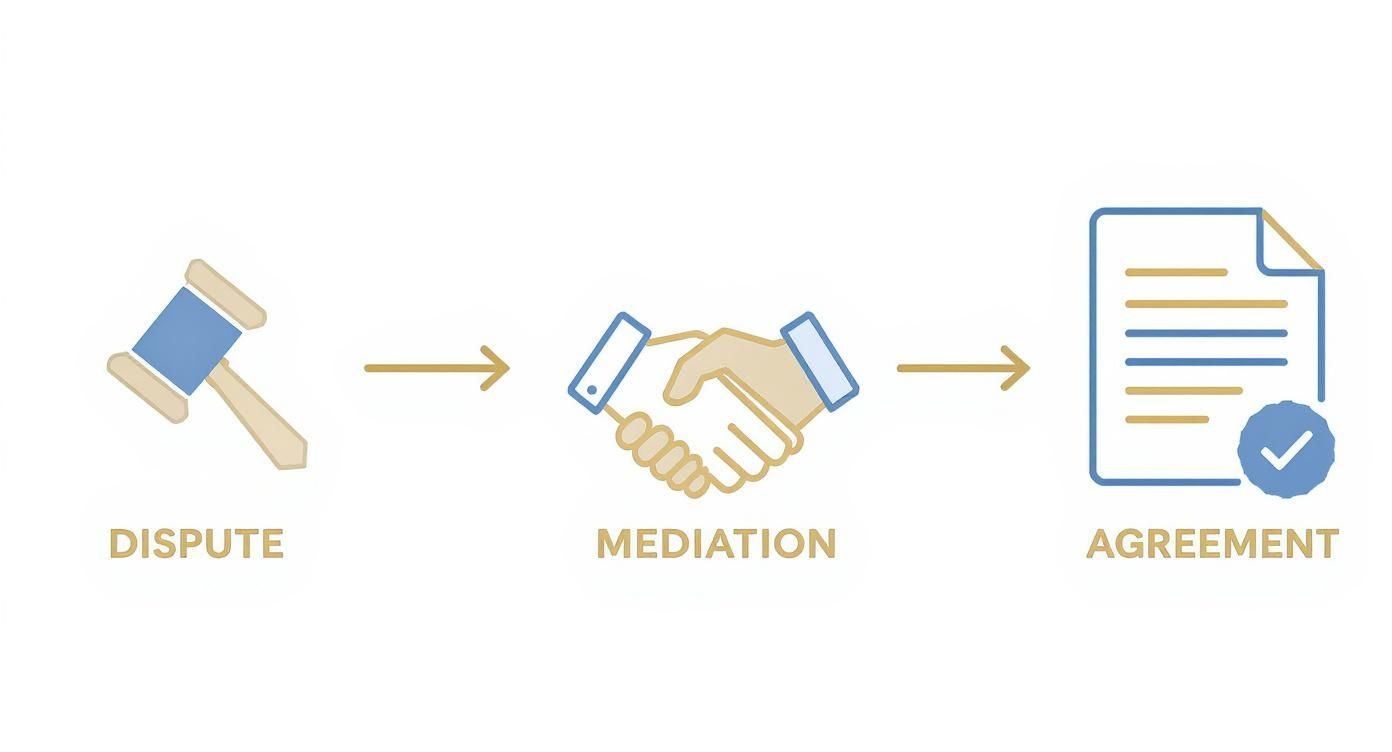
This process flow highlights that mediation is the bridge between a legal dispute and a formal, binding agreement, emphasizing collaboration over conflict.
To give you a clearer picture of the road ahead, here’s a breakdown of what happens at each stage of the Texas mediation process.
Stages of the Texas Mediation Process
This table summarizes each phase of the family court mediation process, what to expect, and your primary objective at each step.
| Mediation Stage | What Happens | Your Goal |
|---|---|---|
| Stage 1: The Order to Mediate | A judge orders you to attend mediation, or you and the other party agree to go voluntarily. This is a standard step in most Texas family law cases. | Acknowledge the requirement and start the process of selecting a qualified mediator with your attorney. |
| Stage 2: Selecting Your Mediator | You, your attorney, and the other side agree on a neutral third-party mediator. This is often a seasoned family law attorney or a former judge. | Choose a mediator with the right experience and temperament for your specific situation. Your attorney will guide this choice. |
| Stage 3: The Preparation Phase | You and your lawyer gather documents, define your priorities, and develop a negotiation strategy. This is your "homework" phase. | Walk into the session fully prepared with your goals, supporting documents, and a clear understanding of where you can compromise. |
| Stage 4: The Mediation Session | The mediator facilitates negotiations, usually by moving between separate rooms. This is where the real work of finding common ground happens. | Engage constructively in the process, listen to the mediator, and work toward a settlement that meets your most important goals. |
| Stage 5: The Settlement Agreement | If you reach an agreement, the mediator drafts a Mediated Settlement Agreement (MSA). Once signed, it's a legally binding contract. | Carefully review the MSA with your attorney before signing to ensure it accurately reflects the terms you agreed upon. |
By understanding these distinct stages, you can approach the entire process strategically instead of just reacting to what’s happening in the moment. Now, let's dive into the details of each step.
Stage 1: The Order to Mediate
Your journey usually kicks off in one of two ways: either you receive a court order telling you to attend mediation, or you and the other party voluntarily agree to participate. A judge often issues this order because Texas courts know just how effective mediation can be. It has a high success rate and produces more customized, practical agreements than a judge could ever create at a trial.
This efficiency is a huge deal, especially with today's court backlogs. To put it in perspective, there were 673,989 documented divorces in the U.S. in 2022, and that number doesn't even include data from massive states like California. Experts estimate the real figure is closer to 900,000 annually. That’s a ton of pressure on the court system, making faster, out-of-court alternatives like mediation more critical than ever. You can learn more about how families are using mediation to resolve arguments and sidestep those long delays.
Stage 2: Selecting Your Mediator
The next step is for you and your attorney to agree with the other side on a neutral mediator. This isn't just a random person; they are a trained professional, often a family law attorney or a former judge, who is skilled in communication and conflict resolution.
The mediator’s job isn't to take sides or make decisions for you. Instead, they act as a facilitator, helping to:
- Keep the conversation productive and civil.
- Pinpoint the core issues that actually need to be resolved.
- Brainstorm creative solutions that you might not have thought of on your own.
- Guide both of you toward finding that all-important common ground.
Your attorney's experience is invaluable here. They will help you select a mediator with the right background and personality for your specific case.
Stage 3: The Preparation Phase
This is where you and your attorney do your most important work. A successful mediation rarely happens by accident; it's almost always the result of thorough preparation.
During this phase, you will:
- Gather Key Documents: This means collecting everything from financial statements and property appraisals to debt records and proposed parenting schedules. Anything relevant to your case needs to be on hand.
- Define Your Goals: You'll work with your lawyer to create a clear list of priorities. This is about identifying your "must-haves," your "nice-to-haves," and the areas where you're willing to be flexible.
- Develop a Strategy: Your attorney will help you anticipate the other party's arguments and prepare effective responses. This preparation ensures you're negotiating from a position of strength, not desperation.
Stage 4: The Mediation Session
On the day of mediation, you, your attorney, the other party, and their attorney will meet with the mediator. While every session is a little different, they typically follow a general structure that promotes progress without forcing confrontation.
You will almost always start in separate rooms with your respective attorneys. The mediator moves between these rooms—a process called "caucusing"—carrying offers, counter-offers, and information back and forth. This private setting lets you speak freely with the mediator and your lawyer without having to face the other side directly.
The mediator uses these private chats to really understand each person's position and gently nudge the negotiation toward a potential settlement. Be prepared for it to take some time. The process can last a few hours or stretch into a full day, depending on how complex your issues are.
Stage 5: The Mediated Settlement Agreement
If you successfully hammer out an agreement on all your issues, the mediator will draft a Mediated Settlement Agreement (MSA). This document is the finish line—it outlines every single detail you've agreed upon. You and your attorney will review it with a fine-tooth comb before you sign anything.
Under the Texas Family Code, a signed MSA is legally binding and irrevocable. That’s a big deal. It means that once your signature is on that paper, neither party can just change their mind and back out. This finality is one of mediation’s greatest strengths, as it provides a conclusive end to your disputes and allows you to finally move forward.
The Legal Rules That Govern Texas Mediation
Walking into a legal negotiation can feel intimidating. Many people picture a casual chat, but in Texas, mediation is a serious process with a very specific set of rules. These laws are in place to protect you, ensure a fair process, and give your final decisions real teeth.
Understanding this legal framework is the key to navigating mediation with confidence. These aren't just suggestions—they are the ground rules that make the entire process work. At the heart of it all is a principle designed to encourage open and honest negotiation, which is exactly what you need when discussing sensitive family issues.
The Power of Confidentiality
The most important rule you need to know about is strict confidentiality. Under the Texas Civil Practice and Remedies Code, whatever is said during mediation stays in mediation. Nothing said by you, your spouse, the lawyers, or the mediator can be dragged into court later if your case goes to trial.
This protection is absolute. It creates a safe zone where you can explore different settlement options, make offers, and talk through tough subjects without worrying that your words will be weaponized against you.
Think of it as the "What happens in Vegas" rule for your divorce negotiations. This legal shield encourages the kind of candid conversation that’s often needed to break through a stalemate and finally find a resolution.
Understanding the Mediated Settlement Agreement
If you and your spouse manage to reach an agreement, it gets written down into a document called a Mediated Settlement Agreement (MSA). This isn't just a summary of your talks; it's a powerful and legally binding contract with special status under Texas law.
According to Section 153.0071 of the Texas Family Code, a properly signed MSA is binding and irrevocable the moment everyone signs it. That means once your signature is on that paper, you can't just change your mind a week later.
This rule provides certainty and finality, ensuring all the hard work you put into reaching a compromise isn't wasted. A judge is required to enter an order that follows the terms of your signed MSA.
The legal weight of a signed MSA cannot be overstated. It is the final word on the issues it covers. This is why it is absolutely critical to have your attorney review every word of the document with you to ensure it protects your rights and accurately reflects your agreement before you sign.
The Duty to Participate in Good Faith
When a judge orders you to mediation, you are legally required to show up and participate in good faith. This doesn’t mean you’re forced to settle or agree to anything. What it does mean is that you have to make a genuine effort to negotiate and work toward resolving your disputes.
So, what does "good faith" look like in practice?
- Attending the Session: You have to show up on time and stay for the duration the mediator requires.
- Engaging in the Process: You're expected to actually participate—listen to proposals, provide information when asked, and give real consideration to the offers on the table.
- Making an Effort: Just showing up and refusing to talk or negotiate can be seen as a failure to participate in good faith.
Failing to meet this standard can have real consequences. A judge could order you to pay the other party's attorney's fees for the wasted time. To get the most out of the process, it's vital to understand the role of mediation in resolving legal divorce matters. The court sees mediation as a valuable tool and expects everyone to treat it with the seriousness it deserves.
Weighing the Benefits and Risks of Mediation
Deciding whether to settle your family's future in a conference room or a courtroom is one of the most critical choices you'll make in your case. It’s a decision that demands a clear, honest look at both the huge advantages of mediation and its potential pitfalls.

For the vast majority of Texas families, mediation provides a calmer, more constructive, and far more efficient path forward. But it's not a one-size-fits-all solution. Understanding the complete picture is what empowers you and your attorney to pick the approach that truly protects your family and your future.
The Powerful Benefits of Choosing Mediation
When you opt for mediation, you’re making a conscious choice to keep control over the final decisions, rather than handing that power to a judge who doesn't know you or your children. This single shift in control unlocks some major benefits that can make a world of difference in your life after the divorce is final.
There’s a reason the global dispute resolution market has been growing by about 9-10% annually. More and more people are realizing that the old way isn't always the best way. With mediation success rates hitting between 80% and 90%, it's become a trusted and reliable process. You can discover more insights about these mediation trends and see why courts and families alike are embracing it.
Here’s what you really stand to gain:
- You Control the Outcome: In a trial, a judge who has only known you for a few hours makes the final call. In mediation, you and your spouse craft the agreement together, making sure it’s a solution you can actually live with.
- It’s Completely Private: Your family’s most personal and financial details become part of the public record in a court trial. Mediation is strictly confidential, protecting your privacy from neighbors, colleagues, or anyone else.
- It’s Faster and Less Expensive: Litigation can drag on for months, sometimes years, with legal fees piling up every step of the way. Mediation is usually wrapped up in a day or two, saving you a massive amount of time, money, and emotional stress.
- It Preserves Co-Parenting Relationships: A courtroom battle is designed to be adversarial. It often destroys whatever goodwill is left between parents. Mediation, on the other hand, is collaborative. It helps you learn to communicate and solve problems, which is the foundation you need for healthy co-parenting.
Mediation vs Court Trial a Comparison for Texas Families
When you're standing at this fork in the road, it helps to see a direct comparison. Below is a table that breaks down the key differences between resolving your case in mediation versus letting a judge decide in a trial.
| Factor | Family Mediation | Court Trial |
|---|---|---|
| Decision-Maker | You and your spouse, with a mediator's help. | A judge makes all final decisions. |
| Cost | Significantly lower. Typically a one-time mediator fee and fewer attorney hours. | Very high. Can involve multiple hearings, depositions, and extensive legal fees. |
| Timeline | Fast. Often resolved in a single day or a few sessions. | Slow. Can take many months or even years to reach a final trial. |
| Privacy | 100% Confidential. All discussions and financial details remain private. | Public Record. Your personal and financial information is accessible to the public. |
| Control | You have full control over the final agreement and its terms. | You have no control over the final outcome. The judge's ruling is binding. |
| Co-Parenting Impact | Collaborative process fosters communication and helps preserve the co-parenting relationship. | Adversarial process often damages the co-parenting relationship, sometimes permanently. |
| Emotional Toll | Lower stress. Focused on finding common ground and solutions. | Extremely high stress. A win-lose environment that is emotionally draining. |
This table makes it clear why so many families find mediation to be the smarter, healthier path. It puts the power back in your hands, where it belongs.
Potential Risks and When to Be Cautious
While mediation is incredibly effective for most, it’s not the right tool for every job. It’s absolutely crucial to recognize the situations where mediation could actually put you at a disadvantage. Your attorney is your best ally in spotting these red flags.
Mediation requires a foundation of good faith and transparency from both sides. If that foundation is missing, the process can become unproductive or, in the worst cases, harmful to the more vulnerable party.
Think carefully about these potential risks:
- Significant Power Imbalances: If one person has always controlled the money, made all the big decisions, or has a psychologically dominant personality, it can be nearly impossible for the other to negotiate on equal footing, even with a lawyer present.
- A History of Domestic Violence or Abuse: Your safety is the #1 priority. Period. In cases involving abuse, the collaborative nature of mediation can be inappropriate and even dangerous. Texas law specifically provides exceptions to mandatory mediation for these reasons.
- Suspected Hidden Assets: Mediation works because both parties agree to be honest about their finances. If you suspect your spouse is hiding money or property, you’ll need the formal discovery tools of litigation—like subpoenas and depositions—to uncover the truth.
- Refusal to Participate in Good Faith: Sometimes, a spouse will agree to mediate just to "check the box" for the court, with zero real intention of negotiating. If that's the case, mediation is likely a waste of your time and money.
How to Prepare for a Successful Mediation Session
Walking into a negotiation without a plan is like trying to build furniture without the instructions—you might eventually get it done, but the end result probably won't be what you were hoping for. When it comes to family mediation, thorough preparation is the single most important factor in reaching a good outcome. It’s what turns anxiety into confidence and allows you to negotiate from a position of strength and clarity.

This isn't about gearing up for a fight. It's about being organized, knowing your goals, and feeling ready to make clear-headed decisions that will shape your future. When you feel prepared, you can focus on finding solutions instead of just reacting to the stress of the day.
Gather Your Essential Documents
Before you can even begin to negotiate a fair settlement, you need a complete and accurate picture of your family’s financial life. Working with your attorney, you should pull together and organize all the relevant paperwork. Having these documents ready prevents frustrating delays and ensures every agreement you make is based on facts, not guesswork.
Your document checklist should include things like:
- Financial Statements: Recent pay stubs, bank account statements, and tax returns.
- Property and Debt Lists: An inventory of all your assets (think real estate, cars, retirement accounts) and all liabilities (mortgages, car loans, credit card balances).
- Proposed Parenting Plan: Your ideal schedule for custody and visitation, including how holidays and vacations would work.
- Proposed Budget: A realistic budget for what your post-divorce life will look like. This helps you figure out what you truly need in terms of support.
This step is foundational. Without this information, it's impossible to have a productive discussion about dividing property or figuring out support.
Define Your Goals and Strategy
Mediation is a process of give-and-take. To navigate it well, you have to know what your absolute priorities are before you ever walk into the room. This is a critical strategic conversation to have with your attorney.
Your goal isn't to "win" every single point. It's to secure an overall agreement that protects what matters most to you. This means figuring out your non-negotiable needs versus the areas where you can afford to be flexible.
For instance, maybe staying in the marital home is your top priority, but you're willing to compromise on how a specific investment account gets divided. Knowing this ahead of time helps your attorney advocate for you effectively and gives you a clear roadmap when offers start coming in. For a deeper dive, our guide on how to prepare for divorce mediation offers more valuable strategies.
Master Your Communication Skills
The emotional side of mediation can be the toughest part. Talking about your kids and your finances is deeply personal, and those conversations can get heated fast. Your ability to stay calm, focused, and respectful will have a direct impact on the outcome.
Here are a few practical tips for managing the conversation:
- Listen Actively: Pay attention to what the other person is actually saying, not just what you want to say next. Sometimes, understanding their perspective is the key to finding a compromise you hadn't considered.
- Use "I" Statements: Frame your needs from your point of view (e.g., "I am concerned about…") instead of using accusatory language (e.g., "You never think about…"). It makes a huge difference.
- Take Breaks When Needed: If you feel yourself getting overwhelmed or angry, ask for a break. Stepping away for a few minutes can help you reset and come back to the table with a clearer mind.
The preference for negotiation is overwhelming; statistics show that approximately 90% of custody arrangements are settled without a judge's intervention. This shows just how powerful effective, prepared communication is in resolving family law matters outside of a courtroom battle. You can read the full analysis of family law trends to see just how many families successfully use these methods.
What Happens After Your Mediation Ends
Leaving the mediation session with a signed agreement is a monumental relief, but it’s not quite the finish line. So, what happens next to officially close this chapter? The good news is the hardest part is behind you, and your attorney will now handle the final legal mechanics.
From Signed Agreement to Final Decree
Your lawyer will take the terms you carefully negotiated in the MSA and formally write them into a Final Decree of Divorce or an Order in Suit Affecting the Parent-Child Relationship. This is the comprehensive legal document that covers everything—from how your property is divided to the specifics of your custody schedule—and gets submitted to the court for the judge's signature.
This step is what transforms your private agreement into a fully enforceable court order. Once the judge signs it, the decree is legally binding on both of you, and your case is officially closed. As you're working through these final details, it's a good idea to also consider the financial aftermath, including understanding how major life changes like divorce impact taxes.
What if You Only Reach a Partial Agreement?
It's not always an all-or-nothing situation. Sometimes, you might agree on custody but remain stuck on how to divide the house. In that case, you’ll still sign an MSA covering all the issues you did settle.
This is a huge win. It dramatically narrows down what a judge needs to decide later, saving you a significant amount of time and money by limiting the scope of a potential trial. Your case will then move forward to court, but only on the handful of issues that are still unresolved.
When Mediation Fails to Produce an Agreement
What if you just can’t find common ground? If you can’t agree on anything and the mediator declares an impasse, your case simply moves forward in the litigation process. It means your disputes will be presented to a judge who will make the final decisions for you, either at a temporary orders hearing or a final trial.
While this can feel disheartening, don't think of your mediation prep as wasted time. All the work you did to organize your documents and clarify your goals will be absolutely essential for building a strong case for trial.
Frequently Asked Questions About Texas Family Mediation
Going through a family law case can feel like you're constantly searching for answers in the dark. To give you some clarity and confidence, here are straightforward answers to the questions we hear most often from Texas families about mediation.
Can I Be Forced to Agree to Something in Court-Ordered Mediation?
Absolutely not. This is probably the most critical thing to understand about the entire process. While a Texas judge can order you to show up and participate in good faith, no one—not the mediator, not the other attorney, not even the judge—can force you to sign an agreement.
Attendance is mandatory, but the outcome is completely voluntary. A settlement only happens if you and the other party both give your final consent to the terms outlined in the Mediated Settlement Agreement. Your lawyer’s job is to give you sound advice on whether a deal is in your best interest, but the final call to sign on the dotted line is yours and yours alone.
What Happens if We Do Not Reach an Agreement in Family Mediation?
If you can't find common ground on every single issue, the mediator will simply declare an impasse. This isn't a failure—it just means your case is headed back to the courthouse for the remaining unresolved issues.
Any partial agreements you managed to hammer out can still be put in writing. This is actually a win, as it narrows down the list of things the judge will have to decide. Hitting an impasse just means your case moves on to the next phase of litigation, where a judge will make the final call on anything you couldn't agree on.
It’s a common myth that an impasse in mediation is a step backward. In reality, the process almost always clarifies where each side stands, making any future court proceedings much more focused and efficient.
Is a Mediated Settlement Agreement Legally Binding in Texas?
Yes, one hundred percent. Under the Texas Family Code, once a Mediated Settlement Agreement (MSA) is signed, it is irrevocable and legally binding on everyone involved. The moment your signature hits that paper, neither you nor your spouse can just wake up the next day with a change of heart and back out of the deal.
This finality is one of mediation’s biggest strengths. The signed agreement becomes the blueprint that the judge will use to create the final orders in your case. This is exactly why having an experienced family law attorney by your side is so critical—they will make sure the agreement is airtight, comprehensive, and protects your rights before you ever pick up that pen.
Who Pays for the Mediator in a Texas Family Law Case?
Typically, the cost for the mediator's time and expertise is split right down the middle (50/50) between you and the other party. These professional fees are completely separate from what you pay your own attorney.
A 50/50 split is the standard way it's done in Texas family law. That said, there are unique situations where the parties might negotiate a different split as part of the overall settlement. If that happens, your attorney will make sure that arrangement is clearly documented in the final agreement.
What to Do Next
- Review Your Case with an Attorney: Before you go to mediation, sit down with your lawyer to discuss these legal rules and how they apply to your specific situation.
- Understand the MSA: Ask your attorney to walk you through the legal effects of a Mediated Settlement Agreement so you are fully prepared for that final, crucial step.
- Commit to Good Faith Participation: Go into the process planning to engage constructively. It gives you the best possible chance of reaching a settlement that works for you.
Navigating Texas family law requires both a level head and a clear understanding of the rules. If you're getting ready for mediation and have questions about your rights and obligations, we are here to provide the clarity you need. We invite you to schedule a free, no-obligation consultation to talk through your situation and see how we can help you move forward. Contact us today to take the first step in securing your family's future.