Skip to content
The uncertainty of what comes next after filing for divorce can be overwhelming. You can't wait months for a final decree to decide who lives in the house, who pays the bills, and when you’ll see your kids. This is where a temporary orders hearing in a Texas divorce comes in—it's the first and most critical step toward creating a stable, court-enforced plan while your case moves forward.
Creating Stability During Your Texas Divorce
Think of a temporary orders hearing as the court’s way of bringing order to the uncertainty you're facing. It’s designed to establish a new normal for your family while the divorce process unfolds.
This hearing is your first real chance to stand before a judge and ask for immediate decisions on the most pressing issues. The orders put in place will create a legally binding set of rules for you and your spouse. And while they aren't permanent, they often set the tone for the final outcome of your divorce, making this hearing one of the most important dates in your entire case.
What Can a Judge Decide?
A Texas judge has broad authority in a temporary orders hearing. Their primary goal, guided by the Texas Family Code, is to protect the best interests of the children and keep things financially stable for both spouses until the divorce is final.
The issues decided here are the ones that simply can't wait. The table below breaks down what a judge can address, what they can order, and why it's so important to get it right.
What a Judge Decides in a Temporary Orders Hearing
| Issue at Hand | What the Judge Can Order | Why It's a Priority |
|---|---|---|
| Child Custody & Visitation | A temporary possession schedule detailing when each parent has the children. | Creates immediate stability and routine for your kids, which is the court's top concern. |
| Child Support | Orders one parent to pay temporary child support based on Texas guidelines. | Ensures your children's financial needs are met without interruption. |
| Spousal Support | Temporary payments from one spouse to another if there's a clear financial need. | Prevents one spouse from being left in a financial crisis while the divorce is pending. |
| Use of Property | Decides who gets to live in the marital home and use specific vehicles. | Avoids conflict over essential assets and provides housing stability, especially for children. |
| Payment of Debts | Specifies who must pay the mortgage, car notes, and credit card bills. | Protects your credit and prevents marital assets from going into foreclosure or repossession. |
As you can see, these orders cover the day-to-day realities of your life. The decisions made here will directly impact your finances and your relationship with your children for months to come.
The Importance of Getting It Right the First Time
These hearings are scheduled quickly, often just a few weeks after you file the divorce petition. That speed is intentional—the court recognizes that families need answers now. In fact, recent Texas judicial statistics show a growing demand for immediate court intervention in family matters. Applications for protective orders not connected to a divorce, for example, saw an 11% increase since 2023, which shows just how responsive courts are trying to be during family crises.
Because these temporary orders are very difficult to appeal before the divorce is final, this initial hearing is your best and most important shot at establishing favorable terms. The arrangements made here carry a lot of weight and can heavily influence the negotiations for your final settlement. For example, whatever temporary custody schedule the judge sets is often the starting point for the permanent one. You can find more details on this in our guide on how to file for temporary custody in Texas.
A temporary orders hearing isn't a "practice run" for your final trial. It is a critical moment that defines your rights, responsibilities, and daily life for the many months your divorce may take.
Ultimately, this hearing provides the structure you need to protect your kids and your finances. It’s your chance to present your side of the story, back it up with evidence, and fight for a temporary plan that ensures your family's well-being during this tough time.
The Road to Your Hearing: A Step-by-Step Breakdown
That first step of filing for divorce can make everything feel both real and terrifyingly uncertain. But understanding the legal road ahead, especially the path to your temporary orders hearing, is the best way to regain a sense of control. This process has a clear, predictable structure designed to bring stability to your family—and fast.
It all kicks off when you or your attorney files a Motion for Temporary Orders alongside your Original Petition for Divorce. This legal document is your formal request to the court for immediate rulings on critical issues like child custody, who pays the bills, and who stays in the house. It's the official starting gun for this phase of your divorce.
The Initial Filing and Temporary Restraining Order (TRO)
Often, your initial filing will include a request for a Temporary Restraining Order (TRO). A TRO is an immediate, short-term order signed by a judge, sometimes without your spouse even being present. Its sole purpose is to freeze the status quo and prevent either of you from making any drastic moves.
A TRO can stop your spouse from:
- Draining bank accounts or selling off community property.
- Removing the children from their school or out of the county.
- Cutting you off insurance or harassing you.
This order is typically valid for only 14 days. Its expiration date creates an urgent deadline for scheduling the actual temporary orders hearing, where both sides get to present their case to the judge.
Serving Your Spouse and The Waiting Period
After filing, the next critical step is officially notifying your spouse of the lawsuit through a process called "service." This isn't just a courtesy; it's a non-negotiable legal requirement under the Texas Rules of Civil Procedure. Nothing can move forward until your spouse has been properly served by a neutral third party, like a sheriff or a private process server.
Once served, your spouse has a specific amount of time to file a legal response, known as an "Answer." This waiting period ensures everyone has a fair chance to prepare. The hearing itself is usually scheduled within a few weeks of the initial filing, especially if a TRO is in place.
While divorce rates in Texas have seen a decline, dropping to roughly 2.7 per 1,000 residents in 2023 from 3.8 in 2003, the need for these hearings remains as urgent as ever for the families going through it. They are the primary tool for managing immediate disputes over money and kids during what is often the most turbulent phase of a divorce. You can explore more about these trends in Texas divorce statistics and their impact on families.
The timeline below gives you a clear picture of how things typically flow from filing the paperwork to getting a ruling from the judge.
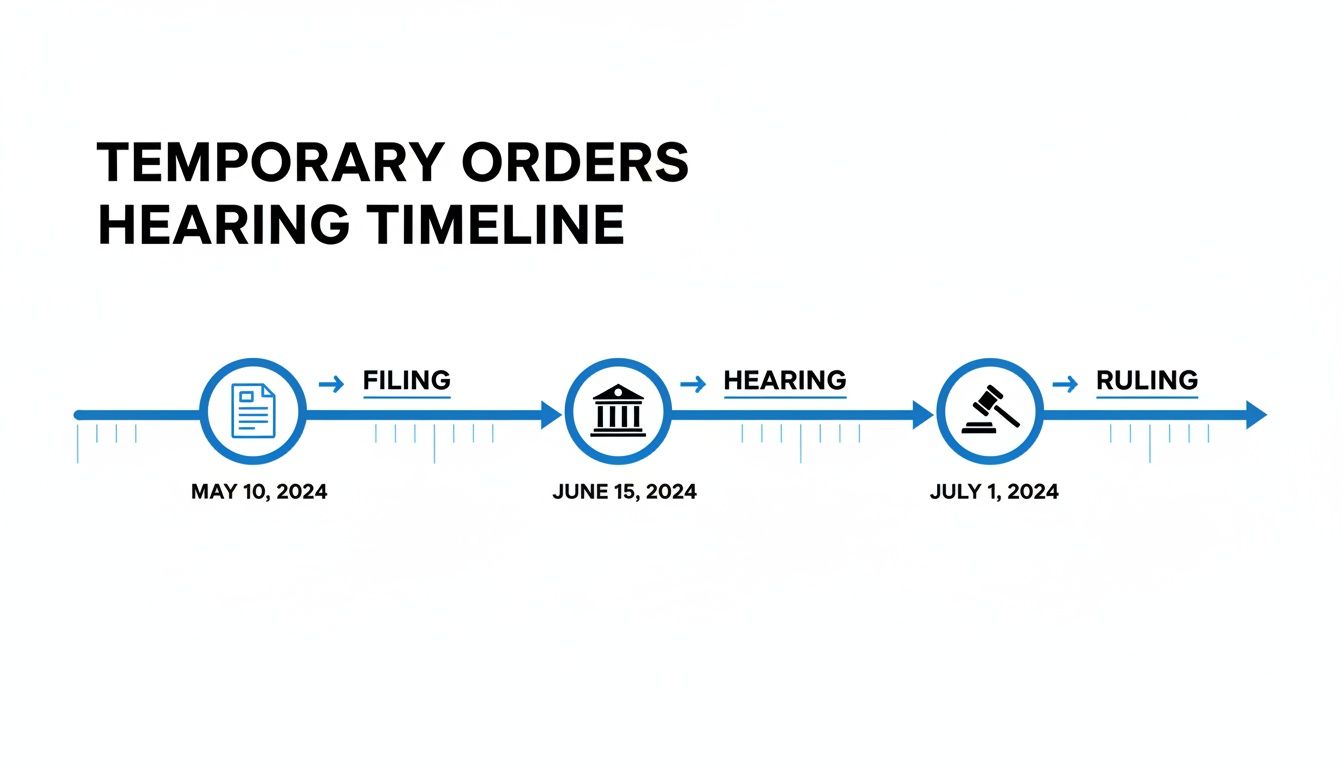
As you can see, while the process has distinct steps, it’s designed to move relatively quickly to address your family's most pressing needs.
The Role of Mediation Before the Hearing
Before you ever step foot in a courtroom, many Texas counties will require you and your spouse to attend mediation. This is a confidential meeting where a neutral third-party mediator helps you try to negotiate an agreement on the temporary issues yourselves.
Mediation is not about deciding who is right or wrong. It’s a practical, solution-focused opportunity to craft your own temporary plan and avoid leaving these critical decisions entirely in a judge's hands.
If you reach an agreement in mediation, your attorneys will draft what’s called a Mediated Settlement Agreement. This document gets signed by the judge and becomes your official temporary order—letting you skip the contested hearing altogether. If you can’t agree on everything, you'll simply head to the hearing to argue the remaining unresolved issues before the judge.
Building Your Case with Strong Evidence and Testimony
That gut feeling of knowing you’re right isn’t enough to win in a Texas courtroom. You have to prove it. Your temporary orders hearing is your first real chance to tell your story to the judge, and solid evidence is what turns your words into a credible, persuasive case.
Getting ready for this hearing means more than just showing up. It’s about methodically gathering the proof you need to protect your children, your home, and your finances. Judges are overloaded with cases and rely on clear, straightforward proof to make decisions. Your job, with your attorney's help, is to make it easy for them to see things your way.

Gathering Your Financial Arsenal
If you're asking the court for any kind of financial help—like child support, temporary spousal support, or for your spouse to keep paying the mortgage—you must back it up with hard numbers. The court needs a crystal-clear picture of what each of you earns and what it costs to run both households.
This is your evidence gathering checklist. Use it to organize the documents and proof you'll need to support your requests and build a persuasive case in court.
Your Evidence Gathering Checklist
| What You Are Asking For | Examples of Supporting Evidence | Practical Advice for Parents & Business Owners |
|---|---|---|
| Child Support | Recent pay stubs (yours and spouse's), last 2 years of tax returns, health insurance premium costs. | The Texas child support guidelines are based on net income. Having accurate proof of income is non-negotiable. For business owners, be prepared with Profit & Loss statements. |
| Spousal Support | Your detailed monthly budget (Inventory and Appraisement), bank statements, proof of your job search if unemployed. | You must prove you lack sufficient property to provide for your minimum reasonable needs. Your budget is key to demonstrating this. |
| Exclusive Use of the Home | Mortgage statements, utility bills, proof the home is in the child's school district. | Show the judge that forcing the kids to move would be disruptive. Stability for your children is a powerful argument. |
| Payment of Debts/Bills | Credit card statements, car loan documents, and utility bills showing the monthly amounts due. | Clearly list who has historically paid each bill. The judge will likely try to maintain the financial status quo. |
| Primary Custody | School records, medical logs, a proposed possession calendar, text messages showing your involvement. | Focus on who has been the primary caregiver. Show, don't just tell, the judge you handle the day-to-day responsibilities. |
| Attorney's Fees | Your attorney's fee agreement and recent invoices. | Frame the request around needing access to legal representation, especially if your spouse controls the finances. |
This isn't just about proving what you need; it’s about justifying your requests based on the financial reality of your marriage. A well-documented budget is often the most powerful tool you have.
Documenting What’s Best for Your Children
When children are involved, every decision the judge makes comes down to one guiding principle from the Texas Family Code: the best interest of the child. All your evidence should be laser-focused on showing how your requests create a stable, safe, and loving environment for them.
Some of the most powerful evidence in custody matters includes:
- A Log of Communications: Keep a clean record of texts and emails between you and your spouse. This can highlight your ability to co-parent effectively or, if necessary, expose a pattern of conflict or unreasonable behavior from the other side.
- School and Medical Records: Documents like report cards, attendance records, and doctor's visit summaries can quickly show which parent is more involved in your child’s education and health.
- A Proposed Possession Calendar: Don’t just describe the schedule you want. Bring a clear, color-coded calendar that shows the judge exactly what your proposed plan looks like. It makes your request easy to understand.
In the eyes of the court, actions speak louder than words. A simple calendar showing you take your child to every doctor's appointment is more persuasive than just saying you are the "more involved" parent.
This kind of documentation paints a clear picture for the judge of your child’s day-to-day life and your central role in it. For a deeper dive into the types of information you may need, check out our detailed guide on the discovery phase of a Texas divorce.
Preparing Your Testimony
Your own words on the witness stand are a critical piece of evidence. How you present yourself can dramatically affect how the judge perceives your credibility. The key is to stay calm, be direct, and stick to the facts.
You and your attorney will work together to prepare for your testimony. You’ll practice answering questions about your finances, your parenting role, and the specific things you are asking the court to order.
The most effective testimony is:
- Direct and To the Point: Answer only the question you were asked. Resist the urge to tell long stories or get sidetracked by emotion.
- Based on Facts, Not Feelings: Instead of saying, “He’s an irresponsible father,” give a factual example: “He has missed four of the last six scheduled pick-up times for our son.”
- Respectful: Always address the judge as “Your Honor.” Remain polite and courteous, even when your spouse’s attorney is cross-examining you.
Remember, the judge is a neutral decision-maker who is there to evaluate the facts. Your calm confidence and well-organized evidence go a long way in building the trust needed for a favorable ruling.
What to Expect on Your Day in Court
Walking into a courtroom for the first time can be incredibly intimidating. But knowing exactly what’s going to happen—and what’s expected of you—can turn that anxiety into quiet confidence.

This hearing is your chance to tell your side of the story directly to the judge. Being prepared for the environment is just as critical as the evidence you bring. Let's walk through the courtroom process so you know precisely what to expect when you arrive.
The Key Players and Courtroom Flow
When you walk in, the room will feel formal, but the process itself is very structured. You and your attorney will sit at one table facing the judge, while your spouse and their lawyer will be at the opposing table.
Also present will be the Judge, who makes the final decisions, and a Court Reporter, who creates an official transcript of every word spoken.
Once the judge calls your case, your attorney will likely present your side first. This usually starts with your testimony, guided by your lawyer’s questions—a process known as direct examination. Afterward, your spouse’s attorney gets to ask you questions, which is called cross-examination. The same thing then happens in reverse for your spouse.
Navigating Courtroom Etiquette
How you conduct yourself in court matters. A judge’s perception of you is shaped not just by your words, but by your behavior. Following proper etiquette shows respect for the court and reinforces your credibility.
Here are a few things to keep in mind:
- Dress Appropriately: Treat it like a serious job interview. Business casual attire is a safe bet—think slacks, a collared shirt, a blouse, or a conservative dress. Avoid shorts, graphic t-shirts, or anything too revealing.
- Address the Judge Correctly: Always use the title "Your Honor." It's also customary to stand when you speak to the judge and when they enter or leave the room.
- Speak Clearly and Calmly: When it's your turn to testify, take a breath. Answer only the question asked, be honest, and stick to the facts. Avoid emotional outbursts or arguing.
- Listen to the Questions: Pay close attention to what you're being asked. If you don't understand something, it’s completely okay to say, "Could you please rephrase the question?" Don't guess.
Your composure under pressure is a powerful form of testimony. By remaining calm, respectful, and focused on the facts, you demonstrate to the judge that you are a reasonable and credible parent and spouse.
Staying level-headed, especially during a tough cross-examination, shows the judge you can handle difficult situations—a key trait they look for when making decisions about children.
The Judge’s Primary Focus
While you may have a long list of things you want the judge to know, it's vital to understand their perspective. In a temporary orders hearing in a Texas divorce, especially when kids are involved, the judge’s questions will almost always circle back to one core theme from the Texas Family Code: the best interest of the child.
The judge needs to determine who has been the primary caregiver, what arrangement will provide the most stability for the children, and how each parent plans to support their well-being.
Be ready to answer direct questions about your parenting role, your child’s daily routine, and why the schedule you’re proposing is the best one for them. For a deeper look into the court's mindset, you can learn more about what judges look for on the first court date for divorce in Texas.
By understanding the process and focusing your testimony on what truly matters to the judge, you can walk into your hearing prepared to present your case clearly and effectively.
After the Ruling: Understanding Your Orders and What Comes Next
That moment when the judge finally speaks and hands down their decisions can bring a wave of relief, anxiety, or a mix of both. But the hearing isn’t truly over when the talking stops. Understanding what happens next is just as crucial as the hearing itself.
The judge’s verbal rulings from the bench must be put into a formal, written document called a Temporary Order. One of the attorneys drafts this document, meticulously detailing every decision made—from the child possession schedule to who pays the electric bill. Both you and your spouse will be required to sign it, confirming you understand and have received its terms.
From Verbal Ruling to Binding Court Order
This written order is not a guideline or a suggestion. It is a legally binding command from the court. Once signed by the judge, it carries the full force of the law. You and your spouse are required to follow it precisely until your divorce is finalized or the order is officially changed.
Think of it this way: the judge's spoken words are the blueprint, but the signed Temporary Order is the legally enforceable contract that will govern your life for the next several months.
The Consequences of Violating Temporary Orders
Failing to follow the Temporary Order is a serious matter. If your spouse isn’t complying—for example, if they refuse to pay court-ordered child support or deny you your scheduled time with the children—you have legal recourse. You can file what is called a Motion for Enforcement.
An enforcement action asks the judge to hold your spouse in contempt of court. If the judge finds that the order was violated, the consequences can be significant and may include:
- Fines
- An order to pay your attorney’s fees
- Make-up visitation time with your children
- In severe or repeated cases, even jail time
It is critical to document every single violation with dates, times, and specific details. This evidence is essential for a successful enforcement action and demonstrates a pattern of non-compliance to the judge.
This process ensures that the court's decisions have teeth and protects you during the divorce.
How Temporary Orders Shape the Next Phase of Your Divorce
Your temporary orders do more than just manage the present; they significantly influence the future of your case. The arrangements for custody and financial support established now often create a "new status quo." This new reality frequently becomes the starting point for negotiations in mediation and for the final terms in your Final Decree of Divorce.
If a particular custody schedule works well for several months, a judge is often reluctant to change it without a very compelling reason. This is why it's so important to get the temporary orders right the first time.
Adapting and Modifying Your Orders
Life doesn't stop just because you have a court order. A job loss, a necessary relocation, or a significant change in a child’s needs can make the current orders unworkable. The Texas Family Code allows for this.
If a "material and substantial change" in circumstances occurs, you can file a Motion to Modify the temporary orders. The court will then schedule another hearing to listen to evidence about the changes and decide if an adjustment is necessary. You cannot, however, decide to change the orders on your own, even if your spouse agrees. Any modification must be approved by the court to be legally enforceable.
Common Questions About Texas Temporary Orders
When you're facing a temporary orders hearing, a lot of questions come up. It's a confusing time, and getting clear, straightforward answers is crucial for your peace of mind. Here are answers to some of the most common concerns.
How Long Do Temporary Orders Last?
Think of temporary orders as the rulebook for your divorce while it's in progress. They are legally binding and stay in effect from the moment the judge signs them until the very end of your case—when your Final Decree of Divorce is officially signed. If you and your spouse decide to reconcile and dismiss the divorce, the orders will end then. Otherwise, they remain the law of your case until a new court order replaces them.
Can We Change the Temporary Orders Later On?
Yes, but it's not as simple as just agreeing to do things differently. To make a change, you have to go back to court. You’ll need to file a formal Motion to Modify the orders, proving that there has been a "material and substantial change" in the circumstances of a parent or child. This could be something significant like a job loss or a major change in a child's needs. A judge will then decide if modifying the orders is justified.
What Happens If My Spouse Ignores the Orders?
If your spouse refuses to follow what the judge ordered, you have a powerful tool at your disposal: a Motion for Enforcement. This is a serious legal action where you ask the judge to force compliance. A judge can find your spouse in contempt of court, which can lead to penalties like fines, an order to pay for your attorney’s fees, or in extreme cases, even jail time. It’s essential to document every single violation with dates, times, and details.
Do I Really Need a Lawyer for This Hearing?
While you technically have the right to represent yourself, it's a huge risk. The temporary orders hearing is arguably one of the most critical moments in your entire divorce. The outcome often sets the tone and trajectory for everything that follows, from custody to finances. An experienced family law attorney understands the rules of evidence, knows how to argue your case based on Texas law, and can protect your rights when the stakes are incredibly high. This isn't just another court date—it's the hearing that will define your reality for months to come.
What to Do Next: Take Control of Your Case
Navigating a temporary orders hearing is the first major step in protecting your family, your finances, and your future. The decisions made here can shape your life for the duration of your divorce and beyond. You don’t have to face this challenge alone.
The compassionate, experienced attorneys at The Law Office of Bryan Fagan, PLLC are here to provide the authoritative guidance you need to feel confident and prepared. We have helped thousands of Texas families establish stable foundations during difficult times. We invite you to schedule a free, no-obligation consultation to discuss your case and learn how we can help you build a solid plan for your next chapter. Contact us today at https://texasdivorcelawyer.us.