Skip to content
When you’re staring down the barrel of a divorce, the thought of keeping your financial head above water on a single income can be paralyzing. That first wave of uncertainty hits hard, but you’re not alone in this. The good news is, you don’t have to wait for the final decree to get help.
Texas law provides a powerful tool called temporary spousal support to give you a financial lifeline while your divorce is pending.
Understanding Your Financial Rights During a Texas Divorce
Texas courts get it. They understand that going from a two-income household to a one-income reality overnight is a recipe for disaster. That’s why the legal system has a built-in mechanism designed specifically to create a financial bridge from your married life to your new, independent one.
This tool is temporary spousal support. Think of it as a court order that requires one spouse to provide financial assistance to the other for a limited time—only while the divorce case is active. Its entire purpose is to cover your necessary living expenses so you can maintain some stability while navigating the legal process.

Temporary Support Is Not Permanent Alimony
It's easy to confuse the different types of support, so let's clear this up right away. Temporary spousal support is not the same thing as the long-term payments people often call "alimony." In Texas, those post-divorce payments are legally called "spousal maintenance," and they come with very strict, and often difficult, qualification rules.
Temporary spousal support, on the other hand, is meant to keep things fair while the divorce is happening. It helps preserve the financial status quo and prevents one spouse from being put at a major disadvantage during the proceedings.
To help you see the difference, here’s a quick comparison of the two main types of spousal support in Texas.
| Feature | Temporary Spousal Support (During Divorce) | Post-Divorce Maintenance (After Divorce) |
|---|---|---|
| Purpose | To cover necessary expenses and maintain financial stability during the divorce. | To provide ongoing support to a spouse who lacks sufficient assets or income after the divorce is final. |
| Eligibility | Based on one spouse's need and the other's ability to pay. More flexible criteria. | Requires meeting strict statutory requirements, often related to marriage duration (e.g., 10+ years) or family violence. |
| Governing Law | Not governed by a specific statute; based on the court's inherent authority to make just and right orders. | Governed by Chapter 8 of the Texas Family Code. |
| Duration | Only lasts until the divorce is finalized. | Can last for a set period after the divorce, with statutory limits (e.g., 5, 7, or 10 years). |
Understanding this distinction is the first step toward building a strong case for the immediate financial help you need. Temporary support ends the moment the judge signs the final decree. At that point, any long-term spousal maintenance would need to have been awarded separately as part of that final order.
"Think of temporary spousal support as a lifeline, not a long-term solution. Its sole purpose is to keep you financially stable from the moment you file for divorce until the judge signs the final decree."
In this guide, we'll walk you through exactly what temporary spousal support is, who qualifies, and the step-by-step process for requesting it. At The Law Office of Bryan Fagan, PLLC, our goal is to replace your anxiety with confidence by giving you the knowledge you need to protect your financial future.
Who Qualifies for Temporary Spousal Support
That gut-wrenching moment you look at your bank account and wonder how you’ll cover the bills alone is a feeling no one should have to endure. Let's talk about temporary spousal support—a crucial financial tool designed to prevent exactly this kind of hardship during a Texas divorce.
The whole point of temporary support is to maintain the financial ‘status quo’ as much as possible, preventing one spouse from being at an unfair disadvantage. Think of it as a lifeline designed to cover your "minimum reasonable needs"—essentials like your mortgage, utilities, car payment, and groceries while the divorce is pending.

The Two Core Requirements For Support
To qualify, you must demonstrate two fundamental things to the court. Unlike post-divorce maintenance, there's no complex, multi-year marriage requirement here. Instead, the entire focus is on the immediate financial reality of your separation.
- You have a clear financial need. This means proving that your monthly income and available assets are simply not enough to cover your necessary living expenses.
- Your spouse has the ability to pay. The court will examine your spouse’s income, assets, and their own expenses to confirm they have the financial capacity to provide support without creating an undue hardship for themselves.
A judge will look at the entire picture. If you’ve been out of the workforce to raise children or support your spouse’s career, the court absolutely takes that into account. Your request is about ensuring you can stay financially afloat while the divorce proceeds.
Proving Your Need To The Court
Simply saying you need money won't cut it; you have to show it with concrete evidence. This is where meticulous preparation becomes your greatest asset. Your attorney will help you prepare a detailed financial document—often called an Inventory and Appraisement or a proposed budget—that clearly outlines:
- Your Monthly Income: This includes wages, freelance earnings, or any other money you have coming in.
- Your Monthly Expenses: You’ll list everything from housing and food to insurance and transportation costs.
- Your Spouse’s Income: Pay stubs, tax returns, and bank statements can all be used to establish your spouse’s earnings.
The goal is to present a clear, compelling snapshot of your financial situation that justifies your request for temporary support. While the rules are more flexible than for post-divorce maintenance, providing this proof is non-negotiable. If you want to dive deeper into the specifics, you can learn more in our detailed guide on how you qualify for spousal support in Texas.
The Legal Basis In The Texas Family Code
While temporary support is granted based on a judge's discretion, its foundation is rooted in Texas law. This support acts as a critical lifeline during the often lengthy pending divorce period, allowing the lower-earning spouse to cover basic needs. Governed by Texas Family Code Section 6.502, courts award this support only after evaluating several key factors.
These include the income disparity between spouses, any marital misconduct like adultery or family violence, and, of course, the paying spouse's ability to afford the payments. It all comes back to proving you have a real financial need.
A common misconception is that you must be unemployed to qualify. This is not true. Even if you work, you may still be eligible if your income is significantly lower than your spouse's and insufficient to meet your minimum reasonable needs.
Ultimately, a judge’s decision is about fairness. They are tasked with making an order that is "just and right" under the circumstances of your specific case. By working with an experienced family law attorney, you can confidently present your case and fight for the financial stability you deserve during this challenging time.
How Courts Determine the Support Amount
One of the biggest questions clients have is, "How much support will I get?" It's a source of a lot of anxiety, so let's pull back the curtain on how a judge actually decides. Unlike the rigid formulas for post-divorce spousal maintenance, temporary support gives judges more flexibility. Their goal is to find an amount that is "just and right" for your specific situation.
There's no magic calculator for this. Instead, it’s a very human process where a judge looks at the evidence you and your spouse provide to make a fair call.
Balancing Needs and Ability to Pay
At its core, the judge’s decision is a balancing act. They start by looking at your proven monthly needs and then weigh them against your spouse's ability to pay.
Your job is to paint a clear picture of your essential expenses with a detailed proposed budget. This isn't a wish list—it’s about what you genuinely need to keep your head above water and maintain a stable home while the divorce is pending. We're talking about the non-negotiables:
- Housing: Your mortgage or rent payments.
- Utilities: Power, water, gas, and internet.
- Transportation: Car notes, insurance, and gas money.
- Groceries: What it costs to feed you and any children in your care.
- Insurance: Health, dental, and life insurance premiums.
On the flip side, the judge will put your spouse’s finances under a microscope. This includes their income from every source (gross and net), their own necessary living expenses, and their overall financial picture. The court isn't trying to leave the paying spouse high and dry, either. The goal is to provide support without creating an unfair financial burden on them.
The Standard of Living During the Marriage
It’s not just about covering bare-bones survival costs. Another huge piece of the puzzle is the lifestyle you and your spouse built together during the marriage. While temporary support isn't meant to perfectly duplicate a luxury lifestyle, it’s designed to prevent a sudden, drastic, and unfair crash in your standard of living.
For example, if you lived in a certain area so your kids could stay in their school district, a judge might find it reasonable to award enough support to keep you in that home for the time being. This provides stability for the kids and avoids uprooting them during an already chaotic time. The judge looks at the "status quo"—how things were right before the separation—to get a baseline for what's reasonable.
A common misconception is that temporary support is limited to a bare-bones survival budget. While it must be based on proven needs, the court can and will consider the lifestyle you were accustomed to in order to make a fair and equitable temporary order.
The Role of Financial Conduct
A judge will also look at how both spouses have been behaving with money. If one spouse has been blowing through community funds on purpose or is trying to hide assets to get out of paying support, the court can absolutely factor that into its decision. This is where being honest and transparent really pays off.
It’s important to know that while Texas law has strict caps on post-divorce spousal maintenance, those rules don't apply in the same rigid way to temporary support. For permanent maintenance, payments are capped at the lesser of 20% of the paying spouse's average monthly gross income or $5,000, according to Texas Family Code §8.055. But for temporary support during the divorce, a judge has more wiggle room to order an amount based on the proven needs and unique facts of the case. You can learn more about the calculations behind these support structures and how they might play out for you.
Ultimately, the amount a judge awards comes down to the specific facts of your case. Building a strong, well-documented argument is the key to getting a fair result that keeps you financially stable while you navigate your divorce.
Your Step-by-Step Guide to Requesting Temporary Orders
Stepping into the court system can feel like you've been handed a blindfold and told to find your way through a maze. It doesn't have to be that disorienting. Requesting temporary orders, which can include temporary spousal support, is a structured process. When you break it down into clear, manageable steps, the anxiety fades, and you feel back in control.
The first move is filing your Original Petition for Divorce. At the same time, your attorney will file another critical document: a Motion for Temporary Orders. Think of this motion as your official, formal request to the judge to make immediate decisions on pressing issues—like who stays in the house, who pays which bills, and, of course, whether you will receive temporary spousal support.
Preparing Your Financial Evidence
This is, without a doubt, the most important part of the process. A judge can’t grant support based on a hunch or your word alone. You have to provide clear, documented proof of what you need and what your spouse can afford to pay.
It’s time to become a financial detective for your own case. Start pulling these documents together right away:
- Pay Stubs: Gather at least the last 2-3 months for both you and your spouse, if you can access them.
- Bank Statements: Collect the last 6-12 months of statements for all checking and savings accounts.
- Tax Returns: The last two years of your joint tax returns offer a solid overview of your household's income.
- Credit Card Statements: These are invaluable for showing the court your family’s spending habits and routine monthly expenses.
Your attorney will take this information and help you build a detailed monthly budget. This budget is then put into a formal court document called a Proposed Inventory and Appraisement, which lays out all your assets, debts, income, and expenses. A well-prepared and honest budget is the foundation of a successful request for temporary spousal support.
The Hearing Timeline and What to Expect
Once your motion is filed, the court sets a date for a temporary orders hearing. This usually happens fast—often within a few weeks to a month. The quick timeline is by design; the court knows how urgent it is to establish some financial stability for your family. You can learn more about what this experience is like by reading about the temporary orders hearing in a Texas divorce.
This hearing is essentially a mini-trial. You and your spouse will both get a chance to testify and present your financial documents to the judge. The judge might ask you direct questions about your budget, what you're doing to find a job if you're unemployed, or your knowledge of your spouse's income.
The flowchart below shows the three main pillars a judge leans on when deciding on temporary support.
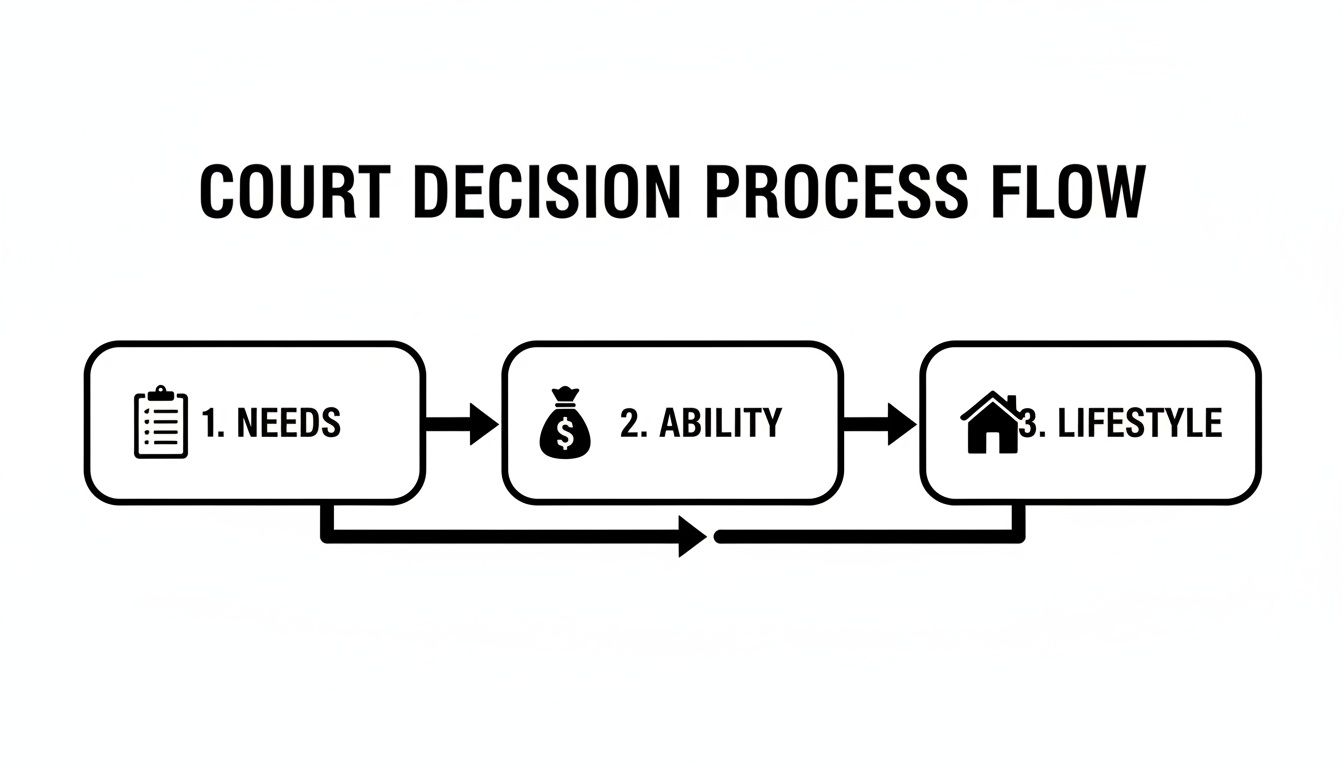
As you can see, the court's decision comes down to a balanced look at your proven financial needs, your spouse's ability to help, and the lifestyle you both established during the marriage.
During the hearing, your attorney’s job is to tell your story. They will present your budget, ask your spouse questions about their finances, and build a solid legal argument for why the amount you’re asking for is "just and right" under Texas Family Code Section 6.502.
At The Law Office of Bryan Fagan, PLLC, we don't see this hearing as a battle to be won. We see it as an opportunity to clearly and respectfully present the facts. Our job is to turn what feels like a daunting procedure into a clear, predictable path toward your financial security.
After listening to both sides, the judge will make a decision right there from the bench. That ruling becomes a legally binding court order that you and your spouse must follow until the divorce is finalized. This order is designed to give you the stability and resources you need to move forward with confidence.
Enforcing or Modifying a Temporary Support Order
Getting that temporary support order is a huge relief. It’s a financial lifeline while your divorce is pending. But what happens if your spouse simply decides not to pay, or if a major life event turns your finances upside down? It’s a scary thought, but remember this: a court order isn’t a polite request. It’s a command, and Texas law has serious teeth to make sure it’s followed.
These orders are built to be both firm and flexible—providing steady support now, with options to adapt if things genuinely change.
When Your Spouse Doesn’t Pay
If those court-ordered payments suddenly stop, it can feel like the floor has dropped out from under you. The most important thing to do is act fast. You can’t let the unpaid balance pile up. Your attorney can file a Motion for Enforcement, which is a formal way of telling the judge, "My spouse is ignoring your order, and I need your help."
This isn't just a slap on the wrist. A judge has powerful tools to compel payment:
- Wage Garnishment: The court can order your spouse's employer to take the support money directly out of their paycheck before they even see it.
- Property Liens: A lien can be placed on their assets, like a house or a car. This means they can't sell that property until you've been paid what you're owed.
- Contempt of Court: For willful non-payment, a judge can hold your spouse in contempt of court. This can lead to hefty fines and even jail time.
An enforcement action makes it crystal clear that ignoring a court order has real, significant consequences. You can learn more about the specifics by reading our in-depth article on filing a Motion to Enforce in Texas.
When Life Circumstances Change
Just as the law provides a way to enforce an order, it also recognizes that life is unpredictable. So, what happens if you or your spouse has a huge shift in financial circumstances while the order is in place? You can go back to the court and ask to change the support amount by filing a Motion to Modify.
To get a modification, you have to prove there’s been a “material and substantial change” in circumstances since the judge signed the original order. It’s a high bar, but it’s definitely not impossible.
For example, if the paying spouse gets laid off from their job through no fault of their own, they could ask the court to temporarily lower their payments. On the flip side, if you, as the receiving spouse, are suddenly diagnosed with a serious medical condition that comes with big bills, you could ask the court to increase the support amount to help cover those new, essential needs.
The key is bringing proof. You can't just say things have changed; you have to show it with documents like termination letters, new job offers, or medical records.
This flexibility is a hallmark of how Texas family law works. While temporary support only lasts until the divorce is final, the idea of adapting to reality is crucial. Even the duration of spousal maintenance after a divorce is tied to real-life factors like marriage length, with strict maximums of 5 years for 10-20 year marriages, 7 years for 20-30 years, and 10 years for marriages over 30 years, as outlined in Texas Family Code §8.054. You can discover more insights about spousal support guidelines in Texas on our blog.
Frequently Asked Questions About Temporary Support
When you’re staring down the complexities of a Texas divorce, it’s completely normal for your mind to race with questions about financial security. The idea of temporary spousal support, in particular, brings up a lot of concerns for our clients—from whether they even qualify to how it all actually works.
Let's cut through the noise and get you some clear, straightforward answers to the questions we hear most often.
Can I Get Temporary Support If I Work Part-Time?
Yes, absolutely. One of the biggest myths we have to bust is that you must be totally unemployed to ask for temporary support. That’s just not how the courts see it. Their main focus is on your actual, demonstrated need and whether your spouse has the ability to help, not simply your employment status.
If your part-time job doesn't bring in enough to cover your minimum reasonable needs, you could still be eligible. A judge will look at the whole picture, including your earning potential and the reasons you might be underemployed—like if you’ve spent years as the primary caregiver for your children. The goal here is to create financial stability during the divorce, and the court understands that a part-time paycheck often isn't enough to fill the gap left after a separation.
How Is Temporary Support Actually Paid?
Once a judge issues an order for temporary support, the goal is to make payments consistent and easy to track. The simplest method is a direct payment from your spouse to you, usually through a bank transfer or a check.
However, to sidestep any potential for conflict or missed payments, the most reliable method is a wage withholding order. This is a powerful tool under the Texas Family Code. The order goes straight to your spouse's employer, who is then legally required to deduct the support amount from each paycheck and send it directly to you. It's the best way to ensure payments arrive on time and in full, without you having to chase them down.
What If My Spouse Is Hiding Income?
This is a very serious and unfortunately common concern, especially in divorces involving business owners or complex, high-value assets. If you have a gut feeling that your spouse is playing games with their finances to dodge a support obligation, your attorney has legal tools to get to the truth. The main one is called discovery.
Through the discovery process, we can formally demand all kinds of financial records, including:
- Bank and investment account statements
- Business profit-and-loss sheets
- Complete tax returns and recent loan applications
- Credit card statements
If your spouse digs in their heels and refuses to hand over the documents, we can file a motion to compel, asking the judge to force them to comply. In some situations, we’ll even bring in a forensic accountant to dig deep, trace hidden money, and present the real financial story to the court.
Does Receiving Temporary Support Reduce My Final Property Settlement?
No, not directly. It’s critical to understand that temporary spousal support and the final division of your community property are two completely separate legal issues in a divorce. The money you get for temporary support is intended to cover your day-to-day living expenses while the divorce is pending. It is not an advance on your share of the marital estate.
That said, the two can be practically linked. For example, receiving significant temporary support might be what allows you to stay in the marital home until the divorce is over. That home could then become part of your final property settlement. Think of temporary support as the tool that keeps you stable right now, while the final property division is about securing your financial future for the long haul.
Key Takeaway: What to Do Next
Getting a handle on your finances during a divorce can feel like trying to find your footing in an earthquake. But as we've walked through the process for temporary spousal support in a Texas divorce, you can see there's a clear, legal path available to secure your stability. The key isn't just knowing the rules—it's taking focused, practical action.
Moving from a state of uncertainty to one of confident preparation starts right now. The steps you take next will build the foundation for a strong, well-supported request to the court. Here are the immediate actions you should focus on:
- Gather Your Financials: Start pulling together all your financial documents. This means recent pay stubs, bank statements for every account you have, your last two years of tax returns, and any credit card statements you can find. These papers are the hard evidence that backs up your request.
- Build a Real-World Budget: Create a detailed list of every single one of your monthly expenses. Don't leave anything out—from the mortgage or rent payment and utility bills to groceries, gas for the car, and insurance premiums. This budget is what proves your “minimum reasonable needs” to the judge.
- Document Your Spouse’s Income: If you have access to your spouse's pay stubs or know where they work and bank, make a note of it. Any piece of information you have about their earnings is critical for showing the court their ability to provide support.
Above all, please know you don't have to walk this path alone. The stakes are simply too high to risk a misstep or a missed opportunity. The right legal guidance can be the deciding factor in securing your financial well-being and peace of mind. At The Law Office of Bryan Fagan, PLLC, we help Texas families understand their rights and build strong cases for the financial support they need. Schedule a free, confidential consultation with us today to get the answers and protection you deserve. Visit us at https://texasdivorcelawyer.us to get started.