Skip to content
Receiving a thick packet of legal documents from your spouse’s attorney can feel overwhelming. Before you panic, it's important to understand this is the official start of the discovery phase of divorce—a formal, pre-trial process where you and your spouse exchange all relevant information and documents. This isn’t about digging up “dirt”; it's about getting everything on the table to create a clear and honest financial picture for a fair settlement.
What Is Divorce Discovery and Why Does It Matter?
When you're facing a divorce, legal terms like "discovery" can sound intimidating and confrontational. But it’s more like creating a detailed map of your entire marital estate before you decide how to divide it. This isn't just a suggestion; it's a fundamental requirement under the Texas Family Code, designed to make sure both you and your spouse are working from the same set of facts.
Think of it as building the foundation for your new life. Without a complete understanding of every asset, debt, and source of income, it's impossible to negotiate a fair settlement. The whole point of the discovery phase is to promote total transparency and prevent one person from having an unfair advantage just because they held the financial reins during the marriage.
The Purpose of Discovery in Your Texas Divorce
The information you gather during discovery is the bedrock for every single decision made in your divorce. It has a direct line to the most critical outcomes you'll face:
- Fair Property Division: Under the Texas Family Code, discovery ensures all community property is identified, valued correctly, and divided in a "just and right" manner.
- Accurate Child Support Calculations: This process verifies both parents' true incomes, which is absolutely essential for calculating child support according to Texas state guidelines. No guesswork allowed.
- Spousal Maintenance Determinations: It provides the court with the facts needed to decide if one spouse is eligible for spousal maintenance and, if so, for how much and for how long.
This process becomes even more critical when your finances are complicated. For Texas business owners or couples with high-value estates, discovery provides the deep-dive analysis needed to protect your financial interests. National trends show why this is so important; with 73 percent of all third marriages ending in divorce, the financial stakes are higher than ever. A thorough discovery process is essential for protecting what's yours. You can explore more about U.S. divorce statistics and see why this phase can't be taken lightly.
Ultimately, participating fully in discovery empowers you and your attorney. It allows you to negotiate from a position of knowledge and strength, dramatically reducing the risk of future fights over hidden assets and ensuring your final divorce decree is built on truth and fairness.
The 5 Essential Tools of Divorce Discovery
Trying to piece together the complete financial picture of your marriage can feel like solving a massive puzzle with half the pieces missing. That’s where the discovery phase of a Texas divorce comes in. It provides a structured, legal way to find every single one of those missing pieces. Your attorney will use five primary tools, each designed for a specific job, to gather all the necessary information and work toward a fair outcome.
The whole point of this process is to make sure every decision is based on facts, not guesswork. It’s the engine that drives a fair resolution, whether you’re dealing with property division, child custody, or financial support.
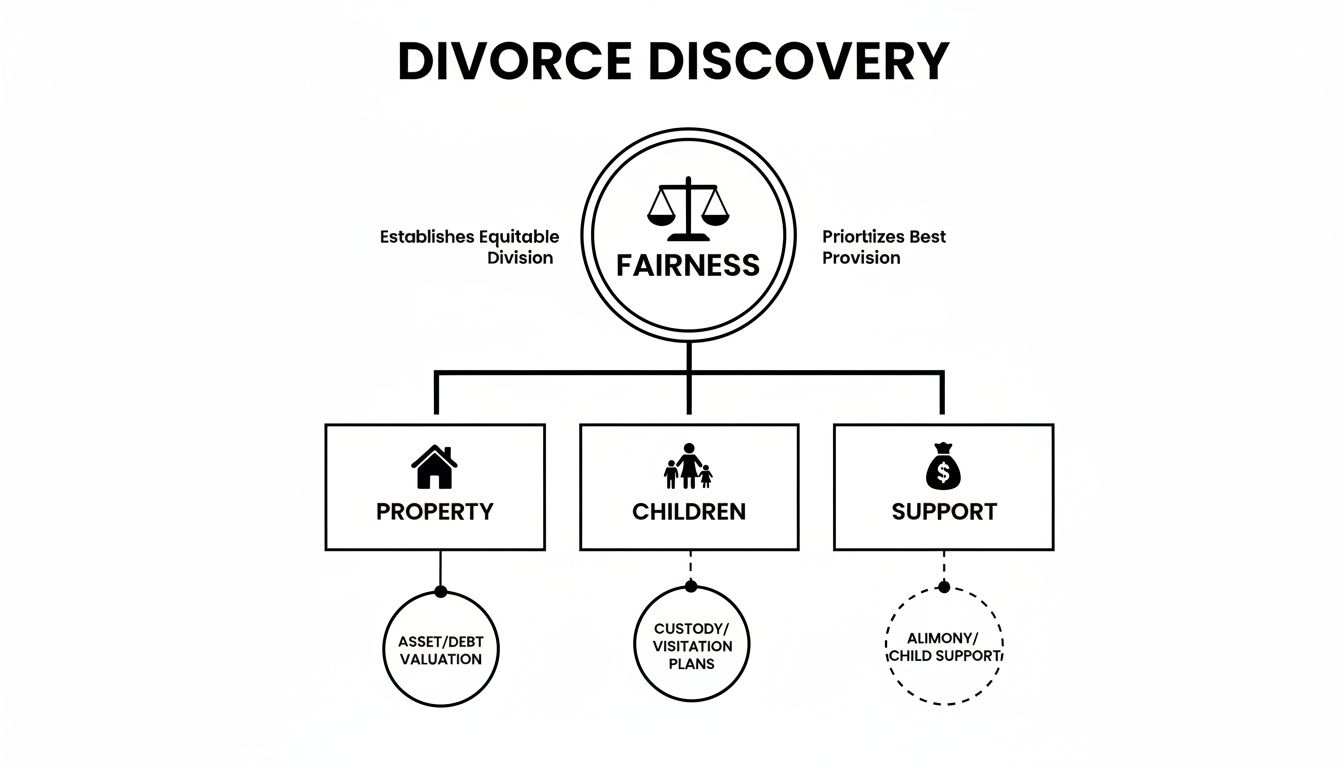
As you can see, discovery is designed to bring everything into the light so that the final agreement is just and right. Let's break down the five tools that make this happen.
Here’s a quick-reference table to help you understand the purpose and function of each formal discovery method used in Texas family law cases.
| Discovery Tool | What It Is | What You Can Expect |
|---|---|---|
| Requests for Disclosure | A standard set of foundational questions that both spouses must answer at the beginning of the case. | Think of this as the basic "get to know you" phase. It covers essential facts like legal names, potential witnesses, and the legal theories of the case. |
| Interrogatories | Custom-written questions tailored to the specific issues in your divorce, which must be answered under oath. | This is where your attorney can dig deeper into unique situations, like a family business, suspected hidden assets, or unusual financial activity. |
| Requests for Production | A formal demand for documents and other tangible evidence to back up claims and verify financial information. | Get ready to see the paperwork. This includes bank statements, deeds, tax returns, and anything else that proves what you own and owe. |
| Depositions | An out-of-court, under-oath interview where one attorney questions the other spouse or a witness. | A face-to-face (or virtual) Q&A session. It's a chance to get direct answers, lock in testimony, and see how a witness might perform in court. |
| Subpoenas | A court order that forces a third party—like a bank, employer, or business partner—to provide documents or testimony. | When your spouse can't (or won't) provide key information, this tool lets your attorney go straight to the source to get it. |
Now, let's explore how each of these tools works in a real-world divorce case.
1. Requests for Disclosure
The simplest and most common starting point is the Request for Disclosure. Think of it as the standard-issue questionnaire that both you and your spouse will fill out. It’s not meant to be overly invasive but rather to establish a baseline of essential information.
Under the Texas Rules of Civil Procedure, these requests cover the basics:
- The correct legal names of everyone involved.
- The names of any potential witnesses who might have relevant information.
- Basic financial details and the legal theories related to your case.
You typically have 30 days to respond after receiving these requests. They are the first step in getting both sides on the same page about the fundamental facts.
2. Interrogatories
If Disclosures are the standard questionnaire, Interrogatories are the custom-built ones. These are detailed, written questions that your attorney drafts specifically for your spouse to answer under oath. Their purpose is to dig much deeper into the issues that are unique to your marriage.
For example, if your spouse owns a business, your attorney might ask very specific questions about its revenue, expenses, and ownership structure. If you suspect hidden assets, Interrogatories can be used to ask direct questions about financial accounts or recent large transactions. They help fill in the blanks that the standard disclosures leave behind.
“Interrogatories are a powerful tool for clarity. They force the other side to go on the record, under oath, about specific financial details or events, which can be crucial for building your case for a just and right division of property.”
Just like disclosures, the other side generally has 30 days to provide written, sworn answers to these questions.
3. Requests for Production
Words are one thing, but documents are proof. Requests for Production are formal demands for the physical or digital documents that back up all the claims being made. This is where you get the hard evidence needed to verify the value of your marital estate.
Commonly requested documents include:
- Financial Records: Bank statements, credit card bills, and loan applications.
- Property Documents: Deeds to real estate, vehicle titles, and mortgage statements.
- Employment Information: Pay stubs, W-2 forms, and employment contracts.
- Business Records: Profit and loss statements, balance sheets, and tax returns.
This tool is absolutely vital for tracing assets and confirming the true value of your community estate. Responding on time is critical; failing to produce documents within the 30-day deadline can have serious consequences. To get a better handle on what you might need to gather, you can read more about the essential documents for filing for divorce in Texas.
4. Depositions
A deposition is a formal, out-of-court interview where your attorney questions your spouse (or other key witnesses) under oath. A court reporter is present to record everything that’s said, creating an official transcript that can be used in negotiations, mediation, or even at trial.
Depositions are most often used in more complex or highly contested cases. They give your attorney the chance to ask follow-up questions in real-time, see how credible your spouse appears, and lock in their testimony. This prevents them from changing their story later on. It’s the most direct way to get answers without the filter of carefully crafted written responses.
5. Subpoenas
What happens when crucial information is held by a third party, like a bank, an employer, or your spouse's business partner? That’s where a subpoena comes into play. A subpoena is a court order that legally compels a person or an organization not directly involved in your divorce to provide documents or testimony.
For instance, if you need bank records that your spouse refuses to provide, your attorney can issue a subpoena directly to the bank. This ensures you get the information straight from the source, removing any chance for it to be altered or withheld. It’s a key tool for ensuring total transparency, especially when one party is being uncooperative.
Your Practical Checklist for Gathering Documents
That feeling of being buried in paperwork is totally normal during a divorce. But getting organized is the single best way you can reclaim some control over the process.
Think of this process less like a chore and more like building the financial story of your marriage. When you gather these documents proactively, you give your attorney the facts they need to fight for your future. This checklist breaks the big task down into smaller, more manageable pieces. Each document is a piece of the puzzle; together, they create the complete picture needed for a fair division of property under Texas law.

Financial Statements and Debt Records
This is all about the daily flow of money in your marriage. These papers show where the money came from, where it went, and what you owe as a couple. They are absolutely critical for spotting spending patterns and figuring out the value of your liquid assets.
- Bank Account Statements: You'll want to track down statements for the last 3-5 years for every account—checking, savings, money markets—whether they're in your name, your spouse's, or held jointly.
- Credit Card Statements: Grab the monthly statements for the same time frame. These are gold mines for identifying marital debts and tracking major purchases.
- Loan Documents: This covers mortgages, home equity lines of credit (HELOCs), car loans, and any personal loans. These papers define your community debts.
Income and Employment Records
Each spouse's income is the bedrock for calculating child support and any potential spousal maintenance. Total transparency here isn't just a good idea; it's required for a fair outcome.
These documents are the primary evidence of each spouse's earning capacity and financial stability. Without them, it's impossible for a Texas court to make an informed decision about support obligations.
Your lawyer will need to see:
- Pay Stubs: The last six months to a year's worth for both you and your spouse.
- Tax Returns: Get the personal and business tax returns for the past five years, making sure to include all schedules and W-2s/1099s.
- Employment Contracts: Any agreements that outline bonuses, stock options, or other forms of compensation are key.
Real Estate and Business Documents
For many Texas families, the house and a family business are the biggest assets on the table. You can't guess at their value. You need specific documents to prove ownership, debt, and what they're worth. This is a non-negotiable step in getting a just and right division of your community estate.
For Real Estate:
- Deeds and titles for any properties you own.
- Mortgage statements and property tax records.
- Any recent appraisals or home inspection reports.
For Business Owners:
- Profit and Loss (P&L) statements.
- Balance sheets and cash flow statements.
- Partnership agreements or corporate records.
Retirement, Investments, and Personal Property
Retirement and investment accounts often make up a huge chunk of a marital estate, and they are absolutely subject to division. At the same time, you can't forget about valuable personal items.
- Retirement Accounts: Statements for 401(k)s, IRAs, pensions, and any other retirement plans.
- Investment Accounts: Statements for brokerage accounts holding stocks, bonds, and mutual funds.
- Personal Property: Titles for vehicles, boats, or RVs. It's also smart to create a detailed inventory of other valuables like jewelry, art, or collectibles.
Once you have everything gathered, it's crucial to check it all for accuracy and consistency. A great way to do this is to learn how to compare documents, which can help you spot any differences between your records and what your spouse provides. For a deeper dive, you can also check out our guide on the essential documents for filing for divorce in Texas.
Discovery in High-Asset and Business Owner Divorces
Watching your personal wealth and the business you’ve poured your life into become subjects of legal scrutiny is an incredibly stressful experience. When you have significant assets or a business to protect, the discovery phase of a divorce shifts from a standard information exchange to a high-stakes financial investigation.
It’s no longer just about swapping bank statements. It’s about making sure every complex asset is identified, accurately valued, and fairly handled under Texas law. This process is about protecting the future you’ve worked so hard to build, and for high-asset and business owner divorces, a standard approach just won’t cut it. You need a deeper, more specialized strategy to get a true and fair financial picture.
Beyond the Basics: Uncovering the Full Financial Story
In a high-asset divorce, the financial portfolio is rarely just a house and a 401(k). The discovery process has to expand to analyze intricate and often less-liquid assets, which requires a level of financial sophistication that goes far beyond a typical case.
To get the job done right, your attorney will likely need to bring in a team of experts, including:
- Forensic Accountants: Think of them as financial detectives. They are trained to trace assets, uncover hidden or mischaracterized funds, and analyze complex financial transactions to ensure complete transparency.
- Business Valuation Experts: If a family business is on the table, a valuation expert is essential to determine its true market value. This is a critical step for ensuring a just and right division of community property. You can learn more about this complex process in our guide to divorce and business valuation.
- Appraisers: Specialists are often needed to value unique assets like fine art, classic car collections, extensive real estate holdings, or valuable jewelry.
This expert-led approach makes sure every single asset is accounted for, from complicated investment portfolios and stock options to intellectual property and trusts.
Navigating the Unique Challenges for Business Owners
If you own a business, the discovery process can feel like a direct threat to your company’s stability and privacy. You have legal obligations to disclose financial information, but you also have to protect your operations, employees, and trade secrets from unnecessary disruption.
A key challenge is separating what’s personal (community property) from what is essential to the business’s continued operation. Your attorney will work to establish clear boundaries and, if necessary, seek protective orders from the court to limit who can access sensitive proprietary information. The goal is to comply with the law while shielding your business from being torn apart in the process.
For business owners, discovery is a delicate balance. You must provide the necessary financial transparency for the divorce while simultaneously protecting the health and confidentiality of the business that supports your family and your future.
The Timeline and Cost of Complex Discovery
It’s important to be realistic. The discovery phase in a high-asset divorce is one of the most time-intensive and expensive parts of the entire process. It can easily span several months to over a year, depending on the complexity of your assets and how cooperative your spouse is.
A typical timeline includes preliminary disclosures (30-60 days), followed by document production (3-6 months), and then expert valuations, which can take an additional 2-6 months. For Texans with significant financial holdings, understanding this commitment is crucial for both planning and budgeting.
What to Do Next
Given the high stakes, trying to navigate this process alone is not an option. You need an attorney with specific experience in high-asset and business-owner divorces.
Here are the immediate steps you should consider:
- Secure Your Team: Find an attorney who understands the nuances of complex property division and has a network of trusted financial experts.
- Gather Key Documents: Start organizing high-level financial documents like business tax returns, partnership agreements, and statements for major investment accounts.
- Prioritize Transparency (with Counsel): Be completely open with your legal team. The more they know, the better they can protect you and build an effective strategy.
The complexity of a high-asset divorce demands a higher level of legal skill and strategic planning. A seasoned attorney won't just manage the intricate discovery process—they will work to safeguard your financial future long after the divorce is final.
Common Mistakes to Avoid During Discovery
The feeling of being under a microscope during discovery can make even the most honest person feel defensive. However, your best defense against costly errors isn't defensiveness—it's preparation and honesty. Getting this wrong can jeopardize your financial future and damage your credibility with the court.
Hiding Assets or Being Dishonest
The single biggest mistake you can make during the discovery phase of divorce is attempting to hide assets or lie on your sworn financial documents. The temptation might be strong, especially if you feel an asset is rightfully yours, but the consequences in a Texas court are severe and long-lasting.
If you get caught, the judge has a lot of power to impose harsh penalties. This could mean awarding a larger portion of the community estate to your spouse, ordering you to pay their attorney's fees, or even hitting you with fines. In extreme cases, you could be looking at fraud charges. Trust is everything in the legal process; once it's gone, it's nearly impossible to get back.
Real-World Scenario: A husband transfers $50,000 from a joint savings account to a new, secret account in his name, hoping his wife won’t notice. Her attorney discovers the transfer through a bank subpoena. The judge not only awards the entire $50,000 to the wife but also orders the husband to pay $10,000 of her legal fees as a penalty for his dishonesty.
Missing Critical Deadlines
Discovery runs on a strict schedule. In Texas, you typically have just 30 days to respond after receiving a request. Ignoring these deadlines or providing incomplete answers can seriously backfire. When you fail to respond on time, you hand your spouse's attorney a golden opportunity to file a "Motion to Compel" with the court.
This motion forces you to provide the information and makes you look uncooperative in the judge's eyes. Consistent delays can lead to even worse sanctions, like the court refusing to let you present evidence on certain matters later on. You completely lose control of the narrative and are forced to play defense for the rest of the case.
Sharing Too Much Unfiltered Information
In an effort to seem transparent, you might feel tempted to just hand over every document you can find. This is a huge mistake. Never send anything directly to your spouse or their attorney. Always, without exception, give all documents and your draft responses to your own lawyer for review first.
Your attorney’s job is to make sure you’re only providing what is legally required and relevant to the case. They will also spot any documents that might be privileged or confidential. Handing over unfiltered information can accidentally give the other side leverage they aren't entitled to and would have never found otherwise.
Failing to Ask Strategic Questions
Discovery isn't just a one-way street where you respond to requests—it's also your chance to gather the information you need to build a strong case. A common mistake is being too passive and not working with your attorney to ask targeted, strategic questions. Well-crafted interrogatories and requests for production can poke holes in your spouse’s claims.
For example, asking for credit card statements can reveal spending habits that completely contradict their claims of financial need. Business records can clarify the true value of a company they might be downplaying. Proactive and smart discovery creates leverage for negotiations and protects you from getting blindsided down the road.
Trying to Navigate It Alone
The discovery process is governed by the Texas Rules of Civil Procedure and is packed with legal complexities, deadlines, and potential traps. Trying to handle it without an experienced family law attorney is like trying to perform surgery on yourself—it’s incredibly risky and the outcome will likely be disastrous.
An attorney doesn't just ensure you comply with all the rules; they act as your strategic advocate. They know what questions to ask, how to interpret the information you receive, and how to shield you from overreaching requests. For more insights on formal interviews, check out our article on common mistakes to avoid during your divorce deposition.
What to Do Next
The discovery phase is where you lay the foundation for your new life. While it can feel invasive and exhausting, its purpose is to ensure every decision in your divorce is built on facts, not guesses. Your commitment to getting this right directly shapes how fair your final outcome will be.
Staying organized, being upfront with your attorney, and thinking strategically about your responses are the keys to navigating this stage with confidence. Every document you find and every question you answer helps paint the complete financial picture needed for a just and right division of your marital estate under Texas law.
Key Takeaway
The information gathered during discovery is the raw material used to build your final divorce decree. By engaging in the process honestly and strategically with the guidance of a skilled attorney, you ensure the foundation of your post-divorce life is stable, fair, and secure.
Take Control of Your Future
This journey might feel intimidating, but you don't have to walk it alone. The single most powerful step you can take to protect yourself is to get professional guidance from an attorney who truly understands the ins and outs of the discovery phase of divorce in Texas. A good lawyer is your advocate, your strategist, and your shield, making sure you meet your legal duties while protecting you from unfair scrutiny.
Proactive planning is crucial, not just for the divorce itself, but for your financial health for years to come. To protect your financial well-being, it's vital to understand what steps you can take to secure your assets. You can learn more about asset protection in divorce and see how taking action early can safeguard your future. This knowledge, paired with expert legal advice, puts you in a position of strength.
You don’t have to face the uncertainty of discovery by yourself. The decisions made during this phase will ripple through your family and finances for a long time. Taking the first step to get legal advice isn't a sign of weakness; it's an act of empowerment. The compassionate attorneys at The Law Office of Bryan Fagan, PLLC are here to help you understand your rights and map out a clear path forward. We invite you to schedule a free, confidential consultation to talk about your specific situation. Let us show you how our experience, empathy, and dedicated advocacy can protect what matters most to you and help you start your next chapter with confidence.
Answers to Common Texas Divorce Discovery Questions
Going through a divorce brings up a ton of questions, especially during the discovery phase. Getting clear, straightforward answers can make a world of difference, helping you feel more confident and in control of where things are headed.
How Long Does Discovery Take in Texas?
There’s no one-size-fits-all answer here; the timeline for discovery really depends on how complex your case is. If you and your spouse are on the same page in a simple, uncontested divorce, the whole process might only take two to three months.
But for more tangled situations—like contested divorces, high-asset cases with businesses and multiple properties, or if you suspect your spouse is hiding assets—it’s a different story. In those cases, discovery can easily stretch out for six to twelve months, and sometimes even longer.
What if My Spouse Refuses to Provide Documents?
It's frustrating when a spouse won't cooperate, but you aren't stuck. If your spouse is refusing to hand over requested information, your attorney has a powerful tool: filing a Motion to Compel with the court.
If the judge grants this motion, your spouse is legally ordered to produce the documents. Ignoring a court order comes with serious consequences, from fines to the judge ruling against them on key financial issues in your divorce.
Is Discovery Information Used in Mediation?
Absolutely. In fact, that's one of its main purposes. The documents and information you gather during discovery are the foundation for productive negotiations in mediation.
Having everything out on the table ensures both you and your spouse are working from the same complete and accurate financial picture. This shared understanding is crucial for reaching a fair and lasting settlement agreement without having to take the fight to trial.
Is Formal Discovery Always Necessary?
Even in the most amicable divorces, Texas law requires a full and honest exchange of financial information. While you might be able to skip some of the formal back-and-forth, transparency is completely non-negotiable.
Ultimately, both parties will have to sign a Sworn Inventory and Appraisement. This is a legally binding document where you swear under oath that all assets and debts have been disclosed. It’s the final check to make sure the divorce decree is fair, legally sound, and based on the real numbers.
The decisions made during the discovery process will echo through your family and finances for years. At The Law Office of Bryan Fagan, PLLC, we’re here to give you the clarity and strategic guidance you need to navigate it. We invite you to schedule a free, confidential consultation to discuss your case and learn how we can protect your interests with compassion and confidence. Contact us today at https://texasdivorcelawyer.us to start your next chapter.