Skip to content
When you're a dad fighting to protect your child, that instinct can be all-consuming. If you're asking how you can get full custody in Texas, know that the path forward means proving to a judge that making you the sole decision-maker is not just better, but absolutely essential for your child’s well-being. This is a high bar to clear, but with the right evidence and a solid strategy, it's a fight you can win.
Understanding What "Full Custody" Really Means in Texas
When you talk about wanting "full custody," you’re likely thinking about having your child live with you and being the one to make all the important decisions. In Texas, the Family Code uses specific terms for this, and the first step in building your case is understanding that language.

You won’t find the phrase "full custody" in the Texas Family Code. Instead, judges use the term conservatorship, which outlines a parent's legal rights and responsibilities. The law presumes that a Joint Managing Conservatorship is in the child's best interest. This is the standard arrangement where you and the other parent share the rights and duties of raising your child, even if one of you determines where the child primarily lives.
What you are seeking is called Sole Managing Conservatorship. This is a significant departure from the standard and is only awarded in situations where a joint arrangement would damage your child's physical or emotional health.
The High Bar for Sole Managing Conservatorship
To be named the Sole Managing Conservator, you must overcome the court's strong preference for joint custody. This isn't about proving you're the "better" parent. It's about demonstrating with compelling evidence that the other parent poses a risk to your child or has shown a severe inability to parent effectively.
According to the Texas Family Code, a judge will only grant sole managing conservatorship if there is clear evidence of serious issues, such as:
- Family Violence: A history of physical, sexual, or emotional abuse toward the child or another family member.
- Substance Abuse: Documented drug or alcohol abuse that interferes with the ability to safely care for the child.
- Extreme Parental Alienation: A consistent, malicious pattern of behavior from the other parent designed to destroy your relationship with your child.
- Child Neglect or Abandonment: A failure to provide for the child's basic needs—like food, shelter, or medical care—or a significant, unexplained absence from the child's life.
- Grossly Poor Judgment: A history of making choices that directly endanger the child's safety or well-being.
What Rights Do You Gain as Sole Managing Conservator?
Securing sole managing conservatorship gives you the exclusive authority to make crucial decisions for your child without the other parent's agreement. This is the fundamental difference between joint and sole arrangements. You can learn more about the nuances of joint custody vs. sole custody on our blog, but the core exclusive rights are game-changers.
The table below breaks down the key differences in parental rights between the standard joint arrangement and the sole conservatorship you're pursuing.
Joint vs. Sole Managing Conservatorship Rights
| Parental Right | Joint Managing Conservatorship (Standard) | Sole Managing Conservatorship ('Full Custody') |
|---|---|---|
| Child's Residence | One parent is designated to establish the child's primary residence, often within a geographic restriction. | The Sole Managing Conservator has the exclusive right to determine the child's primary residence without geographic restriction (unless otherwise ordered). |
| Major Decisions | Rights to make decisions about education, medical care, and psychological treatment are often shared or allocated between parents. | The Sole Managing Conservator has the exclusive right to make all decisions regarding education, medical care, and psychological treatment. |
| Child Support | The non-primary parent typically pays child support to the primary parent. | The other parent (the Possessory Conservator) is ordered to pay child support to the Sole Managing Conservator. |
| Consent to Marriage/Military | Both parents must typically consent for the child to marry or enlist in the armed forces before age 18. | The Sole Managing Conservator has the exclusive right to consent to the child's marriage or military enlistment. |
As you can see, the shift from joint to sole is a complete transfer of decision-making power. It's a significant legal step that courts consider very carefully.
Historically, the road for fathers seeking this kind of authority has been tough, but the legal landscape is evolving. While mothers are still awarded primary care more often, the number of fathers winning these cases is absolutely on the rise. U.S. Census Bureau data reveals that the percentage of custodial parents who are fathers climbed from 16% in 1994 to 20% by 2018. This reflects a slow but steady acknowledgment from the courts that a dad can be, and often is, the most stable and nurturing parent. In Texas, your gender is not a legal barrier to getting sole custody; the strength of your evidence is what truly matters.
Building Your Case Around Your Child’s Best Interest
Your entire case will succeed or fail based on one critical theme: proving that giving you sole conservatorship is in your child's best interest. This isn’t just a legal catchphrase—it is the absolute foundation for every custody decision a Texas judge makes. Everything you do, every piece of evidence you gather, must connect back to this single, powerful standard.
Texas courts rely on a set of guidelines called the "Holcomb factors" to determine what "best interest" means in a practical sense. Your job is to translate your life as a dad into concrete evidence that speaks directly to these factors.
Translating the Holcomb Factors into Real Life
A judge needs to see tangible proof of your child’s emotional and physical well-being and your ability to provide a safe, stable, and loving home. You can start painting this picture by focusing on a few key areas:
- Emotional and Physical Needs: Show how you are the one meeting your child's daily needs, from making healthy meals and helping with homework to offering comfort after a nightmare.
- Stability of the Home: This is about more than just your house. It's about providing consistency, routine, and a predictable environment where your child feels secure.
- Parent-Child Relationship: Document your active involvement. Are you the parent who attends teacher conferences? Do you coach the soccer team? Do you know their best friend's name and what they're worried about at school?
- Parenting Abilities: Showcase your skills as a parent. This means setting healthy boundaries, communicating effectively, and consistently putting your child’s needs ahead of your own.
To make the case for sole conservatorship, you must also present evidence of the other parent's inability to meet these same standards. It's crucial to understand all the factors that could be impacting your child's well-being. For example, knowing how to recognize signs of narcissistic abuse can be vital in demonstrating an unhealthy environment that is actively harming your child.
Situations That Justify Sole Conservatorship
Judges are extremely hesitant to strip a parent of their rights and will only consider it when there is compelling evidence of serious, ongoing issues. Your argument for sole conservatorship becomes strongest when you can document specific, harmful behaviors. We aren't talking about minor disagreements over bedtime or screen time. We're talking about significant problems that endanger your child's welfare.
Some of the most common grounds that lead to a sole managing conservatorship award include:
- Documented Substance Abuse: You need proof of drug or alcohol addiction that directly impacts their ability to be a safe parent. This could include DUIs (especially with the child in the car), failed drug tests, or credible witness testimony.
- Family Violence or Abuse: This requires hard evidence like police reports, restraining orders, photographs, or testimony from believable witnesses about physical, emotional, or sexual abuse.
- Severe Neglect: This involves proving a consistent failure to provide for the child’s basic needs—things like adequate food, necessary medical care, or a safe place to live.
- Parental Alienation: You'll need to show a documented pattern of the other parent intentionally trying to destroy your relationship with your child, such as constantly blocking communication or making false allegations against you.
Your Actionable Evidence Checklist
Strong feelings are not enough in court; you need proof. Start gathering and organizing your evidence now. This documentation will become the backbone of your case.
- Communications: Save every text, email, and social media message. Organize them by date and topic to clearly show patterns of behavior, whether it's conflict, instability, or the other parent's refusal to co-parent.
- School and Medical Records: Collect report cards, attendance records, and any notes from teachers. Obtain copies of medical records that show you’re the parent handling appointments and managing your child's care.
- Photos and Videos: Visual evidence is powerful. Gather photos of you at school events, on vacation, or just doing everyday things like cooking dinner or helping with a school project. Show the judge your life with your child.
- Witnesses: Start a list of potential witnesses. Think about teachers, coaches, neighbors, or family friends who have seen your parenting firsthand and can speak to your child's happiness and well-being when they're with you.
- A Detailed Journal: This is non-negotiable. Keep a calendar or journal to log every missed visitation, every concerning incident, and your day-to-day involvement. Be factual, objective, and detailed. Stick to the facts.
Building this mountain of evidence is the first practical step you can take to illustrate why you are the parent best suited to protect and nurture your child. Our firm has an extensive guide that breaks down the legal framework of the best interest of the child in Texas, which can give you even more context.
While the legal standard can feel daunting, it’s important to know what you’re up against. Historically, courts have often defaulted to mothers. A 2008 review of Canadian family law cases, for example, showed mothers were awarded sole custody around 77% of the time, while fathers got it in only about 8.6% of contested cases. This highlights a traditional bias that fathers often must overcome with overwhelming evidence. You can discover more insights about these custody trends and the fight for shared parenting to understand the broader context of this challenge.
Navigating the Texas Family Court System Step-by-Step
Stepping into the family court system can feel overwhelming. But when you understand the process, you can navigate it with confidence. Let's break down the typical roadmap for a Texas custody case so you know exactly what to expect.
This visual lays out the core components of building a strong case: creating a stable environment for your child, gathering undeniable evidence, and then taking clear, strategic legal action.
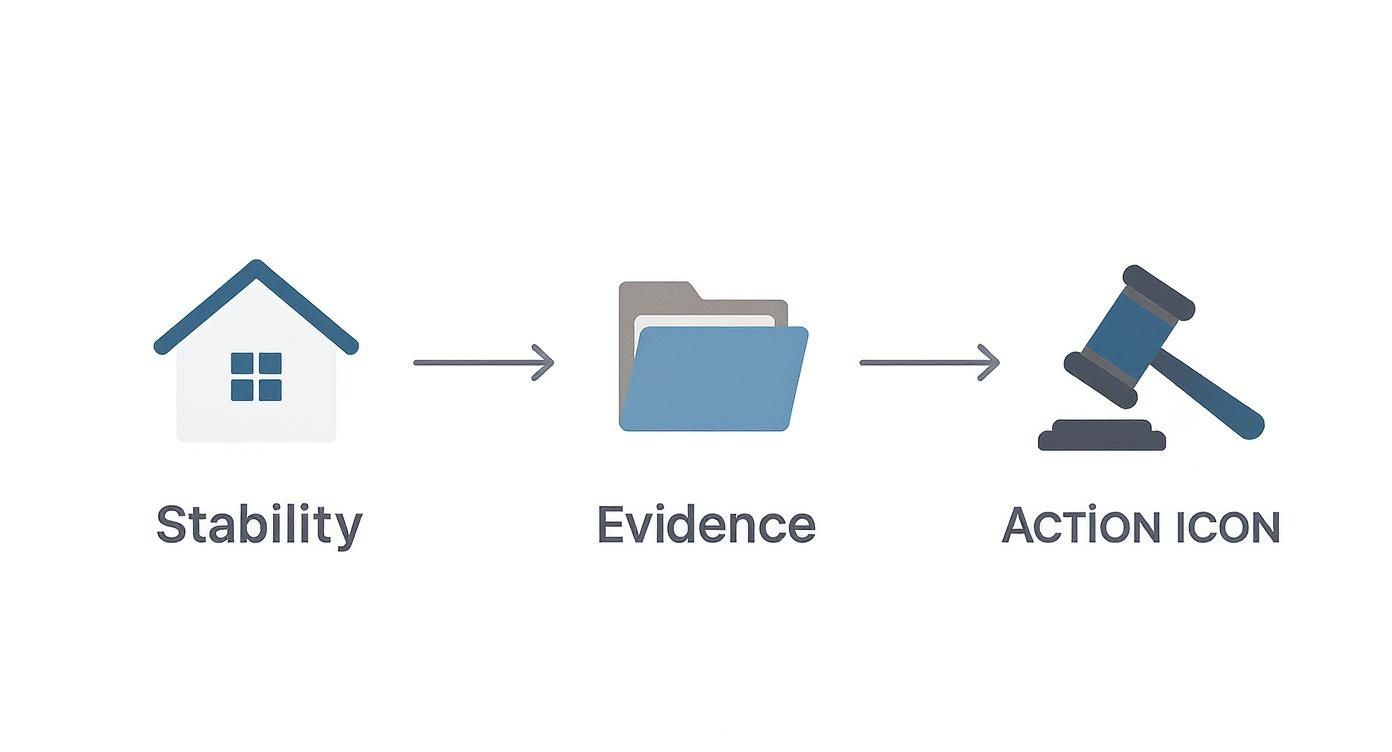
As you can see, a winning case doesn't just happen. It’s built on the foundation of a stable home life, backed up by solid proof, and executed with a smart legal game plan.
Step 1: Filing and Temporary Orders
Your legal journey officially begins when you or the other parent files an Original Petition in Suit Affecting the Parent-Child Relationship. This is the formal document that asks the court to make orders about your child. Once it's filed and the other parent is properly notified (or "served"), the clock starts ticking on crucial deadlines.
Soon after, your attorney will likely schedule a Temporary Orders Hearing. This hearing is one of the most critical moments in your entire case. Here, a judge makes temporary rulings on key issues like:
- Who gets to decide where the child lives for now.
- A temporary possession (visitation) schedule.
- Who pays temporary child support.
- Other immediate rules, such as how you and the other parent will communicate.
While these orders are not final, they establish a "status quo" that can be difficult to change later. If a judge sees your child is thriving under the temporary arrangement, they will be reluctant to disrupt that stability without a compelling reason. This is your first and best chance to prove you are the parent who provides structure, safety, and consistency.
Step 2: Mediation and Discovery
Before you see the inside of a courtroom for a final trial, you will almost certainly go to mediation. This is a mandatory step in most Texas counties. It is a structured negotiation where you, your lawyer, the other parent, and their lawyer meet with a neutral third-party mediator.
The mediator’s job is not to pick a side but to help you and the other parent find common ground and reach an agreement. Many custody cases are resolved in mediation, which can save you significant time, money, and emotional stress. It’s your opportunity to craft a solution instead of leaving the decision in a judge's hands.
Running parallel to mediation is the discovery phase. This is the formal legal process of exchanging information. Through discovery, you can request documents, ask written questions under oath (Interrogatories), and give sworn testimony outside of court (Depositions). This is where you obtain hard evidence—like bank statements, text messages, and school records—that you'll need to prove your case if you cannot settle.
Step 3: Preparing for the Final Trial
If you cannot reach an agreement in mediation, your case will proceed to a final trial. This is where you and your lawyer present all your evidence and witnesses to the judge, and the other side does the same. This is the culmination of all your preparation—every organized document, every credible witness, and every entry in your journal.
A trial can last anywhere from a few hours to several days, depending on the complexity of your situation. After hearing all the evidence, the judge will issue a final, legally binding ruling. That ruling is written into a Final Decree of Divorce or Final Order in Suit Affecting the Parent-Child Relationship, a document that will dictate your rights and responsibilities for years to come.
Using Evidence and Witnesses to Strengthen Your Claim
When you stand before a judge, your passion for your child is powerful, but it’s hard evidence that ultimately shapes the outcome. A judge's decision is based entirely on the facts presented in court. This means your success hinges on your ability to build a case so strong and well-documented that it leaves no doubt about what is best for your child.
Your personal testimony is just the beginning. The most compelling cases are built with a combination of concrete evidence and credible witnesses who can paint a clear, objective picture for the court.
Who Can Testify On Your Behalf
Witnesses provide a third-party perspective that can validate your claims and add significant weight to your case. The best witnesses are not just people who like you; they are individuals who have personally observed your parenting and your child’s well-being.
Consider people who can speak to specific aspects of your child’s life:
- Teachers or School Counselors: They can testify about your involvement in your child's education, any behavioral changes they've noticed, and who consistently handles parent-teacher conferences.
- Coaches or Mentors: These individuals see you and your child in a different environment and can speak to your supportive and encouraging role.
- Family Friends and Neighbors: Long-time friends or neighbors who have seen you interact with your child over the years can provide testimony about your stable home life and positive parent-child bond.
- Therapists or Counselors: If your child is in therapy, their counselor (with proper legal steps) can offer professional insight into the child's emotional state.
These individuals offer the court an unbiased view of your commitment and your child's reality. Their testimony can often be far more impactful than that of close family members, who may be perceived as having a natural bias.
The Court's Eyes and Ears: The Amicus Attorney
In highly contested custody cases, a Texas judge will often appoint an Amicus Attorney or a Guardian Ad Litem. This is a neutral attorney whose only client is your child. Their job is to act as the "eyes and ears" of the court.
The Amicus Attorney's role is to conduct an independent investigation into the child's best interests. They will interview you, the other parent, the child (if old enough), teachers, and anyone else relevant to the case. Their final report and recommendation to the judge carry enormous influence.
Working cooperatively and transparently with the Amicus Attorney is absolutely crucial. Be honest, organized, and always focus on your child's needs, not your conflict with the other parent. This is your chance to show your parenting abilities to a key figure in your case. A positive recommendation from them can be the tipping point in your favor.
Preparing Your Evidence and Testimony
Your own testimony is a cornerstone of your case. You need to communicate clearly, calmly, and effectively, even under the pressure of cross-examination. This is where preparation with your attorney is non-negotiable. For a detailed guide on this, you should review our article on how to prepare for a custody hearing in Texas.
Beyond your words, your documentation must be meticulously organized. Simply having a box of receipts or a phone full of screenshots isn't enough. You need to present a coherent story. When preparing your evidence, the ability to effectively summarize complex documents, reports, or long email chains into clear, concise points is an invaluable skill that can strengthen your claim.
Create a binder or digital folder with clearly labeled sections for things like:
- Communications: Organized chronologically to show patterns of behavior.
- Financial Records: Proof of your financial stability and support for the child.
- School/Medical Records: Documents showing your active involvement.
- Incident Log: Your detailed, fact-based journal of events.
Presenting a powerful, fact-based argument is about more than just having the truth on your side. It’s about proving it with organized, compelling, and undeniable evidence.
Taking Emergency Action to Protect Your Child
Sometimes, you don’t have the luxury of waiting for the standard court process. If you believe your child is in immediate physical or emotional danger, you can't wait weeks for a hearing. The Texas Family Code provides a powerful tool for these urgent situations, allowing you to get in front of a judge almost immediately.

This process begins by filing for a Temporary Restraining Order (TRO) along with your custody suit. A TRO is the court's emergency brake—a fast-acting order designed to prevent imminent harm. A judge can grant it quickly, sometimes without the other parent being present, based on a sworn statement you provide detailing the threat.
What Qualifies as an Emergency
A judge will not grant a TRO lightly. Your situation must involve a clear and present danger to your child, which the law calls "immediate and irreparable harm." This is not about disagreements over parenting styles; it's about credible threats to their safety and well-being.
Real-world scenarios that often justify emergency action include:
- Credible Threats of Abduction: The other parent has threatened to take the child and flee, purchased plane tickets, or suddenly emptied a joint bank account.
- Recent Acts of Family Violence: You have evidence—like police reports, photos, text messages, or witness statements—of recent physical or sexual abuse against the child or someone in the home.
- Dangerous Substance Abuse: The other parent’s drug or alcohol abuse is creating an immediate danger, such as driving drunk with the child or leaving drugs where the child can find them.
- Sudden Neglect: The other parent has abandoned the child or is incapable of providing basic care, perhaps due to a severe and unmanaged mental health crisis.
To get emergency relief, you must present a sworn affidavit that clearly explains the specific harm that will occur if the judge doesn't act immediately. Vague fears will not be enough; you need concrete facts.
The Emergency Hearing Process
Once your request is filed, the court typically reviews it within a day or two. If the judge finds an immediate threat exists, they will sign the TRO. This order is temporary, usually lasting for 14 days.
That TRO immediately sets a follow-up hearing within that 14-day window. This hearing is critical. It’s your chance, and the other parent’s chance, to present evidence to the judge. You must be ready to prove the allegations you made in your affidavit. The judge will then decide whether to convert the TRO into Temporary Injunctions, which are court orders that can stay in place for the duration of your custody case.
Successfully obtaining emergency orders can dramatically shift the momentum in your favor. It immediately establishes you as the protective parent and sets a new status quo where your child is safe in your care. This is a complex legal maneuver, and having an experienced attorney to guide you is vital.
Key Takeaway: Your Action Plan for Seeking Full Custody
The journey to protect your child can feel like a marathon, but this is where knowledge becomes action. You now understand the legal framework and the evidence required; it’s time to put them into a practical plan.
What to Do Next
Success in a custody case is built on discipline and preparation. It's about the small, consistent things you do every day. Focus your energy on these critical tasks right now:
- Document Everything. Start a detailed, fact-based journal today. Record every interaction, every missed visitation, every late pickup, and every concern you have, complete with dates and times. This journal will become one of your most powerful tools.
- Organize Your Evidence. Create a system for saving texts, emails, and photos. Organize them chronologically in a binder or a dedicated folder on your computer so they tell a clear story of your involvement and any issues with the other parent.
- Be Smart on Social Media. Assume that everything you post will be shown to the judge. Avoid arguments, vague complaints about your ex, or photos that could be misinterpreted. Your online professionalism is a strategic advantage.
- Prioritize Your Child. This sounds obvious, but it must be your guiding principle. In every decision you make, ask yourself: "How does this serve my child's best interest?" Your consistent, child-focused actions will speak volumes in court.
The path to becoming a Sole Managing Conservator is demanding, but it is not impossible. It requires unwavering focus, meticulous preparation, and a total commitment to demonstrating that your child’s stability and well-being are your only priorities.
This guide is your starting point, not the finish line. Every family's situation is unique, and your strategy must be tailored to your specific circumstances and your child's needs. You don't have to navigate this complex legal and emotional process alone.
We invite you to schedule a free, confidential consultation with our team at The Law Office of Bryan Fagan, PLLC. Let's sit down, review the details of your situation, and start building a personalized action plan to protect your child and your future.
Tough Questions Dads Ask in Custody Fights
Even with the best legal strategy, you’re going to have specific questions that keep you up at night. Below, we tackle some of the most common concerns we hear from fathers fighting for their kids.
How Does the Other Parent's New Partner Impact My Case?
A new partner only becomes a factor if their behavior is harmful to your child. The court is not concerned that your ex is dating someone new, but it is extremely concerned with your child’s safety and stability.
If this new person has a criminal record, a history of substance abuse, or acts inappropriately around your child, those are critical facts you must bring to the court's attention. Your attorney can help you gather proof—like background checks or witness testimony—to demonstrate that this new relationship creates an environment that is not in your child’s best interest.
How Much Weight Does the Court Give My Child's Wishes?
Under the Texas Family Code, if a child is 12 years of age or older, the judge is required to interview them privately to hear their preference on where they want to live. While the judge must listen, the child's wishes are not the final word.
The judge will consider the child's maturity level and the reasons behind their choice. A child wanting to live with the parent who has fewer rules is unlikely to persuade a judge. But a child explaining that they feel safer or more stable with you carries significant weight.
Ultimately, the judge's decision will always be based on the "best interest" of the child, not just what the child wants. A child's preference is just one piece of the puzzle. It can be a powerful piece, but it will never be the only reason a judge makes a decision.
Navigating these complex questions is not something you should do alone. It takes a strategy built on facts, experience, and an understanding of Texas family courts. At The Law Office of Bryan Fagan, PLLC, our team is dedicated to helping fathers protect their parental rights with strength and compassion.
If you are ready to build a case that puts your child's well-being first, we are here to help. Schedule your free, confidential consultation today by visiting us at https://texasdivorcelawyer.us.