Skip to content
Facing a divorce often brings a wave of financial uncertainty.
One of the biggest questions that probably comes to mind is how you will manage financially. In Texas, what most people call alimony is legally known as spousal maintenance, and it's important to know that it is not a given in every divorce. Understanding your rights and what to expect is the first step toward regaining control.
Understanding Alimony in Texas
As you map out your future, the idea of alimony can feel confusing, maybe even intimidating. You might be worried about how you'll support yourself, or on the flip side, concerned you'll be ordered to pay your ex indefinitely. The first thing to understand is that Texas law is specifically designed to prevent long-term dependency and encourage financial independence for both of you.
Think of spousal maintenance less like a penalty and more like a temporary bridge. It’s a short-term safety net, designed to give a spouse who may have put their career on hold for the family a realistic chance to get the skills or education they need to stand on their own two feet.
The Texas Family Code has very specific and strict rules about who can get spousal maintenance, for how much, and for how long. A judge can’t just award it because one person makes more money; you have to meet specific legal requirements first.
Our goal here is to pull back the curtain on this process. We'll walk you through the rules in plain English, explaining how the system really works, who actually qualifies, and what you can realistically expect. We will also touch on how maintenance fits in with other big pieces of your divorce, like property division and custody.
Getting a handle on the basics is the first step to replacing anxiety with clarity. This knowledge will give you a solid foundation to make smart decisions as you move forward. For a broader overview, you can check out our guide analyzing the legal implications of divorce, which covers custody, property, and alimony laws. It’s a great resource for seeing how all the pieces of your divorce fit together.
Here at The Law Office of Bryan Fagan, PLLC, we are committed to helping you navigate every part of your divorce with empathy and confidence. We believe that with the right information and guidance, you can protect your financial future and move forward.
Qualifying for Spousal Maintenance in Texas
Navigating the question of financial support after a divorce can feel like trying to find your way through a maze in the dark. In Texas, getting a judge to order spousal maintenance isn't automatic. You have to meet a very specific, two-part legal test just to be considered.
Let's walk through these steps together, so you can see the path forward a little more clearly.
Step 1: The Needs Test
Before a judge even looks at why you need support, you first have to prove that you actually do need it. This is what we call the “needs test.” The court needs to see that once the divorce is final, you will lack enough property to provide for your “minimum reasonable needs.”
This isn't just about your bank account. The judge will look at everything you're getting from the divorce—your share of the community property, any separate property you own, cash, and even retirement accounts. The core question is simple: “After everything is divided, can you support yourself at a basic level?” If the answer is no, you’ve cleared the first hurdle.
The flowchart below shows that spousal maintenance in Texas is not a permanent right but a temporary measure with strict qualifications.
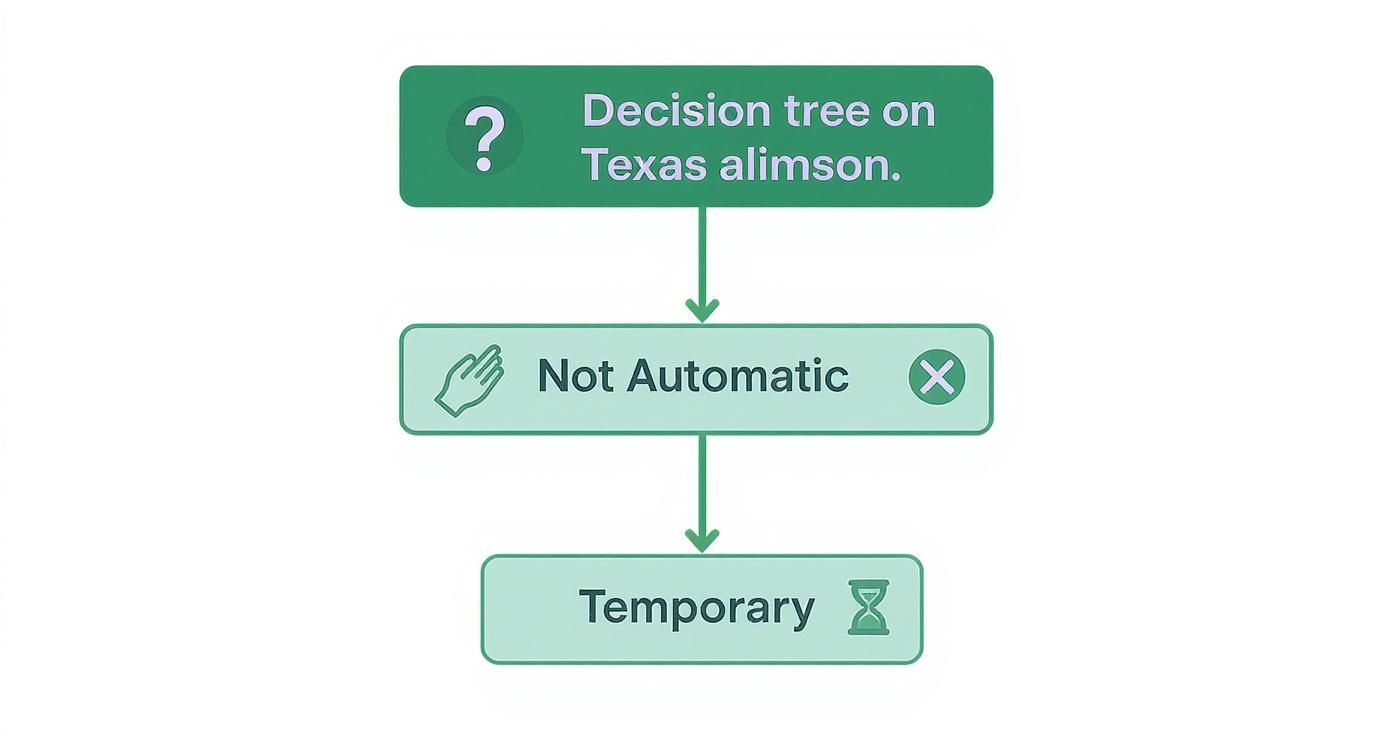
This visual guide reinforces the state's legal philosophy: support is meant to be a short-term bridge to get you back on your feet, not a long-term solution.
Step 2: Meeting a Specific Condition
Once you’ve shown you have a financial need, you’re still not done. You must also prove that your situation fits into at least one of four specific categories laid out in the Texas Family Code. The good news is you only need to meet one of these to move forward.
1. The 10-Year Marriage Rule
This is the most common path. To qualify under this rule, you have to show two things:
- You were married for 10 years or longer.
- You have tried your best to earn enough money or get the skills you need to provide for your minimum needs, but you still can't.
This scenario often fits a spouse who paused their career to raise children or support their partner's career, leaving them with a significant gap in their own work history and making it tough to re-enter the workforce.
2. Family Violence Conviction
The 10-year marriage rule is not required if your spouse was convicted of—or received deferred adjudication for—an act of family violence. This act must have happened within two years of filing for divorce or while the divorce was ongoing.
3. A Disabling Condition
You can also qualify for maintenance if you have a physical or mental disability that keeps you from earning enough to cover your basic needs. A key point here is that the disability must have arisen during the marriage.
4. Care for a Disabled Child
Finally, if you are the primary caregiver for a child of the marriage who has a physical or mental disability requiring substantial care and supervision, you may qualify. The law recognizes that these caregiving duties prevent you from being able to hold a job that would provide a sufficient income.
It's critical to understand that Texas law pushes for financial independence, not long-term dependency. The Texas Family Code puts strict caps on how much support can be paid and for how long. A court cannot order payments that are more than $5,000 per month or 20% of the paying spouse's gross monthly income—whichever is less. This ensures any award is both reasonable and temporary. To see a detailed breakdown of these limits, you can discover more insights about how long alimony lasts.
Building a strong case for spousal maintenance means presenting clear, compelling evidence that proves both your financial need and your eligibility under one of these specific conditions.
Calculating Alimony Payments and Duration
Figuring out how much financial support you might receive—or be asked to pay—is often one of the most stressful parts of a divorce. Once a Texas judge agrees that spousal maintenance is necessary, the next questions are always: How much? and For how long?
The law in Texas provides very clear, firm limits to make sure these awards are fair and, importantly, temporary.

How Much Can Be Ordered?
When it comes to the dollar amount of alimony in Texas, a judge’s decision is boxed in by two strict legal caps. The court simply cannot order payments that go over the lesser of these two amounts:
- $5,000 per month, or
- 20% of the paying spouse's average monthly gross income.
So, even if your monthly needs are higher, or if your ex-spouse is a very high earner, the award can't break through this legal ceiling. "Gross income" is a broad term that includes salary, bonuses, self-employment income, rental income, and even retirement benefits.
How the Payment Cap Works in Practice
Let’s walk through a couple of real-world examples to see how this formula actually plays out.
Example 1: The 20% Rule Kicks In
Imagine your spouse brings home a gross monthly income of $15,000. Twenty percent of that is $3,000. Because $3,000 is less than the $5,000 cap, the absolute maximum a judge could order is $3,000 per month.
Example 2: The $5,000 Rule Takes Over
Now, let's say your spouse has a much higher gross monthly income of $40,000. Twenty percent of that income is $8,000. But since $8,000 is more than the statutory cap, the maintenance award is limited to $5,000 per month.
These caps provide a predictable framework, but they only set the maximum possible award. The final number will come down to the specific facts of your case. For a closer look at these financial dynamics, you can read our article that helps answer the question, who pays for spousal maintenance in Texas divorces?
How Long Can Alimony Payments Last?
Just as Texas law caps the payment amount, it also puts strict time limits on how long those payments can continue. The biggest factor here is the length of your marriage.
The purpose of spousal maintenance in Texas is to be rehabilitative. It's meant to provide a temporary financial bridge, giving you support for the shortest reasonable time needed to get back on your feet and meet your own basic needs.
A judge will use the length of the marriage to set the maximum duration, but they can always order a shorter period if they feel it’s appropriate.
Here's a straightforward breakdown of those limits.
Texas Spousal Maintenance Duration Limits
This table summarizes the maximum duration for spousal maintenance payments based on the length of the marriage, as defined by the Texas Family Code.
| Length of Marriage | Maximum Duration of Maintenance Payments |
|---|---|
| Less than 10 years (but qualifies due to family violence) | Up to 5 years |
| 10 to 20 years | Up to 5 years |
| 20 to 30 years | Up to 7 years |
| 30 years or more | Up to 10 years |
It's critical to remember these payments can stop even sooner. If the receiving spouse remarries or moves in with a romantic partner, the maintenance ends. It also terminates if either you or your ex-spouse passes away.
The 11 Factors a Judge Must Consider
The caps on amount and duration are just the starting point. To arrive at a final, fair number, a Texas judge is required by law to weigh 11 specific factors. This is how the court tailors the decision to your family's unique situation.
A judge will carefully look at:
- Each spouse's ability to provide for their own minimum reasonable needs.
- The education and employment skills of both spouses.
- The duration of the marriage.
- The age, employment history, earning ability, and health of the spouse seeking maintenance.
- The effect of child support or custody on a spouse's ability to work.
- Acts by either spouse that wasted or destroyed community property.
- Each spouse's contributions to the education or earning power of the other.
- The property each spouse brought to the marriage.
- The contributions of a spouse as a homemaker.
- Any marital misconduct, including adultery or cruel treatment.
- Any history or pattern of family violence.
No single factor decides the outcome. Instead, the court pieces everything together to create an order that is just and right for your circumstances.
How Alimony Plays Out in Real-Life
The legal rules for spousal maintenance can feel abstract. Let's ground these concepts in reality by looking at how judges apply them to situations you might recognize. Seeing how the facts are weighed in different circumstances helps you understand how a court might view your own story. These scenarios show how the law tries to strike a balance between your needs and your spouse's ability to pay.
Practical Advice for a Long-Term Stay-at-Home Parent
Let’s imagine Sarah and Tom, who are divorcing after a 22-year marriage. Sarah stepped away from her teaching career two decades ago to raise their children and manage the home, which allowed Tom to build a successful engineering firm. Now, at 50, her teaching certificate has expired, and her professional skills are outdated.
In this situation, a court would likely find Sarah eligible for spousal maintenance. She easily meets the 10-year marriage requirement. The real challenge for her will be proving she has made diligent efforts to find work but still can't earn enough to meet her minimum reasonable needs.
A judge would look at several key factors:
- Sarah's earning potential: After so much time out of the workforce, her immediate income potential is low. The court will expect her to pursue retraining or education to get back on her feet.
- Tom's ability to pay: As a high-earning business owner, Tom clearly has the financial capacity to provide support.
- The property division: While Sarah will get her share of the community property, it might not be enough to generate sufficient income for her needs without having to sell off the assets themselves.
The court would likely order maintenance for up to 7 years—the maximum for a marriage between 20 and 30 years—to give Sarah a financial bridge while she retrains and re-enters the job market. The amount would be capped at the lesser of $5,000 or 20% of Tom's gross monthly income.
Practical Advice for High-Net-Worth Individuals
Now, let's switch gears and look at a high-asset divorce. Maria and David were married for 15 years. David is a surgeon, and Maria took the lead in managing their extensive investments and properties. Their community estate is valued at over $10 million.
Even though their marriage lasted more than a decade, Maria would have an extremely tough time qualifying for court-ordered maintenance. Why? The very first legal hurdle is proving she lacks sufficient property to meet her minimum reasonable needs.
In a high-net-worth case, the division of assets often provides the receiving spouse with substantial property—stocks, real estate, cash accounts—that can generate income. If this income is enough to cover reasonable needs, the request for maintenance will likely fail.
Once their property is divided, Maria will walk away with assets worth around $5 million. A judge would almost certainly conclude that these assets are more than enough to provide for her needs, making her ineligible for spousal maintenance, regardless of David's significant income.
Family Violence in a Shorter Marriage
Finally, consider a shorter, more volatile marriage. Jessica and Mark were married for 6 years. During their marriage, Mark was convicted of an act of family violence against Jessica. Now, Jessica has a part-time job but is struggling to cover her expenses and fears for her safety.
Here, the 10-year marriage rule is irrelevant. Because a criminal conviction for family violence exists, Jessica is eligible to request spousal maintenance despite the shorter duration of the marriage.
The court's decision will come down to her proven financial need and Mark's ability to pay. A recent Texas divorce case underscores how closely courts examine a recipient's efforts toward self-sufficiency, even when eligibility isn't in question. You can discover more insights about how Texas courts view recipient employment efforts in these types of cases. A judge would likely award Jessica temporary support for up to 5 years to help her establish a safe and independent life.
The Divorce Process: Requesting, Modifying, or Enforcing Alimony
Knowing your rights to alimony in Texas is just the start. You also need a clear roadmap for the court process. Getting an order for spousal maintenance—or changing one down the road—is a formal process with specific legal steps. This guide will walk you through how to file, modify, and enforce an alimony order to protect your financial stability.
Step-by-Step: Making the Initial Request
Your journey to request spousal maintenance begins right when the divorce does. This isn't a separate lawsuit you file later; it's a critical part of your Original Petition for Divorce.
This is the very first document filed with the court to start the divorce process. It is absolutely crucial that your petition explicitly states you are seeking spousal maintenance. If you don't include this request from day one, it can be extremely difficult, if not impossible, to ask for it later on.
Once you’ve filed the petition, your request becomes a central point of negotiation, mediation, and—if necessary—a court hearing. You'll need to gather and present evidence that proves both your financial need and your eligibility under one of the specific conditions we've discussed, like a marriage of 10 years or more or a finding of family violence.
How to Modify an Existing Alimony Order
Life is never static. An alimony order that was fair and reasonable at the time of your divorce might not fit your life anymore. Texas law allows for the modification of spousal maintenance orders, but you must prove there has been a "material and substantial change" in the circumstances of either person.
What counts as a material and substantial change? It's not a minor shift. Think bigger, like:
- A significant increase or decrease in income for either you or your ex-spouse (e.g., a major promotion or an unexpected job loss).
- A change in the receiving spouse's living situation, such as moving in with a new romantic partner.
- Changes in health or disability status that directly impact someone's ability to work and earn a living.
To start the process, you must file a Petition to Modify the Prior Order with the same court that issued the original divorce decree. As circumstances shift, understanding the general process of modifying legal agreements can give you helpful context for this legal step. It's important to act quickly, as a court can only change payments moving forward from the date you file the petition—it can't go back in time. For anyone facing this situation, getting advice from an experienced lawyer is crucial. You can learn more about when to hire family law order modification lawyers in Texas in our detailed guide.
Enforcing an Alimony Order When Payments Stop
It’s incredibly stressful when an ex-spouse simply stops making their court-ordered alimony payments. But you are not powerless. The Texas legal system gives you powerful tools to compel them to pay.
If you are not receiving your court-ordered payments, do not wait. The law is on your side, but you must take action to enforce your rights. Ignoring the problem will only let the unpaid balance grow, putting your financial security in jeopardy.
The primary legal tool is a Motion for Enforcement. This motion is a formal request asking the judge to force your ex-spouse to follow the court's order. The court has several powerful methods to ensure you get the money you are owed:
- Wage Withholding Order: This is often the most effective tool. The judge can order your ex-spouse's employer to automatically deduct the alimony payment from their paycheck and send it directly to you.
- Contempt of Court: A judge can find your ex-spouse in contempt of court for willfully disobeying the order. The penalties can be serious, including hefty fines and even jail time until the payments are brought current.
- Money Judgment: The court can issue a judgment for the total amount of unpaid alimony, plus interest. This opens the door to other collection methods, like putting a lien on their property or garnishing their bank accounts.
Whether you're requesting, modifying, or enforcing alimony, the process requires precision and strategic legal action. At The Law Office of Bryan Fagan, PLLC, we are here to provide the authoritative and compassionate guidance you need.
Common Questions About Alimony in Texas
When you're trying to figure out spousal maintenance, the details can feel overwhelming. As you think about what’s next, getting straightforward answers to the big questions is the best way to feel confident and in control. Let’s clear up some of the most common concerns we hear about alimony in Texas.
Does Adultery Affect an Alimony Case in Texas?
Yes, it can. The Texas Family Code requires judges to consider marital misconduct—including adultery—when they decide whether to award spousal maintenance. If a spouse's affair was a reason the marriage fell apart, the court can factor that behavior into its decision on both the amount and the length of any potential alimony payments.
This is a two-way street. A spouse who cheated might find it much harder to get a judge to award them maintenance. On the other hand, the faithful spouse could have a stronger argument for receiving it, as long as they meet all the other legal requirements.
Is Alimony Taxable in Texas?
This is a huge financial question, and the answer is now simple. Thanks to the federal Tax Cuts and Jobs Act of 2017, the old, complicated tax rules are gone. For any divorce finalized after December 31, 2018, here’s how it works:
- The person paying spousal maintenance gets no tax deduction for the payments.
- The person receiving the payments does not count them as taxable income.
Think of it as a clean, non-taxable transfer of assets from one ex-spouse to the other.
What Happens if My Ex-Spouse Remarries?
Texas law is crystal clear on this. Any court-ordered spousal maintenance obligation ends automatically if the person receiving the payments gets remarried. The same is true if they begin cohabiting—which means moving in and living with a new partner in a romantic relationship.
However, the payments don’t just stop. The spouse who is paying must go back to court and file a motion to formally terminate the maintenance order. You have to prove that the remarriage or cohabitation has occurred.
It is absolutely critical to take this legal step to officially end the obligation. If you just stop paying without a new court order, you could face enforcement actions, even if your ex-spouse has clearly remarried.
Can I Get Alimony If We Weren't Married for 10 Years?
Usually, the 10-year marriage rule is a hard requirement, but there are a few very specific and important exceptions. The law recognizes that in some situations, a spouse needs protection regardless of how long the marriage lasted. You might still be eligible for alimony in a shorter marriage if:
- Your spouse was convicted of (or received deferred adjudication for) an act of family violence.
- You have an incapacitating physical or mental disability that prevents you from earning enough to support yourself.
- You are the primary caregiver for a child of the marriage who has a disability requiring such substantial care that it keeps you from working.
These exceptions are designed to protect the most vulnerable individuals coming out of a marriage, ensuring the law provides a safety net when it's needed most.
What to Do Next
It’s normal to feel overwhelmed by the thought of securing spousal maintenance in Texas. But this is the moment to shift from learning to doing. Taking clear, decisive steps now is the best way to regain a sense of control and protect your financial stability.
Key Takeaway
First, start gathering every financial document you can find: tax returns, pay stubs, bank statements, and records of all your assets and debts. This is the hard evidence a court will use to evaluate your need. Next, create a realistic post-divorce budget. A detailed budget is the single most powerful way to prove what your "minimum reasonable needs" are. Finally, honestly assess your earning potential and what it would take to become self-sufficient.
While Texas doesn't publish specific statistics on spousal maintenance awards, broader family law trends offer some context. The state's divorce rate was just 1.4 per 1,000 female residents in 2022, one of the lowest in the U.S. Because eligibility for maintenance often requires a marriage of at least 10 years, these numbers suggest the pool of qualifying cases might be smaller than in other states. You can discover more insights about these family law trends.
Thinking ahead, tools like prenuptial agreements can also play a major role in defining financial security before and during a marriage.
Schedule Your Free Consultation
While these actions are a great start, the single most critical step is to get professional legal advice tailored to your specific situation. You don't have to walk this complex path alone. An experienced attorney can cut through the confusion, develop a clear strategy, and help you transition confidently into your next chapter.
We invite you to schedule a free, confidential consultation with The Law Office of Bryan Fagan, PLLC. Let our compassionate and knowledgeable team help you build a solid plan to protect what matters most—your future. Visit us at https://texasdivorcelawyer.us to take the first step toward security today.