Skip to content
Facing a divorce when you and your spouse can’t agree on what the future looks like can feel like you're caught in a storm without a compass. In Texas, a contested divorce doesn’t automatically mean you’re headed for a bitter courtroom war; it simply means you have at least one issue you haven’t resolved yet. Partnering with a skilled contested divorce attorney in Texas is your first move toward finding a clear path forward and protecting what matters most to you.
What Is a Contested Divorce in Texas?
The phrase "contested divorce" often brings to mind images of high-drama courtroom battles. The reality is much simpler. In Texas, a divorce becomes contested the moment you and your spouse disagree on any single issue related to ending your marriage.
Think of an uncontested divorce like two people using the same road map—you both agree on the route and the destination. A contested divorce is what happens when you have two different maps. That disagreement could be over something as small as who keeps a piece of furniture or as significant as where your children will live.
The Heart of the Disagreement
For many couples, disagreements are a normal part of the process. A case being "contested" doesn't doom you to a long, drawn-out battle; it just signals that you need a formal process to help you find common ground. The most common points of friction are:
- Property Division: How will you divide the assets and debts you’ve accumulated? The Texas Family Code requires a "just and right" division of your community estate, which includes everything from the house and cars to retirement accounts and credit card debt.
- Child Custody (Conservatorship): Who gets to make key decisions for the children, such as education and healthcare choices, and what will the possession schedule look like for when the kids are with each parent?
- Child Support: What financial support is needed to care for the children, and who will pay it based on Texas guidelines?
- Spousal Maintenance: Will one spouse need temporary financial support from the other after the divorce is final?
These legal disputes are often fueled by deeper emotional issues. For instance, studies show that a lack of commitment (75%), infidelity (59.6%), and constant conflict (57.7%) are the primary drivers of divorce. When these are the reasons a marriage ends, it's easy to see how legal battles can erupt, especially since nearly half of all Texas divorces involve minor children, making custody a major point of contention.
How a Divorce Becomes "Contested"
Procedurally, a divorce becomes contested when one spouse files an "Original Petition for Divorce," and the other files a formal "Answer." That Answer tells the court, "I don't agree with everything my spouse is asking for." This isn't a declaration of war. It’s simply the official starting point for negotiations, mediation, and, only if absolutely necessary, litigation.
The key thing to remember is that a "contested" label just means you need help reaching a fair settlement. It's the start of a guided, legal process designed to untangle your lives respectfully.
With an experienced contested divorce attorney, these disagreements can be tackled one by one. Your lawyer serves as your advocate and your navigator, protecting your rights under the Texas Family Code while working toward a resolution that gives you the clarity and confidence to move forward. You can also explore the fundamental differences between contested and uncontested divorce in our in-depth guide.
The Texas Contested Divorce Process Step by Step
The legal road through a contested divorce can feel like navigating a maze without a map. But when you understand each turn and what comes next, you can regain a sense of control. This step-by-step breakdown walks you through the entire process, from the first filing to the final decree, so you know exactly what to expect.
Step 1: Filing the Original Petition and Serving Your Spouse
Your divorce officially begins when your attorney files an Original Petition for Divorce. This is the formal document that tells the court you are seeking to end your marriage. It also lays out your initial requests for things like property division and child custody arrangements. It doesn't have to be aggressive; it's simply the document that gets the ball rolling.
Once filed, the next crucial step is making sure your spouse is formally notified. This is called service of process. A neutral third party, like a sheriff or private process server, will personally deliver a copy of the petition and a legal notice called a citation. This delivery ensures your spouse is officially aware of the divorce and gives them a deadline to file their own response with the court.
Step 2: The Answer and Temporary Orders Hearing
After being served with the papers, your spouse has a limited time to file a formal Answer. This document is their official response to your petition, stating what they agree or disagree with. When they disagree—which is the very definition of a contested divorce—the guided negotiation process begins.
Many contested divorces come with immediate, pressing issues. You might disagree on who stays in the family home, how the bills get paid, or what a temporary parenting schedule should look like while the case is ongoing. To sort these things out quickly, your attorney can request a Temporary Orders Hearing.
At this hearing, a judge listens to both sides and makes short-term, enforceable rulings. These orders create stability for you and your children and stay in place until your divorce is finalized.
This is a critical moment. A skilled contested divorce attorney can fight to secure favorable temporary arrangements for custody, support, and property use, setting a positive precedent for the rest of your case.
This infographic shows the different paths a divorce can take, highlighting how an attorney's role becomes central when a case is contested.
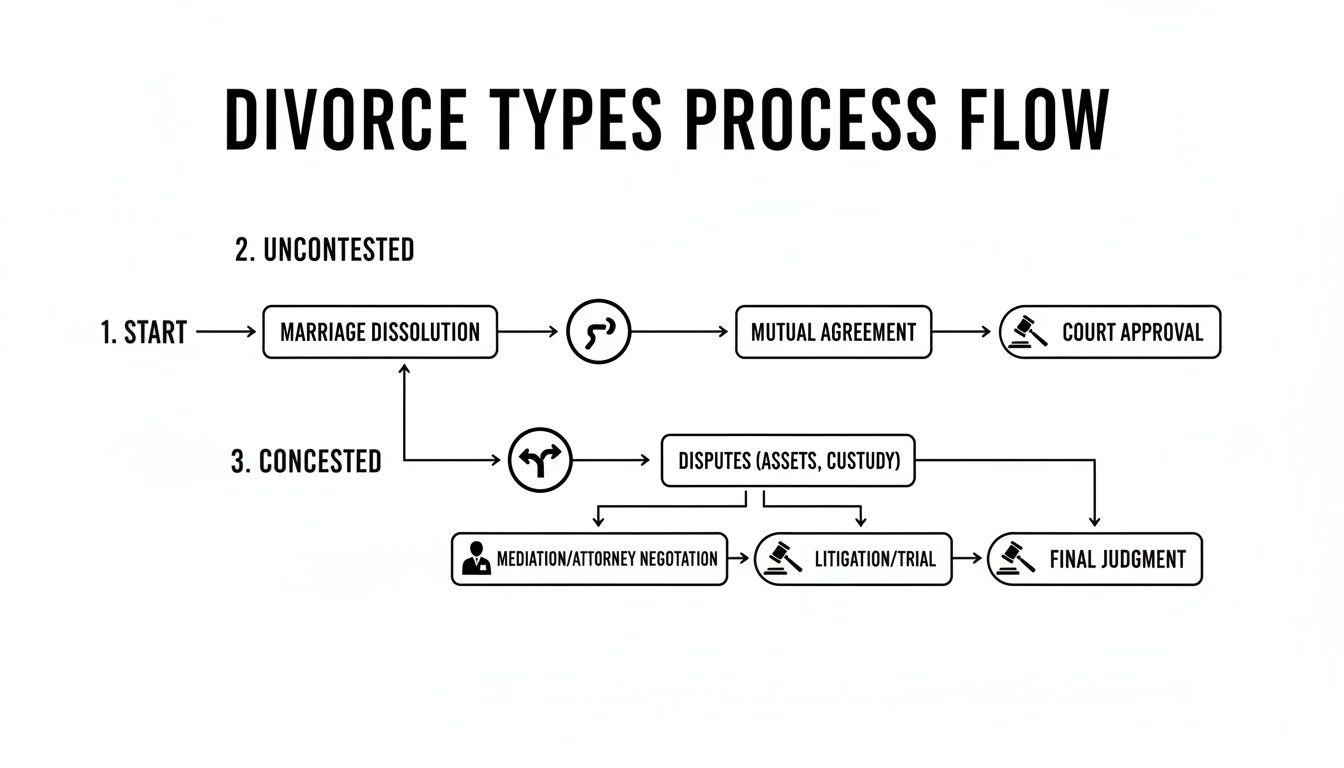
As you can see, the path splits wide open when agreements can't be reached on your own, showing just how important expert legal guidance is for navigating the more complex route.
Step 3: Discovery, Mediation, and Reaching a Settlement
With temporary orders in place, the case moves into what's known as the discovery phase. Think of it as the formal fact-finding mission where both sides exchange information under the court's rules. This isn't optional; it's how you and your attorney ensure all decisions are made with full transparency.
Your attorney will use several legal tools to gather all the necessary facts and documents:
- Requests for Production: These are formal demands for financial records, like bank statements, tax returns, and retirement account details.
- Interrogatories: This is a list of written questions that your spouse must answer in writing, under oath.
- Depositions: This is a more formal, out-of-court interview where you, your spouse, or other key witnesses answer questions from the attorneys under oath, with a court reporter transcribing everything.
This process guarantees that all decisions are based on full financial transparency, which is absolutely essential for achieving a "just and right" division of property under the Texas Family Code.
Even in a heated, contested case, the ultimate goal is to find a resolution without the time and expense of a full-blown trial. In fact, most counties in Texas require you to attend mediation before you’re even allowed to schedule a trial.
Mediation is a confidential meeting where you, your spouse, and your respective attorneys sit down with a neutral third-party mediator. The mediator’s only job is to help you and your spouse find common ground and facilitate a settlement. You can learn more about how contested divorces unfold in Texas and get practical tips for handling each stage.
Step 4: Finalizing Your Divorce
If you reach an agreement on all your issues in mediation, your attorneys will draft a Mediated Settlement Agreement. This is a binding contract that resolves everything. If mediation fails and you're still at an impasse, your case will be set for a Final Trial, where a judge will listen to all the evidence and make the final decisions for you.
Finally, whether you settle in mediation or go to trial, your divorce concludes when the judge signs the Final Decree of Divorce. This comprehensive court order legally dissolves your marriage and spells out the final terms for your property, children, and any support. And remember, Texas law imposes a mandatory 60-day waiting period from the day the petition is filed before any divorce can be finalized.
Understanding the Financial Realities of a Contested Divorce
Let’s get right to it—the first question on your mind is probably, "How much is this going to cost?" It's completely natural to worry about the financial side of things. But understanding where those costs come from is the first step toward getting them under control.
The expense isn't just a random number; it’s directly tied to how complicated your case is and, frankly, how much you and your spouse are willing to fight. Hiring an experienced contested divorce attorney isn’t just another bill to pay—it’s an investment in protecting your financial future. When you have significant assets on the line, like a family business, retirement accounts, or real estate, the right legal strategy can be the difference between a fair outcome and a devastating loss. Our job is to find the most efficient path forward, not to drag out a fight for the sake of billing hours.
What Drives the Cost of a Contested Divorce
The total cost of a contested divorce isn’t a fixed price. Think of it more like a budget that goes up or down depending on a few key factors. The main things that will influence the final number are:
- Attorney's Fees: Most family lawyers work on an hourly basis. The more time your case needs—for phone calls, drafting documents, negotiations, and court appearances—the higher the cost will be.
- Level of Conflict: This is a big one. If you and your spouse can manage to find common ground on some issues, you automatically reduce the time your lawyers have to spend fighting. High-conflict cases always translate to higher legal fees.
- Complexity of Assets: Divorcing as a business owner or with high-value estates is far more complex than a case with a single home and a couple of bank accounts. Valuations, tracing separate property, and forensic accounting all add to the cost.
- Expert Witness Fees: Sometimes, we need to bring in outside experts to get a clear picture. This could be a forensic accountant to trace hidden money, a business valuator, or a real estate appraiser. These professionals have their own separate fees.
The goal should never be to "win" at all costs, but to achieve a "just and right" division of your property as efficiently as possible. A good attorney helps you weigh the cost of fighting over a particular asset against what that asset is actually worth.
For example, a recent analysis shows a typical Texas divorce for families with children averages between $15,000 to $30,000. Contested cases involving prolonged fights over community property can easily shoot past that range, sometimes lasting more than a year. You can find more information about these financial realities on lishmanlaw.com.
Estimated Cost Breakdown in a Texas Contested Divorce
To give you a clearer picture, this table breaks down the potential expenses you might encounter. It’s important to remember these are estimates, but they help show where the money goes.
| Expense Category | Typical Cost Range (2026) | Purpose |
|---|---|---|
| Attorney Retainer | $5,000 – $15,000+ | An initial down payment to secure legal services. It is billed against hourly. |
| Attorney Hourly Rate | $300 – $650+ per hour | Covers all time spent on your case, including calls, emails, and court prep. |
| Filing Fees & Court Costs | $350 – $500 | Standard administrative fees required by the court to file the divorce petition. |
| Mediation Fees | $1,000 – $5,000+ | Cost for a neutral third-party mediator to help you and your spouse negotiate. |
| Expert Witness Fees | $2,500 – $20,000+ | Fees for professionals like forensic accountants, appraisers, or child custody evaluators. |
| Depositions & Discovery | $1,500 – $7,500+ | Costs associated with gathering evidence, including court reporter fees. |
These figures can feel overwhelming, but they underscore the importance of having a clear legal strategy focused on resolution, not just fighting.
How Legal Billing Works
So, how does the payment process actually work? When you hire a contested divorce attorney, you'll typically pay an initial fee called a retainer. Think of this not as a flat fee for the entire divorce, but as a down payment.
That retainer is deposited into a special trust account. As your attorney works on your case, they will bill their hourly rate against that fund. It’s a pay-as-you-go system.
You’ll get a detailed invoice each month that shows exactly what work was done, who did it, and how much time it took. If the retainer runs low, you may be asked to add more funds to it. We believe in being completely transparent about billing so you are never in the dark about where your money is going. Open communication is key to a healthy attorney-client relationship.
Navigating the Key Legal Issues in Your Divorce

When you and your spouse can’t see eye to eye, it can feel like you’re fighting over everything. In reality, most contested divorces boil down to a handful of core issues: your property, your children, and the financial support systems that keep your family afloat.
Getting a handle on the legal rules for each of these areas gives you the power to fight for your future with purpose. These are the moments where a skilled contested divorce attorney in Texas becomes your most important ally, turning complex legal statutes into a real-world strategy to protect what you've worked for and the people you love.
Dividing Your Property and Debts
Texas is a community property state. On the surface, it sounds simple, but the details can get messy. The Texas Family Code starts with the assumption that nearly everything you and your spouse acquired during the marriage—from your wedding day to the day of divorce—belongs equally to both of you.
The court’s job is to divide this "community estate" in a way that is “just and right.” That often means a 50/50 split, but it’s not a guarantee.
- Community Property: This covers the income either of you earned during the marriage, the house you bought together, cars, furniture, and even the growth in retirement accounts.
- Separate Property: This is anything you owned before the marriage. It also includes gifts or inheritances you received during the marriage, as long as they were given only to you.
The burden is on you to prove an asset is your separate property. This is where things get serious, especially for business owners or anyone with a high-value estate. Your attorney will need to meticulously trace funds and document ownership to keep what is rightfully yours from being divided.
Determining Child Custody and Visitation
For any parent, nothing matters more than your children’s well-being. In Texas, the law agrees. Every decision a judge makes about custody is guided by one principle: the “best interest of the child.”
The court looks at two main parts of custody:
- Conservatorship (Decision-Making): This defines who gets to make the big decisions in your child's life—things like where they go to school, what medical care they receive, and their religious upbringing. Courts often name parents "Joint Managing Conservators," which means you share these duties.
- Possession and Access (The Schedule): This is the calendar that lays out when your child will be with each parent. Texas has a Standard Possession Order, which serves as a default schedule, but it can be tailored to fit your family’s unique situation.
Your attorney’s job is to build a powerful case showing the judge why your proposed parenting plan is what’s best for your child. We’ll focus on factors like stability, emotional needs, and each parent’s ability to provide a safe and nurturing home. You can get a head start by learning how to create a solid parenting plan during a custody case.
A judge’s primary goal is to create a stable, loving, and safe environment for your children. Your attorney helps demonstrate how your desired outcome aligns with that critical objective.
Even though the Texas per capita divorce rate dropped by 29% over the last two decades, around 83,000 divorces still happen each year. That means tens of thousands of families are navigating these same custody and property fights, highlighting just how crucial expert legal guidance is. You can find more Texas divorce statistics on williedasherlaw.net.
Calculating Child Support and Spousal Maintenance
Financial support is the third pillar of a contested divorce. These calculations aren’t based on guesswork; they are guided by specific formulas in the Texas Family Code.
Child Support: This is money paid by the non-primary parent (the parent the child doesn't live with most of the time) to the primary parent. The amount is calculated as a percentage of the paying parent’s net monthly income. The basic guidelines are:
- 20% for one child
- 25% for two children
- 30% for three children
- And so on, up to a statutory income cap.
Spousal Maintenance: You might know this as alimony, but getting it in Texas is tough. It’s not a given. A spouse has to prove they don't have enough property to meet their "minimum reasonable needs" and satisfy other strict criteria, like having been married for at least 10 years or being a victim of family violence.
A contested divorce attorney fights for you by making sure all income is properly disclosed for support calculations. We will argue for or against spousal maintenance based on the hard facts of your case and the letter of the law.
How to Choose the Right Contested Divorce Attorney for You
Choosing your legal advocate is hands-down the most important decision you will make in your contested divorce. This choice doesn't just influence the final outcome—it defines your entire experience. You need someone who has your back, understands what’s at stake, and knows how to navigate the Texas court system. This guide will give you the tools to find the right contested divorce attorney for your unique situation.

Think of the initial consultation as your opportunity to interview a potential attorney, not the other way around. Don't hesitate to ask tough, direct questions. You are entrusting your future to this person, and you deserve to feel confident in your choice.
Crucial Questions to Ask During Your Consultation
Walking into a law office can feel intimidating, but remember, you're in the driver's seat. Your mission is to get a feel for their experience, strategic thinking, and whether you can build a solid working relationship. Arrive prepared with a list of questions to make sure you cover all the important ground.
Here’s a checklist of essential questions to ask any attorney you’re considering:
- Experience: "What's your specific experience with contested divorces that involve issues like mine, such as high-value assets, a family business, or a complicated custody dispute?"
- Strategy: "Based on the details I've shared, what’s your initial take on a strategy for my case? What potential roadblocks do you see coming?"
- Communication: "How will you and your office keep me updated? Who will be my main point of contact, and what’s your firm's policy on returning calls and emails?"
- Billing: "Could you walk me through your fees, retainer, and billing structure? Are there ways I can help manage the costs?"
As you prepare for these meetings, understanding the typical lawyer consultation fee can help you budget for this initial phase. While many firms—including ours—offer a free consultation, it’s always wise to be informed about industry standards.
Red Flags to Watch Out For
Knowing what to avoid is just as critical as knowing what to look for. A great attorney inspires confidence with their skill and realistic approach, not with impossible promises. Be on guard for any legal professional who shows these warning signs.
A trustworthy attorney will manage your expectations with honesty and focus on realistic, achievable outcomes. An attorney who tells you only what you want to hear may be setting you up for disappointment.
Keep an eye out for these red flags during your search:
- Guarantees a Specific Outcome: The legal system has too many variables. No ethical attorney can ever guarantee a specific result or a "win."
- Prefers Conflict Over Resolution: Watch out for an overly aggressive lawyer who seems eager for a courtroom fight. They might just be running up your bill instead of seeking efficient solutions through negotiation or mediation.
- Poor Communication: If an attorney is hard to reach, dismissive of your concerns, or relies on confusing legal jargon during the consultation, that’s a preview of what you can expect throughout your case.
Ultimately, you’re searching for more than just a lawyer; you need a trusted partner who combines deep legal experience with a compassionate, client-focused mindset. This is the standard of care we live by at The Law Office of Bryan Fagan, PLLC. If you’d like to explore this topic further, our guide on how to choose the right divorce lawyer offers even more valuable insights.
What to Do Next: Your Action Plan for Moving Forward
Reading through the details of a contested divorce in Texas can feel overwhelming. But what you’ve just done is taken a massive first step toward reclaiming control. You've learned about the court process, the critical issues at stake, and how to find the right legal partner. A contested divorce isn't an endless fight—it's a structured process with a finish line. You don’t have to walk this path alone.
Your story, your family, and your financial security are on the line. At The Law Office of Bryan Fagan, PLLC, our entire practice is dedicated to helping Texas families like yours find a way forward with empathy and skill. We are here to listen, explain your rights in plain English, and build a personalized plan that protects your interests at every turn.
We invite you to schedule a free, no-obligation consultation with one of our experienced family law attorneys. We can meet in-person at one of our Texas offices or virtually, whichever is more comfortable for you. Don’t wait to get the answers you deserve—call us today and let us help you move forward with strength and confidence.
Frequently Asked Questions About Contested Divorce in Texas
It’s completely normal to feel uncertain about the road ahead. We’ve found that getting clear, straightforward answers is the best way to feel more confident and in control. Here are some of the most common questions we hear from clients just like you.
How Long Does a Contested Divorce Take in Texas?
While every divorce in Texas has a mandatory 60-day waiting period, a contested divorce almost always takes longer. Think of it this way: the timeline is directly tied to the level of conflict and complexity.
On average, you can expect a contested divorce to take anywhere from 6 to 12 months. If your case involves highly complex assets or a difficult custody battle, it can certainly stretch longer. The more you and your spouse disagree, the more time is needed for discovery, negotiations, and court hearings, all of which extend the process.
Can We Settle if We Start with a Contested Divorce?
Absolutely. In fact, most contested divorces do settle before ever seeing the inside of a courtroom. Filing for a "contested" divorce just means you and your spouse have unresolved issues at the beginning—it doesn't lock you into a fight to the finish.
A contested filing is simply a starting point for negotiation, not a declaration of war. The legal process itself is designed to guide both sides toward a resolution, with trial as the last resort.
Throughout the case, your attorney will be negotiating on your behalf. Plus, most counties in Texas actually require you to attend mediation—a formal settlement conference—before you’re even allowed to schedule a trial. A contested case that resolves in mediation is a very common, and often ideal, outcome.
What Should I Bring to My First Legal Consultation?
Coming prepared for our first meeting helps us hit the ground running. It allows us to get a clearer picture of your situation and give you the most accurate advice possible. While you don’t need to have every single document, here’s a great starting point:
- Financial Statements: Recent statements for your bank accounts, credit cards, and any mortgage or car loans.
- Tax Returns: Your last two or three years of joint tax returns give a fantastic financial overview.
- A List of Questions: Before you come in, jot down every question and concern you have. There are no bad questions, and this ensures you don’t forget anything important.
- Any Existing Legal Papers: If your spouse has already filed, be sure to bring a copy of every document you've been served.
Do I Have to Go to Court for a Contested Divorce?
Not necessarily. While a trial is always a possibility in a contested divorce, it’s the exception, not the rule. A skilled contested divorce attorney in Texas will always aim to resolve your issues through strategic negotiation and mediation first. This approach saves you the time, expense, and stress of a full-blown courtroom battle.
You will likely need to attend certain proceedings like hearings for temporary orders, depositions, or mediation sessions. However, a final trial only happens if you and your spouse absolutely cannot reach an agreement on one or more critical issues. Our focus is always on finding the most efficient and effective path to a fair resolution for you.
At The Law Office of Bryan Fagan, PLLC, we understand the weight of these questions and are here to provide the answers you need. We are dedicated to helping Texas families find clear, strategic paths forward. Schedule a free, no-obligation consultation with our team to discuss your case and learn how we can protect your family and your future. Visit us online at https://texasdivorcelawyer.us to get started.