Skip to content
Facing the end of a marriage often feels like standing at a crossroads, unsure which path to take. The first major decision you'll make—whether your divorce will be contested or uncontested—sets the stage for your entire journey, impacting your finances, your timeline, and your family's future.
The core difference is simple: an uncontested divorce means you and your spouse agree on all major issues. A contested divorce means you disagree on at least one critical point, requiring a judge to make the final decision for you.
Your choice here boils down to one simple question: can you and your spouse reach a complete agreement on your own?
Your First Critical Choice: Contested vs. Uncontested Divorce
Navigating the end of a marriage can feel overwhelming, but understanding your options is the first step toward regaining control. The route you take will have a major impact on your finances, your timeline, and your family's emotional well-being down the road.
An uncontested divorce is the most direct path. It’s possible when you and your spouse have successfully negotiated every detail, including:
- Property Division: How you’ll divide all assets and debts acquired during the marriage, as required by the Texas Family Code to be "just and right." This includes everything from the house and cars to credit card balances and retirement accounts.
- Child Custody and Support: Where your children will live (conservatorship), who will make important decisions for them (rights and duties), and how financial support will be handled according to Texas guidelines.
This collaborative approach is more common than you might think. It's estimated that more than 95% of divorces are ultimately settled without a full-blown court battle because most couples find cooperation a much better alternative to costly and stressful litigation.
A contested divorce, on the other hand, begins the moment even one of these issues remains unresolved. A disagreement doesn't automatically mean you're headed for a dramatic trial; it just means you need the legal system’s structure to help you and your spouse find a resolution. This process involves formal legal steps like exchanging financial information (discovery), attending court hearings, and, in most Texas counties, mandatory mediation to attempt a settlement.
This decision tree helps visualize the simple question at the heart of your choice: Do you and your spouse agree on everything?
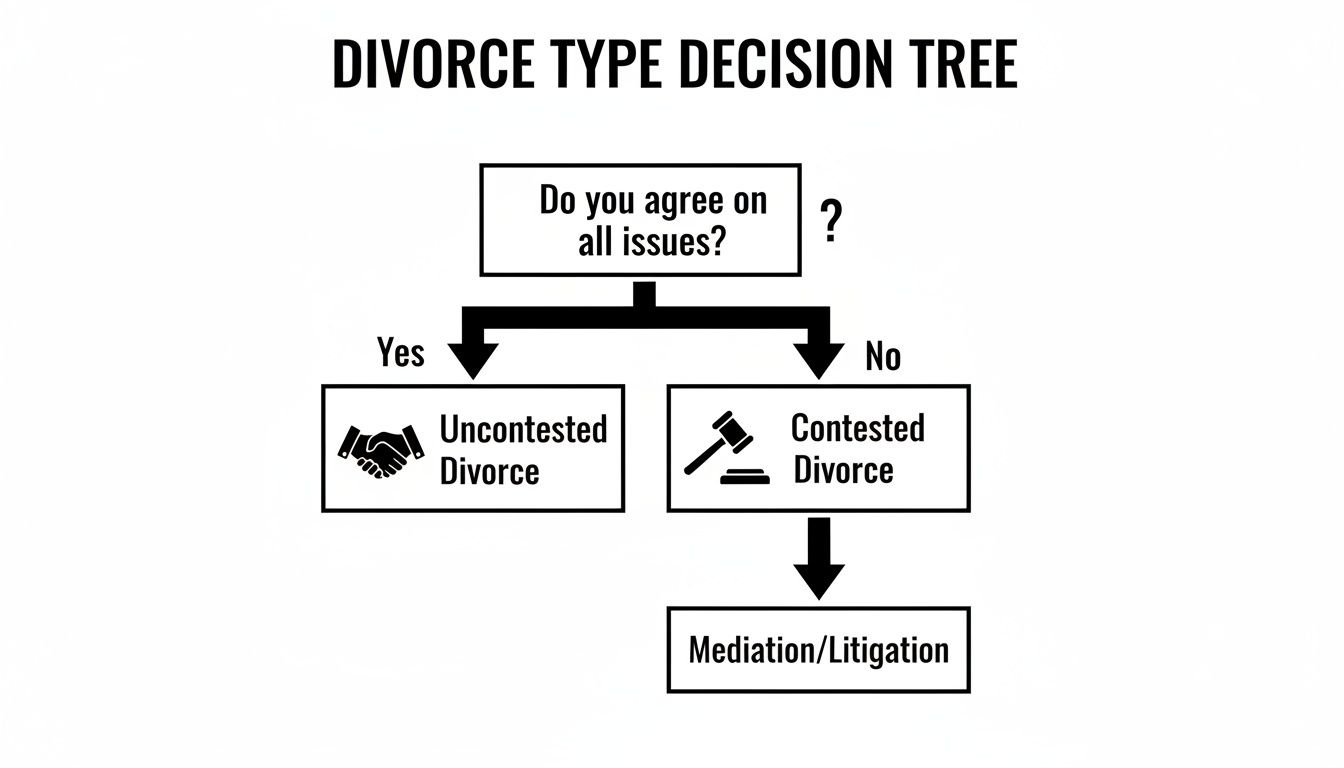
As you can see, total agreement opens the door to a cooperative, streamlined process. Any disagreement, however small, means you'll need to engage with the formal legal system to move forward. It's no surprise that many families are seeing the benefits of staying out of the courtroom. You can explore why more Texans are choosing out-of-court divorce options in our detailed guide.
At a Glance: Key Differences in Texas Divorce Paths
To give you a clearer picture of what each path looks like in practice, here’s a quick summary comparing the core elements of contested and uncontested divorces in Texas.
| Factor | Uncontested Divorce | Contested Divorce |
|---|---|---|
| Agreement Level | Full agreement on all issues (property, kids, support) | Disagreement on one or more issues |
| Decision-Maker | You and your spouse | A judge makes the final decisions |
| Typical Timeline | 2–6 months | 6 months to over a year |
| Average Cost | Lower and more predictable | Higher and variable; can be very expensive |
| Privacy Level | High (details remain private) | Low (financials and disputes become public record) |
| Emotional Stress | Generally lower stress and conflict | Often high stress due to the adversarial nature |
Seeing the differences side-by-side makes it clear how much your initial decision can shape your experience. While an uncontested divorce offers a faster, more private, and less expensive route, it requires cooperation that isn't always possible. A contested divorce provides a structured path to resolution when you simply can't see eye to eye.
The Uncontested Divorce Process in Texas: A Step-by-Step Guide

When you and your spouse agree to move forward cooperatively, you're choosing an uncontested divorce—a path that can save you a tremendous amount of time, money, and heartache. This route puts you in the driver's seat, allowing you both to create agreements that fit your family's needs instead of having a judge make those calls for you.
Even though it’s the more straightforward option, it’s not just a handshake deal. You still have to follow a specific legal process to make sure your divorce is properly finalized under Texas law. Think of it as a clear roadmap. Once you understand each stage, you can navigate the journey with more confidence and less anxiety.
Step 1: Filing the Initial Paperwork
The first official step is filing an Original Petition for Divorce. This document kicks off the legal process and is filed with the district court in the Texas county where either you or your spouse has lived for the last 90 days. One of you must also have been a Texas resident for at least six months.
The spouse who files is the Petitioner, and the other is the Respondent. In an amicable, uncontested case, the Respondent typically signs a Waiver of Service. This document acknowledges receipt of the divorce papers and confirms their agreement to proceed without being formally "served" by a sheriff or process server. It’s a key step that signals cooperation to the court and keeps the process moving smoothly.
Step 2: Drafting the Final Decree of Divorce
This is the most critical document in your case. The Final Decree of Divorce is the legally binding court order that details every single term of your agreement, leaving nothing to chance.
You and your spouse will need to be on the same page about everything, including:
- Division of Community Property: This section clearly lists who gets what assets (the house, cars, bank accounts) and who is responsible for which debts (the mortgage, credit cards, car loans). According to the Texas Family Code, this division must be "just and right." For business owners, this is where you can proactively structure a division that protects the company’s future.
- Child Custody (Conservatorship): A detailed plan outlining the rights and responsibilities of each parent, covering major decisions about your child's education and healthcare.
- Possession Order: A specific, calendar-based schedule detailing when the children will be with each parent—weekdays, weekends, holidays, and summer breaks.
- Child Support: The agreed-upon amount of financial support one parent will pay, which must also cover health insurance and medical expenses.
Even if you agree on everything, having an experienced attorney draft or review your decree is non-negotiable. A poorly written decree can create massive legal and financial headaches for years. For a deeper dive, explore The Complete Guide to Uncontested Divorce Process in Texas.
Step 3: Observing the Waiting Period and Finalizing the Divorce
Texas law requires a mandatory 60-day waiting period that starts the day the Original Petition for Divorce is filed. This "cooling-off" period applies to every divorce in the state, contested or not. A judge cannot sign any final orders until at least 61 days have passed.
Once the waiting period is over and you've both signed the Final Decree, the last step is a brief court appearance called a "prove-up" hearing. Usually, only the Petitioner attends. You'll go before a judge, answer a few straightforward questions to confirm the details in your petition, and present your signed decree. The judge reviews the paperwork to ensure it meets all legal requirements and is in the children's best interest. If everything is in order, the judge signs the decree, and your divorce is final. The hearing itself often takes only a few minutes.
Navigating The Contested Divorce Process in Texas

When you and your spouse can’t find common ground on major issues, a contested divorce provides the formal, structured path needed to reach a resolution. The word "contested" might sound aggressive, but it simply means you need the legal system to provide a framework for making decisions when you can't make them together. The entire process is governed by the Texas Rules of Civil Procedure, ensuring every step is handled fairly and methodically. Understanding this roadmap can help you feel more prepared for what’s ahead.
Kicking Off The Case: Filing and Service
A contested divorce starts the same way as an uncontested one: one spouse, the Petitioner, files an Original Petition for Divorce. This document formally starts the lawsuit and outlines the Petitioner's initial requests regarding property, children, and support.
Here’s where the path diverges sharply. Instead of the other spouse (the Respondent) signing a Waiver of Service, they must be formally notified through service of process. A sheriff, constable, or private process server physically delivers a copy of the lawsuit to them. This formal delivery makes it official, ensuring the Respondent is legally aware of the case and has a strict deadline to file their formal response, known as an Answer.
The Discovery Phase: Uncovering The Facts
Once both of you are officially part of the lawsuit, the case moves into the discovery phase. This is the formal process of gathering information and evidence from the other side to ensure everyone has a complete and accurate picture of the marital estate and any other relevant facts.
This stage is absolutely crucial, especially if you’re a business owner or have a high-value estate. The main tools used during discovery include:
- Requests for Production: Formal demands for documents like bank statements, tax returns, property deeds, and business records.
- Interrogatories: A set of written questions sent to the other party that they must answer under oath.
- Requests for Admission: A list of statements that the other party must either admit or deny, helping narrow down what's in dispute.
- Depositions: Out-of-court testimony where one attorney questions the other party under oath, with a court reporter transcribing everything.
Discovery can feel intrusive, but it's essential for achieving the "just and right" property division that the Texas Family Code demands. For a more detailed look, you can learn more about how contested divorces unfold in Texas.
Setting Ground Rules with Temporary Orders
A contested divorce isn't quick; it can take months or even over a year. You can’t put your life on pause while you wait. That’s why you have a Temporary Orders Hearing to establish rules that will govern your family while the case is ongoing. During this hearing, a judge makes temporary rulings on pressing matters like:
- Who stays in the family home.
- Who is responsible for paying which bills.
- A temporary child custody and visitation schedule.
- The amount of temporary child support and spousal support, if any.
These orders bring much-needed stability for you and your children while the bigger issues are being sorted out.
The Path to Resolution: Mediation and Trial
Before a final trial, most Texas counties require you to attend mediation. This is a confidential meeting where you, your spouse, and your lawyers sit down with a neutral third-party mediator whose job is to help you find a middle ground and reach a settlement. It’s often your best chance to resolve disputes without handing decision-making power to a judge. The vast majority of contested cases settle at this stage.
If mediation fails and you still can't agree, your case will be scheduled for a final trial. At trial, both sides present evidence and arguments to a judge, who will then make the final, binding decisions on every disputed issue. This is the last resort, as it means turning control of your family's future over to the court.
How Each Divorce Path Impacts Your Children and Property
The choice between a contested and an uncontested divorce isn't just about paperwork—it's about who gets to make the final call on the two most important parts of your life: your family and your finances. The way you handle disagreements today will have ripple effects for years, shaping everything from your co-parenting relationship to your long-term financial stability.
The core distinction is simple but profound: who holds the power to decide your family’s future? Will it be you and your spouse, or will it be a judge who has never met you?
Child Custody and Support Decisions
When it comes to your kids, the divorce process can either lay a foundation for healthy co-parenting or create a battlefield that leaves lasting scars.
In an Uncontested Divorce:
You and your spouse stay in control. You can work together to design a possession order (the Texas term for a custody schedule) that is custom-fit for your family. A collaborative agreement can account for your children's unique needs, your work schedules, and family traditions in ways a rigid court order cannot. This approach allows for creative solutions a judge could never order, like building schedules around non-traditional work hours or agreeing on holiday plans that honor your family's customs. This process is built on communication and compromise—the very skills you’ll need for a successful co-parenting relationship long after the divorce is final.
In a Contested Divorce:
When you can’t agree, you hand that decision-making power to a judge. A Texas judge must follow the strict legal standard of the Texas Family Code, which means ruling based on the "best interest of the child." This subjective standard means a stranger will decide on deeply personal matters, like:
- Which parent gets to decide where the child lives.
- How every holiday and summer vacation will be divided.
- The exact amount of child support, calculated using a rigid formula.
The adversarial nature of a contested case can poison the well, making future cooperation nearly impossible. The conflict can be incredibly tough on children, and choosing a path that minimizes fighting is one of the most protective decisions you can make.
The Division of Your Marital Property
Your financial future hangs in the balance, and it all comes down to how your property and debts are divided.
In an Uncontested Divorce:
You and your spouse decide how to split your assets and liabilities. This allows for practical, real-world solutions. For example, one of you might keep the family home in exchange for the other receiving a larger share of a retirement account—a trade-off that helps both of you meet long-term goals. Business owners, in particular, benefit from this control, as you can negotiate a division of business assets in a way that protects the company's ability to operate.
In a Contested Divorce:
A judge will divide your community property based on what they believe is "just and right," as required by the Texas Family Code. But "just and right" does not automatically mean a 50/50 split. A judge can award a disproportionate share of assets to one spouse based on factors like fault in the breakup, differences in earning capacity, or the children's needs. This uncertainty means you lose the power to negotiate a predictable financial outcome and are forced to accept whatever the court decides.
A Realistic Comparison of Divorce Costs and Timelines

For most families facing divorce, one of the most pressing questions is, "What is this going to cost me?" We're not just talking about money—it's an investment of your time, emotional energy, and peace of mind. The path you and your spouse choose will directly shape the answer. Understanding the reality of what you can expect from each is crucial.
The Financial Realities of Each Path
The financial gap between an uncontested and contested divorce is a canyon. An uncontested divorce is built on agreement, which dramatically cuts down on the hours of legal work required and saves you a significant amount of money.
In an uncontested divorce, your expenses are generally straightforward and predictable. You're typically looking at court filing fees and attorney's fees, which can often be handled for a flat fee because the scope of work is clear.
On the other hand, a contested divorce throws financial predictability out the window. Costs are billed hourly and stack up based on the level of conflict. Expenses can multiply quickly and often include:
- Higher Attorney Retainers: A much larger upfront payment for an unknown amount of work.
- Discovery Costs: The formal process of exchanging information is all billable time.
- Mediation Fees: You and your spouse must split the cost of a professional mediator.
- Expert Witness Fees: You may need to hire expensive financial appraisers or custody evaluators.
The more you and your spouse can agree on outside of a courtroom, the more control you keep over the final cost.
Comparing Divorce Timelines in Texas
Time is a resource you can never get back. An uncontested divorce respects your time, while a contested divorce can consume months, or even years, of your life.
The timeline for an uncontested divorce is mostly governed by Texas's mandatory 60-day waiting period. From the day the petition is filed, a judge cannot sign your final decree for at least 61 days. Most amicable cases are wrapped up shortly after this period, usually within 2 to 4 months total.
A contested divorce, however, moves at the court's slow pace. The timeline can easily stretch from 6 months to well over a year, depending on the complexity of your disagreements and the judge's calendar. This extended legal limbo is emotionally and financially exhausting for everyone involved, especially children.
Texas Divorce Estimated Costs and Timelines
| Aspect | Uncontested Divorce (Typical) | Contested Divorce (Typical) |
|---|---|---|
| Timeline | 2–4 months (after the 60-day waiting period) | 6 months to over a year |
| Primary Costs | Court filing fees, flat-rate attorney fees | Attorney retainers, hourly billing, mediation, and expert fees |
| Financial Control | High predictability and control over costs | Low predictability; costs are driven by the level of conflict |
| Emotional Toll | Lower stress, maintains privacy, and helps foster co-parenting | High stress, public proceedings, and can damage relationships |
Weighing these factors helps you see the true cost of disagreement. While an amicable divorce isn't possible for every couple, making an effort to find common ground is a powerful strategy for protecting your finances, your time, and your family's emotional well-being.
What to Do Next
Understanding the difference between a contested and uncontested divorce is a huge first step. Now, it's about turning that knowledge into action. What you do next will set the tone for the entire process, giving you a sense of control when everything else feels uncertain. Preparing for your first conversation with a divorce attorney will ensure it is laser-focused on your situation and how to solve it.
Preparing for a Productive Consultation
Walking into an attorney's office with key documents can be the difference between a vague chat and a real strategy session. This simple preparation gives your lawyer the tools they need to give you specific, practical advice right away.
Try to pull together the following:
- Financial Records: Recent pay stubs, the last two years of tax returns, and statements for all bank accounts.
- Property Information: Deeds to your house, car titles, and recent mortgage statements.
- Debt Statements: A list of everything you owe—credit card balances, car loans, personal loans.
- Business or Retirement Documents: Statements for any 401(k)s, pensions, or records related to business ownership.
Having these documents ready allows your attorney to see the full picture and transforms a get-to-know-you meeting into a planning session dedicated to protecting your family and assets.
While you're navigating the legal maze, don't forget to take care of yourself. The court process is just one piece of a much larger journey of healing. For a compassionate guide on recovery, you may find valuable insights in this resource on How to Heal After Divorce.
Your Next Step: Taking Action
You deserve a legal partner who will listen, clearly explain your rights under the Texas Family Code, and map out a strategy that puts your family's well-being first. If you’re ready to move forward with clarity and confidence, we're here to help.
Navigating these decisions is tough, but you don't have to figure it all out on your own. If you are facing the complexities of property division or child custody in a Texas divorce, contact The Law Office of Bryan Fagan, PLLC today to schedule a free, confidential consultation. Let’s talk about your situation and build a strategy to secure the best possible outcome for you and your family.
Have Questions About Your Texas Divorce? We Have Answers.
We hear many of the same questions from clients trying to understand the divorce process. Here are answers to the most common ones we get about contested versus uncontested divorce in Texas.
Can a Contested Divorce Become Uncontested?
Absolutely, and it happens all the time. Many divorces start as "contested" because of one or two disagreements. But once those key issues are resolved—often through attorney negotiation or mediation—the case can smoothly transition into an uncontested one. This pivot can save you a significant amount of time, money, and emotional energy.
Do I Still Need a Lawyer for an Uncontested Divorce?
While it's not legally required, it is highly recommended. Think of it as insurance for your future. An attorney ensures your Final Decree of Divorce is drafted perfectly, protecting your rights and making sure your agreement is legally airtight. This step can prevent incredibly expensive and frustrating problems from surfacing years down the road.
What Are the Biggest Reasons a Divorce Becomes Contested?
Nine times out of ten, it comes down to two things: children and property. Disagreements over child custody arrangements and the division of complex assets are the most common roadblocks. High-conflict issues often include possession schedules, who makes major decisions for the children, how to value a family business, or how to split a high-value retirement account. These disputes often require formal legal help to be resolved fairly.
Understanding which path is right for you is the first step toward building a secure future. At The Law Office of Bryan Fagan, PLLC, our experienced attorneys are here to provide the compassionate guidance and strategic advice you need to move forward with confidence.
Schedule your free, no-obligation consultation today to discuss your situation and learn how we can protect what matters most to you. Visit us at https://texasdivorcelawyer.us to get started.