 Skip to content
Facing a separation, your mind races with a million questions, but the one that often hits hardest is, "When does child support actually start?"
Here in Texas, child support isn't automatic. It doesn't kick in the day you separate or move out. The legal obligation to pay child support officially begins only when a judge signs a court order. That order is the finish line of a legal process that starts when one parent files a case, such as a divorce or custody suit. Understanding this timeline is the first step toward securing your child's financial stability.
Understanding When the Clock Starts Ticking
At The Law Office of Bryan Fagan, PLLC, one of the biggest misconceptions we clear up is the idea that child support is owed from the moment two parents stop living together. The truth is, without a formal legal case on file with the court, there is no enforceable duty to pay.
Think of filing a lawsuit as the official starting pistol for the child support process.
This is a critical point to grasp. Any money you pay or receive informally before a court order is in place might not count toward your official child support obligation later on. The legal system needs a clean, documented starting point. Filing a case gives a judge the authority to issue orders and ensures that the financial support for your child is structured, consistent, and legally binding.
Key Triggers for a Child Support Order
To get the ball rolling, one of two main legal actions needs to happen in Texas:
Filing a Petition for Divorce: If you're married, the request for child support is simply one piece of the larger divorce proceedings. Your petition asks the court to address all aspects of your separation, including custody and support for your children.
Filing a Suit Affecting the Parent-Child Relationship (SAPCR): If you were never married, this is the type of lawsuit you’ll file. A SAPCR is designed to establish legal parentage, custody, visitation, and—most importantly for this discussion—child support.
Both of these paths lead to the same destination: a court order that lays out exactly when payments begin, how much they will be, and how they need to be paid. Figuring out which path fits your situation is the first real step toward securing your child’s financial stability. Without taking that official action, you're left in a vulnerable spot with no legal way to compel payments.
Legal Steps That Trigger a Child Support Obligation
One of the biggest misconceptions I see is the idea that child support just happens when parents separate. That's not how it works in Texas. Child support isn't automatic; it only begins when you take formal legal action to get a court order.
Think of it this way: until a judge signs an order, any money exchanged between parents is just a voluntary payment. There's no legal teeth to it. To create a real, enforceable child support obligation, you have to file a case with the court. The specific case you file depends entirely on one thing: whether you and the other parent are married.
The Divorce Pathway for Married Parents
If you and your spouse are married, the request for child support is rolled right into your Petition for Divorce. A divorce case is designed to handle everything involved in ending the marriage—dividing property, sorting out spousal support, and, most importantly, making decisions about the kids.
When you file for divorce, you’re officially asking the court to establish custody (conservatorship), create a visitation schedule, and order financial support for your children. Child support is a fundamental piece of this puzzle, ensuring your kids are provided for both while the divorce is ongoing and long after it’s final.
This flowchart breaks down the basic legal journey from filing a case to getting an official child support order.
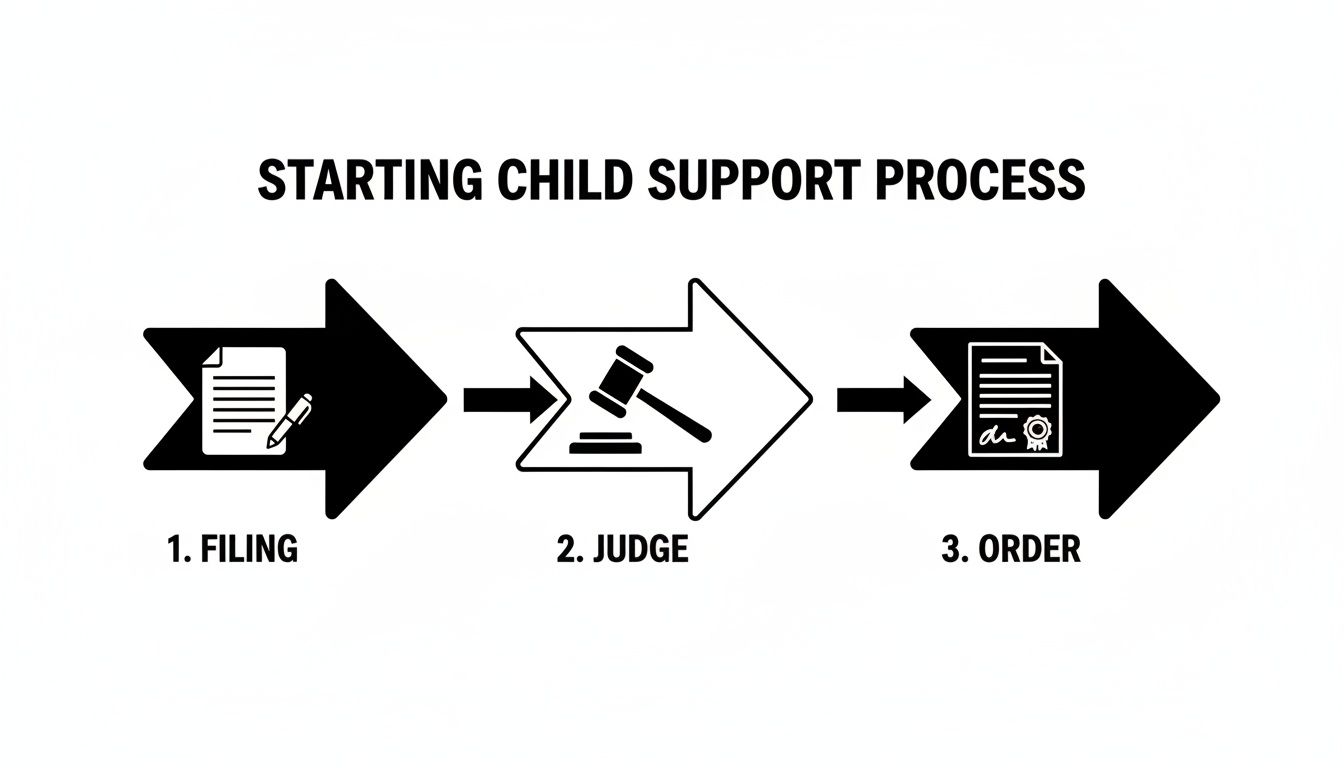
The key takeaway here is that filing the petition is what kicks everything off. It's the action that gives the judge the power to make an enforceable order.
The SAPCR Pathway for Unmarried Parents
So, what happens if you and the other parent were never married? The legal process for you is a Suit Affecting the Parent-Child Relationship, or as attorneys call it, a SAPCR (pronounced "sap-sir").
A SAPCR is a lawsuit built specifically for unmarried parents to legally define their rights and duties. It essentially accomplishes everything a divorce does for a married couple, but only as it relates to the children.
Filing a SAPCR allows the court to:
- Establish Paternity: If the child's legal father hasn't been determined, this is the first step.
- Set Custody Orders: This determines who makes decisions for the child (conservatorship).
- Create a Visitation Schedule: The order will lay out exactly when each parent has the child.
- Order Child Support: This creates the formal, legal obligation for one parent to pay the other for the child's care.
For unmarried parents, filing a SAPCR is the official starting line. It opens the case and allows a judge to put support orders in place. Navigating this as an unmarried parent can be tricky, so it's a good idea to understand how Texas paternity laws work.
The Texas Family Code doesn't treat married and unmarried parents differently when it comes to the duty to support a child. The only real difference is the legal paperwork you file to get your case in front of a judge—a divorce or a SAPCR.
As you move through these legal steps, it's also wise to get a handle on the bigger financial picture. For those with more complex assets, this guide on finance and divorce for high net worth individuals offers some valuable perspective.
No matter your situation, filing the right petition is the one step you can't skip. It's what protects your child’s right to financial support and ensures that every payment is legally binding and backed by the power of the court. Without it, you’re relying on goodwill alone, which can disappear without warning and without legal consequence.
How Temporary Orders Provide Immediate Financial Support
Waiting months for a judge to sign your final divorce or custody order can feel like an eternity, especially when your child’s needs for food, housing, and stability are immediate. This gap between filing your case and getting a final resolution is precisely why Texas courts use Temporary Orders.
Think of a Temporary Order as a legally binding set of ground rules that brings order to the chaos while your case is ongoing. It’s a crucial lifeline that provides immediate financial relief and predictability during a time when everything feels uncertain.

What Are Temporary Orders?
Temporary Orders are court-issued directives that tackle the most urgent issues right at the start of a divorce or custody case. While these orders aren't permanent, they are fully enforceable until a final decree is signed by the judge. They create a stable, temporary structure for your family to operate within.
Some of the key issues addressed in Temporary Orders include:
- Temporary Child Support: This is often where the court first answers the question, "When does child support start?" It sets an initial monthly payment to keep your child's needs met.
- Temporary Custody and Visitation: The order will establish who the child lives with for the time being and create a temporary possession schedule for the other parent.
- Temporary Spousal Support: If one spouse has a clear financial need and the other has the ability to pay, temporary spousal support might be ordered.
- Use of Property: The court can decide who gets to live in the family home or drive a particular car while the case is sorted out.
- Payment of Debts: It can also spell out who is responsible for paying the mortgage, car notes, and credit card bills.
This whole process is like creating a temporary household budget and parenting plan to get you through a major life transition. It provides much-needed clarity and, most importantly, peace of mind while you and your legal team work toward a permanent solution.
The Timeline for Getting Temporary Support
One of the most reassuring things about this process is how quickly it can move. You don’t have to wait for the entire case to be over to get financial help. A hearing for Temporary Orders can often be scheduled within just a few weeks of filing your initial petition.
At this hearing, both you and the other parent will present evidence to the judge about your incomes, expenses, and the child's needs. The judge then makes a ruling based on that information and signs the Temporary Orders. This signature makes the child support obligation official and legally enforceable from that point forward.
Under Texas law, the moment a judge signs the Temporary Order is often the first moment a formal, enforceable child support obligation exists. This ensures your child’s financial needs are met without unnecessary delay.
Child support obligations typically begin on the date a court order is issued or, in many cases, retroactively from the date the petition is filed, helping ensure parents don't evade responsibility during legal delays. In Texas, where firms like The Law Office of Bryan Fagan, PLLC, serve clients, support often kicks in during the Temporary Orders phase of a divorce, frequently within weeks of filing. This covers essentials until a final decree is reached. You can learn more about the research behind these timelines.
Claiming Past-Due Payments with Retroactive Child Support
What happens when a long time passes between your separation and the day you finally file a court case? It's a common worry—that you've missed the chance to get support for all those months your child went without. Thankfully, Texas law provides a powerful tool for this exact situation: retroactive child support.
Think of it as the court's way of hitting the rewind button. It allows a judge to order the non-custodial parent to pay for the period before a formal order was ever put in place. This is all about making sure a child gets the financial support they were always entitled to, even if the legal process got off to a slow start.

How Retroactive Child Support Works in Texas
Under the Texas Family Code, a judge has the authority to order retroactive child support. This isn't something you get automatically; it's a specific request you have to make during your divorce or SAPCR case. The court then looks at the unique circumstances of your situation to decide if ordering these back payments is fair and appropriate.
As a general rule, the law presumes that ordering support going back four years is reasonable. But this is just a starting point. The final call is up to the judge, who will weigh several critical factors before making a decision.
Key Factors the Court Considers
When you ask for retroactive child support, a judge won't just rubber-stamp it. They will dig into the details from every angle to make a fair ruling. Building a strong case means providing clear, convincing evidence on these key points.
The court will want to know:
- Did the paying parent know about the child? A parent who knew they had a child but deliberately failed to provide support is seen very differently from one who was genuinely unaware.
- Did the parent try to avoid their duty? Was the non-custodial parent actively dodging their responsibilities, like refusing to establish paternity or pay support? Any evidence of evasion can heavily influence a judge.
- What was the financial situation? The judge will look at the paying parent's income and ability to provide support during that past period.
- Did the custodial parent try to notify the other parent? Did you make good-faith efforts to let the other parent know about the child's birth and their financial needs?
- Will the order cause an undue hardship? The court also has to consider whether a massive retroactive payment would create an unfair and unmanageable financial burden on the paying parent.
The core purpose of retroactive child support is fairness. It aims to hold a parent accountable for their past obligations while ensuring the final order is reasonable and manageable.
Building Your Case for Retroactive Support
To successfully claim retroactive support, you need more than just a request—you need proof. Your attorney will be instrumental in helping you gather the right documents to show the other parent knew about the child and had the ability to pay during the time in question.
This evidence might include things like:
- Proof of Paternity Awareness: Text messages, emails, social media posts, or even testimony from friends and family can show the parent knew about the pregnancy or birth.
- Financial Records: Your own records demonstrating what you spent on the child (like receipts for daycare, medical bills, and school supplies) can highlight the financial gap left by the other parent.
- The Other Parent's Income: Pay stubs, tax returns, or other evidence of the other parent's employment and income from previous years helps the court calculate what they should have been paying all along.
Securing retroactive child support can make a huge financial difference for your child, helping you recover thousands of dollars for past expenses. Because it's not guaranteed, presenting a well-documented and persuasive case is absolutely critical. An experienced family law attorney can help you navigate this complex process and fight for the full amount your child is owed.
How Texas Calculates Child Support Payments
Worrying about how much child support will be can feel like staring at a complex math problem with no formula. But in Texas, the process is actually surprisingly straightforward and predictable. The state uses a clear, guideline-based formula to determine the amount, which removes a lot of the guesswork and anxiety from the equation.
When you understand this formula, you can anticipate what a potential child support order might look like. That knowledge gives you back a sense of control and clarity during a confusing time.

Step 1: Figure Out Net Monthly Resources
The whole calculation hinges on one key figure: the paying parent's net monthly resources. You can think of this as their take-home pay, but with a few specific legal adjustments. It’s not just about a salary; it's a comprehensive look at all income available to support a child.
To get to this number, the court starts by adding up all the parent’s gross income from every source. This isn't just a W-2. It includes things like:
- Wages, salary, commissions, and bonuses
- Self-employment income
- Rental income from property
- Retirement benefits, pensions, and annuities
- Social Security benefits (but not SSI)
- Unemployment benefits and workers' compensation
- Gifts and prizes
From that grand total, the court subtracts a specific list of legally allowed deductions. These aren't your everyday living expenses. They're things like federal income taxes, Social Security taxes, union dues, and—most importantly—the amount paid for the child’s health insurance premiums. Whatever is left over is the "net monthly resources" used for the child support calculation.
Step 2: Apply The Guideline Percentages
Once that net monthly resource number is locked in, the court simply applies a percentage based on how many children are part of the case. The Texas Family Code lays these percentages out very clearly.
Here’s a look at the standard guidelines laid out in the Texas Family Code. These percentages apply to the non-custodial parent's net resources and determine the baseline child support amount.
Texas Guideline Child Support Percentages
| Number of Children | Percentage of Net Resources |
|---|---|
| 1 Child | 20% |
| 2 Children | 25% |
| 3 Children | 30% |
| 4 Children | 35% |
| 5 or More Children | 40% |
These percentages serve as the standard starting point for nearly every child support case in Texas, providing a consistent and fair framework. For a deeper dive, you can learn more about how child support is calculated in our in-depth guide.
It's also crucial to know that these guidelines officially apply to the first $9,200 of net monthly resources. If the paying parent earns more than that, a judge can order additional support, but only if the child’s proven needs justify a higher amount.
A Practical Example Of The Calculation
Let’s see how this works in the real world. Imagine a parent, Alex, has one child and brings in a gross monthly income of $6,000.
Calculate Net Resources: The court subtracts Alex's taxes, the child's health insurance premium, and other allowed deductions. Let's say these add up to $1,500.
- $6,000 (Gross Income) – $1,500 (Deductions) = $4,500 (Net Monthly Resources)
Apply the Percentage: Because Alex has one child, the guideline percentage is 20%.
- $4,500 x 0.20 = $900
In this pretty standard scenario, Alex’s monthly child support obligation would be $900.
This formula-driven approach creates consistency across the state, ensuring that children get a fair and predictable level of support based on their parent's actual income. While it’s designed to be straightforward, having an experienced attorney on your side can ensure all income is properly identified and every allowable deduction is correctly applied.
Frequently Asked Questions About Starting Child Support in Texas
When you're trying to figure out child support, a lot of questions can start swirling around, and each one feels more urgent than the last. You need straight answers to feel like you're on solid ground. Here are some of the most common questions we hear from parents in your exact situation.
Can We Just Agree on Child Support Without Going to Court?
It’s a tempting thought. Many parents hope to keep things friendly by working out a private, informal child support agreement. While the intention is good, this is a risky path in Texas. A verbal promise or a handshake deal is not legally enforceable.
If the paying parent suddenly decides to stop paying, or only pays a fraction of what you agreed on, you have zero legal power to do anything about it. The court can't enforce an agreement it never knew about or approved. The only way to truly protect your child’s right to consistent support is with a formal court order. That order is what gives you the ability to take action if the payments ever stop.
What Happens if the Other Parent Lives in a Different State?
This is a common scenario, but don't worry—it doesn't stop the process. Thanks to a federal law called the Uniform Interstate Family Support Act (UIFSA), there's a clear roadmap for handling child support cases across state lines.
Under UIFSA, you can file for child support right here in Texas, and our courts can establish a valid order. That Texas order is then sent to the other parent's state for enforcement. You won't have to travel or hire a lawyer in another state. The law ensures that different jurisdictions cooperate to make sure your child gets the support they are entitled to.
The whole point of UIFSA is simple: only one state can have authority over a child support order at any given time. This brilliant rule prevents conflicting orders and legal chaos, creating a much smoother process for families living in different states.
Does Child Support Start Automatically for Unmarried Parents?
No, and this is a critical point that trips up many unmarried parents. Just like with a divorce, there is no automatic child support obligation when an unmarried couple separates. The legal duty to pay only clicks into place once a judge signs a court order.
For unmarried parents, one of you has to take the first step by filing a Suit Affecting the Parent-Child Relationship (SAPCR). This is the legal case that allows a judge to officially establish paternity, create a custody and visitation schedule, and—most importantly—issue a formal, enforceable child support order. Without filing a SAPCR, any money exchanged is considered voluntary and can be stopped at any moment without any legal consequences.
What to Do Next: Your Action Plan
Knowing when and how child support starts is one thing, but taking action is what actually builds a stable foundation for your child. The legal system can feel like a maze, especially when you're already dealing with so much. But you can break it down into a clear, manageable plan.
Your Initial Steps Checklist
- Identify Your Legal Pathway: First, figure out which legal action fits your situation. If you're married, you'll file a Petition for Divorce. If you're unmarried, you’ll file a Suit Affecting the Parent-Child Relationship (SAPCR).
- Gather Key Financial Documents: Start pulling together the essential financial paperwork for both you and the other parent. This includes recent pay stubs, the last two years of tax returns, and proof of health insurance costs for your child.
- File Your Petition with the Court: This is the official starting pistol. Filing the right petition formally opens your case and gives a judge the authority to issue temporary and final child support orders.
- Request a Temporary Orders Hearing: This is a crucial step to get support flowing quickly. Ask your attorney to schedule this hearing as soon as possible to establish temporary child support and custody arrangements.
Once you have an order, you can learn more about what to do if payments stop by reading our guide on how to enforce child support orders in Texas.
The legal side of child support can feel overwhelming, but you don't have to navigate it alone. At The Law Office of Bryan Fagan, PLLC, our team is dedicated to bringing clarity and confidence to your situation so you can protect your child’s future. We invite you to schedule a free, no-obligation consultation to discuss your case with our experienced attorneys. Let us help you take the next step. Visit us at https://www.texasdivorcelawyer.us to learn more.


