Skip to content
That feeling of relief when your divorce is final can quickly turn to frustration when your ex-spouse starts ignoring the judge's orders. When that happens, you aren't stuck. Enforcing a divorce decree in Texas means filing a formal Motion to Enforce with the court. This action legally compels your ex-spouse to follow the specific orders they're violating and turns your decree from a piece of paper into a powerful, actionable legal tool.
Your Decree Is a Court Order, Not a Suggestion
It’s one of the most disheartening experiences after a divorce. You have a signed Final Decree of Divorce, a document you believed settled everything, only to find your ex-spouse treats it like a list of optional guidelines.
This isn't just a simple disagreement or a co-parenting hiccup; it's a direct violation of a legally binding Texas court order.
Your decree carries the full weight of the law. Whether it outlines who gets the house, how often you see your children, or who is responsible for paying a specific debt, each provision is an instruction from a judge. When your ex fails to comply, you have legal recourse to demand what you are owed.
Differentiating Violations from Disagreements
Knowing the difference between a minor issue and a clear violation is the first step. Not every frustration warrants a trip back to court. But when a line is crossed, you need to be ready to act.
It's helpful to distinguish between a frustrating but manageable disagreement and a situation that demands legal intervention. A good faith argument over interpreting a vague clause might be something to mediate, while a flat-out refusal to comply with a clear directive is another matter entirely.
Here’s a table to help you determine if you're dealing with a violation or a simple disagreement.
Violation vs. Disagreement: When to Take Legal Action
| Situation | Potential Violation (May Require Enforcement) | Minor Disagreement (Consider Communication First) |
|---|---|---|
| Child Possession | Consistently denying court-ordered visitation without a valid emergency reason. | Being 15 minutes late for pickup due to traffic occasionally. |
| Child Support | Missing multiple payments or consistently underpaying the ordered amount. | A single late payment due to a banking error that is quickly corrected. |
| Property Transfer | Refusing to sign over a car title or deed by the deadline in the decree. | Asking for a few extra days to move personal items out of the marital home. |
| Debt Payment | Failing to pay a court-ordered credit card debt, causing damage to your credit. | Disagreeing on how to split a utility bill not specifically mentioned in the decree. |
| Home Refinancing | Not making good-faith efforts to refinance the mortgage to remove your name. | Delaying refinancing by a week because of a lender's paperwork delay. |
This table provides a framework to think through your next steps. Consistent, willful refusal to follow clear orders is usually a sign that it’s time to involve the court.
Clear violations are direct refusals to follow a specific, unambiguous order in the decree. These are the situations where taking legal action becomes necessary.
- Financial Violations: An ex-spouse consistently failing to pay child support or spousal maintenance, refusing to sign over a vehicle title, or not paying their share of a joint debt as ordered.
- Property Violations: An ex-spouse not refinancing the mortgage to remove your name from the loan by the specified deadline or refusing to give you personal property awarded to you.
- Custody Violations: An ex-spouse denying you court-ordered possession time with your children or failing to return them at the designated time without a valid reason.
These are not just disputes; they are breaches of a judicial command. The Texas Family Code provides powerful tools to hold your former spouse accountable.
When your ex-spouse ignores the decree, they aren't just disrespecting you—they are defying the court. An enforcement action is your way of asking the judge to step back in and demand compliance.
The Power of the Texas Family Code
The law is firmly on your side when your decree is violated. In Texas, Texas Family Code Chapter 157 gives courts the authority to issue enforcement orders with serious consequences. This can include wage withholding for support, placing liens on property, or even ordering jail time for a willful violation.
For context, statistics from the Texas Office of the Attorney General showed that in 2022, over 250,000 child support cases were active, with enforcement actions recovering $1.2 billion annually through similar mechanisms.
Knowing you have solid legal ground to file for enforcement is empowering. It allows you to move from a place of frustration to one of proactive, confident action. As you consider your next steps, it's helpful to understand the details of what a Texas Final Decree of Divorce truly represents.
Building Your Case: How to Document Every Violation
Before you ever set foot in a courtroom, your most powerful tool is solid, undeniable proof. When it’s time to enforce your divorce decree, you can't just tell the judge your ex isn't following the rules; you have to show them. Building a strong case starts right now, with meticulous documentation of every single violation.
Think of yourself as a meticulous record-keeper for this part of your life. This process isn’t about being petty; it's about creating a factual, emotion-free record that a judge can easily understand and act upon. Every piece of evidence you gather becomes a building block for a successful Motion to Enforce.
Your Essential Evidence Checklist
Gathering the right documents is the bedrock of your enforcement case. Your goal here is to create a portfolio of proof that leaves no room for doubt. Start pulling together any of the following items that apply to your situation:
- Financial Records: Bank statements, cancelled checks, or even payment app histories (like Zelle or Venmo) that clearly show missed or partial child support or spousal support payments.
- Communication Records: Screenshots of text messages or emails where your ex explicitly refuses visitation, acknowledges a missed payment, or otherwise confirms a violation. Crucially, make sure these screenshots include the date and time.
- Property Documents: Think car titles, property deeds, or loan statements. These can prove an asset hasn't been transferred or a debt hasn't been refinanced as ordered in the decree.
- Third-Party Confirmation: Emails from schools, daycare providers, or doctors can be gold. They can corroborate a violation, like your ex failing to pick up a child at the scheduled time.
As you collect these, organize them chronologically for each type of violation. This creates a clear timeline that tells a compelling story to the court without you having to say a word.
Tracking Patterns Versus One-Time Mistakes
A judge needs to see if you're dealing with a consistent pattern of behavior or just an isolated incident. A single late child support payment due to a banking error is a world away from six consecutive months of non-payment. This is where tracking becomes absolutely critical.
A simple spreadsheet can be your best friend. Create columns for the date the obligation was due, the date it was (or wasn't) fulfilled, the amount paid versus the amount owed, and a "Notes" column for any relevant communication from your ex.
For example, if your decree states child support is due on the 1st of the month, your log might show payments arriving on the 15th, the 28th, and then not at all. This simple visual tool instantly demonstrates a clear pattern of disregard for the court's order.
This same method works perfectly for visitation. Log every single instance of denied or late possession time. Note the date, the scheduled time, the actual time of exchange (if it even happened), and any reason your ex-spouse gave. This transforms vague complaints like "He's always late" into concrete evidence like, "Over the past four months, the respondent was late for 8 out of 16 scheduled custody exchanges by an average of 45 minutes." That's the kind of specific data a judge can act on.
The Importance of a Clear Timeline
Once you have your documents and your tracking log, the final step before calling an attorney is to assemble it all into a clear, chronological narrative. This timeline is essentially the story of the violations, backed up by your indisputable facts.
Start from the date the decree was signed and work your way forward. List each violation as a separate event, and reference the specific piece of evidence that proves it. It should look something like this:
- June 1, 2024: Child support of $1,200 due. No payment received. (See attached Bank Statement Exhibit A).
- June 14, 2024: Scheduled weekend possession denied by Respondent. (See attached Text Message Exhibit B).
- July 1, 2024: Child support of $1,200 due. Received partial payment of $500. (See attached Bank Statement Exhibit C).
This organized approach does more than just prepare you for court; it gives your attorney the exact ammunition needed to draft a powerful and effective Motion to Enforce. By doing this homework, you position yourself for the best possible outcome from the very start.
Filing the Motion to Enforce: Making It Official
After weeks or even months of carefully documenting every violation, you’ve built a strong case. Now it’s time to stop waiting and formally ask the court to step in. This is done by filing a legal document called a Motion to Enforce. While the name sounds intimidating, it’s simply the official way to bring your ex-spouse’s non-compliance to a judge's attention and demand action.
Think of this motion as the bridge between your private frustrations and a public, legal solution. It’s where your meticulously organized evidence—the spreadsheets, text messages, and bank statements—transforms into a powerful legal argument. Filing this document kicks off the legal process to hold your ex-spouse accountable for ignoring a court order.
What Goes into a Motion to Enforce
A Motion to Enforce is a document that demands precision. Vague complaints like "he's always late with child support" won't fly in court. You need to be specific, clear, and direct. The Texas Family Code requires your motion to pinpoint exactly how your ex-spouse has failed to follow the final decree.
Here’s what a properly drafted motion must lay out for the judge:
- The Specific Provision Violated: You have to identify the exact section, paragraph, and page number of your Final Decree of Divorce that was ignored. For instance, "Paragraph 6.2 on page 8, ordering the Respondent to pay $1,200 in child support on the first of each month."
- A Clear Description of Each Violation: Detail every single instance of non-compliance with dates and specifics. An example would be, "Respondent failed to pay the court-ordered child support on June 1, 2024, July 1, 2024, and August 1, 2024."
- The Relief You Are Seeking: You must tell the judge exactly what you want them to do about it. This is your "ask." It could be a judgment for the total amount of unpaid support, an order forcing your ex to sign over a car title, or a request for make-up visitation time with your children.
This document is the foundation of your entire enforcement hearing. A well-prepared motion, packed with specific details, signals to the court that you are serious and organized. Getting these components right is critical, and you can learn more in our detailed guide on the Motion to Enforce in Texas.
The Procedural Steps: Filing and Service
Once your motion is drafted, the next step is filing it with the district clerk in the same county where your divorce was finalized. This officially opens your enforcement case. But just filing the document isn't enough to get your ex-spouse into court.
Next comes a crucial step called "service." This is the legal requirement to notify your ex-spouse that you have filed the motion and that they are required to appear in court. In Texas, this usually means hiring a constable, sheriff, or private process server to personally hand-deliver a copy of the filed motion and a citation to appear. This formal delivery ensures your ex can’t later claim they never knew about the hearing. It's all about due process and making sure the system is fair to everyone involved.
The infographic below illustrates these foundational steps of preparing your evidence, which is the work you do before filing the motion.
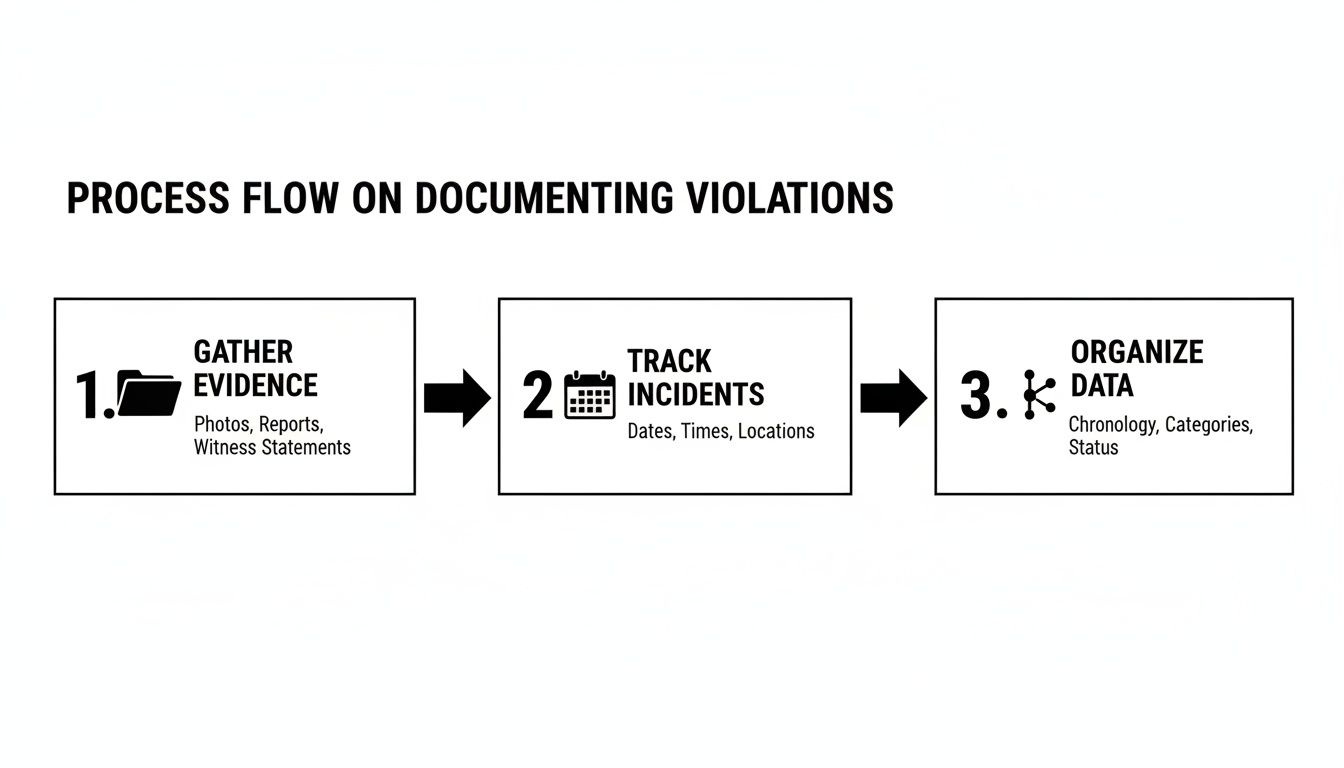
This workflow—gathering proof, tracking patterns, and organizing your timeline—is what gives your Motion to Enforce its strength.
Critical Texas Deadlines You Cannot Miss
In the legal world, timing is everything. Enforcement actions are no exception. Texas law sets strict deadlines, known as statutes of limitations, for when you can file a Motion to Enforce. If you miss these deadlines, you could lose your right to hold your ex accountable—forever.
For the division of property, you generally have only two years from the date your divorce decree was signed to file a motion. If your ex was supposed to sell the house or sign over a 401(k) and still hasn't, the clock is ticking loudly.
Fortunately, the rules are a bit more generous for other types of violations:
- Child Support Arrears: The window to enforce unpaid child support is much longer. You can typically file an enforcement action until the child turns 18 and for years afterward.
- Custody and Visitation: There isn't a hard statute of limitations for enforcing possession orders. However, waiting too long can weaken your case, as a judge might see your delay as acceptance of the new status quo.
These deadlines are absolute. Acting promptly not only protects your legal rights but also sends a powerful message that you expect the court's orders to be followed without excuses or delay.
What to Expect at Your Enforcement Hearing
Walking back into a courtroom can be stressful, but knowing what’s about to unfold can give you back a sense of control. An enforcement hearing isn't a chaotic drama; it’s a very structured process with one specific goal: getting a judge to enforce the orders in your divorce decree. Your preparation is your best tool.
This is your chance to lay out the evidence you’ve painstakingly gathered and show the judge exactly how your ex-spouse has violated the court’s order. You’re asking the court to step in and make things right.

The Key Players and Their Roles
When you walk into that hearing room, you’ll see a few familiar faces, each with a specific job to do. Knowing who’s who will help you feel more grounded.
- You (The Petitioner): You’re the one who started this process by filing the motion. Your job is to present the facts and evidence of the violations through your testimony and the documents you've collected.
- Your Attorney: Your lawyer is your guide and advocate. They will present your case, question both you and your ex-spouse, and make the legal arguments to the judge on your behalf.
- Your Ex-Spouse (The Respondent): They are there to answer for the allegations. They’ll get a chance to present their side of the story or offer a defense for why they didn’t comply with the order.
- The Judge: The judge is the ultimate decision-maker. Their job is to listen to both sides, look at the evidence, decide if a violation happened, and determine the consequences.
This setup ensures everyone gets a fair opportunity to be heard before a decision is made.
Two Main Paths for the Judge
As the judge listens to all the testimony and reviews the evidence, they're really trying to answer one question: Why wasn't the decree followed? The answer to that question sends them down one of two very different paths.
The first path is all about intent. Did your ex-spouse know what the decree said and simply decide not to follow it? This is the core question for a finding of contempt of court.
The second path considers whether the decree itself was the problem. Sometimes an order is so poorly written or ambiguous that it’s genuinely hard to know what was required. If the judge finds this is the case, they won't hold your ex in contempt. Instead, they will issue a clarification order, which essentially rewrites the confusing part in plain, specific language so there are no more excuses.
The Consequences of Contempt of Court
If the judge finds your ex-spouse in contempt, it’s a big deal. It means they've concluded the violation was willful—a direct defiance of a court order. Under the Texas Family Code, a judge has serious power to penalize someone for this.
These penalties aren't just about punishment; they're meant to force future compliance. A judge can order:
- Fines: The court can impose a monetary penalty for the violation.
- Jail Time: For each violation, a judge can sentence the respondent to up to 180 days in county jail. Often, a judge will "suspend" the sentence, meaning your ex stays out of jail as long as they start complying immediately.
- Payment of Your Attorney's Fees: This is a big one. If you win, the judge can—and very often will—order your ex-spouse to pay you back for all the legal fees and court costs you had to spend just to get them to follow the rules.
A finding of contempt sends an unmistakable message: court orders are not suggestions. The judge will use these tools to make sure the decree you worked so hard to get is finally respected.
Practical Remedies the Judge Can Order
Beyond just penalties for contempt, the judge’s main goal is to solve the problem. They will issue practical, real-world orders to fix the specific violation you came to court to address. This is where you get tangible results.
For example, a judge might order the immediate payment of a lump sum for all missed child support. They could force the sale of a house that was supposed to have been sold years ago. If your ex refused to sign over a car title, the judge can appoint someone else to sign it in their place.
When it comes to custody violations, the court can create a schedule of make-up visitation to give you back the parenting time you lost. The entire point of these remedies is to deliver what you were promised in your original divorce decree. That’s the end game.
Powerful Remedies the Court Can Grant
When you file a motion to enforce, you aren't just asking a judge to wag a finger at your ex-spouse. You're demanding real results. And thankfully, a Texas judge has a whole toolbox of legal remedies designed to force compliance and make you whole. This is the point where the words in your decree finally turn into action.
The court's main goal isn't just to punish—it's to fix the problem. Whether you're owed thousands in back child support, you've been locked out of property that is rightfully yours, or you've lost precious time with your kids, the judge can issue very specific orders to set things right.

Financial Remedies for Unpaid Support
When it comes to unpaid child support or spousal maintenance, the Texas Family Code gives judges some of their strongest enforcement powers. They take financial support for children and former spouses incredibly seriously. Our guide on how to enforce child support in Texas explores these options in much greater detail.
One of the most common and effective tools is a wage withholding order. This is an order sent straight to your ex's employer, requiring them to deduct the support payments directly from each paycheck. That money is then sent to the state disbursement unit, ensuring it gets to you on time, every time.
A judge can also place liens on property. This attaches a legal claim to your ex’s non-exempt assets, like bank accounts, cars, or real estate. They can't sell the property or touch the money in the account until the support debt is paid off. In more extreme cases, the court can even order those assets to be seized and sold to cover what you're owed.
Another surprisingly powerful tool is the suspension of licenses. A judge can order the state to suspend your ex's:
- Driver’s license
- Professional licenses (doctor, lawyer, plumber, etc.)
- Recreational licenses (like hunting or fishing permits)
You’d be surprised how quickly someone finds the money to pay up when they can't legally drive to work.
Enforcing Property and Asset Division
What if your ex just flat-out refuses to hand over property you were awarded in the divorce? It’s a maddeningly common problem. The good news is that the court can step in with direct orders to break the stalemate.
I’ve seen this countless times with vehicle titles. An ex refuses to sign over the title to the car you were awarded. Instead of letting it turn into a years-long fight, a judge can simply appoint the district clerk to sign the title on your ex's behalf, effectively completing the transfer without their cooperation.
Or maybe the marital home was supposed to be sold, but your ex is dragging their feet. A court can appoint a receiver—a neutral third party—to take control of the house, list it for sale, and see the transaction through. The judge can also hit your ex with a money judgment for the value of any property you never received, which you can then collect just like any other debt.
Solutions for Custody and Visitation Violations
When your ex denies you court-ordered time with your children, the emotional toll can be devastating. A judge will work to correct this injustice and make sure it doesn't become a pattern.
The most common solution is ordering make-up possession time. The judge will look at the evidence, calculate exactly how much time you lost, and create a schedule for you to get that time back with your kids—often hour for hour.
If the violations are happening over and over, or if they're particularly severe, the judge can take bigger steps. While less common in a straightforward enforcement case, a judge could potentially modify the possession schedule to give the other parent fewer opportunities to interfere. They can also order the violating parent to repay you for any money you lost because of their actions, like non-refundable plane tickets for a vacation they torpedoed.
What to Do Next: Your Path to Enforcement
Feeling overwhelmed is completely normal. The legal system can seem complicated, but your goal is simple: making sure the orders in your divorce decree are followed.
Let’s boil this down into a clear plan so you can move forward with confidence. You don't have to navigate this frustrating situation alone.
A Clear Path Forward
Taking the right steps, in the right order, makes all the difference. If you focus on these three actions, you’ll be on the firmest possible ground to enforce your divorce decree.
- Get Your Paperwork in Order: Start gathering every piece of evidence. This means bank statements, emails, text messages, and your tracking log. Organize it all by date to create an undeniable timeline of every single violation.
- Watch the Clock on Legal Deadlines: Time is not on your side, especially for property division, which has a strict two-year statute of limitations in Texas. Acting quickly is essential to protect your legal rights.
- Talk to an Experienced Family Law Attorney: This is the most critical step you can take. A seasoned attorney can look at the evidence you've collected, explain your specific options, and handle the heavy lifting of filing a Motion to Enforce.
You Don’t Have to Fight This Alone
At The Law Office of Bryan Fagan, PLLC, we’ve stood beside countless Texans who were in the exact same spot you are now. We understand the frustration and exhaustion you're feeling, and we’re here to offer the clear, authoritative guidance you need to take back control.
You’ve already done the hard work of finalizing your divorce. Let us help you protect what’s rightfully yours.
Schedule a free, no-obligation consultation with our team today. We'll listen to your story and help you figure out the best way forward.
Have Questions About Enforcing Your Texas Divorce Decree? We've Got Answers.
When an ex-spouse refuses to follow your divorce decree, it’s natural to feel frustrated and uncertain. To give you some clarity, here are the real-world answers to the questions our clients ask us most when it's time to take action.
How Long Do I Have to File an Enforcement Action in Texas?
This is a critical question because the deadlines—what lawyers call the statutes of limitations—are strict and depend entirely on what you're trying to enforce.
When it comes to property division, the clock is ticking. You generally have a window of two years from the date the judge signed your divorce decree to file a Motion to Enforce. If you let that deadline slip, the court might lose its power to force your ex to hand over that property.
Thankfully, the rules are much more generous for unpaid child support. You can go after those back payments (arrears) right up until the child turns 18, and even for several years afterward. Given how tight the property deadline is, you absolutely cannot afford to wait if your ex isn't complying.
Can My Ex Actually Go to Jail for Ignoring the Decree?
Yes, they can. While it’s not the first tool a judge reaches for, jail time is a very real possibility for serious violations. This is reserved for situations of contempt of court, where a judge determines that your ex willfully and intentionally ignored a clear order.
We see this most often with failure to pay child support, but it can be used for other major violations, too. A judge has the authority to sentence someone to up to 180 days in county jail for each individual violation. More often than not, a judge will use the threat of jail as leverage, sometimes "suspending" the sentence on the condition that your ex complies immediately. It's a powerful wake-up call.
What if My Ex Moved to Another State?
An out-of-state ex doesn't get a free pass. While enforcing a decree across state lines adds a few extra steps, it is absolutely done all the time. Federal laws were put in place specifically to make sure a state border doesn't erase a legal obligation.
Here’s how it generally works:
- For Child Support: A powerful law called the Uniform Interstate Family Support Act (UIFSA) is your best friend here. It creates a streamlined process to register your Texas order in your ex’s new home state. Once registered, their local courts can enforce it just as if it were their own order.
- For Custody and Visitation: A similar law, the Uniform Child Custody Jurisdiction and Enforcement Act (UCCJEA), governs interstate custody issues, ensuring consistency and preventing "forum shopping."
Enforcing property division across state lines can be a bit more complicated and is where having an attorney who understands these interstate procedures becomes essential. The bottom line is simple: your decree follows your ex-spouse, no matter where they go.
You fought hard to get your divorce finalized. Now, it's time to make sure the terms of that decree are more than just words on paper. If you're done with the excuses and ready to demand what you're owed, The Law Office of Bryan Fagan, PLLC is here to stand with you. We'll help you enforce your rights with the full force of the law.
Schedule a free, no-obligation consultation with our team today by visiting us at https://texasdivorcelawyer.us to talk about your case and get the compassionate, authoritative guidance you deserve.