Skip to content
Holding the signed Texas Final Decree of Divorce is a strange, powerful moment. It's often a mix of relief that the long process is over and a heavy dose of uncertainty about what truly comes next. This isn't just a piece of paper; it’s the court's official, legally binding order that formally dissolves your marriage and lays out the ground rules for your separate lives.
Think of it as the complete architectural blueprint for your post-divorce reality.
What a Final Decree Means for Your Future
The road through a Texas divorce is a marathon, not a sprint. It’s emotionally exhausting, packed with negotiations, endless paperwork, and conversations you never imagined having. Reaching this final stage is a huge accomplishment, but it's critical to understand exactly what this document means for you and your family. It provides the legal muscle and clarity you need to actually move forward with confidence.

This decree is the final word on every decision made during your case, whether you and your spouse worked it out in mediation or a judge had to make the call after a trial. It’s a powerful court order that spells out your rights and responsibilities from the second the judge's ink is dry.
Why This Document Is So Important
The finality of the decree is what gives it teeth. It’s not a list of suggestions or a temporary ceasefire. It's a court order, backed by the full authority of the Texas Family Code, and both you and your ex-spouse are legally required to follow it.
This means if the decree awards you the house, it's legally yours. If it sets out a specific visitation schedule for the kids, that schedule is now the law. Understanding this is key to appreciating why every single detail inside that document matters so much to your future.
The Final Decree of Divorce is more than just the end of your marriage—it is the legally enforceable beginning of your new life. Every word carries weight and has real-world consequences for your finances, property, and relationship with your children.
Key Functions of the Decree
To really get a feel for its impact, let’s break down the main jobs this document will do in your life from here on out:
- It Officially Ends the Marriage: The moment a judge signs that decree, your legal status changes. You are no longer married; you are divorced.
- It Divides Your Life: The decree painstakingly carves your shared life into two separate ones. It divides your community property and debts, confirms what is separate property, and draws a clear financial line between you and your former spouse.
- It Establishes a Parenting Plan: For couples with children, the decree contains the entire co-parenting rulebook. This includes a detailed possession order, conservatorship rights, and child support obligations. We cover how these terms get finalized in court in our guide to the Texas divorce prove-up process.
- It Provides Legal Recourse: If your ex-spouse refuses to follow the rules, the decree is the weapon you'll use to take them back to court and force them to comply through an enforcement action.
At its core, the decree is designed to prevent future fights by providing a clear, final answer to every major question raised in your divorce.
Decoding the Key Sections of Your Divorce Decree
Let's be honest, legal documents can feel intimidating. They're often packed with dense language that seems like it was written for lawyers, not for you. But when it comes to your Texas Final Decree of Divorce, you cannot afford to just skim it and hope for the best. This document is the legally binding rulebook for your new life, and understanding every single word is critical to protecting your future.
Think of the decree as the detailed instruction manual for your post-divorce reality. Every section tackles a specific, vital piece of your life—from your house and your bank accounts to, most importantly, your children. Breaking it down piece by piece makes it far more manageable.
Your final decree is the culmination of your entire divorce process. In Texas, there’s a mandatory 60-day waiting period after the initial petition is filed before a judge can finalize a divorce. This "cooling-off" period, required by Texas Family Code §6.702, gives you time to negotiate the very terms that will fill these pages. And with over 90% of cases settling out of court, that negotiation time is priceless. You can get a clearer picture of these trends by reviewing divorce and custody statistics.
Let's walk through the core components you'll find in every decree.
Dividing Your Property and Debts
One of the heaviest lifts in any divorce is untangling your shared financial life. This section of the decree is where the court officially divides your community estate, and the details matter immensely.
In Texas, we operate under community property rules. As a practical matter, this means that most of the assets and debts you and your spouse acquired during the marriage—your home, cars, retirement accounts, even credit card debt—are considered part of the marital estate. The law demands a “just and right” division, which is a fair split, but not always a perfect 50/50.
This part of your decree will list, with painstaking detail, every single asset and liability and assign it to either you or your ex-spouse. For example, it will spell out:
- Who gets the family home and who is on the hook for the mortgage.
- Which specific bank accounts (down to the last four digits) now belong solely to you.
- How retirement accounts, like a 401(k) or pension, are to be split. This often requires a separate, complex order called a QDRO (Qualified Domestic Relations Order).
- Who is responsible for paying off specific debts, such as credit card balances or car loans.
Clarity here is non-negotiable. A vague description like "the Honda" is a recipe for disaster if you own two. A well-drafted decree will include Vehicle Identification Numbers (VINs), full account numbers, and legal property descriptions to leave zero room for future arguments.
Child Conservatorship and Possession Orders
For parents, no section carries more weight than the one governing your children. In Texas law, you won't see the word "custody." Instead, your decree will lay out conservatorship and a possession order. These two things define the legal framework for your new co-parenting relationship.
Conservatorship outlines your rights and duties as a parent. The vast majority of Texas parents are named Joint Managing Conservators, which means you share the responsibility for making major decisions for your children. However, the decree must name one parent who has the exclusive right to make certain key decisions, such as:
- Determining the child's primary residence (this often comes with a geographic restriction).
- Making non-emergency decisions about education and invasive medical procedures.
- Consenting to the child's marriage or military enlistment.
The possession order is the calendar. It’s the nitty-gritty schedule that details exactly when your children will be with each parent. Most decrees use the Texas Standard Possession Order as a starting point, but it can be customized to fit your family's unique situation. This schedule clearly defines regular weekends and weekdays, and creates a concrete plan for holidays, birthdays, and summer vacations.
A detailed and unambiguous possession order is your best defense against future conflict. It provides a clear, court-ordered answer to "Whose weekend is it?" and prevents needless arguments over holiday plans.
Child Support and Medical Support
This section lays out the financial obligations for raising your children. It’s about much more than just a monthly check; it covers the full scope of your child's financial well-being.
The decree will clearly state:
- The exact amount of monthly child support one parent (the obligor) must pay to the other (the obligee).
- The specific date the payments are due each month.
- Who is responsible for providing health and dental insurance for the children.
- How unreimbursed medical expenses (co-pays, prescriptions, braces) will be divided, which is typically 50/50.
These orders are legally binding and are almost always enforced through a wage withholding order sent directly to the paying parent's employer. This ensures your children receive consistent and timely support.
To give you a clearer overview, here’s a quick summary of what these essential sections cover.
Key Components of a Texas Final Decree of Divorce
| Decree Section | What It Defines | Why It's Critical for You |
|---|---|---|
| Property & Debt Division | Who gets what assets (house, cars, bank accounts) and who pays what liabilities (mortgage, credit cards). | This section finalizes your financial separation. Any ambiguity can lead to costly legal battles later on. |
| Conservatorship | The legal rights and duties of each parent, including who makes major decisions about the children. | This defines your authority as a parent regarding your child's education, healthcare, and primary residence. |
| Possession & Access | The detailed schedule (the "calendar") of when the children will be with each parent, including holidays and summers. | This is your roadmap for co-parenting. A clear schedule prevents constant conflict and provides stability for your kids. |
| Child & Medical Support | The amount of monthly child support, who provides health insurance, and how out-of-pocket medical costs are split. | This ensures your children’s financial needs are met consistently and fairly. It's a court order, not a suggestion. |
| Spousal Maintenance | If applicable, the amount and duration of alimony payments from one spouse to the other. | If you are awarded or ordered to pay this, the decree locks in the terms, which are very difficult to change. |
Understanding these sections is the first step toward ensuring your decree is a tool for a stable future, not a source of endless confusion.
Spousal Maintenance and Other Orders
Finally, if it applies to your situation, the decree will include a section for spousal maintenance (what most people call alimony). This is not awarded in every Texas divorce. It's typically reserved for longer marriages where one spouse lacks the ability to earn enough income to meet their minimum reasonable needs.
If a judge does grant maintenance, the decree will specify:
- The exact monthly payment amount.
- The precise duration of the payments—how many months or years they must be made.
- The conditions that would automatically terminate the payments, such as the receiving spouse's remarriage.
By getting familiar with these key components, you empower yourself to read your Texas Final Decree of Divorce with confidence. You can ensure it accurately reflects your agreements and, most importantly, protects your new beginning.
How a Proposed Decree Becomes Legally Binding
Seeing that first draft of your final divorce decree is a major milestone. It feels like the finish line is in sight, but that document isn't official just yet. Think of it as a detailed blueprint for your post-divorce life. Before it becomes a legally binding court order, it needs a judge’s signature.
How you get from that draft to a signed, enforceable document depends entirely on how you and your spouse have handled the divorce so far. In Texas, the process typically follows one of two paths: you reach an agreement, or a judge makes the decisions for you at a trial.
This flowchart gives you a bird's-eye view of how all the pieces—property, kids, support—come together before the final decree can be signed.
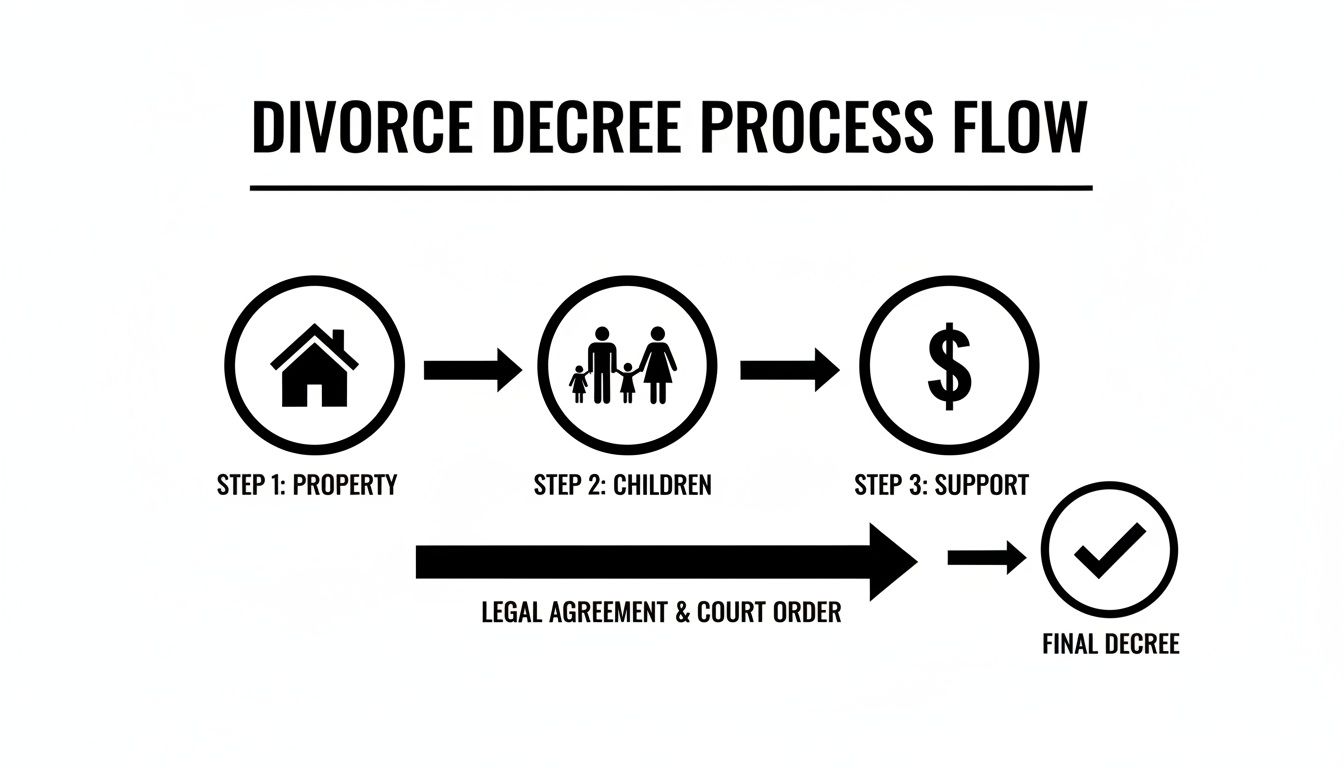
As you can see, every single issue has to be resolved, one way or another, before a judge will make your divorce official.
The Well-Traveled Road: Settlement Through Mediation
The dramatic courtroom showdowns you see on TV are rare in real-life Texas divorces. The vast majority of cases—well over 90% of them—are finalized through a settlement. The most common and effective way to get there is through mediation.
Mediation is a structured negotiation process where you, your spouse, and your lawyers sit down with a neutral third-party mediator. Their job is to help you find common ground and hash out all the remaining disagreements.
Once a deal is struck on everything, you’ll sign a Mediated Settlement Agreement (MSA). This is a critical moment.
An MSA isn't just a handshake deal; it's a binding and irrevocable contract. According to the Texas Family Code, once you sign it, you can't simply change your mind later. This agreement becomes the rock-solid foundation your attorney uses to draft the Final Decree of Divorce.
The decree that gets drafted must perfectly reflect what’s in the MSA. Every last detail—who gets the house, how the 401(k) is split, the exact dates for holiday visitation—is pulled directly from the terms you both agreed to and signed.
The Road Less Traveled: Resolution Through Trial
What happens when you and your spouse are at a complete impasse? If you cannot agree on core issues like custody or major assets, your case will be set for trial. This means you put your case in the hands of a judge.
At trial, both sides will present evidence, call witnesses, and make their arguments. The judge listens to everything and then makes the final rulings. After the judge announces their decisions, one of the attorneys will be ordered to draft a proposed decree that contains everything the judge just ordered.
This path takes control out of your hands. The final outcome is based entirely on what a judge believes is fair and appropriate after hearing a limited version of your story in a courtroom.
The Final Step: The "Prove-Up" Hearing
No matter which path you took, the very last step is usually a brief court appearance called a "prove-up" hearing. Don't let the word "hearing" worry you. This isn't another trial; it's more of a short, formal procedure to finalize everything.
Typically, one spouse and their lawyer will stand before the judge. The judge will ask a few simple, scripted questions under oath. You can expect things like:
- Confirming your name and that you meet the state's residency requirements.
- Stating that the marriage is broken and there's no chance of reconciliation.
- If you settled, testifying that the agreement was fair and you signed it voluntarily.
- Affirming that all the orders involving your children are in their best interest.
After you answer these questions, your lawyer hands the Final Decree of Divorce to the judge. The judge gives it a final review to make sure it follows the law and matches either your settlement agreement or the court's trial rulings.
Once the judge is satisfied, they sign it. The second that ink dries, you are officially divorced, and the decree is a powerful, legally binding court order. For a more detailed breakdown of this last step, you can read more about the timelines and steps for officializing a Texas divorce post-mediation.
What to Do Next
Knowing how this final stage works can take a lot of the stress and uncertainty out of finishing your divorce. Your most important job here is to ensure the proposed decree is 100% accurate and reflects every single term you agreed to, with no vague language.
If you're nearing the end of your divorce, a small mistake in the final decree can create massive headaches later on. It’s not too late to get an experienced eye on your documents. Contact The Law Office of Bryan Fagan, PLLC today for a free consultation to make sure your decree is drafted properly and your future is protected.
Common Pitfalls That Can Weaken Your Final Decree
Getting your final decree signed can feel like you’ve finally crossed the finish line of a marathon. But if that decree is poorly drafted, you might find you’ve just run straight into the starting blocks of a whole new legal race. A Texas Final Decree of Divorce is supposed to be the final word—the document that provides absolute clarity and prevents future fights. Unfortunately, common mistakes can leave the door wide open for arguments, confusion, and expensive trips back to court.
A decree riddled with vague language or missing details isn't a solid foundation for your new life; it's a legal document full of holes. Spotting these issues before a judge puts ink to paper is your best defense and can save you from a world of stress and financial pain down the road.
Vague Language and Ambiguous Terms
The single most dangerous pitfall is ambiguity. A decree that seems “good enough” when you’re both trying to be agreeable in mediation can quickly become a massive problem when you and your ex-spouse suddenly have very different interpretations of the same words. To be effective, every single order must be crystal clear, specific, and leave zero room for debate.
Just look at the difference between weak language and strong, enforceable language:
Weak: "The parties will split the holiday season with the children."
Strong: "Mother shall have possession of the children for the first half of the Christmas holiday in odd-numbered years, beginning when school is dismissed for the holiday break and ending at 12:00 PM on December 28th."
Weak: "Wife is awarded the household furniture."
Strong: "Wife is awarded the following items of property: the leather sectional sofa located in the living room, the Samsung 65-inch television (Serial #ABC123), and the oak dining table with six matching chairs."
Specificity is your best friend in a divorce decree. A strong order doesn't just say what should happen; it explains exactly who does it, what they do, when and where they do it, and how it gets done.
Overlooking Financial Details and Deadlines
Untangling your finances is one of the decree’s most critical jobs. Simply stating that one spouse will refinance the house or pay off a credit card just isn't enough. Failing to nail down precise instructions and firm deadlines is a recipe for disaster.
A solid decree has to include:
- Clear Deadlines: A hard date by which something must be done. For example, "Husband must refinance the mortgage on the marital residence within 90 days of the date the decree is signed."
- Explicit Instructions: The how is just as important as the what. For retirement accounts, this means including the specific language needed to draft a Qualified Domestic Relations Order (QDRO) to divide the funds properly.
- Consequences for Failure: What happens if someone doesn't follow through? The decree needs teeth. It should outline the consequences, like forcing the sale of the house if that refinance deadline is missed.
Without these crucial details, you could find yourself years down the line, still fighting to get your name off a mortgage or struggling to close a joint account your ex continues to use.
Relying on Verbal Promises
Here’s one of the most painful lessons people learn in a divorce: if it's not written down in the decree, it's not legally enforceable. You and your spouse might have had all sorts of side conversations and made promises to each other in good faith. Maybe they promised to help with college tuition down the road or said they’d cover a certain debt that wasn't assigned to them.
No matter how sincere that promise sounded at the time, verbal agreements are worth absolutely nothing once the judge signs the decree. That document is considered the final, complete, and entire agreement between you two. A court simply cannot enforce a "handshake deal" that isn't included in the official order.
This is why it's so important to make sure every single agreement you’ve reached—no matter how big or small—is spelled out in the final document. The moment that decree is signed, it overrides every verbal or informal promise made before it.
What to Do Next
The time to catch these pitfalls is before your decree is finalized. You have to read every single line with your attorney and ask yourself, "Is there any possible way this could be misinterpreted?" If the answer is yes, that language needs to be fixed.
Ensuring your decree is airtight isn't just a legal formality; it's one of the most important investments you can make in your own future peace of mind. If you're worried about the language in your proposed decree, don't just hope for the best. Schedule a free consultation with The Law Office of Bryan Fagan, PLLC, and let our experienced attorneys review your document to protect you from costly future disputes.
Life After the Decree: Enforcing and Modifying Your Orders
Holding your signed Texas Final Decree of Divorce in your hands feels like the end of a long, difficult chapter. But it's also the beginning of a new one, and that legal document is your roadmap. So, what happens when your ex-spouse decides to take a detour and ignore that map? Or when life throws a curveball, and the original route no longer makes sense?
This is where you discover that your decree isn't just a piece of paper filed away in a drawer. It's an active, enforceable order that can be legally upheld and, when necessary, changed to fit new circumstances.
Enforcement is about holding someone to the existing plan, while modification is about formally changing that plan when life demands it.
When Your Ex-Spouse Ignores the Order
It's one of the most maddening post-divorce realities: your former spouse treats the court's orders like a gentle suggestion. Maybe child support payments have stopped coming. Perhaps they won't sign the title to the car you were awarded. Or maybe they are consistently late for custody exchanges, throwing your entire schedule into chaos.
You don't just have to put up with it. When this happens, it's time to file a Motion to Enforce.
An enforcement action is you asking the judge to step in and compel your ex-spouse to follow the rules. The Texas Family Code gives the court serious tools to get their attention, including:
- Forcing the non-compliant party to pay your attorney’s fees.
- Holding them in contempt of court, which can lead to hefty fines or even jail time.
- Granting you "make-up" possession time if you've been unfairly denied access to your children.
Taking this step is serious, but it's how you give your decree the legal teeth it was meant to have. You can get a deeper understanding of this process by reading our guide on filing a motion to enforce.
When Life Demands a Change to the Decree
Life moves on. People get new jobs, need to relocate for family or career reasons, or experience a significant shift in their finances. When these big changes occur, the original orders for your children might become impractical or, more importantly, may no longer be in their best interest. This is where a modification becomes necessary.
You can't just make a new deal with a handshake. Verbal agreements are completely unenforceable and can lead to a world of trouble down the line. To formally change the decree, one of you has to file a Petition to Modify the Parent-Child Relationship. To win in court, you have to prove two key things:
- There has been a material and substantial change in circumstances for one of the parents or the children.
- The modification you're asking for is in the best interest of the children.
A "material and substantial change" isn't a minor annoyance. We're talking about a game-changing event like a parent remarrying, a huge swing in income (up or down), a move to another city, or a child developing new medical or educational needs.
A successful modification results in a brand-new court order that reflects your family's new reality. It’s a vital tool for adapting to life's inevitable twists and turns while keeping your children’s stability at the forefront.
The Reality of Post-Decree Legal Fights
While Texas divorce rates are relatively low, at 2.1 to 2.7 divorces per 1,000 people, post-divorce legal battles are surprisingly common. This is especially true after a high-conflict divorce. In our experience, enforcement and modification filings can jump by 20-30% in cases that were highly contested from the start. These stats, which you can explore further by looking at divorce rate trends on divorcerate.org, really underscore the need for a rock-solid, clearly written decree from day one.
What to Do Next
Your Final Decree of Divorce is a powerful legal instrument, but it's only as good as your ability to use it. Whether you need to hold your ex-spouse accountable or update your orders to fit your new life, you don't have to figure it all out on your own. The actions you take now will safeguard your rights and your children’s future.
If you’re dealing with a non-compliant ex or facing a major life change, the time to get help is now. Schedule a free, confidential consultation with The Law Office of Bryan Fagan, PLLC today. We'll walk you through your options and help you take the right legal steps to protect your family.
Your Post-Divorce Checklist: Key Steps After the Decree is Signed
The moment the judge’s pen leaves the paper on your Texas Final Decree of Divorce, you can finally breathe a little easier. While the biggest legal and emotional hurdles are behind you, a few practical steps are still ahead. These aren't just minor details; they're the crucial actions that formally untangle your old life from your new one and set you up for a truly fresh start.

Think of this as the final checklist. It’s what you need to do to close the book on your marriage and move forward with total legal clarity and confidence.
Executing Property and Vehicle Transfers
Your decree clearly states who gets the house and which car belongs to whom, but the titles don't just update themselves. You have to take action to make those court orders official in the real world.
- For Real Estate: If you were awarded the marital home, your ex-spouse needs to sign a Special Warranty Deed. This is the legal instrument that officially transfers their ownership interest over to you. Once it's signed and notarized, it has to be filed with the county clerk to put the world on notice that the property is now yours alone.
- For Vehicles: It’s a similar process for any car, truck, or boat. Your ex must sign over the title to any vehicle awarded to you. You'll then take that signed title down to the Texas Department of Motor Vehicles to get a brand new one issued just in your name.
Securing Your Financial Future
Creating a clean break with your finances is one of the most important things you can do after a divorce. It protects you from any future debts your ex might incur and gives you full control over your own money.
Your decree is the legal authority you need to separate your financial lives. Presenting a certified copy to banks and financial institutions is the key that unlocks your ability to close joint accounts and secure your assets.
Here’s what should be at the top of your financial to-do list:
- Close every joint checking, savings, and credit card account.
- Update your will, power of attorney, and any other estate planning documents.
- Change the beneficiaries on your life insurance policies and retirement accounts, like your 401(k) or IRA.
What to Do Next
Skipping these steps can cause massive legal and financial headaches later on. Each item on this list is a critical piece of the puzzle, turning what was decided in a courtroom into your new reality. Properly tying up these loose ends is the final, essential step in protecting yourself and building a secure foundation for your future.
If you have questions about how to put your decree into action or just want to make sure every last detail is handled correctly, don't leave it to chance. Schedule a free consultation with The Law Office of Bryan Fagan, PLLC today to ensure your transition is seamless and your new chapter starts on the right foot.
Your Top Questions About Divorce Decrees Answered
Once the dust starts to settle, it's natural to have a lot of questions about the final decree. This document is the finish line, but what does that really mean for you? Let's walk through some of the most common questions we hear from clients just like you.
How Long Until I Get the Final Decree in Texas?
In Texas, there's a mandatory 60-day waiting period that starts the day after one spouse files for divorce. So, even if you and your spouse agree on everything from day one, a judge can't legally sign off on your divorce until that 60-day clock runs out.
But let's be realistic—most divorces take longer. A more typical timeline is anywhere from four to twelve months. The exact duration really depends on how complicated your finances are and how much you and your spouse are able to agree.
Can We Change the Judge's Final Order Later On?
Yes and no. It depends entirely on what you want to change.
Anything related to the kids—like custody (conservatorship), visitation schedules, and child support—can be revisited down the road. To get a modification, you'll have to go back to court and show that there's been a "material and substantial change in circumstances" and that your proposed change is what’s best for the children.
The property division, however, is a different story. That part of the decree is almost always permanent. Once it's signed, it's set in stone. This is exactly why it's so critical to get every single detail right the first time around. There are no do-overs.
What If My Ex Ignores the Decree?
A Texas Final Decree of Divorce isn't a friendly suggestion; it's a court order with real teeth. If your ex-spouse refuses to follow the rules—maybe they're not paying child support, won't sign over a car title, or are playing games with the visitation schedule—you have legal options.
You can take them back to court by filing a Motion for Enforcement. A judge can force them to comply and has the authority to issue penalties like fines, making them pay your attorney's fees, or even ordering jail time for contempt of court.
Do I Really Need a Lawyer to Write the Decree?
Legally, no, you aren't required to have an attorney. But attempting to draft a final decree on your own is a huge risk. This is a highly technical legal document where one wrong word or a vague phrase can create a loophole that costs you dearly in the future.
Think of an experienced family law attorney as your quality control. They ensure the language is precise, unambiguous, and legally sound, protecting your finances and your rights as a parent from future arguments and legal battles. It’s the single best investment you can make in your own future.
Key Takeaway
Your Texas Final Decree of Divorce is the most important document in your case—it is the legally binding roadmap for your life after marriage. To protect your future, you must ensure it is specific, comprehensive, and accurately reflects all agreements, especially regarding property, debts, and your children. Vague language or overlooked details can lead to expensive and stressful legal battles down the road. Taking the time to get it right with an experienced attorney is a critical investment in your peace of mind.
Ready to talk? Schedule a free, no-obligation consultation with us today by visiting our website at https://texasdivorcelawyer.us.