Skip to content
It's incredibly frustrating when the court order you put your faith in gets ignored.
You went through the entire legal process, got a judge to sign off, and now your ex-spouse is acting like the order doesn't even exist. In Texas, you're not powerless. Filing a motion for contempt of court is a serious and effective way to hold someone accountable for violating a judge’s direct order. Essentially, you're asking the court to enforce its own decree with sanctions that can include fines, jail time, and making the other party pay your attorney's fees.
When Your Ex Defies a Court Order
Watching your ex-spouse disregard a court order can feel like the entire legal process was a waste. Maybe they’re refusing to pay child support, consistently denying you court-ordered time with your kids, or failing to hand over property you were awarded in the divorce. These violations aren't just unfair—they're illegal. You have rights, and the Texas legal system provides a clear path to enforce them.
At The Law Office of Bryan Fagan, PLLC, we understand the anger and helplessness that comes with these situations. You don’t have to just sit back and accept it. Filing a motion for contempt is your way of telling the judge, "The order you signed is being ignored, and I need your help to make it right."
Common Grounds for Filing a Contempt Motion
You can file a motion for contempt for almost any violation of a final decree of divorce or another family court order. The key is that the order must contain clear, specific, and unambiguous language that the other party has defied. You can't hold someone in contempt for violating a vague suggestion.
Some of the most frequent reasons Texas parents and ex-spouses file for contempt include:
- Failure to Pay Child Support: This is perhaps the most common enforcement action. If your ex has the ability to pay but simply chooses not to, the court can find them in contempt.
- Violating the Possession (Custody) Schedule: If your ex consistently keeps the children from you during your court-ordered possession periods, it’s time to seek enforcement.
- Not Following Property Division Orders: An ex-spouse who fails to refinance a mortgage, sign over a car title, or turn over specific assets awarded to you can be held accountable.
- Failure to Pay Spousal Maintenance: Just like child support, court-ordered spousal support is absolutely enforceable through contempt proceedings.
Filing a motion for contempt is a critical enforcement tool in family law. Success rates for these motions in Texas hover around 65-70%, often resulting in fines up to $500 per violation or jail time up to 180 days under Texas Family Code § 157.001. You can find more information about how contempt works in other jurisdictions on rostrumlegal.com.
Contempt Isn't Your Only Option
While a contempt motion is a heavy hitter, it’s important to understand how it fits in with your other legal tools. Contempt is considered quasi-criminal, meaning it can lead to punishments like jail time. Other enforcement actions might be more focused on compelling a specific action, like seizing assets to cover unpaid child support.
A motion for contempt sends a clear message: willful disobedience of a court order has serious consequences. It is the court's way of preserving its authority and ensuring that its decrees are respected.
Choosing the right legal strategy depends on the specifics of your case. For instance, if your main goal is to get the child support money you're owed, a motion for enforcement combined with a request for wage garnishment might be faster. But if you're dealing with a pattern of willful defiance, the threat of jail time from a contempt action might be the only thing that gets their attention.
Contempt vs. Other Enforcement Tools in Texas
When a Texas family court order is violated, you have a few different legal actions you can take. This table breaks down the main options to help you see which one might be the best fit for your situation.
| Legal Action | Primary Goal | Potential Outcome | Best For |
|---|---|---|---|
| Motion for Contempt | To punish past violations and coerce future compliance. | Fines, jail time, probation, payment of attorney's fees. | Willful and repeated violations of clear court orders. |
| Motion for Enforcement | To force compliance with the order. | Order to comply, wage garnishment, property liens. | Recovering unpaid support or compelling specific actions. |
| Clarification Order | To resolve ambiguity in the original order. | A new, clearer order from the judge. | Situations where the original order is vague or confusing. |
An experienced family law attorney can analyze your court order and your ex-spouse's actions to pinpoint the most effective strategy for protecting your rights and getting the compliance you deserve.
Gathering Evidence to Build Your Case
Feeling like you have to prove your ex is ignoring a court order is a heavy burden. Before you step into a courtroom, your success hinges entirely on the strength of your evidence. A judge can't act on your word alone; they need clear, undeniable proof that a violation occurred. This is where your work begins. You must become a detective for your own case, carefully collecting every piece of information that tells the story of your ex-spouse's non-compliance.
The Four Pillars of a Contempt Case
To win a contempt case in Texas, you have to prove four specific legal elements. Think of them as the four legs of a table—if even one is missing, your entire case can collapse.
A judge will be looking for proof of each of these points:
- A Clear and Specific Order Exists: You must point to the exact language in your divorce decree or custody order that your ex violated. It can't be vague; it has to command or prohibit a specific action.
- The Other Party Knew About the Order: This is usually the easy part. If your ex was in the room when the order was made or was properly served with a copy, the court assumes they knew what was in it.
- The Other Party Had the Ability to Comply: This is critical, especially in child support cases. You need to show that your ex had the money to pay or was physically able to follow the possession schedule.
- The Violation Was Willful: This is the key. You have to demonstrate that your ex chose not to follow the order. This separates an accidental mistake from intentional defiance of the court’s authority.
Building a compelling case means being strategic about how you gather your proof. You can learn more about formal legal tools for gathering evidence in our detailed guide on the discovery process for divorce in Texas.
What Kind of Evidence Do You Need?
The right evidence depends entirely on the specific violation. Vague accusations get you nowhere in court; you need concrete, documented proof. Your motion needs to be more than just a complaint—it should be a detailed account of each violation, backed by solid evidence.
Let's look at a few common scenarios and the kind of proof you'll need:
- Unpaid Child Support: Gather bank statements showing the lack of deposits, your ex's pay stubs or employment records (if possible), and a certified payment history from the Texas Attorney General's Office.
- Visitation Violations: Keep a detailed calendar or journal logging every missed or late exchange. Save all text messages, emails, and phone logs where you discuss visitation. A voicemail where your ex flat-out refuses a visit can be incredibly powerful.
- Failure to Divide Property: You'll need a copy of the divorce decree that spells out the property division. If your ex was supposed to refinance a home, get letters from the mortgage company. For a vehicle, a copy of the title can show it was never transferred into your name.
A well-drafted motion for contempt is essentially a roadmap for the judge. Each violation should be listed as a separate count, complete with the date, time, and specific details of what happened. Precision is your best friend here.
The Importance of Credible Witnesses
Sometimes, the best evidence doesn't come from a document, but from another person. A credible, neutral third party who has seen the violations firsthand can be a game-changer for your case. This could be a family member who witnessed your ex refusing to let you see your kids or a business associate who knows your ex has the income to pay support but is choosing not to. A witness's testimony in court can add significant weight to your claims.
Navigating the Legal Process of Filing and Service
Once you’ve gathered your evidence and your attorney has drafted a rock-solid motion, it's time to start the case with the court. This part can feel formal and intimidating, but breaking it down into steps makes it manageable.
The first move is filing your Motion for Enforcement by Contempt. This must be done with the district clerk in the same Texas county that issued your original divorce or custody order. This isn't just a suggestion—it's a jurisdictional rule. Your attorney will submit the paperwork (usually electronically) and pay a filing fee.
This simple visual breaks down how we build your case from the ground up.
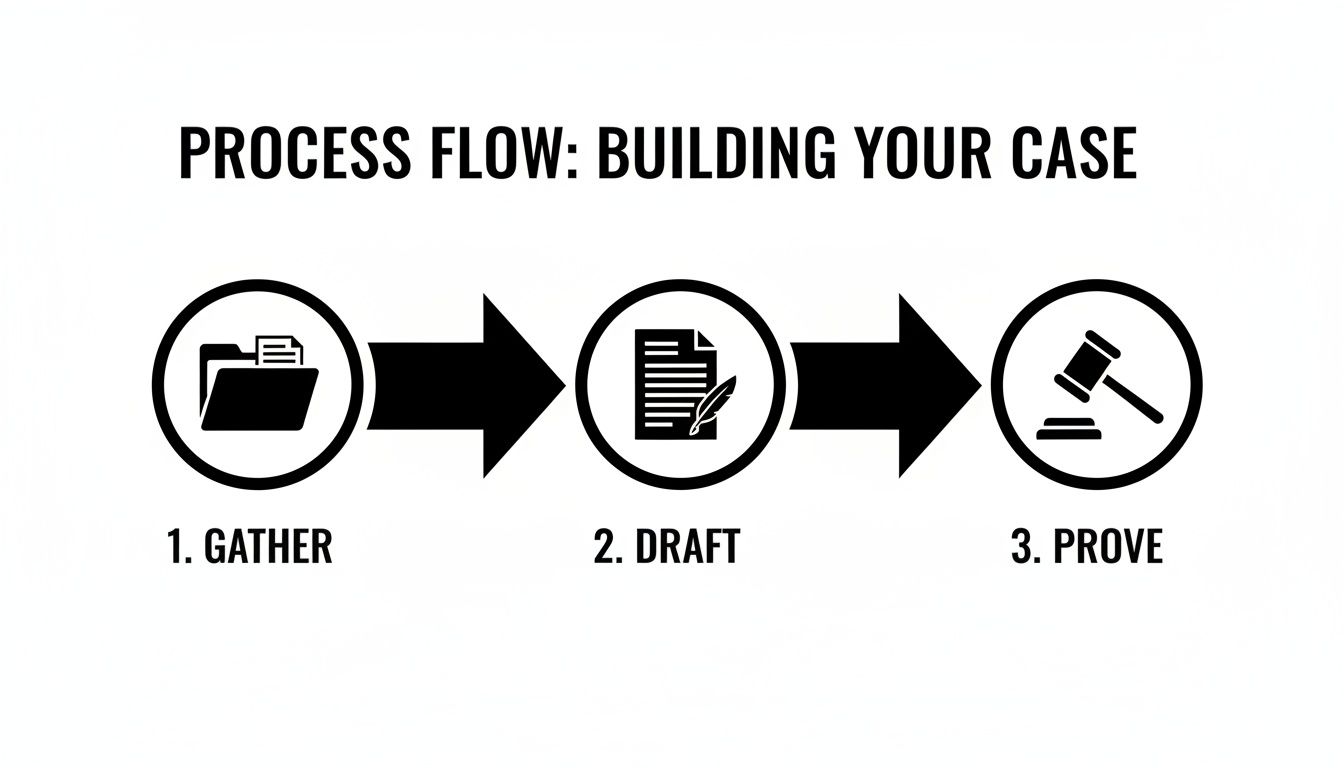
As you can see, every step—gathering the facts, drafting the legal arguments, and proving it all in court—is a building block for the next.
The Critical Step of Proper Service
Once the motion is filed, you can't just text your ex to let them know they're being sued. The law requires a formal notification process called service of process, and this is one of the most important steps in the whole case.
Texas law is very clear: the other party must be personally served. This means a neutral third party, like a private process server or a county constable, must physically hand-deliver a copy of the filed motion and a court-issued citation directly to your ex-spouse. This delivery proves to the court that the other side was officially notified and has a chance to respond.
In contempt cases, proper service isn't just a good idea—it's non-negotiable. If the other party isn't personally served according to the Texas Rules of Civil Procedure, the judge has no authority to even hear the case. It will almost certainly get dismissed.
Alternatively, the other party might agree to sign a Waiver of Service, which states they received the lawsuit and don't need formal service. To see if this might be an option, you can learn more about what a Waiver of Service means in Texas.
Understanding Texas Timelines
The law is also strict about timing. Once your ex is served, they are legally entitled to a certain amount of notice before any hearing can happen. The citation they receive will order them to appear in court on a specific date, giving them enough time to find an attorney and prepare their defense. Getting these procedural rules right is where having an experienced family law attorney really pays off. A single slip-up can cause massive delays or even get your case thrown out.
What to Expect at Your Contempt Hearing
Walking into a courtroom can be intimidating, especially when you’re the one who started the action. This hearing is where all your preparation finally comes to a head. Knowing what to expect can calm your nerves and help you feel ready.
This hearing is your chance to lay out your case for the judge. As the person who filed the motion (the “movant”), you and your attorney will go first. You'll present the evidence you’ve collected and testify about what happened. Each piece of evidence is a building block to prove the core elements of contempt: a clear order existed, your ex knew about it, they were able to follow it, and they willfully chose not to.
Understanding the Burden of Proof
In a contempt hearing, the “burden of proof” is the legal standard the judge uses to weigh the evidence. The standard changes depending on what you’re asking the court to do.
There are two main standards:
- Preponderance of the Evidence (Civil Contempt): If your main goal is to force your ex to follow the order moving forward—like turning over property—you have to prove it’s “more likely than not” that the violation happened.
- Beyond a Reasonable Doubt (Criminal Contempt): If you're asking the judge to punish your ex with jail time for past violations, the bar is much higher. You must prove the violation beyond a reasonable doubt—the same tough standard used in criminal trials. This is because taking away someone's liberty is the most serious sanction a court can impose.
How Your Attorney Will Present Your Case
Your lawyer will walk the judge through each violation, one by one. They will call you to the witness stand to testify, then use documents, text messages, or emails to back up your story. After your testimony, your ex’s attorney will get to cross-examine you. This is why it’s so important to stick to the facts and stay as calm as possible. Once you’ve presented your side, it’s your ex’s turn to offer a defense.
Common Defenses and How to Counter Them
It’s rare for someone to simply admit they violated a court order. More often, they’ll raise a defense to excuse their behavior. Being ready for these arguments is key.
Some of the most common defenses include:
- Inability to Comply: This is the go-to defense in child support cases. Your ex might claim they lost their job or didn’t have the money. Your attorney can push back with evidence of their income, bank statements, or even photos of lavish spending.
- The Order Was Vague: They might argue the court order was unclear. This defense highlights why having a tightly drafted original order is so crucial.
- Lack of Knowledge: An ex might claim they were never served with the order. Your attorney can usually shut this down by showing the judge the official "return of service" filed by the process server.
Statistics from the Office of Justice Programs show that contempt motions are a serious tool. In Texas family courts, an estimated 12,000 contempt motions are filed annually for divorce enforcement, with a 55% success rate leading to significant child support recoveries or jail sentences. You can learn more about these findings on the OJP website.
Potential Outcomes of the Hearing
After listening to both sides, the judge will make a ruling. If you win, the judge has a toolbox of options to enforce the order and penalize the violation.
The judge could order your ex-spouse to:
- Immediately do what the order says.
- Pay all back-due child support, sometimes with interest.
- Pay for your attorney’s fees and court costs.
- Serve jail time (up to 180 days per violation).
- Be placed on community supervision (probation) to ensure future compliance.
Ultimately, the goal is to get the compliance you were entitled to all along. Walking into that hearing prepared, with a skilled attorney by your side, gives you the best possible shot at making that happen.
Understanding the Consequences of Contempt
When you decide to file a motion for contempt, you're taking a serious legal step. This motion gets its power from the potential consequences, which are designed to compel your ex to finally respect the court's authority.

It’s critical to understand the two different types of contempt a judge can find, because they lead to very different outcomes.
Civil Contempt vs. Criminal Contempt
Think of it this way: one is about forcing action, and the other is about punishment.
- Civil Contempt is coercive. It's meant to get the other person to comply with the order from this point forward. The classic example is a judge saying, "You will sit in jail until you turn over the past-due child support." The person found in contempt holds the keys to their own jail cell—compliance means freedom.
- Criminal Contempt is punitive. This is about punishing someone for willfully violating the court's order in the past. It results in a fixed sentence, like a specific number of days in jail or a set fine, and it doesn't matter if they decide to comply later.
This distinction directly impacts the level of proof needed at your hearing and shapes the specific remedies the judge will consider.
Penalties Under the Texas Family Code
When a Texas judge finds your ex in contempt, the Texas Family Code lays out specific and significant penalties they can impose for each separate violation.
The primary punishments a judge can order include:
- A fine of up to $500 per violation.
- Jail time in the county jail for up to 180 days per violation.
If your motion detailed ten separate times your ex denied you court-ordered possession of your children, the judge could theoretically sentence them to significant jail time and thousands of dollars in fines.
A finding of contempt is the court reasserting its authority. The penalties are not just about your individual case; they send a message that court orders are not optional suggestions—they are legally binding commands.
Other Powerful Remedies a Judge Can Order
Fines and jail time aren't the only tools in the judge's toolbox. A Texas family court has other powerful ways to enforce compliance, especially when children and money are involved.
If your contempt motion is successful, the judge could also order:
- Payment of Your Attorney's Fees: The judge has the authority—and frequently uses it—to order the non-compliant party to pay you back for every penny you had to spend on legal fees to bring this motion.
- Suspension of Licenses: This is a big one for unpaid child support. The court can order the suspension of all sorts of state-issued licenses, including a driver's license, professional licenses (like for a doctor or plumber), and even hunting and fishing licenses.
- Make-Up Visitation Time: If you were wrongfully denied time with your children, the judge can order a new schedule that gives you make-up time to compensate for every period you lost.
These enforcement actions are on the rise. In Texas, contempt motions are frequently used to enforce property division and spousal maintenance orders. Data from the Texas Supreme Court shows around 8,500 of these motions are filed each year, with a staggering 40% leading to coercive sanctions like wage garnishment or short-term jail stays under Family Code provisions. To better understand the potential repercussions, an explanation of the punishment for contempt of court can also be insightful.
What to Do Next
Navigating the process of filing a motion for contempt of court is complex, but it's one of the most powerful tools you have to hold your ex-spouse accountable. You don't have to go through this alone. The legal system provides a clear path for enforcing the orders that were designed to protect your family’s stability. While the procedures are strict, they exist to ensure fairness while giving you the leverage you need to demand compliance.
Key Takeaway
Success in a contempt action boils down to a few core principles:
- Precision is Everything: Your motion can't be vague. It must detail each specific violation with dates, times, and hard facts.
- Evidence is Your Foundation: You can't win without strong documentation. Think texts, emails, bank statements, and witness testimony.
- Procedure Cannot Be Skipped: Basics like correct filing and personal service are the bedrock of your case. If they're not done right, the case can fall apart.
Remember this: a court order isn't just a piece of paper; it's a direct command with the full weight of the law behind it. You have every right to demand that it be followed.
If you're dealing with a former spouse who refuses to follow court orders for custody, support, or property division, you don't have to just accept it. While this guide provides a solid roadmap, every family's situation is unique. For a more detailed look at the legal filing itself, check out our guide on the motion to enforce in Texas.
Protecting your family’s future is our priority. If you're ready to enforce your rights, we are here to help. Contact The Law Office of Bryan Fagan, PLLC today for a free, confidential consultation to talk through your case and explore your options.
Common Questions About Filing for Contempt
When you're thinking about taking legal action against an ex who refuses to follow court orders, it’s completely normal to have a lot of practical questions. You're already dealing with enough stress; you need clear, straightforward answers to figure out the best path forward.
How Long Does This Process Usually Take?
The timeline for a contempt motion can vary. From the moment we file the motion, you could be looking at anywhere from a few weeks to several months to get a hearing date on the court’s calendar. It’s not an instant fix, but it's designed to be much faster than a full-blown divorce trial.
A few things can influence the timing:
- The Court’s Caseload: Busy courts in places like Harris or Dallas County often have a backlog, which means longer waits for hearing dates.
- Service of Process: If your ex is hard to find or is actively dodging the process server, that can cause significant delays.
- The Other Party’s Response: If your ex hires a lawyer who then asks for more time to prepare or files their own motions, the timeline can stretch out.
What Are the Potential Costs Involved?
The cost of a contempt action depends on how complicated your case is. You'll have initial court filing fees and the cost of hiring a process server. The biggest variable is attorney's fees, which are tied to the amount of time we need to prepare your case and argue it in front of the judge.
But here’s the good news: a key provision in the Texas Family Code gives the judge the power to order the non-compliant party to pay for your reasonable attorney’s fees and court costs if you win. This is a powerful tool that can make pursuing enforcement financially possible for many people.
What if My Ex Lives in Another State?
This is a common concern, but it does not stop you from taking action. If your original order was issued by a Texas court, that court almost always keeps what’s called “jurisdiction” to enforce its own orders. That means you can still file your contempt motion right here in Texas.
Enforcing an order across state lines brings specific legal rules into play, mainly under the Uniform Interstate Family Support Act (UIFSA). The process can get more complex, but an experienced family law attorney knows how to navigate these procedures to hold your ex accountable, no matter where they live.
Successfully navigating a contempt action requires a sharp legal strategy and a deep understanding of Texas family law. At The Law Office of Bryan Fagan, PLLC, our attorneys are here to help you enforce your rights with confidence. Schedule your free consultation today to discuss your situation and get the clear, actionable advice you deserve.