Skip to content
Staring at a retirement statement during a divorce can feel like looking at a future that's suddenly been erased.
In Texas, only the portion of your 401(k) earned during your marriage is considered community property and subject to division. This fundamental rule, rooted in the Texas Family Code, is designed to protect what you built before saying "I do" and what you will build long after your divorce is final. Understanding how this works is the first step toward regaining control over your financial future.
Your 401(k) at a Financial and Emotional Crossroads

For most Texans, a 401(k) is more than just a number on a page; it's the tangible result of years of hard work, early mornings, and long hours. Watching that nest egg become a bargaining chip in divorce negotiations can be incredibly disheartening. But understanding your rights under Texas law is the first step toward regaining a sense of control. This guide will walk you through what dividing a 401(k) in a Texas divorce actually looks like, in plain English.
Understanding the Key Legal Terms
Before we get into the math, it’s vital to understand the foundational concepts that will shape every conversation about your retirement accounts. These are the terms your attorney and the judge will use, so getting familiar with them now puts you ahead of the game.
- Community Property: This is the legal term for any assets you or your spouse acquired during the marriage. According to the Texas Family Code § 3.002, there is a strong presumption that everything you both earned or bought while married is community property. For your 401(k), this includes your contributions, any employer matches, and all investment gains that occurred between your wedding day and the day the divorce is finalized.
- Separate Property: This is anything you owned before the marriage. It also includes assets you received during the marriage as a gift or inheritance. The balance in your 401(k) the day before you got married is your separate property, and it’s protected from division.
- Qualified Domestic Relations Order (QDRO): Think of this as a special set of instructions for your retirement plan administrator. A QDRO (pronounced "kwah-dro") is a court order, completely separate from your final divorce decree, that tells the plan how to split the account. It’s the essential legal tool needed to divide a 401(k) without triggering a ton of early withdrawal penalties and taxes.
The goal isn’t just to split assets down the middle; it's to secure the future you've worked so hard for. When you understand the rules, you can negotiate from a position of strength and clarity.
As you figure out the path forward, it’s smart to consider all the reasons for early 401k access that might apply to your situation, as knowing every option is key. This guide gives you the framework, but your unique circumstances will ultimately define the best strategy.
It can be a gut punch to see your hard-earned 401(k) on a list of assets to be divided in a divorce. After all, it's your name on the account, tied to your job. But Texas law sees things differently. In the eyes of the court, a marriage is a partnership, and that view extends to the wealth you build together.
Under the Texas Family Code, there’s a powerful presumption that anything either spouse acquires during the marriage is community property. That means it belongs to both of you. When it comes to your 401(k), the community portion is everything that went into the account from the day you said "I do" until the day the divorce is finalized.
And it’s not just about the money you contributed from your paycheck. The community share also includes:
- Employer Matching Funds: Every dollar your company kicked in during the marriage is part of the marital estate.
- Investment Growth: All the interest, dividends, and market gains that built up during the marriage are also considered community property.
Distinguishing Marital vs. Separate Funds
The key to protecting your assets is drawing a clear line between what’s yours and what’s ours. Your separate property is the slice of your 401(k) that belongs only to you and isn't up for division. This includes the total value of the account on the day before you got married.
Think of your 401(k) as a big savings jar. The money you put in before the wedding is your separate property. Every contribution you and your employer made during the marriage, plus all the growth that happened along the way, is community property. A Texas court's job is simply to divide the community portion in a just and right manner.
To lock down your separate property claim, you must provide clear and convincing proof of the account's value right before the marriage. This process, called "tracing," usually means digging up old account statements from that period. If you can’t produce that proof, the court might presume the entire account is community property. You can get a deeper look into what community property is in Texas in our detailed guide.
How the Community Portion Is Calculated
So, how does a court actually figure out the exact community property value of your 401(k)? To keep things fair and straightforward, Texas courts often rely on a simple formula.
Let’s walk through a common scenario. Say you worked at your company for a total of 20 years, but you were married for 12 of those years. The marital interest in the plan is based squarely on that 12-year overlap.
Here’s how the math works: if you were in the 401(k) plan for 20 years but married for 12 of them, the community property portion would be 60% (12 ÷ 20) of the account's total value at the time of divorce. This approach ensures that only the wealth built during the marriage is on the table, protecting your pre-marital savings. The Investment Company Institute offers more insights on how these calculations work.
This formula is applied to the entire account balance, which automatically accounts for all the growth and employer contributions that occurred during those 12 years of marriage.
Key Takeaway: The law isn’t just looking at the dates on your contribution statements. It focuses on the duration of the marriage relative to your total time in the retirement plan to determine the community share.
Getting this right is vital. It shifts the discussion from emotional arguments to a fact-based division that respects both your pre-marital hard work and the contributions made during the partnership. When you know exactly what part of your retirement is divisible, you can negotiate more effectively and plan your financial future with real confidence.
Navigating the QDRO Process in Texas
When it comes to dividing a 401(k) in a Texas divorce, there's one document that stands above all others in importance: the Qualified Domestic Relations Order, or QDRO.
It’s a common misconception that your divorce decree is enough to split a retirement account. It isn't. Think of the QDRO as a separate, highly specific set of instructions sent directly to the 401(k) plan administrator. Your decree might say your spouse receives 50% of the community portion, but only a QDRO can actually make the transfer happen.
Without a properly executed QDRO, trying to move money out of the account is a recipe for disaster. You could be hit with massive income taxes and a steep 10% early withdrawal penalty. This document is the legal key that unlocks the 401(k), allowing the funds to be transferred to the other spouse tax-free and penalty-free.
The Step-by-Step QDRO Process
Getting a QDRO approved isn't a quick signature-and-done deal. It’s a meticulous process, and every 401(k) plan has its own unique rulebook. Using a generic, boilerplate template is asking for trouble—rejections, delays, and more legal fees are almost guaranteed.
Here’s a step-by-step breakdown of how it unfolds in Texas:
- Drafting the Order: After you and your spouse agree on the division (often through negotiation or mediation), an attorney crafts the QDRO with precise language that mirrors your divorce settlement. It must clearly name the plan, the participants, the exact amount or percentage to be paid, and how it’s getting distributed.
- Getting the Plan's Pre-Approval: This is a crucial step. Before it ever goes to a judge, the draft QDRO should be sent to the 401(k) plan administrator for a preliminary review. They’ll check it against their specific rules and federal law, giving you a chance to fix any issues before it becomes a court order.
- Judge's Signature and Filing: Once the plan administrator gives their unofficial okay, the QDRO goes to the judge to be signed. After that, it’s filed with the court clerk and becomes an official, legally binding order.
- Final Submission and Execution: The final, signed, and court-filed QDRO is sent back to the plan administrator. This time, it's for keeps. They will execute the order, separate the funds into the appropriate shares, and distribute them as instructed. This process can take several weeks to a few months.
The infographic below breaks down the foundational step of this process: figuring out exactly which part of the 401(k) is divisible community property.
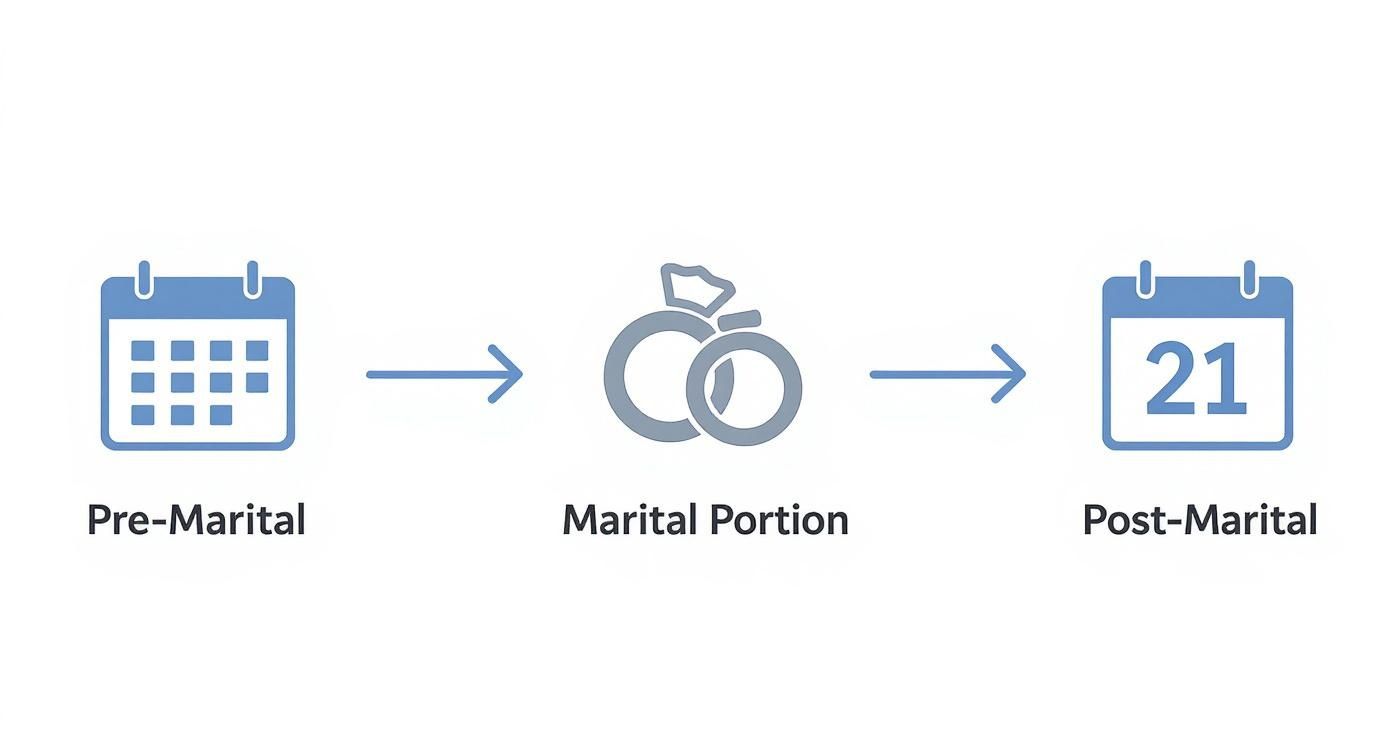
This visual shows how Texas law isolates the money earned during the marriage, protecting pre-marital savings and any contributions made after the divorce is final.
Avoiding Common QDRO Pitfalls
While the process looks straightforward on paper, many cases get derailed by a few common mistakes. Knowing what to watch for can save you a world of headache and expense.
Vague language is a primary culprit. A QDRO can't just say "half of the 401(k)." It has to be crystal clear about how that half is calculated—for instance, "50% of the community property portion of the account balance as valued on the date of divorce." It also must address what happens to market gains or losses on that share between the divorce date and the day the money is actually paid out.
A rejected QDRO isn’t just an inconvenience; it can mean going back to court, paying more legal fees, and waiting months longer for funds that are rightfully yours. Attention to detail is everything.
Another frequent problem is failing to account for outstanding 401(k) loans. If you have borrowed against your account, the QDRO absolutely must spell out how that loan balance affects the division of the remaining assets. If it’s silent on this point, the plan administrator will almost certainly kick it back.
Finally, don't procrastinate. The market doesn't stop moving just because your divorce is final. If the market tanks between the date of the decree and the execution of the QDRO, the value of the share being transferred goes down with it. Getting the QDRO finalized and submitted promptly helps lock in the value as close to the divorce date as possible, giving both spouses financial certainty.
Exploring Settlement Options Beyond a 50/50 Split
When you think about dividing a 401(k) in a divorce, your mind probably jumps straight to a clean 50/50 split. But that’s far from your only option. In fact, some of the most successful divorce settlements come from thinking strategically about your entire financial picture, not just one account. You have more control here than you might think.
The real goal is to find a solution that protects your long-term financial health. Sometimes, that means keeping your retirement account intact and finding another way to arrive at a fair and just division of your community estate.
The Power of the Asset Offset
One of the most effective strategies is what we call an asset offset, sometimes known as a buyout. Put simply, this means you trade assets of equal value instead of splitting the 401(k) itself. It's a powerful tool, especially for business owners or those with high-value estates.
Here’s a common scenario: imagine the community property portion of your 401(k) is valued at $200,000. Under Texas law, your spouse would typically be entitled to $100,000 of that. Now, let’s say you also have $100,000 of equity in the family home. Instead of going through the hassle of a QDRO to pull money from your retirement, you could offer your spouse the full $100,000 of home equity in exchange for them waiving their claim to your 401(k).
This approach can be a win-win for several key reasons:
- Keeps Retirement Funds Invested: You avoid having to sell off investments—potentially at a terrible time in the market—and allow your retirement nest egg to continue growing without interruption.
- Preserves Key Assets: This is especially useful if you're a business owner who needs to maintain liquidity or if one spouse feels strongly about keeping the family home.
- Simplifies the Process: An offset can often be much simpler and faster than drafting, approving, and executing a QDRO, which can easily drag on for months.
The key to a successful offset is an accurate, professional valuation of all assets involved. You have to be certain the trade is truly equal to be considered a fair division under Texas law.
This strategy requires open communication and good-faith negotiation, which usually happens in mediation. It allows you to tailor the settlement to what matters most to each of you, rather than being forced into a rigid, one-size-fits-all formula.
Rollover vs. Cash Out: A Critical Decision
If you do decide to divide the 401(k), the receiving spouse (legally known as the alternate payee) has a critical choice to make once the QDRO is processed. There are two main paths to take, and they have wildly different financial consequences.
A direct rollover into an Individual Retirement Account (IRA) is almost always the smartest move. The funds move directly from the 401(k) plan to the new IRA without the receiving spouse ever touching the money. This is a non-taxable event, meaning no taxes or penalties are due. The money just keeps growing for retirement, but in a new account.
The other path is to take a cash distribution. While a QDRO lets the receiving spouse avoid the 10% early withdrawal penalty, it does not avoid income taxes. The entire distribution is treated as ordinary income for that year, which can easily push someone into a much higher tax bracket and lead to a shockingly high tax bill come April.
Let’s put these choices side-by-side to make the distinction crystal clear.
This table outlines the primary methods for handling a 401(k) in a Texas divorce, helping you weigh the pros, cons, and financial implications of each approach.
Comparing 401(k) Division Strategies
| Strategy | How It Works | Best For… | Key Consideration |
|---|---|---|---|
| Asset Offset | Trading an asset of equal value (like home equity) to keep the 401(k) intact. | Spouses who want to preserve specific assets or avoid the complexity of a QDRO. | Requires accurate valuation of all assets to ensure a "just and right" division. |
| QDRO Direct Rollover | The awarded 401(k) funds are transferred directly into the receiving spouse's IRA. | Anyone focused on preserving retirement savings and maximizing long-term, tax-deferred growth. | This is a non-taxable event. The money is not taxed until it’s withdrawn in retirement. |
| QDRO Cash Out | The plan administrator cuts a check for the awarded amount directly to the receiving spouse. | Someone with an immediate, critical need for cash who understands and can absorb the big tax hit. | The full amount is taxed as ordinary income, though the 10% early withdrawal penalty is waived. |
Ultimately, choosing the right strategy comes down to individual financial needs and long-term goals. However, for anyone focused on building a secure future, a direct rollover is the superior choice for protecting the value of your divorce settlement. It's vital to discuss these options during your negotiations so both parties fully understand the real-world impact of their decisions.
Common Mistakes That Can Jeopardize Your Retirement
Watching your retirement savings get caught in the crossfire of a divorce is stressful. But making unforced errors can turn a difficult situation into a financial disaster. The path to dividing a 401(k) is full of potential traps, but with a little foresight, you can sidestep them and protect the future you’ve worked so hard to build.
One of the costliest mistakes is trying to handle the division informally. I've seen couples agree to just "cash out" a portion and hand it over, but this is a tax nightmare waiting to happen. Without a QDRO, the IRS sees any withdrawal as a regular distribution. That means income taxes and, often, a 10% early withdrawal penalty hit the account holder.
Forgetting the Fine Print
After a divorce, your life is in chaos, and small administrative tasks can easily fall through the cracks. But forgetting to update your 401(k) beneficiary can have devastating consequences.
If your ex-spouse is still listed as your primary beneficiary and something happens to you, they could legally inherit your entire retirement account. It doesn't matter what your will or even your divorce decree says. It's a simple fix with massive implications—as soon as your divorce is final, make it your top priority to contact your plan administrator and update this information.
The Dangers of a DIY QDRO
Given how critical this document is, attempting to draft a QDRO without an experienced family law attorney is a huge risk. Every 401(k) plan has its own specific rules and required language. A generic template you download from the internet will almost certainly be rejected by the plan administrator.
This leads to months of delays, frustration, and racking up more legal fees to fix it. An attorney who handles these documents regularly knows how to get it right the first time.
A poorly drafted QDRO isn't just a document with typos; it's a financial liability. It can stall your settlement, trigger unexpected tax bills, and fail to protect your assets the way it was supposed to.
State laws also play a massive role here. While rules vary, Texas is a community property state. This means any money put into a 401(k) during the marriage—including all contributions and investment growth—is generally subject to an equal split. You can see how different states handle 401(k) division to understand why Texas-specific legal advice is so crucial.
Ignoring Market Fluctuations
Finally, many people forget to account for market volatility. If your divorce decree says your ex is entitled to a specific dollar amount, what happens if the market tanks between the date of the decree and when the QDRO is processed? You'll have to hand over a much larger percentage of your account to meet that fixed number.
On the flip side, a market upswing could mean they get a smaller percentage. A well-drafted QDRO addresses gains and losses during this interim period, ensuring a fair outcome no matter which way the market swings. For a deeper dive into asset protection, check out our guide on how to protect assets during divorce.
Your Action Plan for Protecting Your Future

Understanding your rights is a great start, but it's the decisive actions you take from here that will truly safeguard your financial future. Knowledge on its own won't get you across the finish line; you have to apply it to your specific circumstances. The whole process can feel like a lot to handle, but breaking it down into clear, manageable steps brings order to the chaos.
What to Do Next
Your main goal right now is to get organized and bring in a professional who can advocate for your best interests. Here are the practical next steps to take control of the 401(k) division process.
- Step 1: Identify Every Account: First things first, make a complete list of all retirement accounts held by both you and your spouse. This includes every 401(k), IRA, pension, or other retirement vehicle. Don't leave anything out.
- Step 2: Gather All Statements: Next, track down the most recent statements for every single account you listed. For your 401(k), you will also need the statement from the month right before your marriage to clearly establish your separate property claim.
- Step 3: Consult an Attorney: This is the most critical step. An experienced Texas family law attorney can explain your rights in plain English, guide you through the complexities of the QDRO process, and fight for a settlement that protects your financial future. This isn't the time for guesswork.
This process is daunting, but you absolutely do not have to navigate it alone. We are here to provide the compassionate guidance and authoritative legal support you need to move forward with confidence.
Knowing how Texas community property laws apply to your unique situation is everything. You can learn more about surviving the financial storm of divorce and retirement in our dedicated guide.
The financial well-being you have after this divorce hinges on the choices you make today. We invite you to schedule a confidential consultation with The Law Office of Bryan Fagan, PLLC to help secure your future.
Common Questions About Dividing a 401(k) in a Texas Divorce
When you're facing a divorce, the thought of splitting up a 401(k) you've spent years building can bring up a lot of urgent, specific questions. It's completely normal. Here are some straightforward answers to the concerns we hear most often from our clients here in Texas.
Can my spouse really get my 401(k) if we were only married for a few years?
Yes, they can. The length of your marriage doesn't give you a free pass; it just changes the math. Under the Texas Family Code, every dollar contributed, every employer match, and all investment growth that happened during the marriage is considered community property. It doesn't matter if you were married for three years or thirty.
A shorter marriage just means that the community property slice of the pie will be smaller and, frankly, a lot easier to calculate. Your pre-marital balance, however, remains your separate property, safe and sound.
Will I have to pay a bunch of taxes when my ex gets their share?
No, you won't. This is a common fear, but a properly executed Qualified Domestic Relations Order (QDRO) handles this cleanly. A QDRO allows the funds to be transferred from your 401(k) to your ex-spouse's retirement account without you—the original account holder—incurring any tax liability. For you, it's a non-taxable event.
Your ex-spouse will only pay taxes on those funds when they decide to withdraw them, likely years down the road during their own retirement. If they opt to take an immediate cash payout instead of rolling the funds over, they'll be the one responsible for the income taxes.
What happens to my Social Security benefits?
This is where you can breathe a sigh of relief. While your 401(k) is divisible, your Social Security benefits are not considered community property in a Texas divorce. They are yours alone. However, the length of your marriage can still play a big role in what your ex-spouse may be able to claim from the government later on.
If your marriage lasted at least 10 years, your ex-spouse might be eligible to apply for spousal benefits based on your work record. This benefit can be worth up to 50% of what you'd receive at your full retirement age. As the experts at SuperLawyers.com explain in their guide to splitting a 401(k), this doesn't reduce your own Social Security check by a single penny. It costs you nothing.
This rule is especially critical for couples over 50 facing a "gray divorce." It provides a vital layer of financial security for a lower-earning spouse without penalizing the higher earner.
What if my ex-spouse dies before they retire?
This is an important detail that a good family law attorney will never overlook. A well-drafted QDRO should always address this exact scenario by naming a contingent or "successor" alternate payee.
This provision ensures that if your ex-spouse passes away after the divorce is final but before they've received their share of the 401(k), their portion will go to their designated heirs (like your children). Without this language, the funds could revert back to you, which is likely not what anyone intended. It's a small detail that protects their estate and gives the plan administrator clear instructions.
The complexities of dividing retirement assets demand skill, precision, and a deep understanding of Texas law. You don't have to figure all this out on your own. The team at The Law Office of Bryan Fagan, PLLC is here to provide the compassionate guidance and authoritative legal support you need. Schedule a free, confidential consultation with us today to protect your financial future.