Skip to content
The judge signed your divorce decree, but you may still be staring at the paperwork wondering what exactly happens next.
That reaction is normal. Individuals often expect finality to feel clean and simple. In reality, the end of a Texas divorce often brings relief, fatigue, and a long list of practical tasks that still need attention. If you don't handle those tasks in the right order, small loose ends can turn into bigger problems with property, support, records, or parenting.
What happens after a divorce is final in Texas? The short answer is this. Your Final Decree of Divorce becomes the instruction manual for your next phase of life. It tells you what must be transferred, paid, updated, signed, filed, and followed. It also becomes the document you will rely on later if your former spouse doesn't do what the decree requires.
Your Divorce Is Final Now What
A final divorce doesn't mean every issue is finished. It means the court has entered binding orders that now have to be carried out in practice.
Texas divorce procedure often feels like it builds toward one final hearing, one final signature, and one final day. But the decree itself usually begins the implementation work. As one practical Texas guide explains, a signed divorce decree is often only the beginning of the next steps because many post-divorce obligations run on specific deadlines, and the decree controls later enforcement, record changes, and post-divorce compliance, especially when custody, support, or divided assets are involved in the case (Texas post-divorce compliance guidance).
Treat the decree like a checklist
If you put your decree in a drawer and assume things will sort themselves out, you're inviting trouble.
A better approach is to read it line by line and separate its terms into four buckets:
- Administrative tasks like getting certified copies, updating your name, and changing records
- Financial tasks like closing joint accounts, dividing accounts, and changing beneficiaries
- Property tasks like deeds, car titles, and retirement transfers
- Parenting and support tasks like possession schedules, child support, insurance, and reimbursement records
That sounds simple, but the details matter. One missed signature on a deed or one beneficiary form left unchanged can create conflict long after the marriage is over.
Practical rule: Your decree isn't just proof that you're divorced. It's the document you will use to prove who gets what, who pays what, and what each parent must do.
Start with the pages that create action
Don't reread every sentence the same way. Start with the parts that require action now. Those usually include language about transfers, deadlines, support, insurance, conservatorship, possession, and any future documents one party must sign.
If any part of the decree is hard to follow, review a more detailed explanation of a Texas Final Decree of Divorce. The wording matters. Texas courts enforce what the decree says, not what either spouse assumed it meant.
What works and what doesn't
A few habits make this phase easier:
| What works | What usually causes problems |
|---|---|
| Reading the decree with a pen and calendar | Relying on memory |
| Keeping digital and paper copies together | Assuming the other side will handle everything |
| Saving proof of each completed task | Making verbal side deals with no record |
| Asking for clarification early | Waiting until a deadline passes |
You don't need to panic. You do need a plan. Once you break the decree into tasks and deadlines, the process becomes far more manageable.
Your Immediate Post-Divorce Administrative Checklist
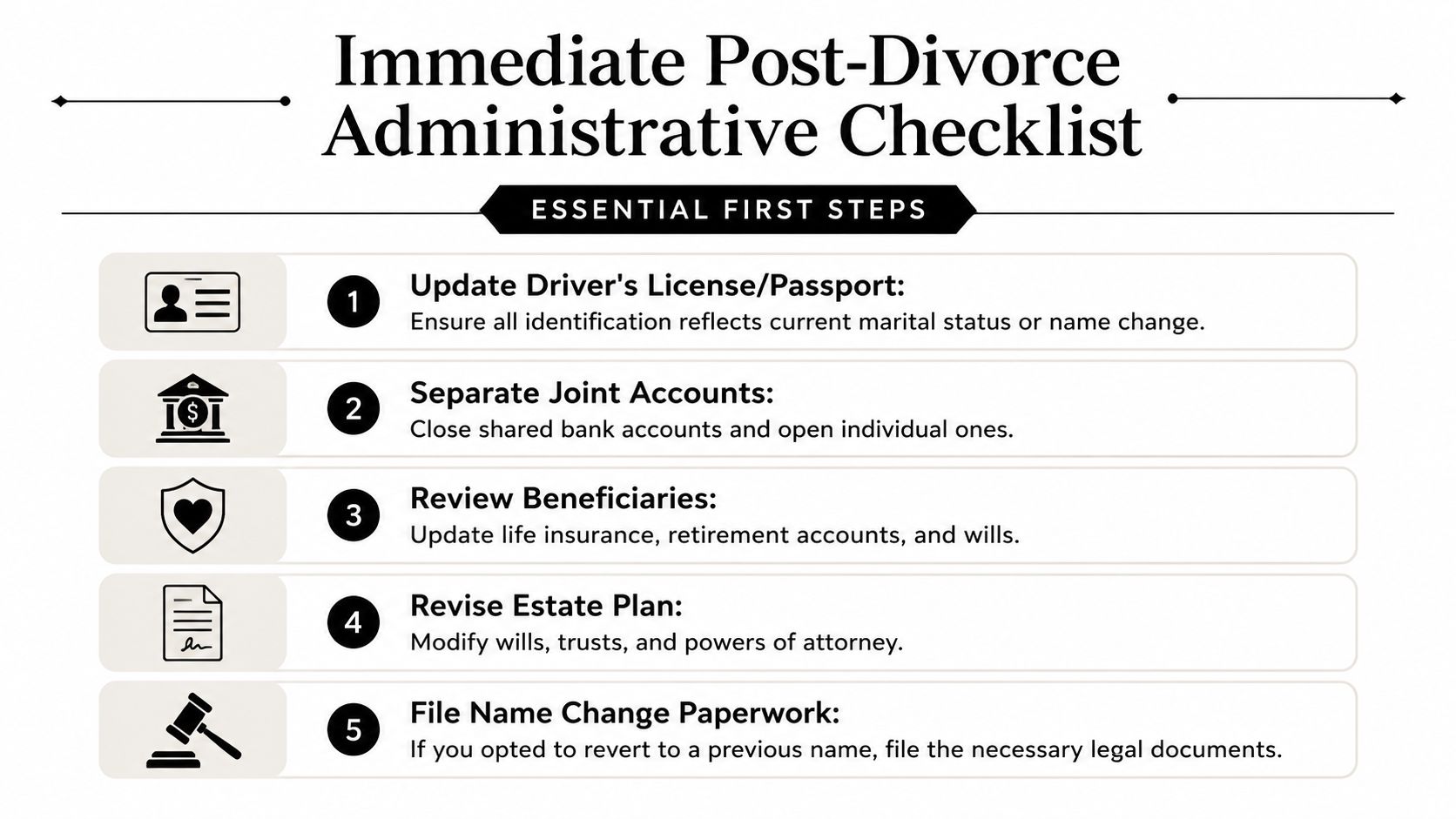
Before you deal with larger financial issues, handle the paperwork that makes your divorce usable in daily life.
Texas Law Help notes that the signed Final Decree of Divorce must be filed with the clerk before the divorce is officially final, and it recommends obtaining a certified copy right away because that copy is commonly needed for title transfers, deed recording, enforcement, and record updates (Texas Law Help divorce finalization steps).
Get certified copies first
This is the first errand many people delay, and it causes needless frustration later.
Ask the district clerk for certified copies of your decree as soon as it has been filed. A plain photocopy may help you review terms at home, but agencies and financial institutions often want a certified copy when you need to prove the divorce, a name change, or authority to transfer property.
Update your legal identity and records
If your decree includes a name change, don't assume one update will automatically fix everything else. It won't.
Use your certified decree to work through identity records in a deliberate order:
- Social Security record. This helps align your name with other agencies and employers.
- Driver's license or state ID. Your Texas identification should match your current legal name.
- Passport. If you travel, don't wait until you book a trip.
- Employer records. Update payroll, benefits, and emergency contact information.
- Bank and credit union records. Make sure your accounts reflect your legal name and current status.
Build one post-divorce document file
A simple file system saves time and reduces mistakes. Keep one folder, digital or physical, with:
- Certified decree copies for agencies, title work, and financial institutions
- A task list pulled directly from the decree
- Confirmation letters and receipts showing what you've already changed
- Contact information for your attorney, clerk, lender, HR department, and insurance providers
Don't hand over your only certified copy every time someone asks for documentation. Confirm whether they need to inspect it, copy it, or keep it.
Handle these small items early
These tasks seem minor until they block something bigger:
- Mailing address updates so statements and court notices go to the right place
- Emergency contacts at work, school, and medical offices
- Online account recovery information tied to old shared phone numbers or email addresses
- Marital status records with insurance carriers and benefit administrators
The fastest way to feel organized after divorce is to secure your documents first. Once that is done, the larger financial and property work becomes much easier to complete.
Securing Your Financial and Property Interests
Many post-divorce disputes don't start with dramatic courtroom fights. They start with everyday delay. A joint credit card stays open. A deed isn't recorded. A retirement account division sits unfinished. Then one problem leads to another.

A useful way to think about this stage is simple. The decree awarded property, but now you have to make ownership real.
Texas family-law guidance warns that your implementation plan should focus on deadlines. Review each obligation line by line, calendar it, keep proof of compliance, and update financial and security credentials promptly to reduce enforcement problems or title defects (Texas post-divorce checklist guidance).
Start by separating money access
Suppose your decree awards each spouse their own checking account, assigns responsibility for certain debts, and requires one spouse to remove the other from a joint credit line. If nobody acts quickly, both people remain exposed.
Handle shared money access in this order:
- Open replacement accounts first so your paycheck, automatic drafts, and savings transfers have somewhere to go.
- Close or freeze joint accounts where appropriate so new charges or withdrawals don't continue.
- Change passwords and account recovery details on banking, investing, and payment platforms.
- Review autopay arrangements because old mortgage, utilities, insurance, or subscription charges often keep hitting the wrong account.
This is also a good time to build a fresh budget and debt payoff plan. If you need practical guidance on that side of the transition, this resource on rebuilding finances after divorce can help you think through the next phase.
Transfer property the way the decree requires
A decree may say you were awarded the house, a vehicle, a business interest, or another asset. That award matters, but the title work still has to be done correctly.
For real estate, people often focus only on who keeps the property and forget the separate step of signing and recording the right deed. If your home transfer involves title language you don't understand, a plain-English explanation of alienation clauses in real estate can help you spot issues that may affect refinancing, transfers, or lender consent.
For vehicles and land, don't rely on informal possession alone. If your former spouse gave you the keys but the title is still wrong, the paperwork isn't finished.
Watch for retirement account divisions
Retirement assets often need more than a decree. Some plans require a separate order to divide the account correctly. If that paperwork is delayed, you can end up with a decree that says one thing and a plan administrator who can't implement it yet.
That is why I tell clients to treat retirement division as its own project. Don't assume your decree alone moved the money.
Here's a short discussion of post-divorce property issues that many Texans find useful:
Update beneficiary designations and estate documents
This is one of the most overlooked parts of post-divorce planning. Your bank account may be separate, but your life insurance, retirement account, transfer-on-death designation, or will may still point to your former spouse.
Review:
- Life insurance policies
- Retirement accounts
- Payable-on-death and transfer-on-death designations
- Your will, trust, and powers of attorney
- Health care directives and emergency authority documents
Some people can manage these tasks on their own. Others need coordination among a divorce attorney, estate planning attorney, lender, or financial professional. The right choice depends on the complexity of the assets, not your ability to fill out forms.
Implementing Custody Visitation and Support Orders
If you have children, daily life after divorce depends less on legal terminology and more on routines that work.
The decree may appoint conservators, set possession and access, order child support, require medical support, and assign responsibility for certain expenses. Those orders only help your family if you follow them closely and document what happens.
Read the parenting schedule like an operations calendar
Many parents make one of two mistakes. They either assume the schedule is flexible enough to "figure out as you go," or they become so focused on technical wording that ordinary communication breaks down.
A better middle ground is to turn the possession order into a shared calendar. Enter exchange times, holiday periods, school breaks, and pickup locations exactly as ordered. Then use that same calendar as your reference point when questions come up.
Keep these habits in place:
- Use one consistent calendar system so both parents are looking at the same dates
- Confirm exchange details in writing when needed
- Track deviations calmly if either parent asks to trade days or adjust times
- Preserve records of messages about missed exchanges, schedule disputes, or late pickups
Make support payments traceable
Support fights often become proof fights. That means the method of payment matters almost as much as the amount.
If your decree requires support through a state disbursement process or another specific channel, use that method. If medical support or uninsured expense sharing is ordered, keep invoices, receipts, proof of payment, and written requests for reimbursement in one place.
When parents keep good records, many disputes stay small. When records are scattered, small disputes grow into enforcement cases.
Don't improvise around unclear terms
If the decree is hard to apply in real life, don't solve the problem with repeated verbal side agreements and no paper trail. That's one of the fastest ways to create later conflict.
Instead, identify the exact language causing trouble. Is it the exchange location? Holiday rotation? insurance responsibility? reimbursement method? Then get legal guidance before the confusion hardens into a pattern.
If compliance becomes a problem, review your options for how to enforce a divorce decree in Texas. Enforcement is often less about one dramatic violation and more about repeated failures to follow clear orders.
Children need consistency more than perfection
No co-parenting arrangement runs flawlessly. Schedules change. Kids get sick. Work shifts happen. The strongest post-divorce parenting systems don't depend on perfect behavior from either parent. They depend on clear orders, good records, and reasonable communication.
That structure protects your children and protects you. It also puts you in a stronger legal position if the other parent stops following the decree.
Understanding Legal Deadlines and Future Modifications
One of the biggest mistakes people make after divorce is assuming every part of the decree works the same way forever. It doesn't.
Some parts of the decree are meant to be carried out and then left alone. Other parts can change later if life changes in a legally meaningful way. Knowing the difference can save you from waiting too long to act, or from trying to reopen an issue the court considers settled.
Property division is generally final
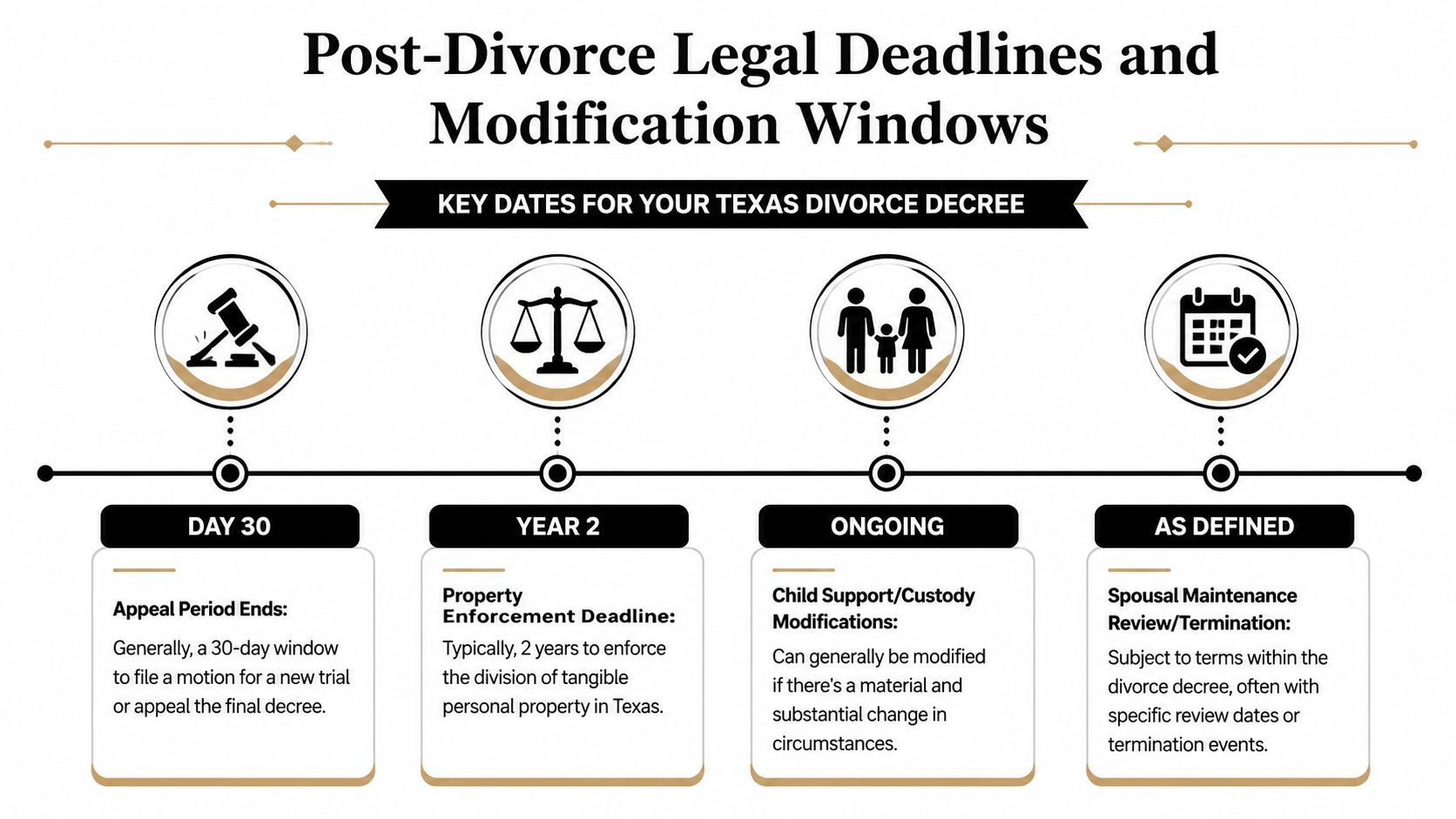
In Texas, post-decree enforcement timing matters. The Texas State Law Library explains that a motion to enforce the division of property must be filed within two years of the date the final decree was signed, and missing that deadline can cost you the right to ask the court to enforce that part of the order (Texas State Law Library after-divorce enforcement guidance).
That matters more than many people realize. If your former spouse never signed over a vehicle, failed to deliver property awarded to you, refused to cooperate on a deed, or didn't complete another property requirement in the decree, waiting too long can hurt your legal options.
Proof matters as much as the deadline
Clients often know something wasn't done, but they don't keep the documents that show it.
If property transfer or compliance is an issue, keep:
- The signed decree
- Emails or messages requesting compliance
- Draft deeds, title documents, or transfer paperwork
- Receipts, statements, and account records
- Any written refusal or unexplained delay
Courts work from evidence, not frustration. A clean file often matters more than a long argument.
Child-related orders can be modified
Property division is usually final. Child-related orders are different.
Texas guidance for consumers consistently explains that child custody, visitation, and support can be modified later, but a parent asking for a change must show a material and substantial change in circumstances involving the child or a parent (Texas modification overview).
That standard is important because it keeps the court from revisiting parenting orders every time a parent is unhappy. The court is looking for a meaningful change, not ordinary post-divorce tension.
Know which lane your problem fits in
This chart helps simplify the issue:
| Issue | Usually final or modifiable | Common response |
|---|---|---|
| Division of house, car, debts, accounts | Generally final | Enforcement if not completed |
| Deed or title transfer not done | Generally final | Enforcement and proof collection |
| Conservatorship terms for children | Modifiable | Modification case if circumstances changed |
| Possession and access schedule | Modifiable | Modification if current order no longer fits |
| Child support | Modifiable | Review based on changed circumstances |
The practical lesson is straightforward. If your problem involves property that was already divided, think in terms of enforcement and timing. If your problem involves children and changing circumstances, think in terms of modification and evidence.
What To Do Next Building Your Future and When to Call an Attorney
Divorce paperwork ends one case. It doesn't end your need for good judgment.
Some post-divorce tasks are straightforward. You can update your records, close accounts, change passwords, revise your beneficiary forms, and keep a calendar of parenting obligations without much legal help. Other problems need legal attention quickly, especially when your decree is unclear or the other party isn't complying.
The right question isn't can you do it yourself
The better question is whether the task involves legal risk if it's done incorrectly or too late.
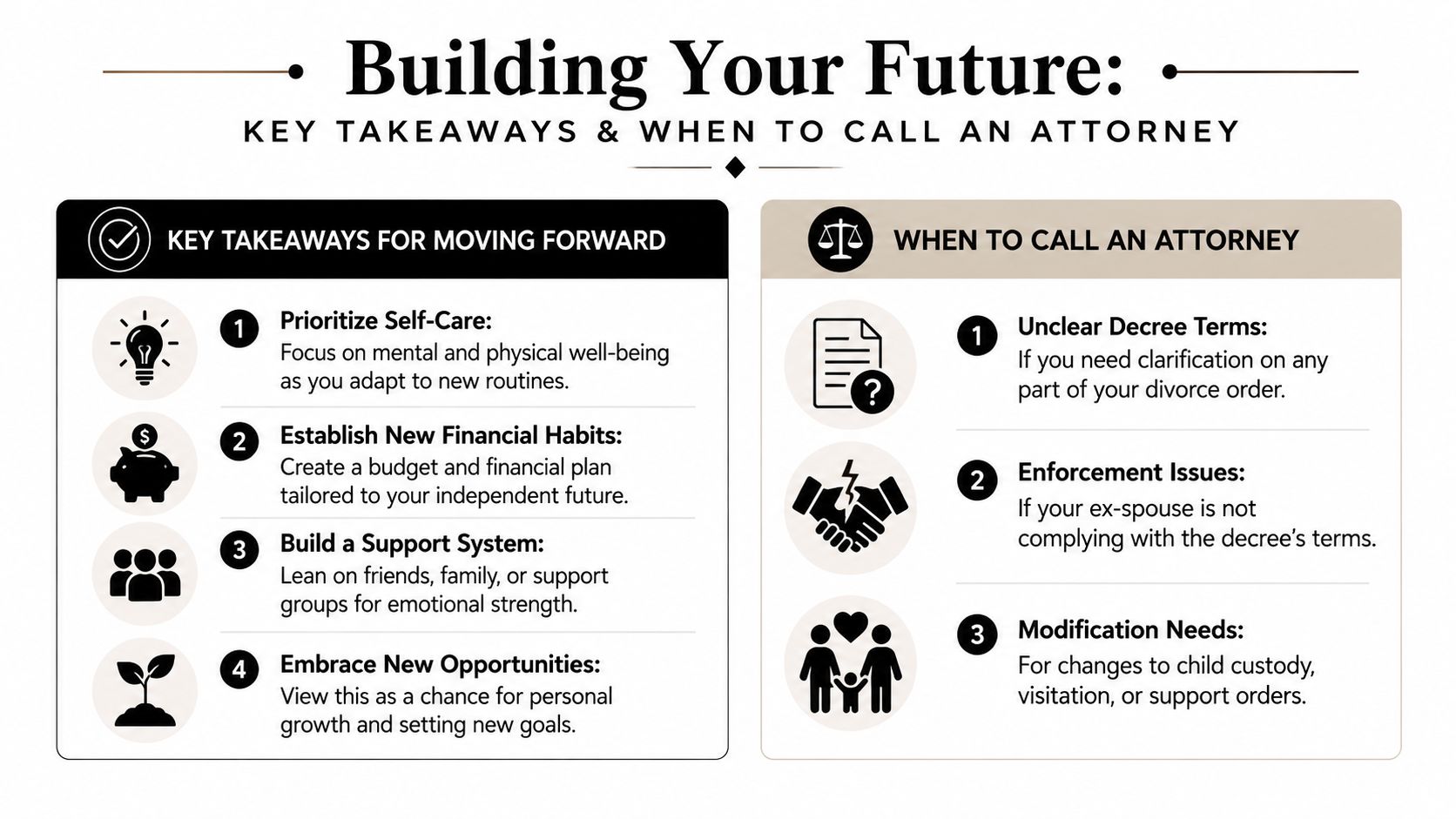
You may be able to handle routine record updates on your own. But you should think seriously about calling an attorney when:
- Your ex-spouse isn't complying with a property transfer, support obligation, or possession order
- The decree language is vague enough that both sides read it differently
- A retirement account division still hasn't been implemented
- A deed, title, or refinance issue is blocking transfer of awarded property
- A child's needs have changed enough that the current order no longer works
- Safety concerns or conflict levels make direct communication difficult
For clients in those situations, a post-divorce legal review with a Texas family-law firm such as the Law Office of Bryan Fagan, PLLC can focus on enforcement, clarification, or modification options based on the actual decree language and current facts.
Special cases need a longer checklist
Some decrees carry extra layers of post-divorce work. That often includes:
- Business owners dealing with ownership records, valuation carryover issues, and account access
- High-asset households with trusts, investment accounts, executive compensation, or multiple properties
- Military families handling benefit-related questions and implementation details
- Parents in high-conflict cases who need strict documentation and structured communication
- Protective order situations where safety planning matters as much as compliance
The more complex the asset or parenting issue, the less wise it is to rely on assumptions.
Key takeaway
Key Takeaway
Your Texas divorce decree is part checklist, part rulebook, and part safety net. Use it to complete transfers, protect your finances, follow parenting orders, preserve proof, and act quickly if enforcement or modification becomes necessary.
What to do this week
If you're feeling stuck, keep it simple. Do these first:
- Get certified copies of your decree and store them safely.
- Highlight every action item in the decree.
- Create one deadline calendar for transfers, support, and parenting terms.
- Update identity, banking, and beneficiary records.
- Save proof of each completed step.
- Call a lawyer if something isn't being followed or no longer works.
While property and debt division are generally final, child custody, visitation, and support can still be modified later if there has been a material and substantial change in circumstances affecting a parent or child. That distinction matters because it tells you whether your next legal step is enforcement or modification.
You don't have to solve every post-divorce issue in one day. You do need to start in the right order.
If you're dealing with an unclear decree, missed property transfers, support problems, or a parenting order that no longer fits your family's reality, Law Office of Bryan Fagan, PLLC offers free consultations for Texans who need guidance after divorce. You can speak with an attorney about enforcement, modification, or the next practical steps to protect your rights and move forward with confidence.