Skip to content
In Texas, you must wait 30 days after your divorce is finalized before you can marry someone else. If you remarry too soon, that new marriage can carry serious legal consequences because Texas treats it as voidable, not automatically safe or settled.
That rule catches many people off guard. You may feel emotionally done with the marriage long before the paperwork is signed, or you may already be planning a future with someone new. But the legal timeline matters, and getting it right can spare you a great deal of stress, expense, and uncertainty later.
Your New Beginning Starts with Understanding the Rules
The day your judge signs the Final Decree of Divorce can feel like a release. You've been through conflict, paperwork, court settings, maybe mediation, and hard decisions about children, property, or support. It makes sense that you'd want to look ahead instead of back.
For some people, that next step includes remarriage. For others, it means knowing they have the freedom to choose what comes next. Either way, if you're asking how long after divorce can you remarry in Texas, you're asking the right question at the right time.
Why this rule matters emotionally and legally
Texas doesn't treat remarriage as a casual administrative detail. The law builds in a pause after divorce so your legal status is clear before a new marriage begins. That may feel frustrating when you're ready to move on, but it exists to reduce confusion and prevent legal problems.
That matters even more if your divorce involved children, retirement accounts, real estate, a family business, or future support obligations. A rushed remarriage can create overlap between your old legal life and your new one. That's where trouble starts.
Practical rule: Your divorce isn't the only date that matters. The exact day the judge signs your decree starts a separate legal countdown.
What readers often misunderstand
People often mix up three different moments:
- Filing for divorce: This starts the case, but it does not start the remarriage waiting period.
- Finalizing the divorce: This is the judge's signature on the decree. That date is what controls the remarriage rule.
- Getting a marriage license: Even after you're free to remarry, Texas still has a separate waiting period tied to the license.
You're not alone if this feels like too many moving parts. Family law often works that way. The emotional timeline and the legal timeline rarely match.
A lot of people also need support beyond the courtroom. If you're still processing the grief and identity shift that often comes after divorce, Bybsandthrive's guide to divorce offers a thoughtful mental health resource for rebuilding after the end of a marriage.
The right mindset for this stage
Try to think of remarriage as both a personal commitment and a legal act. When those two line up, your new beginning rests on firmer ground. When they don't, even a happy event can become complicated.
That's why the safest approach is simple. Confirm your decree date, understand the waiting rules, and don't assume an exception applies unless a court has clearly granted it.
The Official Texas Remarriage Timeline Explained
Texas remarriage law makes more sense when you see it as a sequence instead of one single rule. Each step sits on top of the one before it.
Start with the visual timeline below.
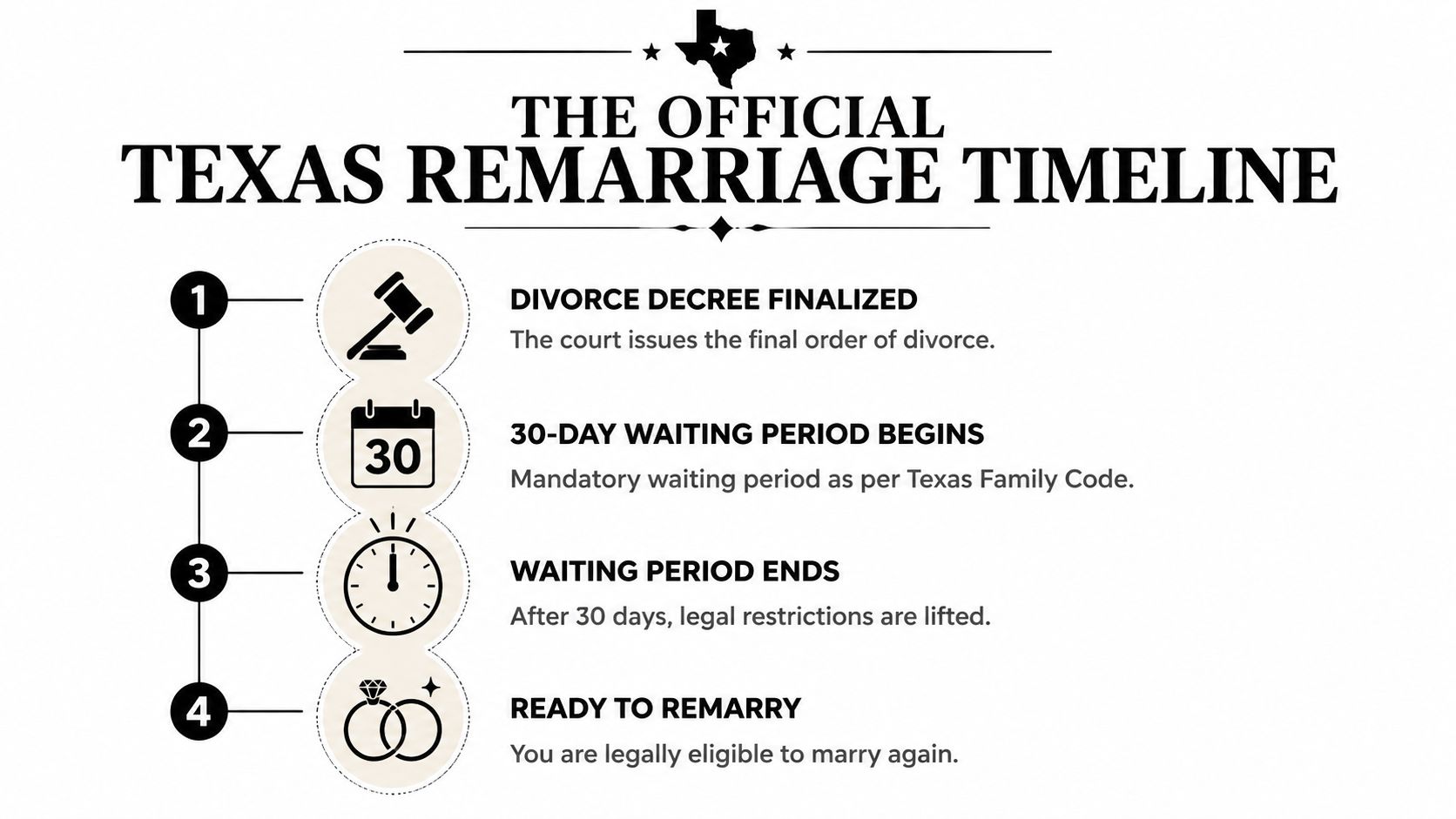
Step one begins when the divorce is filed
Texas has a minimum 60-day waiting period from filing a divorce to final decree, and after the judge signs the decree there is a 30-day post-decree waiting period before remarriage. In practical terms, that often makes the minimum from filing to a new marriage about 90 days, before accounting for the separate marriage license delay, as explained in this overview of Texas remarriage timing.
That first waiting period belongs to the divorce itself. It doesn't mean your case will end at the first possible moment. Many divorces take longer because of parenting disputes, property valuation, business interests, or negotiation over support.
If your case is still pending and you want a clearer sense of how that first deadline works, this guide on the Texas divorce 60-day waiting period can help you place your divorce date in context.
Step two starts on the decree date
The 30-day remarriage waiting period begins when the judge signs your Final Decree of Divorce. It does not begin on the day you filed. It does not begin when you moved out. It does not begin when you reached a settlement.
That decree date is the legal trigger.
A simple example helps. If your judge signs the decree on a Monday, the waiting period starts that Monday. If you're planning a ceremony, your calendar should be built around that signed date, not around anything that happened earlier in the case.
The judge's signature matters more than your filing date, your mediation date, or the day you emotionally decided the marriage was over.
Here is a short video that helps explain the issue in plain language.
Step three involves the marriage license
Even after the remarriage restriction ends, Texas adds another step. There is a 72-hour waiting period after a marriage license is issued before the ceremony can occur, so the legal path is not just divorce finalization, then remarriage. It is divorce finalization, the post-decree wait, then the marriage license wait, as described in this discussion of Texas remarriage timing and license rules.
That surprises people who think the end of the divorce waiting period means they can marry the same day. Usually, they can't.
A simple way to remember the sequence
| Milestone | What it means |
|---|---|
| Divorce filed | Your case begins |
| Judge signs decree | Your divorce becomes final |
| Post-decree waiting period ends | You become eligible to remarry |
| Marriage license waiting period ends | Your ceremony can go forward |
If you're planning quickly, treat each milestone as mandatory unless a court has waived a specific requirement.
Can the 30-Day Waiting Period Be Waived
Yes, but many people assume the waiver is easier to get than it really is.
Texas courts can waive the remarriage waiting period for good cause. The problem is that “good cause” doesn't mean convenience, travel plans, venue deposits, or the fact that you and your partner are ready. Courts expect proof.

What courts usually want to see
Courts require a high evidentiary burden for a waiver. A military deployment requires a certified order with a specific departure date, not just a notice. A medical waiver needs a sworn affidavit from a doctor that details the procedure and why waiting is impossible. Only a small percentage of requests are granted without a formal motion and this level of proof, as discussed in this explanation of early-remarriage challenges and waiver practice.
That means a casual request usually won't work. Courts want documentation, and they want it presented in a proper legal format.
Common examples and where people go wrong
Here are the situations that often lead people to ask for a waiver:
- Military deployment: You may have a real deadline, but a general notice usually isn't enough. The court wants formal orders and a specific date.
- Urgent medical need: A surgery or treatment schedule may support a waiver, but courts look for sworn medical detail, not a brief note.
- Remarrying your former spouse: Texas allows former spouses to remarry each other immediately. This is the clearest exception.
A lot of confusion comes from internet summaries that say military or medical needs “may qualify” and stop there. That leaves out the hard part, which is proving the request in a way a judge will accept.
A waiver request lives or dies on documentation. If the evidence is weak, the deadline usually stays in place.
Procedure matters too
A waiver isn't just a conversation with the clerk or a promise made during your divorce hearing. It usually requires a proper filing and supporting evidence. If you're sorting through court paperwork and trying to understand what has to be signed, filed, and served, this primer on what a waiver of service means in Texas family law helps distinguish one legal waiver from another.
The practical takeaway is simple. Don't book a ceremony on the assumption that a judge will waive the rule. Wait until the court has granted relief and you understand whether any other marriage-license rule still applies.
The Serious Risks of Remarrying Too Soon
The biggest mistake people make is assuming an early remarriage is automatically invalid and therefore easy to fix. That's not how Texas treats it.
A marriage entered during the waiting period is voidable, not void. That difference sounds technical, but it has real consequences.
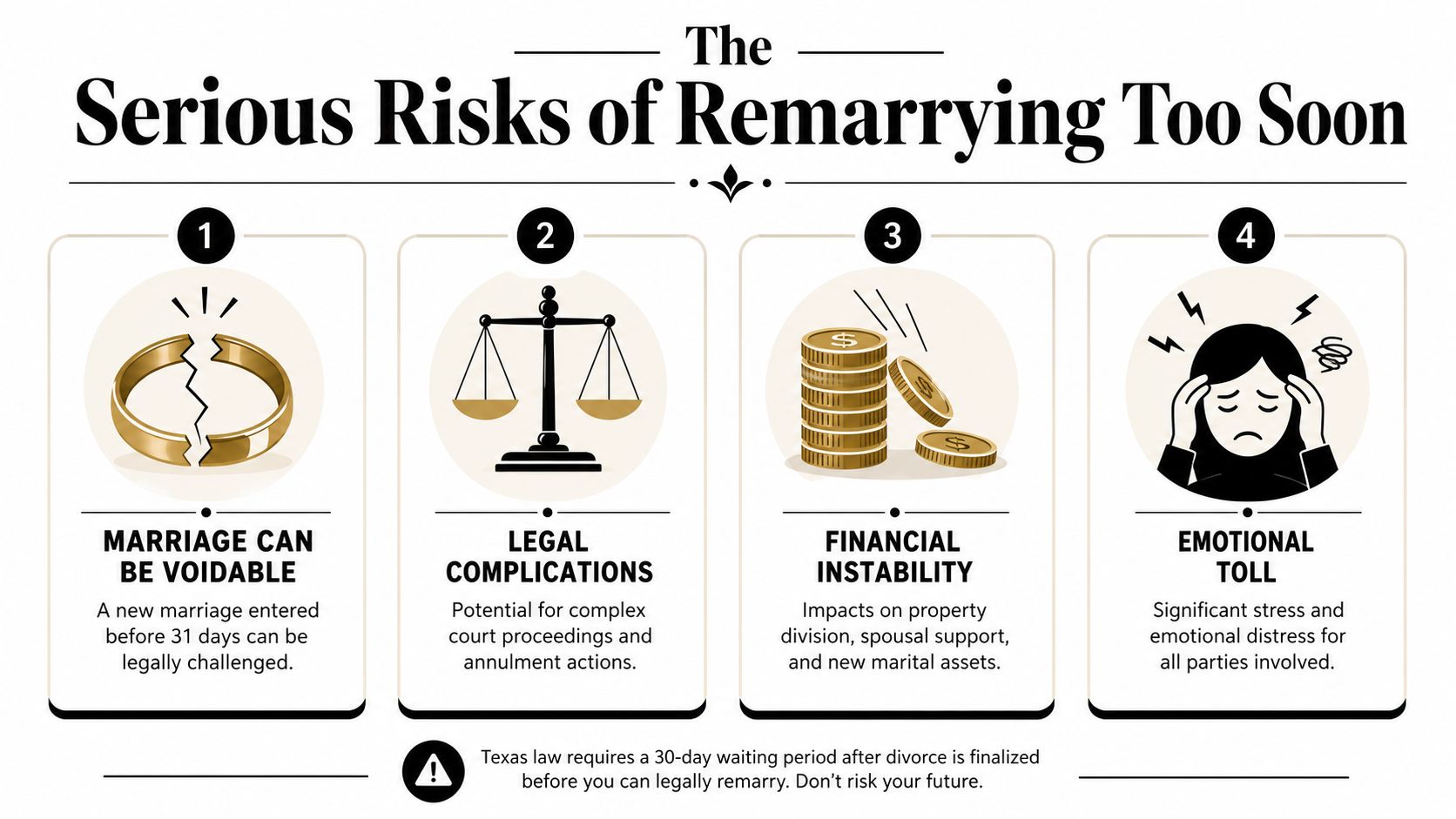
Voidable and void are not the same
Think of a void marriage as something the law treats as invalid from the start.
A voidable marriage is different. It stands as legally valid unless and until someone with the right to challenge it asks a court to do something about it. That creates uncertainty, not clarity.
Texas guidance explains that a marriage entered into within the 30-day waiting period is voidable, and Texas Family Code § 9.201 also allows a two-year window to enforce property division from the first divorce. That overlap can create legal limbo around property and children if the second marriage is challenged, as noted by the Texas State Law Library's post-divorce guidance.
Why this matters in real life
The problem isn't only whether the second marriage survives. The problem is everything attached to that marriage while it remains in question.
Consider a few practical pressure points:
- Property rights: If you acquire property after the new marriage ceremony, you may later face questions about how that property should be treated if the marriage is challenged.
- Children: Texas law generally tries to avoid chaos for children, but an unstable marriage status can still create conflict and stress around legal parentage, custody planning, and household decision-making.
- Enforcement from the first divorce: If property division from the first marriage still needs enforcement, the overlap can make your financial life messier than it needs to be.
Legal limbo is the real danger
The phrase “voidable” isn't usually feared because it sounds softer than “void.” In practice, it can be harder to live with.
You may think you're married. You may act as a married couple. You may combine finances, make plans, and present yourselves to family and friends as fully settled. Then a challenge appears, and the legal foundation under those choices starts to shift.
You're not protecting your new relationship by rushing. You're exposing it to avoidable uncertainty.
This issue can hit business owners especially hard. If you own a company, hold partnership interests, or expect large income swings, uncertainty around marital status can complicate how you plan for ownership, disclosure, and asset protection. Parents can face a different set of concerns. A premature remarriage may not decide custody by itself, but it can add strain to an already sensitive co-parenting environment.
The wiser path is boring, but safe. Wait until the law clearly allows remarriage. Clean timelines make future disputes less likely.
Practical Steps for Getting Remarried in Texas
Once the waiting period has passed, or a judge has signed a waiver, the goal shifts from legal timing to clean execution. This part matters more than many people expect. A second marriage should start on a clear paper trail, not on assumptions that can cause trouble at the clerk's office or later when you update accounts, benefits, and family records.
Start with the document that controls everything. Your signed divorce decree is the court's final instruction sheet. It shows the date your divorce became final and may also address name restoration or other details that affect your identification and records. If you want a plain-English explanation of what that document does, review this explanation of a Texas divorce decree.
Keep a certified copy where you can reach it quickly.
That one step can save a lot of stress if a county clerk asks for proof that your prior marriage ended, or if you need to correct a mismatch between your decree and your current ID.
A practical checklist helps here:
- Confirm the exact date on the signed decree. Do not rely on memory or the date of your hearing.
- Verify any waiver in writing. If a judge waived the 30-day period, keep the signed order with your decree.
- Check county marriage license requirements. Each clerk's office may have slightly different document and ID expectations.
- Choose the ceremony date with cushion. Leave room for license timing, office hours, and unexpected delays.
- Review your name documents. Your divorce decree may restore a prior name, while remarriage may lead to a different update process.
It helps to treat remarriage paperwork like travel documents before an international flight. If one item is missing, the plan may stop at the counter even though the trip itself is simple.
Then look beyond the wedding day. A legal marriage changes more than your relationship status. It can affect bank accounts, retirement plans, insurance beneficiaries, emergency contacts, estate planning documents, and school or medical records tied to your children. Handling those updates early reduces the chance of conflicting records later.
If you are organizing the ceremony itself, practical tools can lower the stress level for everyone involved. Wedding QR codes can help guests find schedules, directions, and RSVP information in one place.
Some remarriages need extra care. Parents with custody orders should make sure the wedding date and related travel do not disrupt parenting schedules or notice requirements. Business owners should keep personal and business records clearly separated as household finances begin to change. People with substantial assets should review account titles, beneficiary designations, and estate documents so the new marriage fits the plan they want.
The basic idea is simple. Wait until the law allows remarriage, gather the right papers, and tie up the practical details before the ceremony. That gives your new marriage what it deserves at the start. Clarity.
What to Do Next Protect Your New Beginning
A new marriage should begin with clarity, not doubt. If you're moving forward after divorce, the best gift you can give yourself is a clean legal start.
That means respecting the court's timeline, reading your decree carefully, and not relying on assumptions. It also means stepping back for a moment if your situation includes children, unresolved property questions, military service, medical urgency, or significant assets.

A careful plan protects more than your wedding date
The legal issue may sound narrow, but the ripple effects can be broad. Remarriage affects your household, your children, your finances, and your future planning.
That's why it helps to think in layers:
- Family layer: How will this affect parenting schedules, co-parent communication, or your child's sense of stability?
- Financial layer: Are your accounts, beneficiary choices, and property records aligned with your new legal status?
- Court layer: Have all prior orders been followed, enforced, and properly documented?
For people who are rebuilding financially after divorce, a basic planning review can be just as important as the legal one. Resources like Wealth Collective financial planning can help you think through budgeting, goals, and decision-making as your life changes.
Questions worth asking before you set a date
If you're unsure, ask yourself:
- Has the judge signed my decree yet, or am I assuming the case is finished?
- Do I know the exact day the waiting period ends?
- Do I need a waiver, or do I only want one because the schedule is inconvenient?
- Does my new marriage affect unresolved issues from my divorce orders?
- Have I updated the documents that matter outside the courthouse?
These are not small details. They are the practical steps that turn a hopeful plan into a stable one.
The safest remarriage is the one that doesn't leave loose ends behind.
Key takeaway
If you remember only one thing, remember this: Texas gives you a path to remarry, but it expects you to follow the timeline exactly unless a judge grants an exception. A rushed wedding can create legal limbo at the very moment you want peace.
If your divorce involved mediation, support disputes, enforcement concerns, child custody questions, or substantial assets, individualized legal advice matters even more. General information can help you understand the rule. It can't apply the rule to your decree, your dates, and your risks.
You've already done hard work to close one chapter. Your next chapter deserves the same care.
If you have questions about your decree, a possible waiver, child-related concerns, property enforcement, or the right date to remarry, schedule a free consultation with Law Office of Bryan Fagan, PLLC. You can get clear, Texas-specific guidance so your new beginning starts on solid legal ground.