Skip to content
When you picture yourself on the witness stand, it's easy to feel like one wrong answer could change everything.
That fear is normal. In a Texas divorce, cross-examination often feels more personal than almost any other part of trial because your spouse's attorney isn't just talking about paperwork. They're asking about your parenting, your spending, your messages, your judgment, and your credibility in front of a judge who may decide issues involving your children, property, support, and final decree.
The good news is that cross-examination is usually far more structured than people expect. It's not a free-for-all. It isn't a movie scene with dramatic surprises and shouting. It's a controlled process with rules, patterns, and limits. Once you understand those patterns, the courtroom stops feeling quite so mysterious.
Texas divorces also follow a broader legal path that matters here. A case usually begins with the filing of an Original Petition for Divorce, then temporary orders, exchange of information, possible mediation, and if settlement doesn't resolve every issue, trial. Along the way, Texas courts address child-related questions under the best interest of the child standard, divide community property in a manner the court considers just and right, and may decide support or enforcement disputes depending on the facts. By the time cross-examination happens, much of your case has already been shaped by those earlier steps.
Introduction The Courtroom Spotlight Is On You
You may be reading this the night before court, sitting at your kitchen table with a folder of bank records, school notes, and printed text messages, wondering what will happen when the other lawyer starts asking questions.
Cross-examination is often expected to feel hostile. Sometimes it does. But more often, it feels tight, repetitive, and oddly narrow. The attorney may ask about a date, a document, a text thread, a bank statement, or a parenting exchange. They may sound calm. They may sound sharp. Either way, the structure is usually the same. They want control, and they want short answers.
That matters because fear often comes from not knowing the rhythm. Once you know the rhythm, you can prepare for it.
Why this feels so personal
In family court, the facts aren't abstract. Questions can touch the date of separation, your role with the children, spending during the marriage, or whether a message really says what the other side claims it says. If custody is disputed, your testimony may affect conservatorship, possession, visitation, and decision-making. If property is disputed, your answers may affect how the court views assets, debts, and credibility.
Under the Texas Family Code, divorce cases often involve overlapping issues. The court may consider parenting arrangements, child support, community property, reimbursement claims, separate property arguments, temporary orders, and enforcement concerns in the same case. That can make cross-examination feel like every part of your life is under a microscope.
Cross-examination feels less intimidating when you stop treating it like a performance and start treating it like a process.
What you can control
You can't control the opposing attorney's tone. You can't control every question. You can't control whether your spouse says something unfair on direct examination.
You can control your preparation, your pace, your documents, and your responses.
That's where confidence comes from in divorce court. Not from having a perfect memory. Not from winning every exchange. From knowing what cross-examination is designed to do, and how to stay steady while it's happening.
What Is Cross-Examination in a Texas Divorce
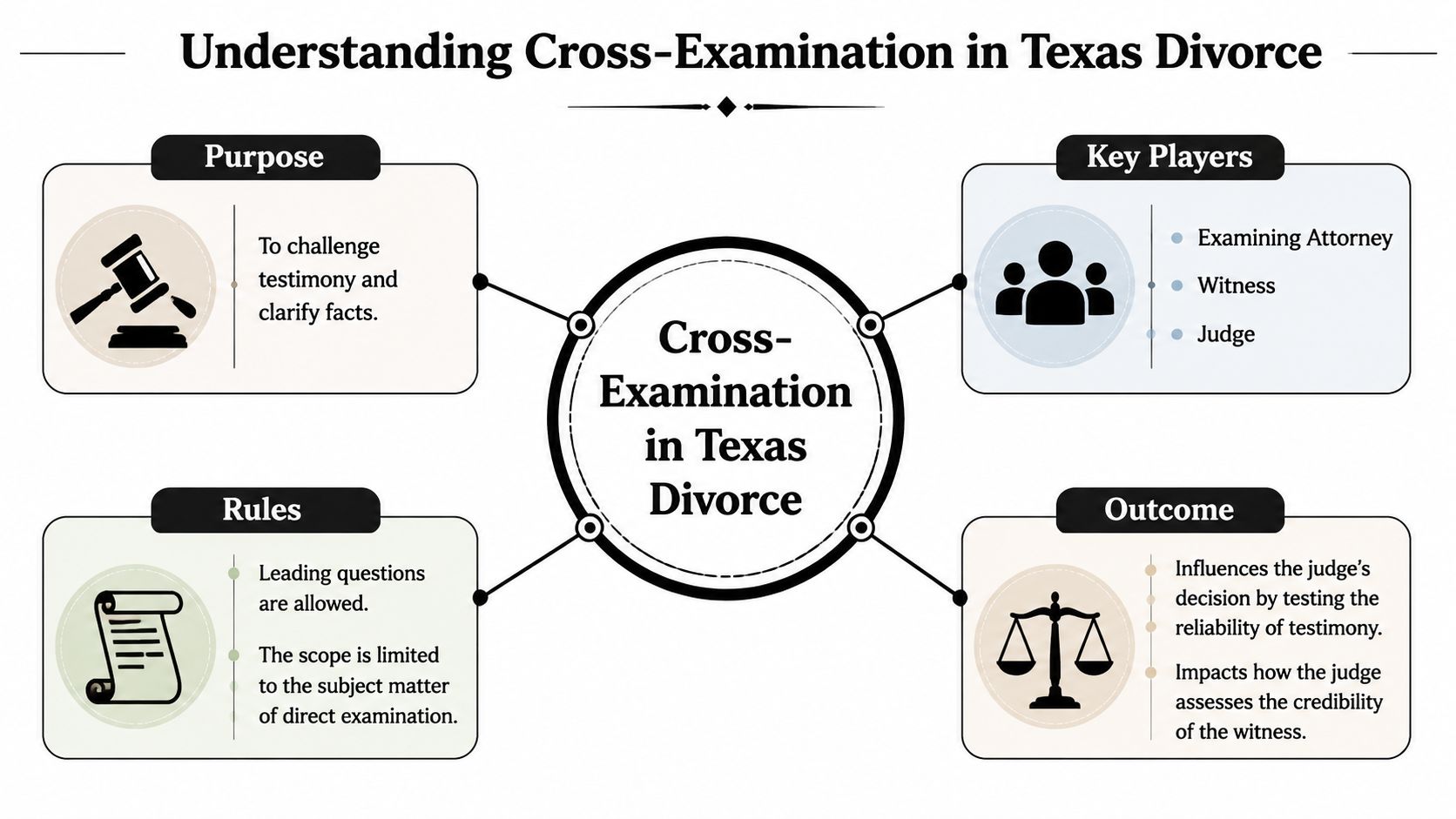
Cross-examination is the part of trial where the other lawyer questions a witness after direct examination. If your lawyer called you first, your spouse's lawyer questions you next. If your spouse testified first, your lawyer gets that turn.
In a Texas divorce, this part of the case works like a stress test. The goal is not to let the witness tell the whole story again. The goal is to test whether key parts of that story stay consistent when the questions get narrower, faster, and tied to records.
What the other lawyer is trying to prove
A lot of people expect cross-examination to be a dramatic argument. In real Texas courtrooms, it is usually more controlled than that. The questioning lawyer is often trying to do one of four things: limit your answer, show an inconsistency, tie you to a document, or suggest that your memory is less reliable than you believe.
That is why the questions are often short and leading. Instead of asking, "What happened with the school emails?" the lawyer may ask, "You told the court you handled school communication, correct?" Then they may follow with a printed email, a text thread, or an exhibit from discovery.
Document-based questions matter because they can make a witness feel cornered. A text pulled from months ago, an email missing part of the chain, or a bank statement with one highlighted transaction can be presented in a way that seems larger than it really is. Your job is not to out-argue the lawyer. Your job is to listen carefully, answer the question asked, and make sure you do not agree with an incomplete summary just because the document looks official.
Why cross can feel harder than direct examination
Direct examination gives your lawyer room to build context. Cross-examination usually strips context away.
That is intentional.
If direct examination is a wide-angle photo, cross-examination is a zoom lens. The lawyer may focus on one date, one message, one transfer, or one sentence from a prior statement and keep returning to that single point. In divorce cases, that often means questions about parenting decisions, spending, property claims, sobriety concerns, or digital communications between spouses.
Texts and emails create special problems. A message can sound harsh when read aloud. A screenshot can leave out what came before or after. A witness who guesses about a date, sender, or missing context can lose credibility faster than a witness who says, "I need to see the full message," or "I do not remember that without the document in front of me."
The rules are narrower than they seem
Cross-examination is not unlimited. Trial-advocacy guidance from the AFCC explains that effective cross often stays focused on inconsistency, bias, prior statements, and points that matter to the factfinder, as discussed in its article on effective cross-examination strategy.
In plain terms, that means the other lawyer usually has a plan. They are not asking every possible question. They are picking the points they believe will shape how the judge sees your credibility.
Texas divorce trials are often bench trials, which means the judge, not a jury, decides what facts are proven. Judges hear cross-examination all the time. They are watching for clear answers, consistency, and whether a witness stays grounded when challenged.
What cross-examination means for your case
Cross-examination sits inside a larger legal framework. The judge may be deciding conservatorship, possession, child support, characterization of property, reimbursement claims, or whether a proposed division of community property is just and right. A question that sounds small can matter because it connects to one of those legal issues.
Here is a simple way to read the process:
| Part of the process | What it means for you |
|---|---|
| Direct examination | Your lawyer introduces your testimony and gives context |
| Cross-examination | The other lawyer tests specific parts of that testimony with tighter questions |
| Objections | Lawyers ask the judge to block improper questions or improper evidence |
| Judge's role | The judge decides what is relevant, what is credible, and what weight to give it |
If you want a broader picture of how testimony fits into trial, this guide on how to prepare for divorce court in Texas step by step helps place cross-examination in the full court process.
The most important point is simple. Cross-examination is not a test of whether you can win an argument on the witness stand. It is a test of whether your testimony stays accurate, careful, and steady under pressure.
How to Prepare for Cross-Examination Before Trial
The hard part of cross-examination often starts long before you walk into court. It starts the night a text message pops up on a printed exhibit, or a date in your testimony does not match a bank record, or you realize the other side may ask about an email you forgot you sent six months ago.
That is why preparation matters so much. Good preparation lowers the chance of surprise. It also gives you something solid to stand on when the questioning feels fast or sharp.
Start with the record that already exists
Cross-examination usually grows out of documents, not drama. The other lawyer looks for places where your testimony can be compared against something fixed on paper or on a screen. That may be your inventory and appraisement, discovery responses, affidavits, financial records, prior testimony, emails, texts, school records, or parenting calendars.
A useful way to prepare is to treat your case file like a map. You are looking for intersections where one fact connects to another. A move connects to a school change. A bank transfer connects to a reimbursement claim. A late-night text may connect to a parenting dispute or an allegation about communication.
Focus on these areas:
- Dates and timelines. Review marriage, separation, moves, account openings, large purchases, job changes, and important events involving the children.
- Statements that can be compared. Check whether what you said in a pleading, affidavit, or discovery response lines up with the supporting records.
- Digital communications. Read texts and emails in full threads, not just isolated lines. Context changes meaning.
- Documents the other side is likely to use. If a record could be shown to you on the stand, you should have seen it before trial.
- Exhibit organization. Keep records grouped by issue so you can recognize what you are being shown without scrambling.
You do not need a memorized script. You need familiarity. There is a big difference.
Prepare for document-based questions
Many witnesses expect aggressive questions. They are less prepared for quiet, controlled questions tied to a document in the lawyer's hand.
That kind of cross can be more effective because paper feels objective. A lawyer may show you a bank statement, a screenshot, a Venmo history, a school attendance record, or a text thread and ask for short admissions. If you have not reviewed those records carefully, you can feel trapped even when the answer is simple.
Your job is to slow the moment down in your own mind. Read before answering. Make sure you know what page, what date, and what message you are being asked about. If a screenshot looks incomplete, say that you need to see the full exchange or the full document to answer accurately.
That is not being difficult. That is being careful.
Practice answering the question that was asked
Rehearsal helps because cross-examination tests control. The other lawyer may already know the answer they want before they ask the question. Your preparation should teach you how to stay accurate without volunteering extra information, arguing, or trying to outsmart the questioner.
Ask your attorney to practice with the kinds of topics your case involves. In a Texas divorce, that might mean custody disagreements, separate property tracing, business income, hidden account accusations, reimbursement claims, spending during the marriage, or conflicting versions of a text conversation. If you want the larger trial context first, this guide on how to prepare for divorce court in Texas step by step can help you place witness preparation inside the full court process.
One rule helps many clients: uncomfortable truths need the most practice. If an honest answer makes you tense in a conference room, it will feel harder under oath unless you have already worked through it with your lawyer.
Pay special attention to texts, emails, and screenshots
Digital evidence creates a different kind of pressure. People write casually on their phones. Courtrooms read those words slowly, line by line.
A short message can look harsher on paper than it felt in the moment. An incomplete screenshot can leave out what came before or after. A lawyer may also use timestamps, deleted-message gaps, contact names, emojis, or forwarding history to suggest a meaning you did not intend.
Prepare for that in advance. Review message threads in context. Ask your lawyer which communications are likely to become exhibits. If there are nicknames, sarcasm, shorthand, or family-specific phrases, explain them before trial, not for the first time on the witness stand.
Do the human preparation too
Your body affects your testimony. A hungry, exhausted, disorganized witness has a harder time listening carefully and answering with patience.
Choose courtroom clothing that is neat and conservative. Put your phone away. Bring your glasses if you need them to read. Keep your papers in order. Eat beforehand if you can. Those steps sound small, but they help you stay steady when the pressure rises.
Later in your preparation, it also helps to watch a plain-language walkthrough of witness preparation and courtroom expectations:
If your case involves money, business records, or tracing
Complex cases require slower review. If income, business expenses, valuation, tracing, or reimbursement claims are disputed, cross-examination may turn on one ledger entry, one transfer, or one line in a credit card statement. The question may sound simple while the document underneath it is doing all the actual work.
In those cases, spend more time with the source records than with summaries. Make sure you understand where numbers came from, what an account was used for, and which records support your position. If your case may reach trial, one option is working with counsel such as the Law Office of Bryan Fagan, PLLC to review likely exhibits, testimony themes, and problem areas before you ever take the stand.
The Cross-Examination Process Step by Step
The first time you testify, even small details can feel strangely big. Where do you stand. When do you sit. What happens if someone says "objection." Do you keep talking. Do you look at the judge or the lawyer.
The process is more routine than it feels in the moment.
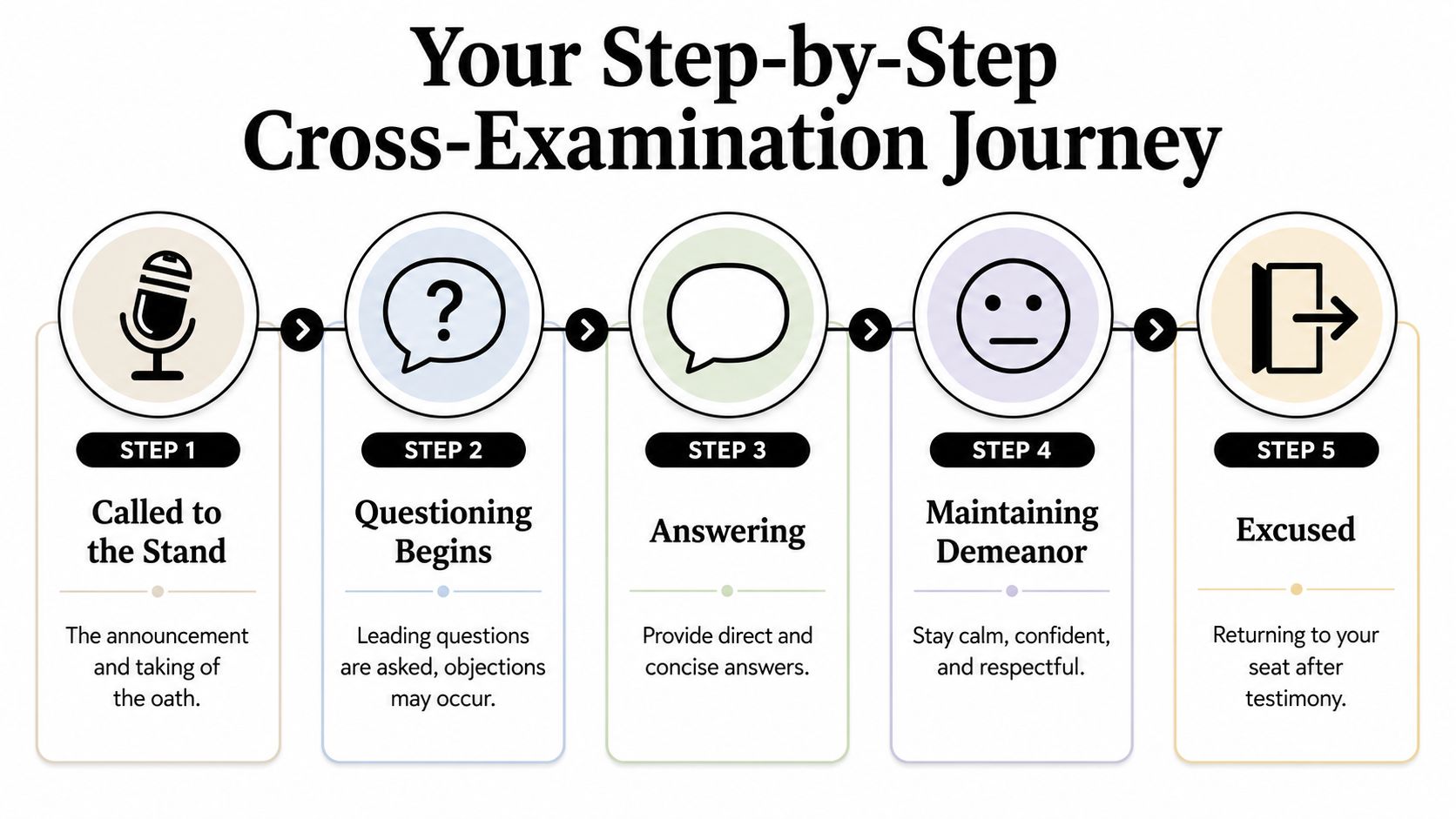
Step one is simpler than you think
Your name is called. You go to the witness stand. You take the oath to tell the truth. Then you sit down and answer the questions from the lawyer who called you first.
After direct examination ends, cross-examination begins.
What cross usually sounds like
Cross often comes in short, leading questions:
- "You received that email, correct?"
- "That was after the temporary orders hearing, right?"
- "You didn't tell the court about that account in your first disclosure, did you?"
- "The children were with your mother that weekend, not you, correct?"
The format can feel restrictive because it is restrictive. The questioning lawyer is trying to keep control over the wording, pace, and subject.
If you've never seen how pretrial information shapes these questions, it helps to understand what discovery is really like in a Texas divorce case, because many cross questions come straight from documents, disclosures, and prior written responses.
What happens when lawyers object
An objection means one lawyer believes a question or answer breaks a courtroom rule. If that happens while you're on the stand, stop talking immediately.
Then wait.
The judge may allow the question, limit it, or tell the lawyer to rephrase it. Your job is not to argue with the objection or explain why you think the answer is fair. Your job is to listen for the ruling and answer only after the judge has spoken.
If an objection interrupts you, silence is usually the safest move until the judge tells you to continue.
The rhythm matters
A common mistake is thinking every question deserves a full explanation. It doesn't. Some do. Many don't.
Cross-examination is often strongest when the lawyer asking questions is brief and selective. Sometimes the most effective move for counsel is to stop after a contradiction has landed, rather than giving the witness room to repair it. That's one reason the process can feel abrupt. A few narrow questions may matter more than a long exchange.
When the questioning ends, your lawyer may ask follow-up questions on redirect. Then the judge may excuse you, or ask a few questions directly. After that, you return to your seat.
Common Questions and Tactics Used in Divorce Cases
The questions that worry people most are usually not the complicated legal ones. They're the familiar ones asked in an unfriendly format. Questions about your children, your money, your messages, your choices.
What matters is not just the topic. It's the tactic behind the topic.
Custody and parenting questions
In Texas, child-related disputes often center on conservatorship, possession, decision-making, communication, and the child's routine. On cross, the other lawyer may try to show inconsistency between what you say now and what your records suggest.
Examples might sound like this:
- "You say you attend school meetings, but you weren't present at this one, correct?"
- "You told the court co-parenting communication is difficult, but in this text you refused to answer about pickup, right?"
- "You introduced the children to your new partner before discussing it with the other parent, correct?"
The goal is usually one of three things: to suggest a pattern, to undermine your judgment, or to show that your testimony is broader than the facts support.
Property and support questions
If the dispute involves assets, debts, reimbursement, or maintenance, cross may focus on records and timelines rather than emotion. The lawyer may move quickly between your testimony and the paper trail.
Typical examples include questions about:
- Bank statements and transfers
- Credit card spending
- Business accounts or expense classifications
- Retirement or investment records
- Claims that property is separate rather than community
- Work history and earning capacity
These questions matter because Texas courts divide community property in a manner the court finds just and right. That doesn't mean every item is split mechanically. It means credibility and documentation can carry real weight.
Digital evidence is where many witnesses get trapped
This is one of the most overlooked parts of what to expect during cross-examination in divorce court. Family courts increasingly rely on electronic communications as practical proof of behavior, parenting patterns, and financial conduct. Trial-prep guidance notes that witnesses need to be ready for document-based traps involving authentication, gaps in records, and how to admit uncertainty without sounding evasive, as discussed in this guide to cross-examination and trial preparation in family court.
Digital evidence questions often come in forms like these:
| Type of record | What the lawyer may try to prove |
|---|---|
| Texts | Tone, timing, refusal, threats, parenting decisions |
| Emails | Knowledge, notice, financial disclosures, planning |
| Photos | Presence, condition of a home, travel, who attended an event |
| Location data | Whether you were where you claimed to be |
| Screenshots | Prior statements, social media posts, inconsistent timelines |
If you're shown a text or email, slow down. Look at the full message if allowed. Make sure you understand the date, sender, and context before answering. Don't guess what was omitted. Don't adopt the lawyer's summary if it overstates the record.
If you're trying to sort out what records matter before trial, this article on what evidence matters most in a Texas divorce case can help you focus.
A screenshot is not dangerous because it is electronic. It is dangerous because it looks simple when it often isn't.
Expert witnesses get crossed differently
In high-conflict custody cases or higher-asset divorces, experts may include custody evaluators, business appraisers, or forensic accountants. Their cross-examination is often less about personality and more about methods.
A lawyer may press an expert on assumptions, workpapers, missing data, or whether the conclusion follows from the records reviewed. That is especially important where valuation, income attribution, or parenting recommendations may influence the final outcome.
Your Survival Guide While on the Witness Stand
By the time you are under cross-examination, you don't need a motivational speech. You need rules you can remember.
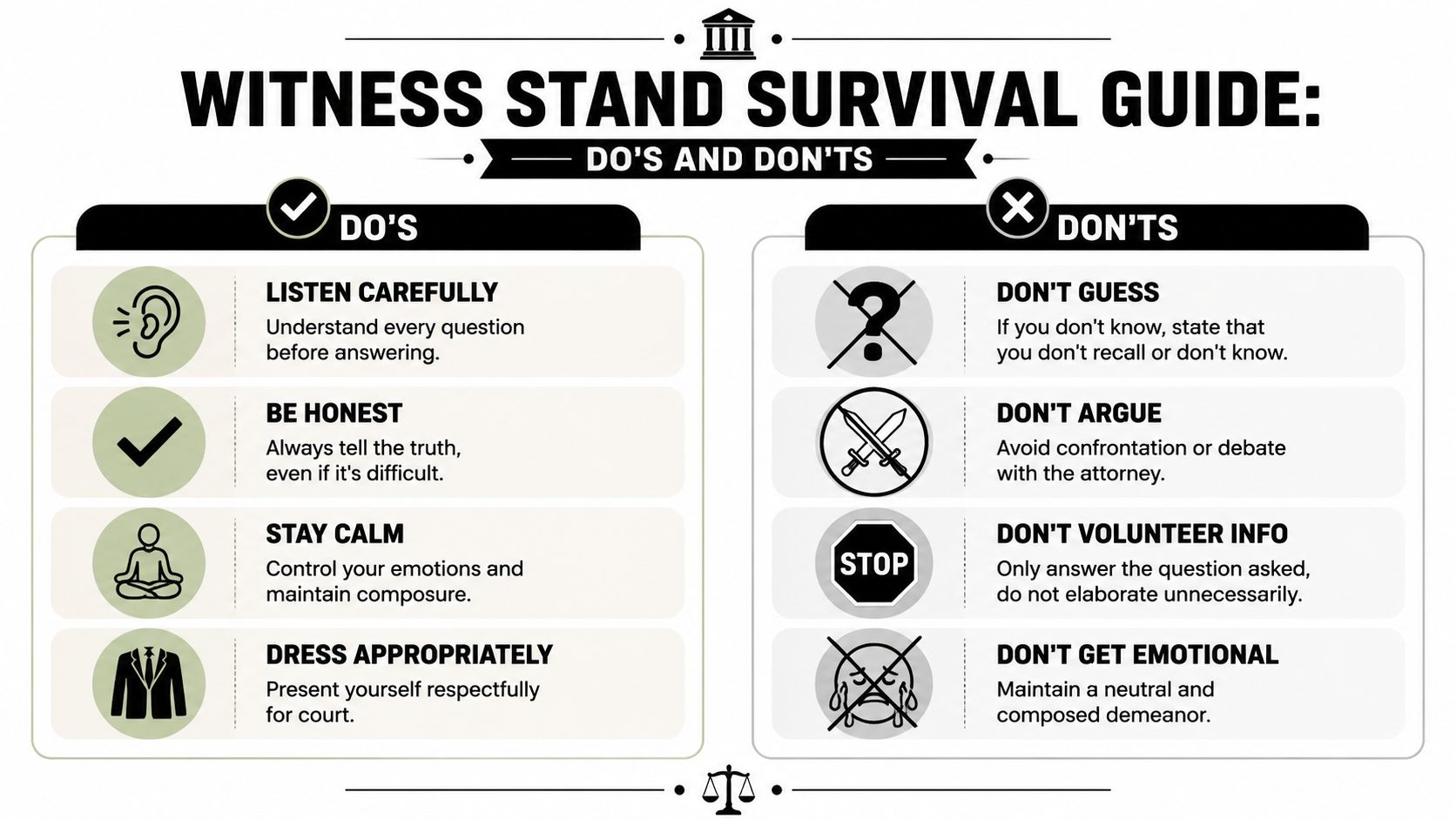
Start with this. The witness stand is not the place to win an argument with the other lawyer. It is the place to protect your credibility.
The rules that keep you steady
| Do | Don't |
|---|---|
| Listen to the full question | Interrupt the lawyer |
| Answer truthfully and briefly | Volunteer extra information |
| Pause if you need a moment | Rush to fill silence |
| Ask for clarification if confused | Guess or speculate |
| Stay respectful | Argue, roll your eyes, or react sarcastically |
What these rules look like in real life
- If you don't understand a question, say that you don't understand it and ask for it to be repeated or rephrased.
- If you don't remember, say you don't remember. Don't patch holes in memory with assumptions.
- If a document is shown to you, read it carefully before answering. A lawyer's description of a document is not the same thing as the document.
- If the question calls for yes or no, answer yes or no if that's truthful. If a short clarification is needed to avoid a misleading answer, your attorney can help decide how to address that.
- If you feel angry, slow your breathing and lower your pace. Fast answers often create avoidable mistakes.
A special note on experts
If your case involves an expert witness, remember that the same courtroom discipline applies when your lawyer cross-examines them. In divorce litigation, effective expert cross often attacks the reliability foundation under Rule 702, including whether the opinion is reliable, helpful, and based on sound methods, and whether the method has features such as testing, peer review, a known error rate, and general acceptance in the field. If those foundations are weak, the judge may give the opinion less weight or exclude it, as reflected in Federal Rule 702 guidance.
That may sound technical, but the practical point is simple. Judges are not required to accept an expert's conclusion just because the witness has impressive credentials.
Key takeaway
Your job on the stand is modest but powerful. Tell the truth. Stay inside the question. Keep your tone even. Let your preparation carry the weight.
What To Do Next You Are Not Alone
Cross-examination is hard because it compresses so much of your life into a few tense minutes. But it is still a process you can prepare for. The more familiar you are with your records, your likely problem areas, and the courtroom rhythm, the less power fear has over you.
That matters in every stage of a Texas divorce. From filing to temporary orders, discovery, mediation, trial, and final decree, the strongest position usually comes from preparation. If children are involved, your testimony may affect conservatorship, possession, and support. If property is disputed, your answers may shape how the court views credibility, tracing, valuation, and fairness. If enforcement or modification issues arise later, the same careful approach to records and testimony still matters.
You do not need to be flawless to be believable. You need to be careful, honest, organized, and ready.
If your case may go to trial, now is the time to prepare with intention rather than waiting for the courtroom to force the issue.
If you're facing divorce, custody litigation, or a contested property dispute in Texas, schedule a free consultation with Law Office of Bryan Fagan, PLLC. You can talk through what to expect during cross-examination in divorce court, how Texas judges evaluate testimony, and what steps may help you protect your family, your finances, and your peace of mind.