Skip to content
Your phone buzzes, your ex sends an angry text, and suddenly you're staring at a court order wondering whether one mistake is about to make your case much worse.
When you're in the middle of a Texas divorce or custody case, temporary rules can feel like they control everything. Where you live. What you spend. When you see your children. Who pays which bill. Even how you communicate. When life gets messy, people slip. Sometimes the issue is frustration. Sometimes it's confusion. Sometimes it's a real emergency and you make a choice first, then worry about the court later.
If you're asking what happens if you violate temporary orders in Texas, the answer depends on one critical point. What kind of order was violated? The legal consequences are not all the same.
That distinction holds more significance than is often understood. A short-term emergency restraint is different from temporary orders in a pending family case. Both are different from a protective order tied to family violence. Courts don't treat them interchangeably, and you shouldn't either.
When a Court Order Feels Impossible to Follow
A common situation looks like this. You're trying to get through a divorce, money is tight, your work schedule changes, and the temporary order says you must exchange the children at a certain place and time every week. Then your child gets sick, your ex won't cooperate, and one missed exchange turns into a threat: “I'm filing enforcement.”
That threat gets your attention because it should.
Texas courts use temporary orders to stabilize a case while it is pending. These orders are legally enforceable, and Texas sources note that violating them can lead to contempt proceedings, fines, attorney's fees, and even jail in serious cases, while a TRO generally lasts 14 calendar days under Rule 680 and temporary orders can stay in place until they are changed or final orders are entered, as discussed in this Texas overview of temporary restraining orders and temporary orders in Texas family cases.
The hard part is that many violations don't begin with bad intent. They begin with stress. One parent thinks, “I was only a few hours late.” Another thinks, “I needed to move money to cover bills.” A spouse assumes, “The judge will understand why I ignored that one paragraph.” Sometimes the judge does understand the context. But that doesn't mean the judge excuses the violation.
Practical rule: If an order feels unfair, confusing, or unworkable, your safest move is to ask the court to change it, not to break it.
That's true for parents, business owners, and spouses with complicated finances. In high-conflict cases, even a small violation can become a credibility problem. Judges watch who follows orders. They also watch who treats the process like it's optional.
If you're worried that you already crossed a line, don't panic. But don't minimize it either. The right response starts with identifying the exact order at issue and the enforcement path attached to it.
Is It a TRO, Temporary Orders, or a Protective Order?
Before you can judge the risk, you need to name the order correctly. Many people use these terms as if they mean the same thing. They do not.
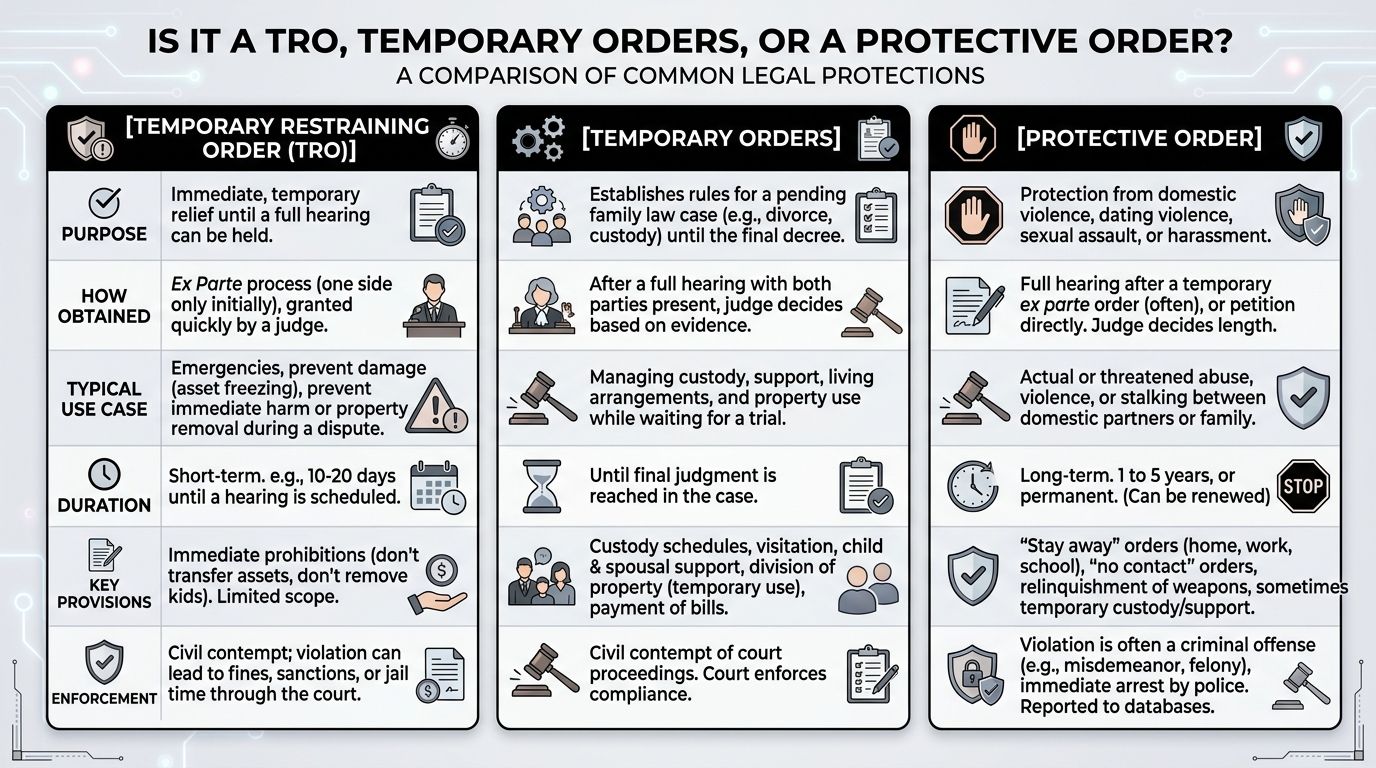
A TRO is the emergency brake
A temporary restraining order, often called a TRO, is an emergency order. Texas Law Help explains that a TRO generally lasts 14 calendar days and cannot set custody or child support. Temporary orders can set custody, visitation, and support, and they can remain in place for months or until the case is finalized. You can review that distinction in this guide on temporary orders and TROs in Texas.
That single difference changes a lot. A TRO is designed to stop immediate harmful conduct. It is often narrow and urgent. It is not the long-term operating manual for your divorce.
If your case involves a TRO and you are unsure what it restricts, this explanation of a temporary restraining order in a Texas divorce can help you spot the issues that often trigger confusion.
Temporary orders are the rules for everyday life during the case
Temporary orders usually come after the court has had a chance to hear more detail. These orders can govern daily family life while the case is pending. They often address:
- Parenting schedules that say when each parent has possession
- Financial duties such as child support, bill payment, or use of accounts
- Property use including who stays in the home or uses certain vehicles
- Behavior restrictions tied to preserving property or reducing conflict
These are the orders typically referenced when someone asks what happens if you violate temporary orders in Texas. They are not short-lived emergency restraints. They are active court commands that shape the case until the judge changes them or signs final orders.
A short explanation from a family law attorney can help if you want a visual overview.
Protective orders are in a different category
A protective order usually appears in cases involving family violence or threats of family violence. These orders carry a much heavier enforcement structure than ordinary temporary orders in a divorce.
Think of it this way:
| Order type | Main purpose | Usual duration | Can cover custody or support |
|---|---|---|---|
| TRO | Immediate emergency restraint | Generally 14 days | No |
| Temporary orders | Day-to-day rules during the case | Until modified or final orders | Yes |
| Protective order | Safety in family violence situations | Depends on the court's order | May affect access and contact restrictions |
The label on the order is not a technical detail. It tells you which court process you're dealing with and how serious the enforcement risks may be.
Civil Enforcement Contempt, Fines, and Attorney's Fees
Most violations of temporary orders in a pending divorce or custody case land in civil enforcement first. That means the other side asks the family court judge to enforce the order.

What civil enforcement usually looks like
The usual tool is a motion for enforcement. In that filing, the accusing party identifies the exact order, the exact language that was violated, and the specific dates or acts that allegedly broke the rule.
If you want to understand the mechanics, this guide on filing a contempt of court motion in Texas family court gives a useful starting point.
A judge then decides whether the order was clear enough to enforce and whether the violation happened. That sounds simple, but in real cases, the fight often turns on details. Was the order specific? Was compliance possible? Did the text message, bank record, school pickup log, or witness testimony support one side more than the other?
The penalties are real even in civil court
Under Texas family-law protective-order enforcement language, contempt can bring up to $500 in fines, up to 6 months in jail, or both, and if the prohibited act is also separately punishable, the fine can rise to $4,000 and jail can extend to 1 year, as explained by WomensLaw's Texas enforcement overview.
Even when a judge does not impose jail, civil enforcement still hurts. Common outcomes include:
- Contempt findings that put you in direct conflict with the court
- Attorney's fees that shift the cost of enforcement onto you
- Make-up parenting time if you withheld possession or access
- Orders to comply immediately under stricter court supervision
Judges use these remedies for a reason. The court is not only correcting one event. The court is sending a message that its orders must be followed while the case is pending.
A lot of people think, “It's only temporary, so the judge won't care that much.” In practice, judges often care a great deal because temporary orders are what keep the case from collapsing into chaos.
What works and what doesn't
Some responses help. Others make the situation worse fast.
What tends to help
- Quick correction if you can fix the problem immediately
- Clean documentation showing what happened and why
- Prompt legal advice before you answer allegations casually
- A modification request if the order became unworkable
What usually backfires
- Self-help decisions like withholding the children because you feel justified
- Loose excuses that don't match the written order
- Deleting messages or hiding records
- Ignoring the hearing notice and hoping it goes away
If you're a parent, understand this point clearly. Violating temporary parenting orders is not only about punishment. It can shape how the judge views your judgment, reliability, and willingness to support your child's relationship with the other parent.
When a Violation Crosses the Line into Criminal Charges
Some family court violations don't stay in family court. That risk is highest with protective orders and conduct involving threats, assault, stalking, harassment, or repeated prohibited contact.
Why protective-order cases are different
Texas courts treat family-violence-related orders seriously for obvious reasons. A Texas courts report stated that from 2021 to 2023, courts issued an estimated 162,497 protective orders, including several types of protective relief, according to the Texas protective-order report.
That scale matters because it reflects a system that handles these cases regularly and enforces them firmly. Violating a protective order in Texas can be a felony, with punishment ranging from 2 to 10 years in state prison and fines up to $10,000 in certain situations, including some repeat violations within 12 months.
If you're unsure whether the order in your case is a restraining order, temporary order, or protective order, this comparison of a protective order vs. restraining order in Texas is worth reading before you make assumptions.
Criminal exposure changes everything
Once police involvement or criminal charges enter the picture, the stakes expand beyond your divorce or custody file. You may be dealing with:
- Arrest risk after an alleged prohibited contact or encounter
- Bond conditions that create additional restrictions
- A criminal record if the case results in a conviction
- Collateral damage to employment, licensing, and reputation
And in the family case, the consequences can keep building. TexasLawHelp materials note that a parent may be denied access where there is a proven history or pattern of family violence during the 2-year period before filing or while the case is pending. That means the same conduct can affect punishment and custody.
If an order says no contact, stay away. Don't send a “peace offering” text. Don't use a friend as a go-between unless your lawyer tells you it's allowed. Don't test the boundary.
The biggest mistake people make here is treating a protective-order violation like an emotional misunderstanding. Courts and prosecutors may see it as a public-safety issue, not a relationship dispute.
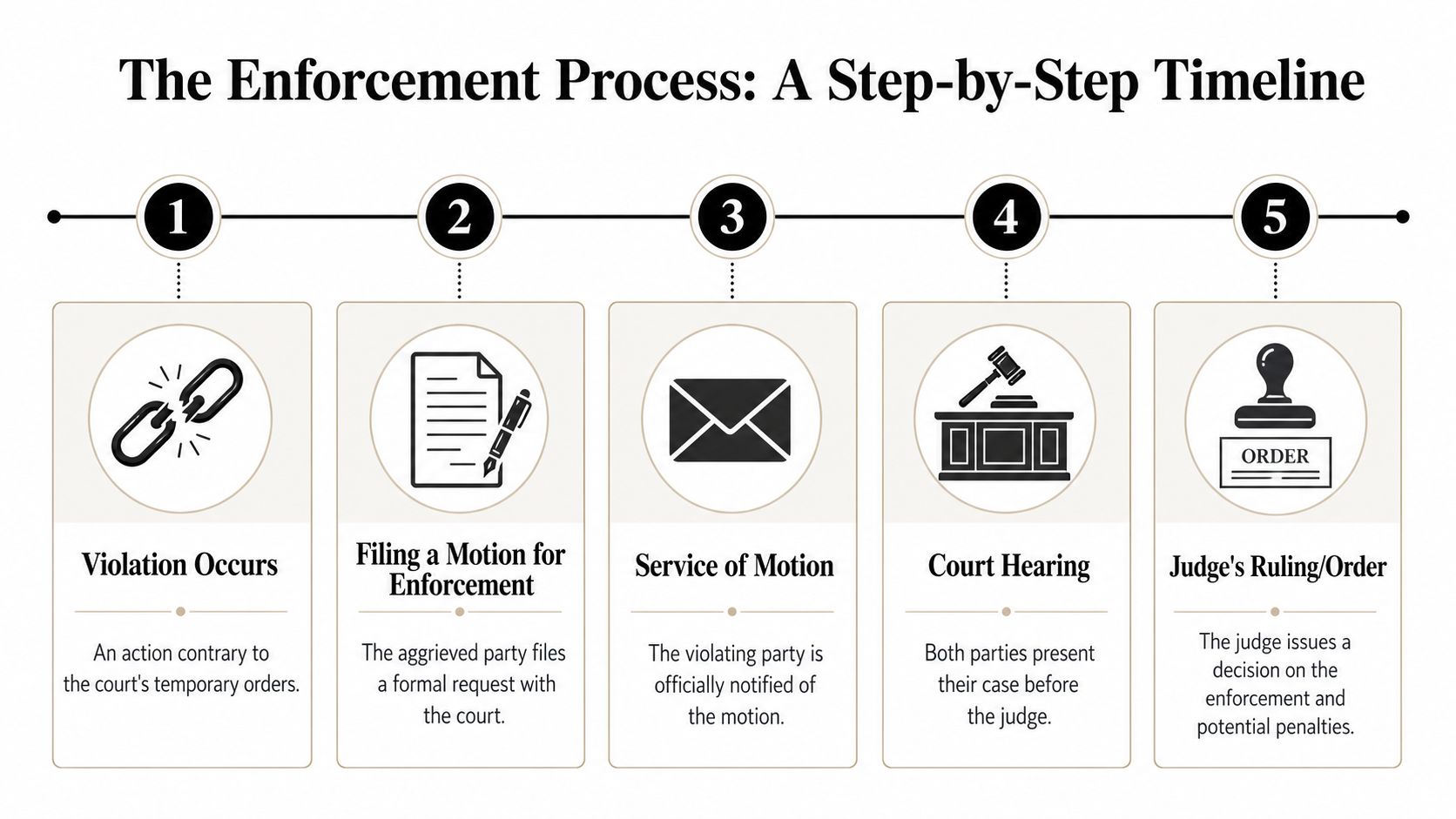
How a Violation Is Brought Before the Judge
The court process feels less mysterious when you break it into steps. An enforcement case is formal. It is not a side argument the judge handles casually in the hallway.
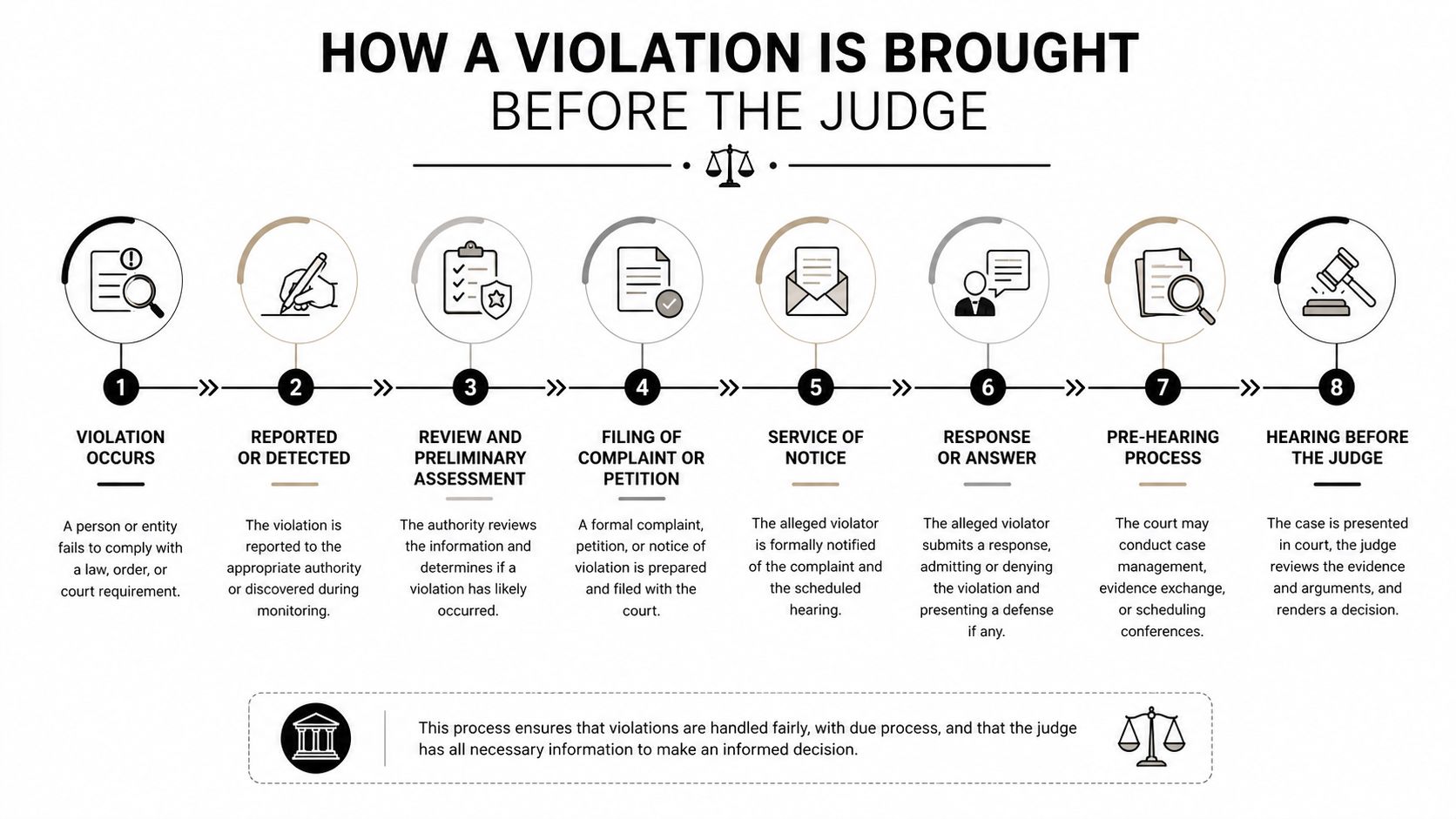
Step one is the paper trail
The person claiming a violation usually starts by gathering proof. In real cases, that often means texts, emails, parenting apps, call logs, bank records, school records, or witness statements.
The strength of the case often depends less on outrage and more on documentation. Judges hear accusations every day. They want specifics.
Step two is filing and service
After the evidence is organized, the complaining party files a motion for enforcement. The motion should identify the order and the alleged violations with enough detail for the other side to respond.
Then the accused party must be served properly. Service matters because contempt can carry serious penalties. If you receive service, treat it as urgent. A missed deadline or missed hearing can make a bad situation much worse.
Step three is preparation for the hearing
Before the hearing, both sides usually prepare exhibits, testimony, and legal arguments. At this stage, strategy matters.
For the person seeking enforcement, the key question is often, “Can I prove a clear violation of a clear order?” For the person defending against the allegation, the questions shift. “Was the language too vague?” “Did the event happen the way they claim?” “Was compliance impossible under the circumstances?” “Do the records support my version?”
Here's the practical sequence individuals should expect:
- Violation is documented with dates, times, and supporting records.
- Motion is filed with the court asking for enforcement.
- Notice is served so the accused party has a chance to respond.
- Hearing is held where both sides present evidence and testimony.
- Judge rules and may issue penalties, make-up orders, or other relief.
What the judge is really evaluating
The judge is not only deciding whether something happened. The judge is also measuring reliability.
A parent who keeps detailed records and follows the order carefully usually presents better than a parent who operates from memory and emotion. A business owner who can show why a financial transfer complied with the order is in a stronger position than someone who says, “I didn't think it mattered.” A spouse with a high-value estate case must be especially careful because asset movement during a pending case can trigger suspicion quickly.
Mediation sometimes helps resolve related disputes in a divorce, but contempt issues tied to clear violations often still require direct court attention. If the order itself is the problem, modification may be more useful than fighting over repeated violations.
What to Do Next If You Are Facing an Allegation
If you've been accused of violating a court order, your next moves matter more than your explanations to your ex. If you're the person seeking enforcement, your job is different. In either role, discipline helps.
If you are accused of violating the order
Start with this. Take the allegation seriously. Don't assume the judge will dismiss it because you meant well.
Do these things first:
- Read the exact order carefully. Not what you remember. Not what your ex says it means. Read the signed language.
- Preserve every record. Save texts, emails, screenshots, receipts, calendar entries, app messages, and location-related proof if it matters.
- Write out a timeline while events are fresh. Include dates, times, who was present, and what happened before and after the alleged violation.
- Talk to a lawyer before contacting the other side if emotions are running high.
If you've been served with a hearing notice, don't miss it. If you're unfamiliar with how courts treat missed hearings, this explanation of what is failure to appear gives useful background on why showing up matters.
Here are defenses or responses that sometimes arise in real family cases:
| Possible issue | Why it matters |
|---|---|
| Ambiguous order language | Courts prefer clear commands before imposing contempt |
| Lack of proof | Allegations still need evidence |
| Impossibility of compliance | Sometimes a person truly could not comply |
| Prompt corrective action | A fast fix can improve how the court views the situation |
None of those are automatic wins. They are fact-sensitive and should be developed carefully.
If you need to enforce the order
Do not answer one violation with another. That almost always complicates the case.
Instead:
- Document each incident separately. One long emotional note is less helpful than a clean list with dates and details.
- Save original evidence. Keep screenshots, but also preserve full message threads and app records if available.
- Match conduct to the order. Point to the exact paragraph or provision violated.
- Stay child-focused in parenting cases. Judges respond better to concrete effects on the child than broad complaints about your ex's attitude.
The strongest enforcement requests usually read like records, not rants.
If money is involved, gather statements and transaction histories. If parenting time is involved, use calendars, school records, exchange logs, and communication history. If the problem is ongoing, ask your lawyer whether enforcement, modification, or both make the most sense.
When modification is smarter than escalation
Sometimes the order was never practical to begin with. Work schedules change. A child's needs shift. A business owner may face income volatility or operational obligations that weren't fully understood when the temporary order was entered.
In those situations, the better move may be to ask the court to modify the temporary orders rather than repeatedly falling out of compliance. Courts are far more receptive to people who seek lawful relief than to people who unilaterally rewrite the order for themselves.
Don't Navigate This Alone Find Your Legal Advocate
Temporary-order problems feel personal because they are personal. They affect your children, your schedule, your home, and your finances. But once a violation issue reaches court, it becomes procedural too. The judge will care about wording, proof, timing, service, credibility, and whether the order involved ordinary temporary rules or a much more serious protective-order framework.
That is why calm, early legal advice matters. Good representation helps you separate what feels unfair from what is legally enforceable. It also helps you decide whether to defend, seek enforcement, request modification, prepare for mediation, or protect yourself from a civil case turning into a criminal one.
This is especially important if your case overlaps with other court risks. For readers trying to understand how courts view noncompliance more broadly, this article on probation violation consequences offers a useful comparison point about why ignoring legal conditions can snowball.
Key takeaway
If you're asking what happens if you violate temporary orders in Texas, the short answer is this:
- A TRO violation may bring immediate civil consequences tied to an emergency order.
- A temporary-order violation often leads to enforcement, contempt, attorney's fees, and possibly jail.
- A protective-order violation can create separate criminal exposure with much more severe penalties.
The right response is almost never to argue by text, improvise your own workaround, or hope the issue fades. Your best move is to get the order reviewed, preserve evidence, and act before the next hearing is set.
If you're facing an allegation that you violated a Texas family court order, or you need help enforcing one, schedule a free consultation with Law Office of Bryan Fagan, PLLC. You can get clear guidance on your options, your risks, and the next step that protects your family and your future.