Skip to content
If your divorce is contested in Texas, the legal minimum is still tied to the 60-day waiting period, but a real contested case usually takes 9 months to 2 years, and some high-conflict or complex cases take 2+ years. That gap catches many people off guard, especially when they expected the trial itself to be the main event instead of one step in a much longer process.
You may be reading this while your home life feels suspended. Bills still have to be paid, your children still need stability, and you want a straight answer about how long this will last. The hard truth is that Texas law creates a minimum timeline, not a realistic one for families who disagree about custody, support, or property. The good news is that once you understand what drives the calendar, the process starts to feel less mysterious and more manageable.
The Reality of a Contested Divorce Timeline in Texas
When people ask how long a contested divorce trial takes in Texas, they often mean something bigger. They want to know when this whole chapter will finally end.
Texas does impose a waiting period before a divorce can be finalized, but that rule doesn't tell you much about a litigated case. In Dallas-focused Texas family law reporting, contested divorces with children are described as taking 9 months to 2 years, and more complex or high-conflict matters can stretch to 2+ years. That practical range is discussed in this overview of Texas divorce timing.
Why the timeline feels so much longer
A contested divorce doesn't move from filing straight to trial. The court usually has to deal with service, temporary rules for the family, document exchange, settlement efforts, and scheduling issues before a judge ever hears final testimony.
That means the trial is often the visible tip of the case, not the whole case.
Practical rule: The more issues you and your spouse disagree on, the less useful the bare statutory minimum becomes.
Some divorces are mainly about one issue. Others involve parenting schedules, child support, a house, retirement accounts, business interests, separate property claims, reimbursement claims, and accusations about spending or concealment. Each added dispute creates another layer of preparation.
What this means for you
A realistic timeline helps you make better decisions. It affects where you'll live, how you budget, how you gather records, and how you prepare your children for change.
If you're trying to understand how long your matter may take from start to finish, this guide on how long it takes to process a divorce in Texas is a useful companion resource.
The point isn't to make you feel stuck. It's to replace false hope with a strategy. Once you know why cases last as long as they do, you can focus on the parts you can control.
Uncontested vs Contested Divorce A Tale of Two Timelines
A client comes in expecting the divorce to be over soon because both sides want out. Then we identify the actual disputes: where the children will live, who stays in the house, how to handle retirement accounts, whether one spouse wasted community funds. At that point, the timeline changes.
Texas law sets a minimum waiting period before a divorce can be finalized. Under Texas Family Code Section 6.702, that minimum is generally 60 days from filing, with limited exceptions. For an uncontested divorce, that waiting period is often the main clock. For a contested divorce, it is only the starting point.
Typical Divorce Timelines in Texas
| Stage | Uncontested Divorce Timeline | Contested Divorce Timeline |
|---|---|---|
| Filing the petition | Starts the case | Starts the case |
| Waiting period | Must still wait for the statutory minimum before finalization | Must still wait, and the case usually continues well beyond that |
| Agreement on issues | Spouses already agree on property, children, and support | Spouses disagree on one or more major issues |
| Discovery | Often limited or unnecessary | Often extensive and time-consuming |
| Temporary orders | Often avoided | Frequently necessary |
| Mediation | Sometimes used to finalize details | Commonly used to try to resolve disputes before trial |
| Court involvement | Usually brief final prove-up hearing | Repeated hearings, scheduling, and possible trial setting |
| Real-world timing | Often finished relatively quickly if paperwork is complete and both sides cooperate | Usually measured in months, and sometimes much longer if disputes remain unresolved |
The difference is not just conflict for conflict's sake. The court needs enough reliable information to make enforceable decisions. If one spouse says an account is separate property and the other says it is community property, records have to be gathered and reviewed. If parents disagree about conservatorship or possession, the court may need temporary rules first so the children have stability while the case is pending.
That is why contested cases take longer. The delay usually comes from specific legal tasks, not courtroom drama.
An uncontested divorce is largely an agreement put into legal form. A contested divorce requires evidence, deadlines, negotiation, and sometimes interim hearings before anyone is ready for a final trial. Mediation may resolve part of the case or all of it. Discovery may expose missing information that changes settlement positions. Temporary orders can calm a bad situation, but setting and preparing for that hearing adds time.
Clients often ask what they can control. Quite a bit. You can turn over financial documents quickly, answer discovery truthfully and on time, avoid emotional spending fights, and stay focused on the issues that matter most. You cannot control the court's docket or your spouse's level of cooperation, but you can avoid being the reason the case slows down.
In Texas divorce cases, the timeline usually follows the amount of information the court needs and the number of decisions the spouses cannot make on their own.
That is the contrast between uncontested and contested divorces. One moves mostly on paperwork and agreement. The other moves on proof, procedure, and the pace of unresolved issues.
The Key Stages That Define Your Divorce Calendar
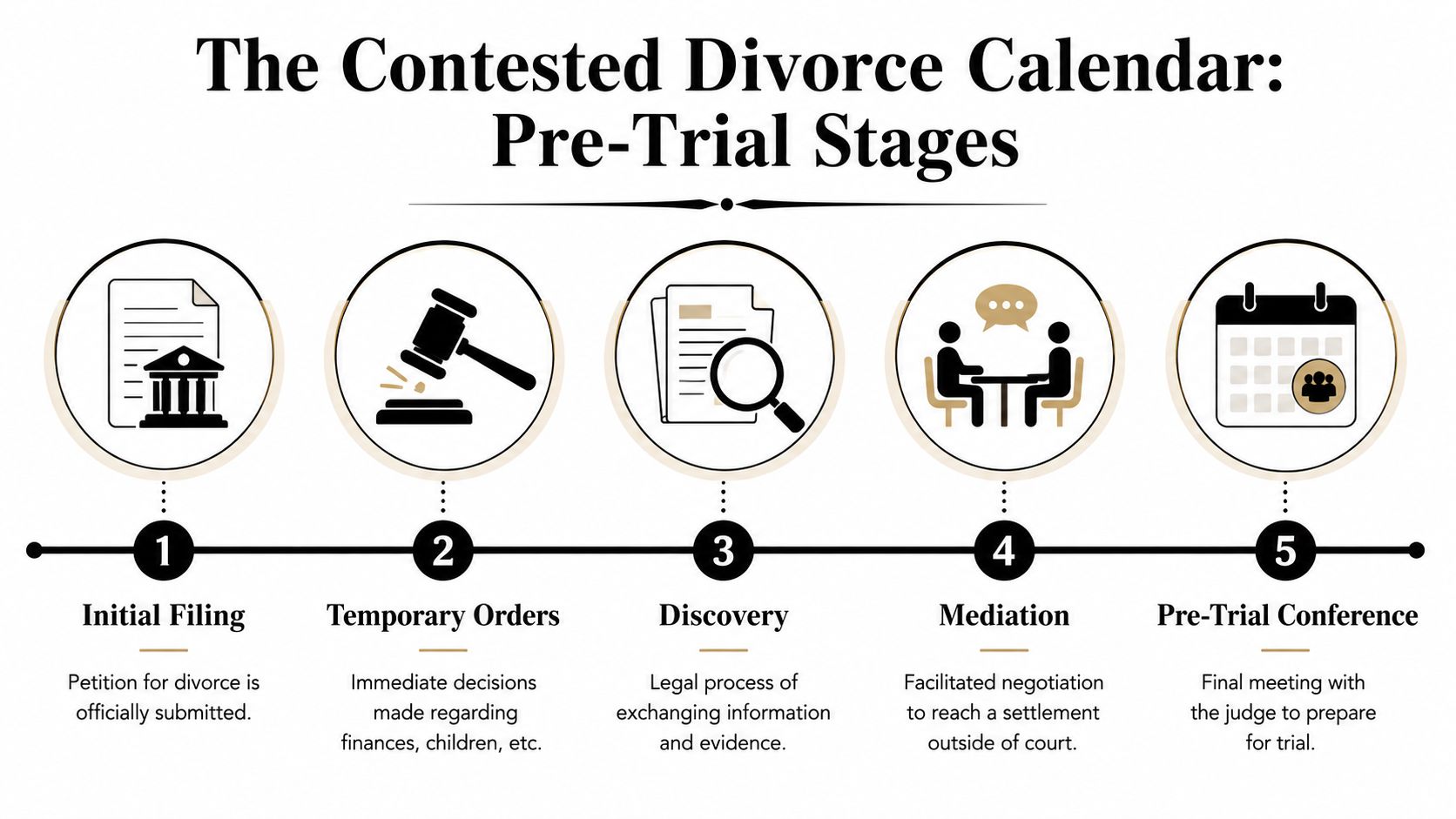
A contested divorce does not sit still after filing. It moves through a series of legal stages, and each one answers a different question the court cannot leave unresolved.
Filing and service
The process starts when one spouse files the Original Petition for Divorce and the other is served, unless service is formally waived. That sounds administrative, but it matters. A case cannot move in an orderly way until the court has both parties properly before it.
This stage often feels slow because little appears to be happening from the client's point of view. In reality, deadlines are starting, lawyers are evaluating immediate risks, and both sides are deciding whether the case is headed toward early agreement or early conflict.
Temporary orders
Temporary orders are often the first point where the court steps in and sets ground rules. If you and your spouse cannot agree on who stays in the home, how bills get paid, how parenting time will work, or whether either party can move money around, a temporary orders hearing may be necessary.
These hearings shape the months that follow. Good temporary orders can stabilize a case and reduce day-to-day conflict. Poorly drafted or heavily contested temporary orders can create new fights, require more evidence, and push the calendar out.
Temporary orders may cover:
- Use of the marital home: Who remains in the residence and under what conditions.
- Parenting schedules: Temporary possession, exchanges, and decision-making for the children.
- Financial responsibilities: Mortgage payments, credit cards, insurance, child support, or spousal support.
- Conduct rules: Limits on harassment, asset transfers, hiding records, or disrupting the children's routine.
If there is a practical point to understand here, it is this: the court is not trying to finish your divorce at this stage. The court is trying to create enough stability so the case can continue without constant emergency hearings.
Discovery
Discovery is usually the longest and most work-intensive stage because it is where the facts get tested. Each side requests documents, written answers, and other evidence needed to value property, verify income, trace accounts, and examine claims about the children or finances.
That may include bank statements, retirement records, business documents, tax returns, appraisals, phone records, and sworn testimony. In cases involving a family business, separate property claims, or suspected hidden income, discovery tends to take longer because the missing information is often the reason settlement was not possible early on. A closer look at discovery in a Texas divorce case helps explain why this stage can expand quickly.
Clients have more control here than they think. Turning over organized records early, answering written discovery on time, and flagging missing documents before deadlines can save weeks of avoidable delay.
Mediation and pre-trial preparation
Most contested divorces do not go straight from discovery to trial. There is usually a serious push to settle first, often through mediation. That is not a formality. Mediation gives both sides a chance to make decisions with more privacy, more flexibility, and less expense than a trial allows.
Some cases settle in full at mediation. Others resolve property issues but leave parenting disputes for the judge. Even partial agreements matter because they shorten trial time and reduce what still has to be proved.
If the case does not settle, the final stretch is pre-trial preparation. Lawyers organize exhibits, prepare witness testimony, update property inventories, identify disputed issues, and make sure the case is ready to be heard. By the time a contested divorce reaches trial, the wait usually reflects the work required to get reliable facts in front of the court, not simple delay for its own sake.
Major Factors That Can Lengthen a Contested Divorce
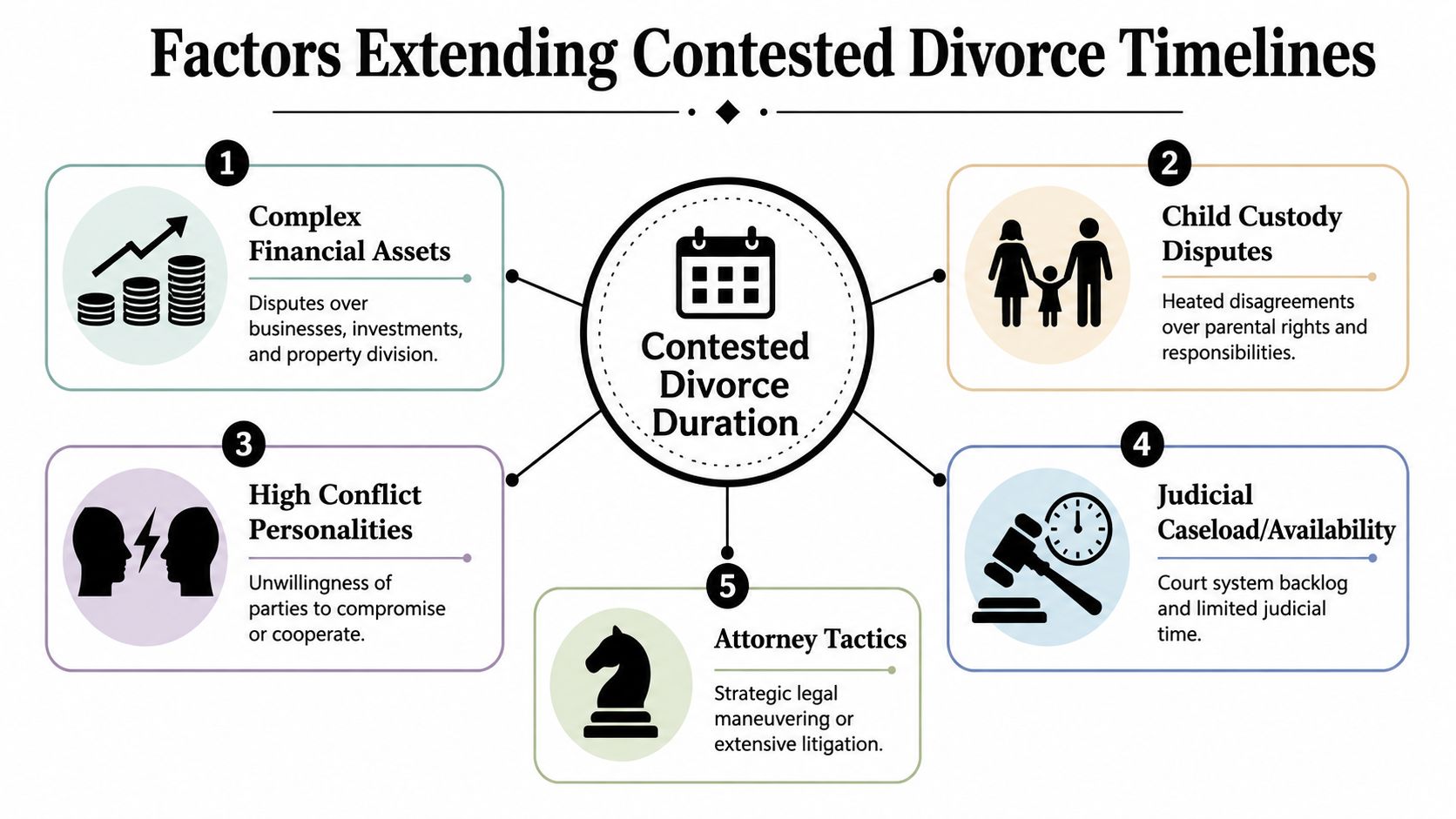
Two spouses can file in the same month and end up finishing on very different schedules. The difference usually comes from what has to be proved, what information is missing, and how much court involvement the case needs before a judge can make final decisions.
Child-related disputes
Cases involving children often slow down for a simple reason. Judges need enough facts to enter orders that will work after the case is over, not just calm things down for the next few weeks.
Disputes about conservatorship, possession, school choice, counseling, relocation, or decision-making usually require more than each parent's preferred schedule. The court may need school records, medical information, testimony from parents and other witnesses, and sometimes temporary orders that have to be tested in real life before a final ruling makes sense. If a parent raises concerns about substance abuse, family violence, mental health, or chronic interference with parenting time, the timeline can stretch further because those allegations usually require evidence, responses, and additional hearings.
Complex property questions
Property issues can lengthen a divorce just as much as custody disputes. A closely held business, professional practice, multiple real estate holdings, stock options, retirement accounts, reimbursements, or separate-property claims all take time to sort out correctly.
The delay is not usually caused by paperwork alone. The primary issue is verification. If one spouse says an account is separate property and the other says it was commingled, that claim has to be traced. If a business is part of the estate, someone may need financial records, profit and loss statements, tax returns, and valuation work before settlement talks become productive. Cases involving suspected hidden income, unusual withdrawals, or wasted assets tend to move slower because each side needs documents first and arguments second.
That is where formal information exchange matters. If you want a clearer sense of why requests for documents, written questions, and depositions can expand the calendar, review this explanation of discovery in a Texas divorce case.
High-conflict behavior
Some delays are built into the legal issues. Others come from how the parties handle the case.
A spouse who ignores deadlines, withholds records, files repeated emergency motions, cancels mediation, or takes extreme settlement positions can add months to a case. Courts can address that conduct, but even a justified court response takes time. I often tell clients that conflict changes the pace of a divorce because every avoidable dispute creates another task for the lawyers and another decision point for the judge.
A calmer approach usually does not mean giving in. It means choosing the fights that matter, answering requests on time, and keeping the record clean and organized.
A short video can also help if you're trying to understand how conflict affects the broader case path.
Court scheduling and docket congestion
Some delays have nothing to do with either spouse. Court calendars matter, especially in busy counties where judges are balancing large family-law dockets with hearings that cannot be postponed.
The Texas State Law Library explains that a divorce must be finalized in court after the waiting period runs, except in certain family-violence-related situations, and hearing availability affects when that can happen, as explained by the Texas State Law Library's finalizing-divorce guidance.
Sometimes your case is ready before the court has room for it. That isn't satisfying, but it's real.
That is frustrating, but it helps to understand the trade-off. Even a well-prepared case can wait for a trial setting, while a poorly prepared case can lose its setting and wait even longer. Clients usually have more control over the second problem than they realize.
What to Expect When Your Case Goes to Trial
By the time your case reaches trial, you've likely spent months dealing with paperwork, negotiations, and court settings. The courtroom itself is usually more structured and less chaotic than people fear.

What the day usually looks like
A typical divorce trial starts with the judge calling the case. Each lawyer may give an opening statement that frames the dispute. After that, the parties present evidence through testimony, documents, and sometimes third-party witnesses.
Your lawyer asks questions designed to build your position. The other side's lawyer cross-examines. The judge may ask questions too. At the end, each side makes a closing argument about what orders the court should sign.
If you're trying to reduce anxiety before appearing in court, this guide on what to expect in divorce court can help you picture the process more clearly.
What clients often misunderstand
Many people assume trial is the longest part of the case. It usually isn't. The trial is often the moment when all the earlier work is finally presented in one place.
Another common misunderstanding is that the judge will always rule immediately. Sometimes that happens. Sometimes the judge takes the matter under advisement and issues a decision later. Then the lawyers still have to prepare and enter final orders that match the ruling.
Trial isn't a dramatic surprise reveal. It's an organized presentation of the evidence your side spent months building.
That perspective matters. When you know what trial is for, you can prepare with less fear and more focus.
Strategic Steps to Help Minimize Delays
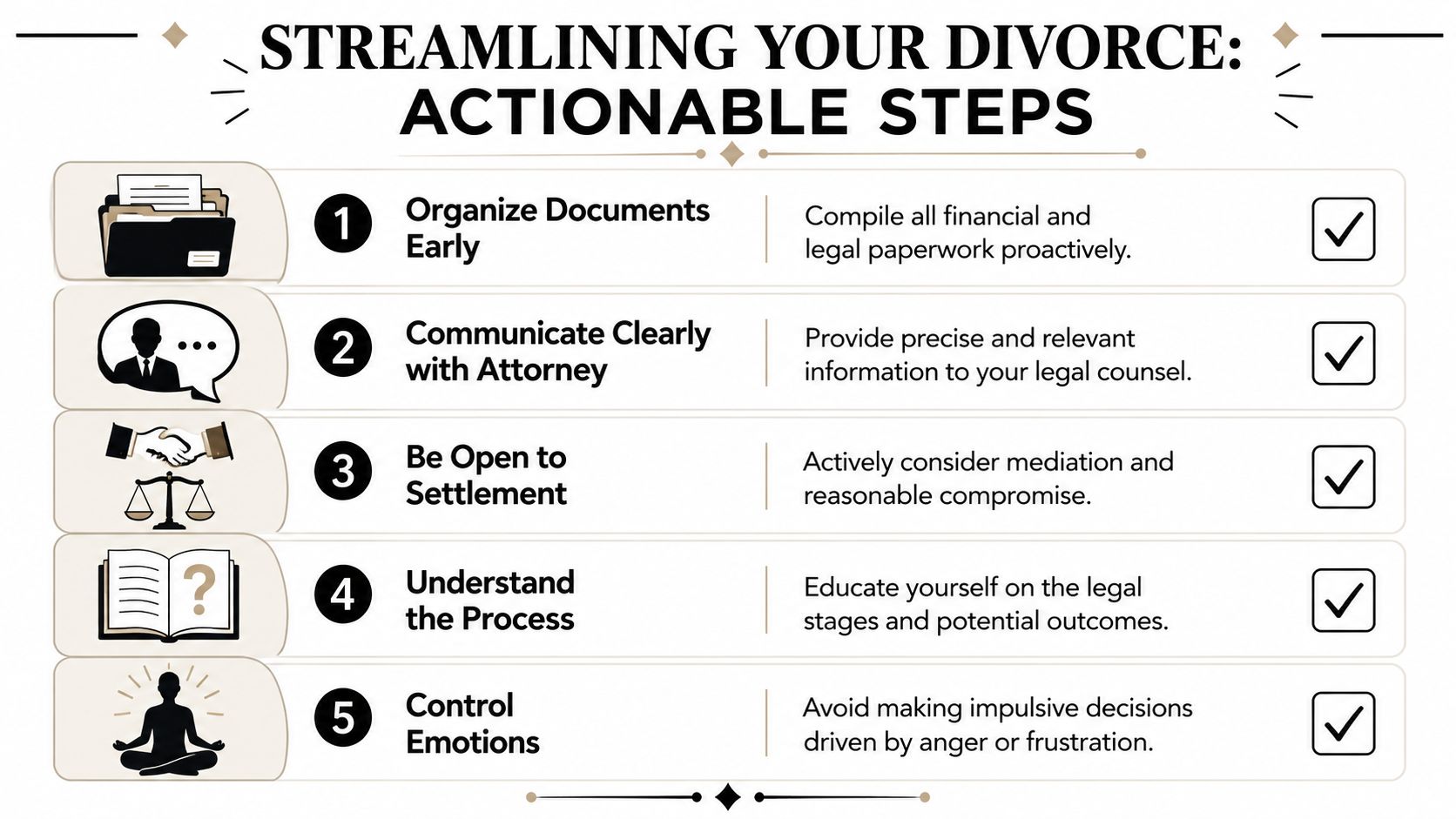
Clients often ask me the same question after a difficult hearing or a stalled round of negotiations: "What can I do right now that shortens this case?" The honest answer is that no one can force a crowded Texas court to move faster, and no one can make the other side cooperate. You can, however, keep your own case from slowing down for preventable reasons.
The longest delays usually come from a few predictable pressure points. Discovery drags when records are incomplete. Temporary orders fights expand when neither side has a clear proposal. Mediation fails when a party walks in angry, underprepared, or unrealistic about likely trial outcomes. Those are the stages where preparation saves time.
Start with the documents. If your lawyer has to chase down tax returns, bank statements, retirement records, business information, loan balances, and property documents piece by piece, the case slows down early and stays slow. A well-organized client gives counsel something concrete to work with. That affects discovery responses, settlement proposals, mediation preparation, and trial readiness.
Speed matters in communication too. If your attorney asks for information on Monday and gets it three weeks later, deadlines do not pause just because life is busy. Courts still expect responses. The other side still files motions. Fast, complete answers are one of the few parts of this process fully within your control.
It also helps to decide what is truly worth fighting about.
Some disputes feel important because the divorce is painful. That is understandable. But judges do not reward parties for spending months and thousands of dollars arguing over issues with little legal or financial value. Focus on the questions that shape your life after the divorce: parenting terms, support, the house, major accounts, debt allocation, and any business or separate property claims. Narrower disputes are easier to negotiate, mediate, and present to the court.
Mediation deserves serious work before the session starts. Review the documents. Understand your realistic range of outcomes. Know where you can compromise and where you cannot. A productive mediation does not require trust or friendship. It requires preparation and a practical goal. If online conflict is making settlement harder, ContentRemoval.com's divorce reputation advice offers useful guidance on handling public and digital fallout during a contentious split.
A few habits regularly make cases take longer:
- Hiding or withholding information: Missing records lead to more requests, more suspicion, and often more court involvement.
- Treating every disagreement like a trial issue: Overfighting minor points can delay resolution of the issues that matter.
- Using children to gain an advantage: That approach tends to create emergency filings, custody disputes, and credibility problems.
- Posting, texting, or spending impulsively: Those choices often create new evidence, new arguments, and new delays.
The right legal support also affects timing in concrete ways. An experienced Texas family law attorney keeps deadlines clear, presses for records, prepares for hearings, and tells you which fights are worth the time and expense. The Law Office of Bryan Fagan, PLLC handles contested family law matters involving property, parenting issues, mediation, and trial preparation. Those are the points in a case where delay usually starts or gets corrected.
Gaining Clarity and Control Over Your Future
A contested divorce in Texas is rarely fast, but it isn't random. The timeline usually reflects identifiable hurdles such as temporary orders, discovery, settlement efforts, and the court's own schedule. Once you see those moving parts clearly, the process becomes easier to manage emotionally and practically.
If your divorce is especially tense, remember that the case doesn't just affect your finances and parenting plan. It can also affect your privacy and digital footprint. This practical guide on ContentRemoval.com's divorce reputation advice offers useful ideas for handling online reputation issues during a contentious split.
You don't need to solve everything today. You do need a plan. The earlier you get clear advice about your priorities, documents, deadlines, and realistic options, the more control you'll have over the road ahead.
If you're facing a contested divorce and need clear answers about timing, custody, property division, mediation, or trial strategy, schedule a free consultation with Law Office of Bryan Fagan, PLLC. You'll get a chance to discuss your specific situation, understand what may affect your timeline, and start building a practical plan to protect your family and your future.