Skip to content
No. Texas is a community property state, but divorce courts use a just and right standard, so property is often divided close to 50/50 without being legally required to be equal.
If you're lying awake wondering whether you'll lose half of everything you built, that fear is understandable. Divorce doesn't just end a relationship. It forces you to sort out your home, accounts, debts, retirement, business interests, and the future you thought you were building. The good news is that Texas law gives judges room to be fair, not just mechanical.
The Short Answer Is No But It Is Complicated
When people ask, Is Texas a 50/50 divorce state?, the most honest answer is no, but many cases still end up near that range. Texas is a community property state, which means the law generally treats property and debt acquired during the marriage as belonging to both spouses. But that doesn't mean a judge must split everything straight down the middle.
Under Section 7.001 of the Texas Family Code, a court must divide community property in a manner that is just and right, not automatically equal. That gives the judge discretion to look at the actual facts of your marriage and your financial situation. Many outcomes are close to equal, but equality is a common result, not a legal command, as explained in this discussion of common misconceptions about Texas divorce and in this overview of Texas community property and divorce.
What that means for you
A court can look beyond names on titles or accounts. If a house, vehicle, retirement contribution, or debt was acquired during the marriage, the starting point is usually that it belongs to the community estate.
That still leaves a major question. What would be fair in your situation? A judge may consider children, earning power, health, fault in the breakup, and future financial need. Those facts can push a case closer to equal, or justify something different.
Practical rule: Don't assume "community property" means "my spouse gets half of every single asset." Courts divide the overall community estate, not every item one by one in a perfectly equal way.
Why the distinction matters
Many people make expensive mistakes. They either panic and give up too much in settlement talks, or they dig in around a strict 50/50 expectation that Texas law doesn't require.
If you understand the rules early, you can make smarter decisions about negotiation, documentation, and strategy. That matters whether you're protecting a paycheck, a family home, a retirement account, or a closely held business.
Understanding Community Property vs Separate Property
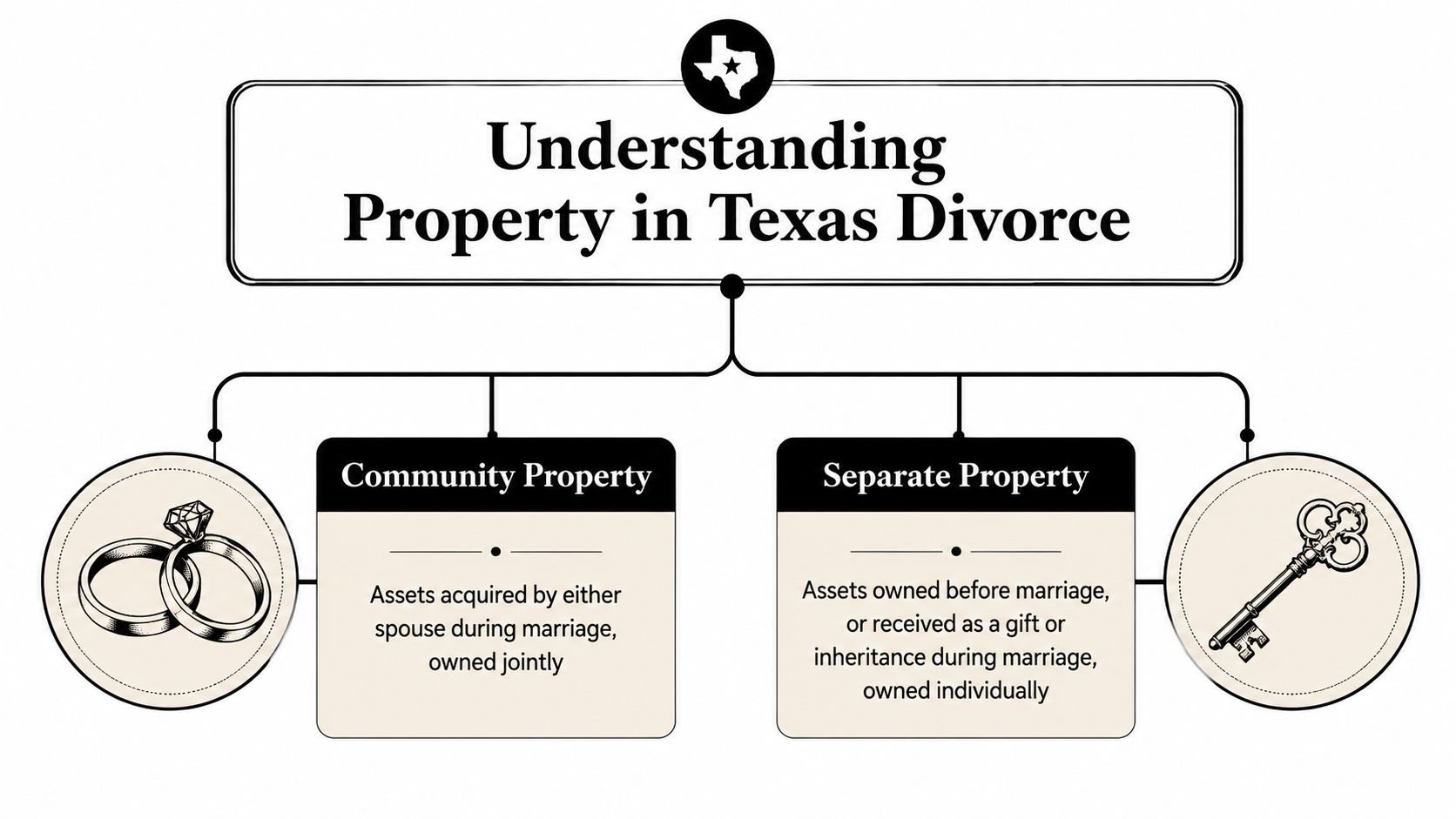
Before you can talk about percentages, you have to know what's even on the table. In Texas divorce law, property usually falls into one of two buckets: community property or separate property.
Think of it this way. You each walked into the marriage with your own wallet. During the marriage, you also built a shared account together. The court can divide the shared account. It doesn't divide what legally remains yours alone.
What usually counts as separate property
Separate property often includes:
- Property you owned before marriage
- Gifts made specifically to you
- Inheritances left to you
If you received an inherited house or cash during the marriage, that doesn't automatically become community property just because you were married when you received it. But the details matter. If inherited property is sold, improved, mixed into joint accounts, or used in ways that blur the paper trail, proving its separate character can become harder. If you're dealing with inherited real estate, practical guidance on how to maximize profit from inherited property may help you think through timing, condition, and sale strategy.
What usually counts as community property
Texas law generally presumes that property owned by either spouse at divorce is community property unless proven otherwise. That means many assets acquired during the marriage start in the community bucket, even if only one spouse's name is on the deed, title, or account.
Common examples include:
| Property type | Common starting point in divorce |
|---|---|
| Earnings during marriage | Usually community |
| Home purchased during marriage | Usually community |
| Vehicles bought during marriage | Usually community |
| Retirement contributions made during marriage | Usually community |
| Debts incurred during marriage | Often treated as community obligations |
For a fuller discussion, see separate property vs community property and How Property Is Divided in a Texas Divorce, which explains the just-and-right division of community property in depth.
The label on the asset matters less than the history behind it.
Why records matter so much
In real cases, the fight often isn't over the law. It's over the proof. If you claim something is separate property, you need documents that clearly trace where it came from and why it belongs outside the community estate.
That becomes especially important for business owners, professionals with deferred compensation, and people with high-value estates. A mixed account, an undocumented transfer, or years of poor bookkeeping can turn a strong separate property claim into a hard courtroom argument.
What Just and Right Division Really Means
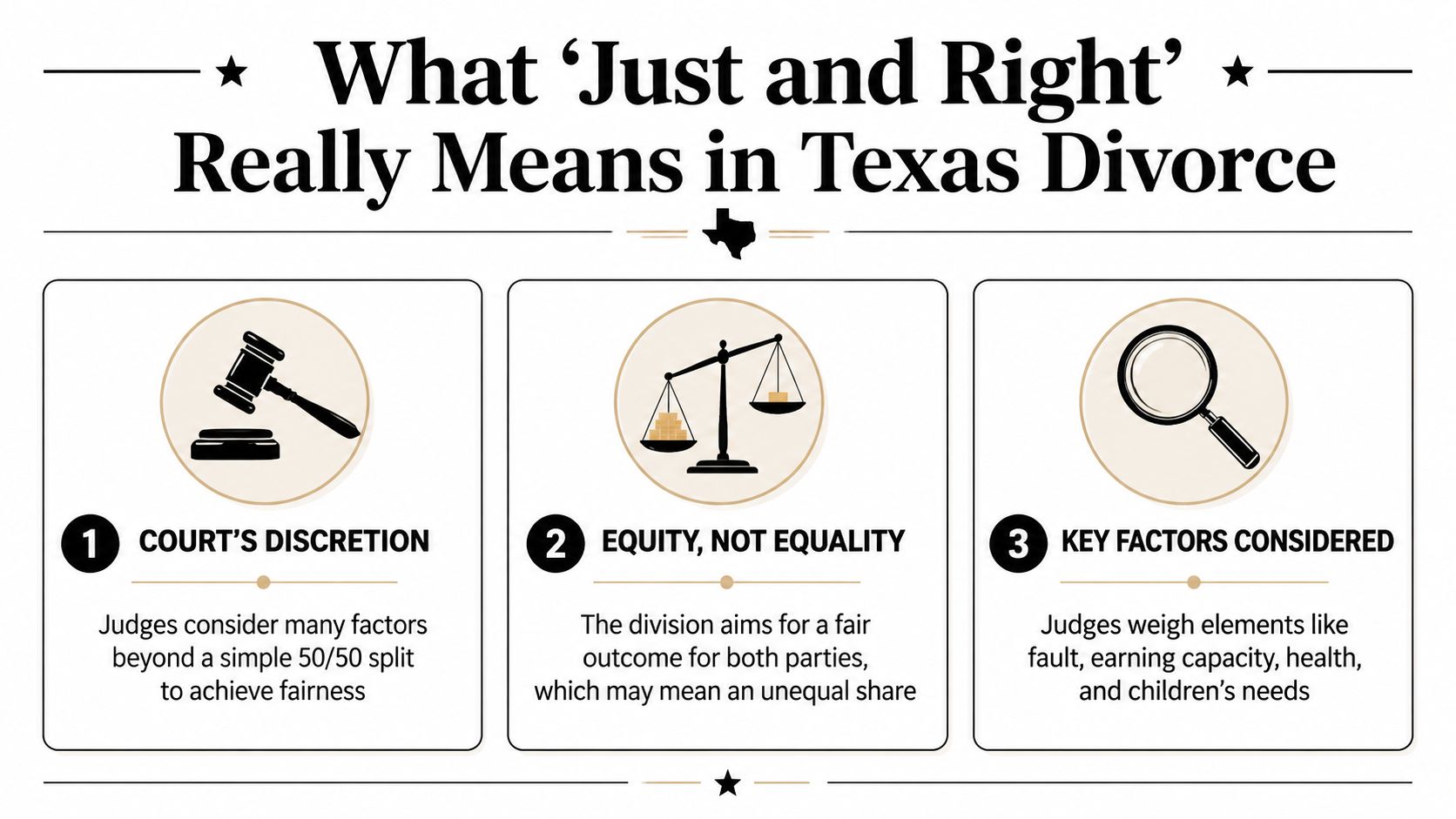
The phrase just and right sounds vague because it is broad by design. Texas courts use it to reach a fair result based on the facts in front of them, not a fixed mathematical formula.
If you and your spouse can't reach an agreement, the judge decides how to divide community property and debt in a way the court considers just and right. That usually means 50/50, but not always, and the court may consider age, health, future needs, and fault in the divorce when making that call, as described by Texas Law Help's explanation of property and debt division in divorce.
Fair doesn't always mean equal
A fair division asks practical questions.
- Can one spouse earn far more after divorce?
- Does one spouse have major health concerns or future expenses?
- Will one parent be carrying most child-related responsibilities?
- Did one spouse's conduct hurt the marriage or the finances?
Those questions matter because the court isn't only sorting out the past. It's also looking at how each person will function after the divorce is final.
What judges often look at
A judge may weigh factors such as:
- Earning capacity if one spouse can realistically rebuild faster than the other
- Health and age when future financial security is uncertain
- Children's needs if one parent will bear more of the daily costs and responsibilities
- Future need when one spouse will leave the marriage at a financial disadvantage
- Fault when misconduct affected the marriage or the estate
For a more detailed discussion of how courts evaluate these issues, see property division in Texas divorce.
A judge isn't grading the marriage. The judge is deciding what allocation of the community estate is fair under the law.
Where parents and business owners need to be careful
If you have children, property division doesn't happen in a vacuum. Conservatorship, parenting time, child support, and the family home can all affect settlement choices. Some parents accept a property arrangement because it helps create housing stability for the children. Others give away too much because they're focused only on custody.
Business owners face a different risk. They often assume the company itself won't be touched if it stays in one spouse's name. That's not a safe assumption. What matters is when the interest was acquired, how it grew, what records exist, and whether the value is partly community. You may also need to think about mediation, support, and later enforcement actions if an order isn't followed.
Why a Judge Might Award a Disproportionate Share
A disproportionate division usually comes down to proof. One spouse says, "I should get more than half." The court asks, "Why, and what documents back that up?"
In Texas, a judge can award more than 50 percent of the community estate if the facts show that an equal split would be unfair. The legal reasons often include fraud on the community, wasting marital assets, or fault that had a meaningful effect on the marriage or the estate. Courts also look at practical realities such as one spouse's ability to earn income after divorce, whether one spouse helped build the other's career or business, and whether the property itself can be divided without causing more harm than good, as explained in this discussion of disproportionate share awards in Texas divorce.
Fault in the breakup
Fault still matters in some cases, even though Texas allows no-fault divorce.
Adultery, cruel treatment, or other serious misconduct will not automatically produce a lopsided award. Judges usually want to see a connection between the misconduct and fairness in the property division. If a spouse carried on a long affair and spent community money on trips, gifts, rent, or hotel rooms, that is different from a bare accusation with no financial proof behind it.
Waste or fraud involving community assets
This issue shows up often in real cases. One spouse drains a joint account before separation. A bonus disappears. Credit cards suddenly carry charges neither spouse can explain. Money gets "loaned" to a relative and never comes back.
Those facts can support a claim for waste or fraud on the community. In plain terms, the court may decide that one spouse took or spent more than his or her fair share before the divorce was finished. A disproportionate award can be the court's way of balancing that out.
Judges do not award a larger share because someone is more upset. They do it when records, transfers, statements, and testimony show a real economic loss.
Income and opportunity gaps
Some unequal divisions have nothing to do with bad conduct. They come from the economic facts of the marriage.
A common example is a long marriage where one spouse stepped out of the workforce to raise children or support the other spouse's career. If that spouse is leaving the marriage with weaker earning power, fewer retirement benefits, or limited immediate job prospects, a 55/45 division may be easier to justify than a straight 50/50 split. The same issue comes up when one spouse will keep an income-producing business and the other will receive assets that do not generate cash flow.
Judges also look at whether an asset is practical to divide. A small business, medical practice, or closely held company may need to stay with the spouse who runs it. If so, the court has to offset that value somewhere else, and the overall division can end up uneven on paper even if the court believes it is fair in real life.
After you've seen how these issues show up in real disputes, this short video can help put the court's reasoning in context.
Why you may hear numbers like 55/45 or 60/40
In practice, many disproportionate awards are modest. A judge may move the division enough to address a specific problem without swinging far from equal. That is why clients often hear examples like 55/45 instead of something much more dramatic.
A 60/40 result usually needs stronger facts. Clear evidence of hidden transfers, major depletion of community funds, or a serious financial disadvantage after divorce gives the court more reason to shift the percentages. The larger the requested deviation, the more important the paper trail becomes.
That is the practical point. If you believe a 50/50 split would be unfair, the argument has to be tied to evidence, dollars, and a concrete explanation for why the division should move from equal to 55/45 or 60/40.
The Property Division Process from Start to Finish
A Texas property case usually turns on paperwork before it turns on courtroom arguments. Spouses often assume the main fight starts at trial. In practice, the result is usually shaped much earlier, when the records are gathered, the property is classified, and the weak spots in each side's story become clear.
Step one through step three
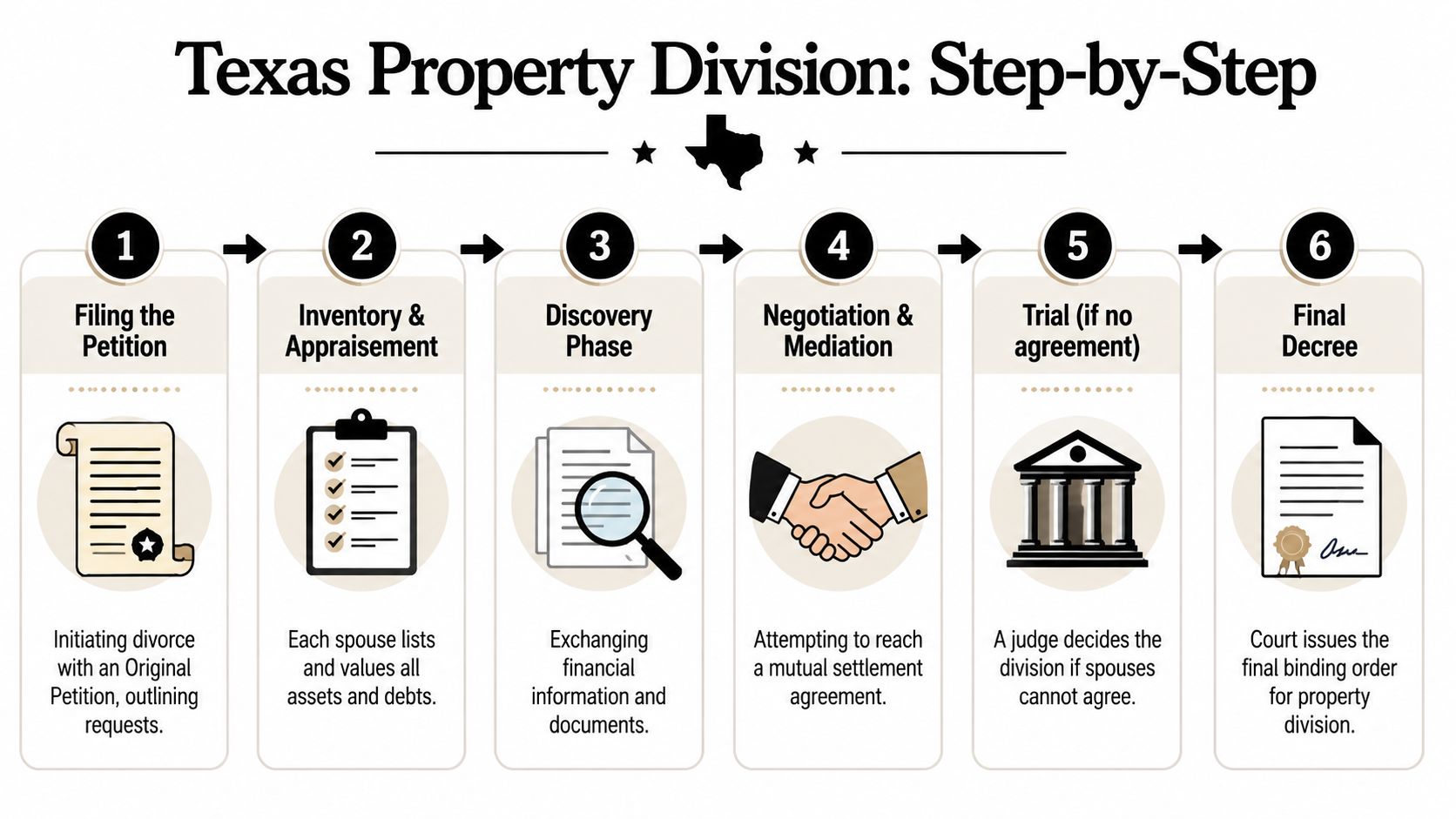
File the divorce case
One spouse files the Original Petition for Divorce. That starts the case and gives the court authority to issue temporary orders about money, property use, or who stays in the home while the divorce is pending.Identify what exists
Both sides begin listing what they own and what they owe. That includes bank accounts, retirement plans, real estate, vehicles, credit cards, loans, business interests, and any unusual assets such as stock options or deferred compensation. If something is missing from the first list, it can become a much bigger problem later.Prepare the inventory
Many courts require a sworn inventory and appraisement. This is not just a formality. It forces each spouse to state, under oath, what property exists, whether it is claimed as community or separate, and what value is being assigned to it. If the case later turns into a dispute over a 55/45 or 60/40 division, this document is often where the fight starts to take shape.
Step four and step five
Next comes discovery. Lawyers request statements, deeds, tax returns, payroll records, loan documents, retirement records, and business information. If one spouse suspects hidden accounts, cash withdrawals, transferred funds, or unusually low business income, discovery is where those issues are tested.
Then the case usually shifts to negotiation or mediation. That is where real-world trade-offs matter. One spouse may want to keep the house but give up retirement funds. Another may want more liquid cash now instead of a larger share of an asset that cannot be sold quickly. A deal that looks equal on paper can feel very different once monthly bills, taxes, and refinancing deadlines are taken into account.
Client advice: Organized records usually give you a stronger position in settlement talks because they narrow the room for guesswork, delay, and denial.
If settlement fails
If settlement does not happen, the judge decides the property division at trial. The court reviews the evidence, hears testimony, and signs a Final Decree of Divorce that says who gets each asset and debt.
The decree needs detail. It should address transfer deadlines, account closings, refinance requirements, sale terms for real estate, retirement division language, and what happens if someone does not follow through. A vague decree causes expensive problems after the divorce is final.
Tax issues also need attention here, especially if one spouse handled the returns or there are concerns about old joint liabilities. If that is part of your case, Omni Tax Help for spouse relief can help you understand one piece of that risk.
Where related issues connect
Property division rarely stands alone. It often overlaps with:
- Temporary orders about who uses the home, vehicles, or bank accounts during the case
- Custody arrangements that affect whether keeping the house is realistic
- Child support and spousal maintenance that affect post-divorce cash flow
- Mediation strategy when parenting and property terms are being negotiated together
- Enforcement if a spouse refuses to sign documents, transfer title, or pay an assigned debt
The practical point is simple. A fair result is built step by step. Good records, clear property tracing, realistic valuations, and a decree with specific instructions do more to protect you than broad arguments about what feels fair.
What to Do Next to Protect Your Assets and Your Future
You don't need to solve everything today, but you do need to get organized. The choices you make at the start of a divorce can shape the result months later.
Start with these practical steps
- Gather records early such as bank statements, retirement statements, deeds, mortgage information, tax returns, business records, and credit card statements.
- Make a property list that includes what you believe is community property, what you believe is separate property, and any debt tied to either category.
- Preserve digital access to statements, downloads, and account histories before passwords change or records disappear.
- Avoid major money moves like draining accounts, transferring titles, hiding cash, or making revenge purchases.
- Think about tax exposure before agreeing to any division involving retirement funds, real estate sales, or old joint liabilities. If you're worried about tax debt connected to your former spouse, this guide to Omni Tax Help for spouse relief may help you understand one part of that problem.
When legal help matters most
If you own a business, expect a fight over separate property, have a high-value estate, or believe your spouse wasted or hid assets, don't treat your divorce like a simple paperwork exercise. Those cases turn on documentation, valuation, tracing, and strategy.
If you're also dealing with parenting issues, property decisions should be coordinated with custody, support, and possession planning. A house award may look good on paper and become a burden if the payment, taxes, and maintenance don't fit your post-divorce budget.
Key Takeaway
Texas doesn't require an automatic 50/50 split in divorce. The court divides community property in a just and right way, which may be close to equal or may shift based on fault, financial need, earning power, health, children, wasted assets, or other case-specific facts. Your outcome depends less on myths about divorce and more on the quality of your records, your negotiation strategy, and the evidence behind your position.
If you're facing divorce and want clear advice about your property, your children, and your next steps, schedule a free consultation with Law Office of Bryan Fagan, PLLC. You can get practical guidance on how Texas courts handle community property, separate property, mediation, custody, support, and enforcement so you can move forward with a plan that protects your assets and your future.