Skip to content
An uncontested divorce in Texas usually costs $300 to $5,000. If you handle a simple case yourself, you may spend $300 to $500, but if you use a flat-fee attorney for an agreed divorce, the typical total is $1,500 to $5,000.
If you're sitting at your kitchen table pricing out divorce while trying to keep your life from spinning apart, that number matters. You need a real-world budget, not vague promises. You also need to know where the cost changes by county, where parents get surprised, and when paying a lawyer is the smart move instead of the expensive move.
Facing Divorce and Worried About the Cost
Divorce is hard enough without wondering whether every step will trigger another bill.
Individuals searching for uncontested divorce Texas cost want one thing. Control. You want to know what the court requires, what you can avoid, and what makes the price go up. That's the right way to approach this.
An agreed divorce is often the most efficient path in Texas, but only if you understand the parts of the bill. Some costs are mandatory. Some are optional. Some are avoidable if you and your spouse stay organized and cooperative.
The first budget question to answer
Start here. Your cost usually comes from three buckets:
- Court costs: Filing with the district clerk is mandatory.
- Document help: You may draft and file your own paperwork, or you may pay for legal help.
- Issue complexity: Children, property division, and special decree terms can make drafting more involved.
Practical rule: Don't treat divorce cost as one flat number. Treat it like a budget with fixed costs, flexible costs, and mistake-prevention costs.
Texas courts won't open your case until the filing fee is addressed. If paying that fee is a real hardship, you may be able to ask the court to waive it through an Affidavit of Inability to Afford Payment of Court Costs and fee waiver process. That option can change the starting math in a big way.
You should also think beyond the filing window. A cheap divorce that leaves you with a broken decree, unclear parenting terms, or property language you can't enforce later isn't cheap. It's delayed expense.
What Makes a Divorce Uncontested in Texas
You are sitting at the kitchen table with a simple goal: finish the divorce without burning money on avoidable conflict. That only works if both of you agree on every term the court needs to sign the Final Decree.
In Texas, an uncontested divorce is a full agreement case. The court is not looking for a couple who gets along. The court is looking for complete, written agreement on all material issues.
That usually includes:
- division of property
- division of debts
- responsibility for closing joint accounts or refinancing loans
- if children are involved, conservatorship
- possession and access
- child support
- medical support
If even one of those issues is still in dispute, your case is no longer uncontested. At that point, the cost usually starts rising because someone has to negotiate, revise documents, or prepare for a hearing.
Property terms matter more than many couples expect. Texas follows community property rules, and the judge must approve a division that is just and right. That does not guarantee a 50-50 split. It means your decree needs clear language about who keeps the house, the car, the retirement funds, the credit card balances, and any personal property worth fighting over. For a closer look, read How Property Is Divided in a Texas Divorce.
Children also change the definition of "agreed" in a very practical way. Parents do not just need a general understanding. They need terms that can go into an enforceable court order. If your parenting plan is vague, or if you have not pinned down support and health insurance, you do not have an uncontested case yet.
That is one reason generic cost guides miss the mark. A couple with no children may only need a clean property and debt division. A couple with children has to reach agreement on parenting rights, schedules, support, and medical coverage too. More issues mean more drafting, more chances for disagreement, and often higher document-preparation costs even when the case stays amicable.
If you want the faster agreed route, Uncontested Divorce in Texas The Faster Path explains how these cases work. You can also review this step-by-step guide to the uncontested divorce process in Texas to see what the court requires.
Here is the rule I give clients. An uncontested divorce stays affordable only while the agreement stays complete, specific, and written well enough for a judge to sign without correction. That is the line that protects your budget.
A Detailed Breakdown of Every Potential Cost
You need a budget that matches your case, not a generic statewide estimate.

Filing fees by county
The filing fee is your starting point. You pay it to the district clerk when the divorce is filed, and the amount changes by county.
A practical budgeting range for many Texas counties is about $250 to $350, based on this discussion of Texas uncontested divorce filing fees and fee waivers.
Here are county examples that show why local numbers matter:
| County | Typical filing fee |
|---|---|
| Harris County | About $337 to $350 |
| Travis County | About $300 to $350 |
| Bexar County without children | $350 |
| Bexar County with children | $401 |
Bexar County proves the point. A case with children can cost more at filing than a no-children case. That difference catches parents off guard, and it belongs in your budget from day one, as shown in this Texas uncontested divorce filing fee breakdown with county examples.
The child-related cost people miss
Children change the cost math in two ways.
First, some counties charge more to file a divorce involving children. Second, the paperwork is usually more demanding. Parents need terms for conservatorship, possession, support, medical support, and other details the court can enforce. That means more drafting time and more chances for revisions if anything is vague.
Budget accordingly. A no-kids agreed divorce and an agreed divorce with children are not priced the same in reality.
If you have children, build your budget around a parenting case, not a property-only case.
DIY cost versus attorney-assisted cost
A true DIY divorce works best for a narrow group of cases. No children, very limited property, very little debt, and full agreement on every term.
In that kind of case, total out-of-pocket cost can be about $300 to $500, including filing fees and basic administrative costs, according to this Texas uncontested divorce cost overview.
Attorney-assisted agreed divorces usually cost more, but they also buy you cleaner drafting and fewer expensive mistakes. If you want a broader comparison of fee structures, review this guide on the cost of a divorce lawyer in Texas.
The price goes up as the decree gets harder to draft. A short decree for spouses with no house, no retirement, and no children is one thing. A decree for parents dividing a home, retirement accounts, vehicles, and debt is a different project.
What you're paying for when you hire help
You are paying for accuracy.
That includes making sure the decree covers property division, debt allocation, transfer language, child support terms, health insurance provisions, and court-required wording. If you own a business, have retirement accounts, or need detailed terms about the house, custom drafting matters even more. One missing clause can cost far more to fix later than it would have cost to draft correctly the first time.
Costs you can often avoid
Some expenses are preventable if the case stays organized and agreed.
- Service costs: You may avoid formal service fees if your spouse signs a waiver.
- Extra drafting charges: Repeated revisions usually increase attorney time.
- Corrective filings: Incomplete or rejected paperwork can create added cost.
- Post-divorce cleanup: Bad decree language can force you to pay later to fix title, debt, or child-support problems.
My advice is simple. Do not chase the lowest upfront number if it increases the odds of paying twice. The cheaper divorce is the one that gets finished correctly the first time.
The Uncontested Divorce Process and Timeline in Texas
You file expecting a simple agreed divorce. Then the clerk rejects a form, your spouse delays signing, and the prove-up gets reset. That is how a low-cost case starts getting expensive.
In Texas, an uncontested divorce is usually predictable if both spouses stay in agreement and the paperwork is done right the first time. The court process itself is not complicated. The delays usually come from bad drafting, missing information, or last-minute disagreements about children, support, or property.
The seven basic steps
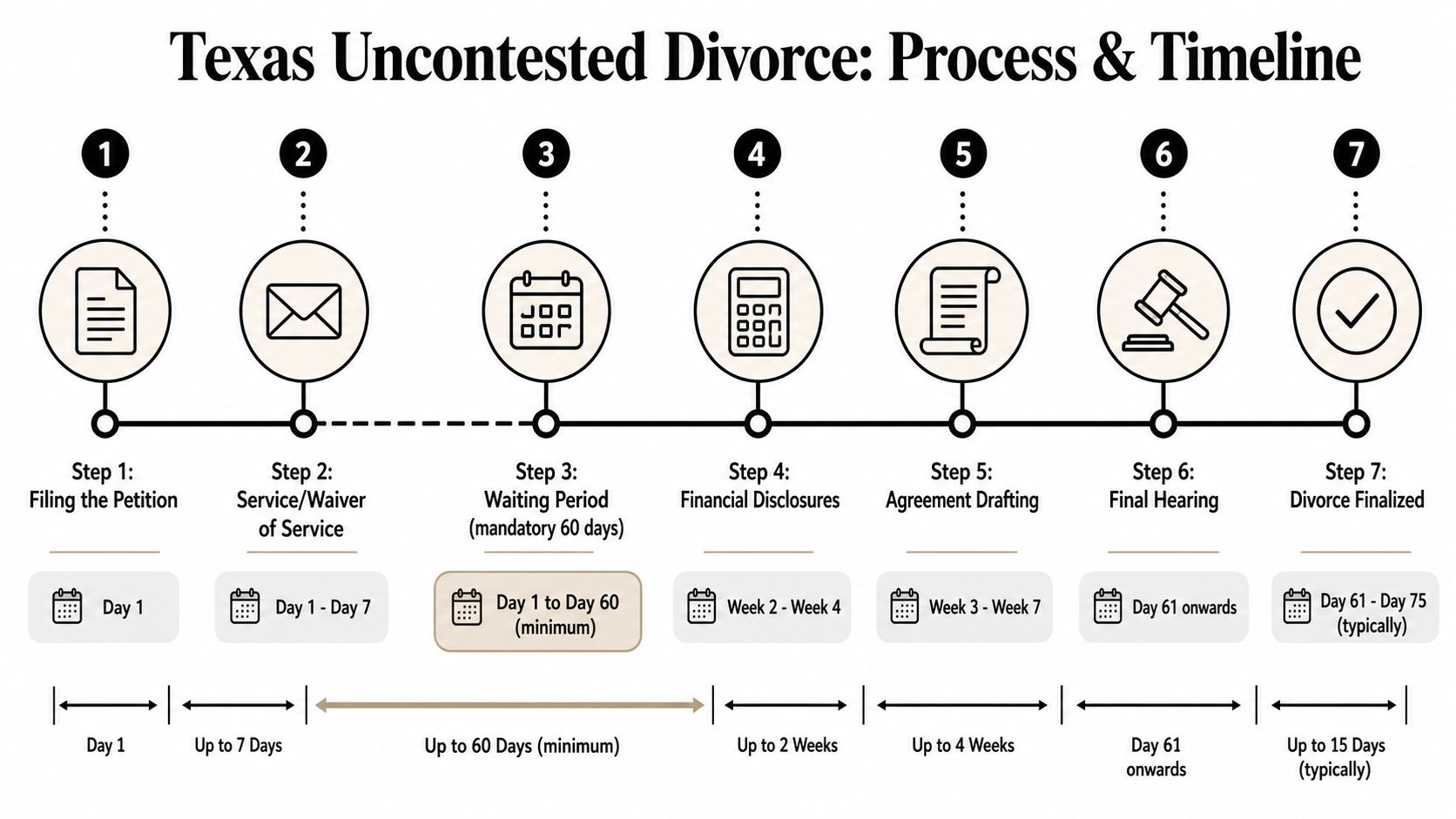
- File the Original Petition for Divorce
- Handle service or get a waiver signed
- Wait through the mandatory 60-day period
- Exchange needed financial information
- Draft the final agreement and decree
- Attend the final prove-up hearing
- Get the signed Final Decree of Divorce
Texas requires a waiting period in a standard divorce. You cannot file and finish the case a few days later just because you both agree. Use that time well. A smart couple uses the 60 days to finish the decree, confirm account balances, check legal descriptions for real estate, and make sure child-related terms are complete if children are involved.
That last point matters more than people expect. Cases without children are often faster because the decree is shorter and there are fewer issues to resolve. If you have children, the agreement usually needs terms for conservatorship, possession, child support, medical support, and school or exchange details. Even in an agreed case, that added drafting can slow the timeline and increase cost.
This short video gives a helpful overview of the process in action:
What happens at the final hearing
The final hearing is commonly called a prove-up. Usually, one spouse appears in court, answers a few basic questions, confirms the case meets Texas requirements, and asks the judge to sign the decree.
If your documents are clean, this step is often brief.
If they are not, the judge may refuse to sign, ask for corrections, or require you to come back. That means more time, more frustration, and sometimes more attorney fees. This is one of the clearest places where careful drafting saves money.
The realistic timeline
The shortest possible timeline in a standard agreed divorce is tied to the 60-day waiting period. Real-world timing depends on how quickly you reach full agreement, how organized your paperwork is, and how busy your county court is. That county-to-county variation matters. Some courts process agreed prove-ups faster than others, and local hearing availability can affect how long you wait even after everything is signed.
A simple case with no children and very little property often moves faster than a case involving parenting terms, a house, retirement accounts, or detailed debt allocation. That is why generic online timelines can be misleading. Your timeline is not just about state law. It is also about your county, your documents, and how much needs to go into the decree.
For a smoother process, follow these rules:
- Reach full agreement early: Property terms, parenting terms, and debt allocation should be settled before the final draft.
- Use the waiting period wisely: Do the drafting, review, and signature work during that time.
- Check every detail: Names, dates, cause numbers, and property descriptions need to match across all documents.
- Get help with sticking points: If communication is the problem, use practical tools like this negotiation guide for busy professionals to keep small disagreements from turning into billable conflict.
My advice is simple. Treat the timeline as part of your budget. In an uncontested divorce, speed usually comes from preparation, not luck.
How to Lower Your Uncontested Divorce Costs
You can spend a few hundred dollars and still end up with an expensive problem. I see that happen when spouses save money on the front end, then pay later to fix a vague decree, redo child provisions, or clean up property terms that should have been clear the first time.
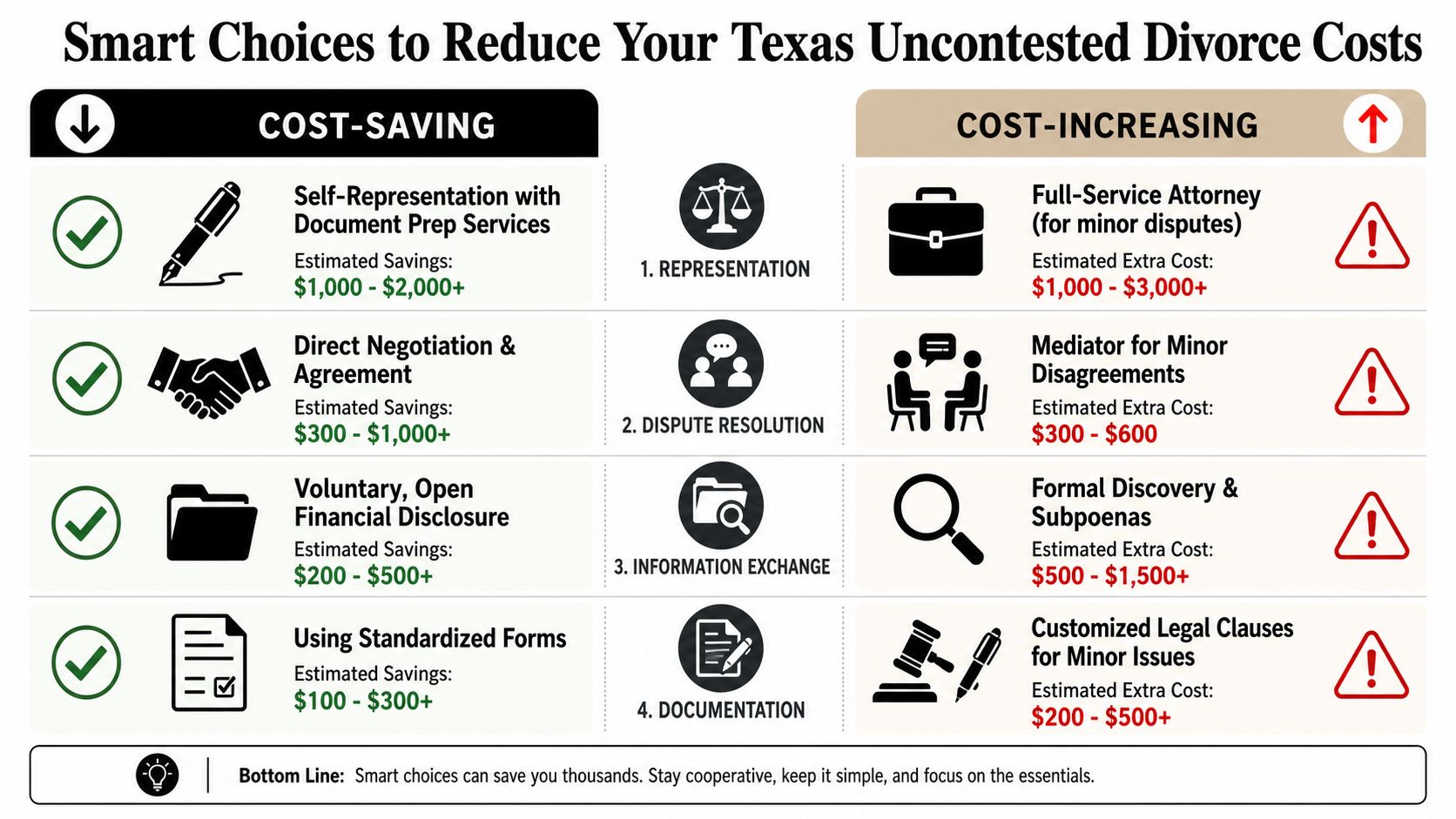
The cheapest uncontested divorce is not always the lowest-cost divorce overall. In Texas, the smart move is matching the level of help to the level of risk in your case. That matters even more if children are involved, because parenting terms, support details, and medical support language usually make the paperwork more demanding than a no-children case.
Four ways to handle the case
Here is the clearest way to compare your options:
| Approach | Best fit | Main advantage | Main risk |
|---|---|---|---|
| DIY | Very simple cases | Lowest upfront cost | Mistakes in the decree |
| Document service | Simple agreed cases | Less paperwork burden | No legal strategy |
| Flat-fee attorney | Most agreed divorces | Predictable pricing and legal review | Higher upfront spend |
| Limited-scope attorney help | People who need targeted review | You pay for key tasks only | You still handle parts yourself |
DIY usually works only when the case is simple. No children. No house. No retirement division that needs special language. No spouse changing terms every week.
For many Texas couples, a flat-fee lawyer or limited-scope review is the better value. You spend more upfront, but you cut the risk of rejected paperwork, sloppy property language, or child-related orders that create conflict later.
My direct recommendation
Use DIY only if your agreement is complete and your decree is straightforward.
Hire at least limited legal help if any of these apply:
- You have children: Child support, possession schedules, and health insurance terms leave more room for mistakes.
- You own a home: The decree needs clear language on title, refinance responsibility, sale terms, and deadlines.
- You have retirement accounts: Division orders may require added steps and precise wording.
- One spouse handles all the finances: Agreement is not enough if one person does not fully understand the accounts and debts.
- Your communication is shaky: Repeated revisions drive up cost fast, even in an agreed case.
This is the part generic cost guides miss. A no-children agreed divorce and an agreed divorce with children are not priced the same in real life. The filing fee may be similar in your county, but the drafting work is often not. More terms usually mean more review, more chances for disagreement, and more cost.
Smart habits that keep fees down
You can keep costs under control without cutting corners.
- Settle the hard points before anyone drafts the decree: Every round of revisions costs time.
- Build a shared document file: Tax returns, pay stubs, mortgage statements, retirement balances, and insurance information should be easy to access.
- List every account and every debt: Hidden surprises are what turn an uncontested divorce into a contested one.
- Be specific about the children: School schedule, exchange logistics, medical support, and extracurricular costs should be discussed early.
- Use outside help for communication problems: If discussions keep stalling, this practical negotiation guide for busy professionals can help you stay focused and avoid turning small disputes into billable conflict.
- Pay for review where it matters most: A lawyer can review the decree, flag missing terms, and catch expensive errors without taking over the whole case.
One strong decree usually costs less than one cheap decree plus post-divorce repair work.
If you are comparing service levels, one option is speaking with Law Office of Bryan Fagan, PLLC about an agreed divorce and whether limited or full support fits your case. That can make sense if you want legal review and cost control without turning an amicable case into a fight.
Is an Uncontested Divorce Always the Right Choice
No. Sometimes it's the right label for the court, but the wrong strategy for you.
An agreed divorce works well when both spouses understand the finances, have equal access to information, and are making informed decisions. It stops being safe when one spouse is guessing, pressured, or relying on vague promises.
Red flags that should slow you down
You should pause and get legal advice if any of these apply:
- You own a business: Business interests raise valuation, income, and control issues.
- You have a high-value estate: Real estate, investments, bonuses, and deferred compensation need careful treatment.
- You suspect hidden assets or debt: Agreement isn't meaningful if you don't know what exists.
- Your spouse controls the money: Power imbalance often produces bad deals.
- You agree on custody in principle, but not on details: Texas parenting orders need clear, workable terms.
Under the Texas Family Code, child-related orders must protect the child's best interest. In plain English, that means your parenting plan can't be vague. Who has the child on school nights? Who carries health insurance? How are exchanges handled? If your order is fuzzy, future conflict is almost guaranteed.
Why business owners need extra caution
If you or your spouse owns a company, the divorce isn't simple just because you're both being polite.
The decree may need to address ownership, income characterization, account access, goodwill questions, reimbursement issues, and whether one spouse is keeping the company in exchange for other assets. Business value can also affect support negotiations and overall property division.
Fair isn't the same as fast
I support uncontested divorce when it protects you. I don't support speed for its own sake.
A fast divorce is a good result only when the paperwork reflects a fair and informed agreement.
The same is true for parents. If you both want peace, that's good. But peace lasts only when the decree answers the practical questions you'll face after the divorce is over.
Your Next Steps and Final Document Checklist
You are at the point where small mistakes get expensive.
Before you file anything, answer one question clearly: do you and your spouse agree on every major term, including property, debt, and, if you have children, the parenting details that will govern daily life? If yes, treat the process like a legal project with a budget and a checklist. If no, stop trying to force an agreed case. That usually costs more later.
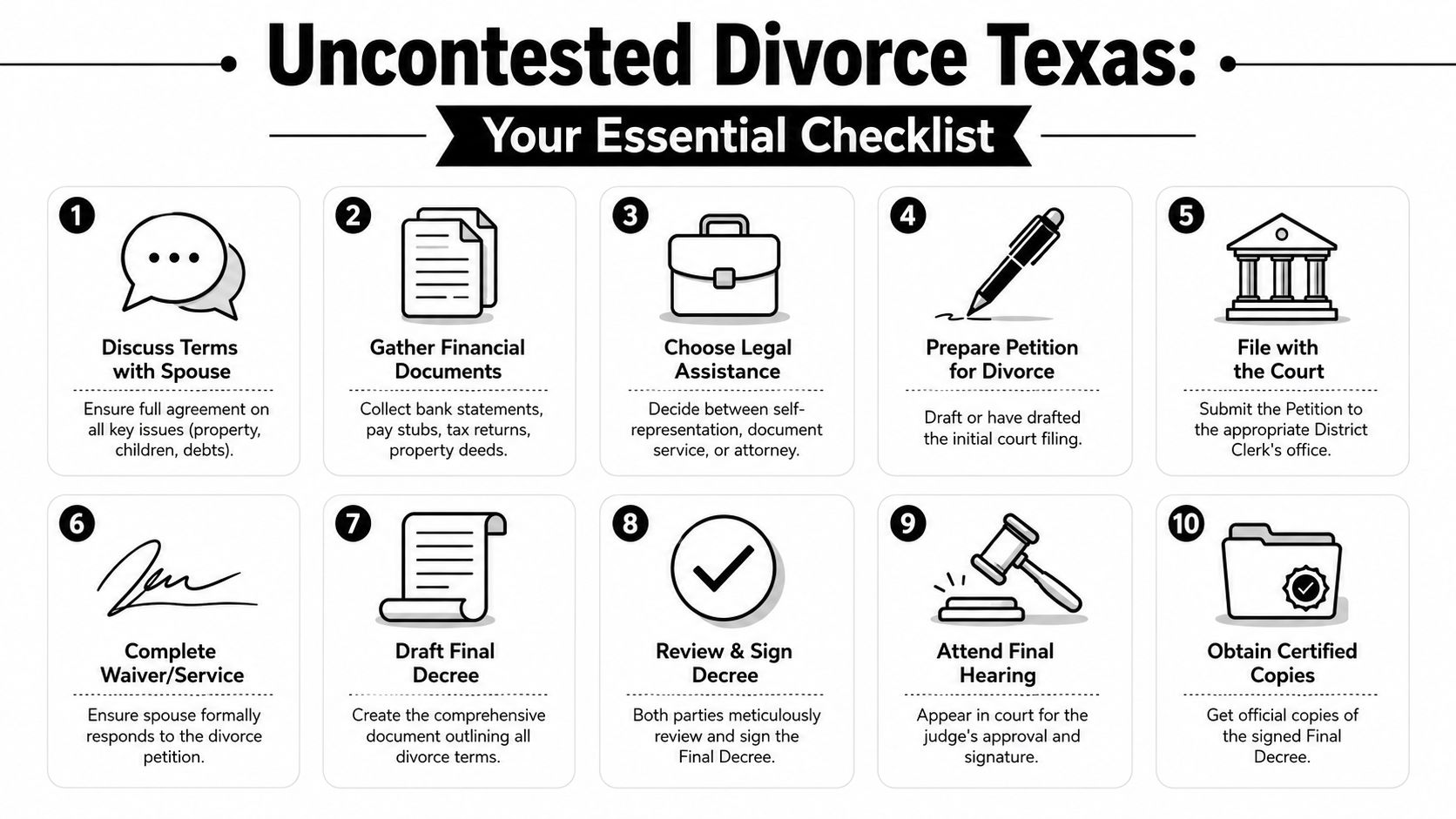
Final document checklist
Get these documents organized before filing or signing:
- Original Petition for Divorce: Starts the case
- Waiver of Service or service plan: Covers how your spouse is legally notified or participates
- Financial records: Bank statements, pay stubs, tax returns, debt statements, deeds, retirement account information, and vehicle records
- Written property and debt agreement: A clear division of accounts, loans, credit cards, real estate, and personal property
- Parenting terms: If you have children, a written agreement on conservatorship, possession, child support, medical support, and practical exchange details
- Final Decree of Divorce: The court order that controls what each of you must do after the divorce
- Certified copies plan: Decide how many signed copies you will need for title transfers, retirement division, school records, or future enforcement
Children usually mean more paperwork and more precision. County filing fees may not change much, but drafting and review costs often do because child-related orders have more moving parts and less room for vague language.
What to do next
Follow this sequence:
- Confirm full agreement in writing
- Check your county filing fee so you can build a realistic budget
- Choose the right level of help, DIY, document review, or flat-fee attorney support
- Draft every document carefully, especially the final decree
- Review names, dates, account references, and child-related terms before signing
- Plan for post-decree costs, including certified copies and any transfer paperwork
One strong recommendation. Do not judge cost by the filing fee alone. A divorce with children, a house, retirement accounts, or uneven finances often costs more to draft correctly, even when nobody is fighting.
If you want a final check before filing, schedule a free consultation with Law Office of Bryan Fagan, PLLC. You can discuss likely county costs, child-related drafting issues, property questions, mediation concerns, and the documents your case should include before you sign.