Skip to content
You may be trying to book a summer trip right now and realizing that your court order, not your calendar, decides whether that plan works.
If you're asking, what is the vacation rule for couples? (possession/visitation) in Texas, the short answer is this: vacation time is controlled by your possession order, and the biggest problems usually come from missed deadlines, not from the trip itself. Parents often assume they can work out dates later. That assumption creates avoidable conflict.
Texas law gives you a structure. Your order fills in the details. When you understand both, vacations become easier to plan and much harder to fight about.
The Foundation of Your Schedule The Standard Possession Order
Most Texas parents start with the Standard Possession Order, often called the SPO. This is the default possession schedule Texas courts commonly use when it fits the child's best interest. It creates a baseline calendar so both parents know where the child will be during ordinary weeks, school terms, holidays, and breaks.
In plain English, the parent who decides the child's primary residence is often called the managing conservator or primary parent. The other parent is often called the possessory conservator, meaning the parent with scheduled periods of possession and access. Those labels matter because the vacation rules build on that structure.
For parents who live 100 miles or less apart, Texas generally gives the possessory conservator possession on the 1st, 3rd, and 5th weekends of each month, from 6 p.m. Friday to 6 p.m. Sunday, plus Thursday evenings during the school year from 6 p.m. to 8 p.m. according to Texas custody guidance on the Standard Possession Order.
Why the baseline matters
Vacation rules don't replace the whole order. They override parts of it at certain times.
That means if you don't understand the normal schedule first, it becomes much harder to tell whether a holiday, summer election, or travel plan changes your weekend time. Many disputes happen because one parent is looking only at the trip dates, while the other is looking at the actual court order.
If you need a fuller breakdown of how the standard calendar works in real life, this guide to the Texas Standard Possession Order is a useful companion.
Practical rule: Treat your possession order like an operating manual, not a rough suggestion. The vacation terms only make sense when you read them against the full schedule.
Where this fits in a divorce case
Possession terms are usually addressed during the divorce or custody case and then carried into the final order. The process typically starts with filing, service, an answer from the other side, temporary orders if needed, negotiation or mediation, and then a final decree. If the other spouse never answers, a case can still move forward under the rules described in Default Divorce in Texas: When a Spouse Doesn't Respond.
For parents, business owners, and spouses with substantial property, this matters because travel planning often overlaps with mediation, temporary orders, and final decree drafting. A vague order can create expensive disputes later. A clear order usually prevents them.
Decoding the Texas Summer Vacation Rule
A parent books a July trip, tells the other parent after the flights are purchased, and then learns the order defaulted to different summer dates months earlier. That is one of the most common and most preventable possession problems I see.
The 100 mile rule changes the length of summer possession
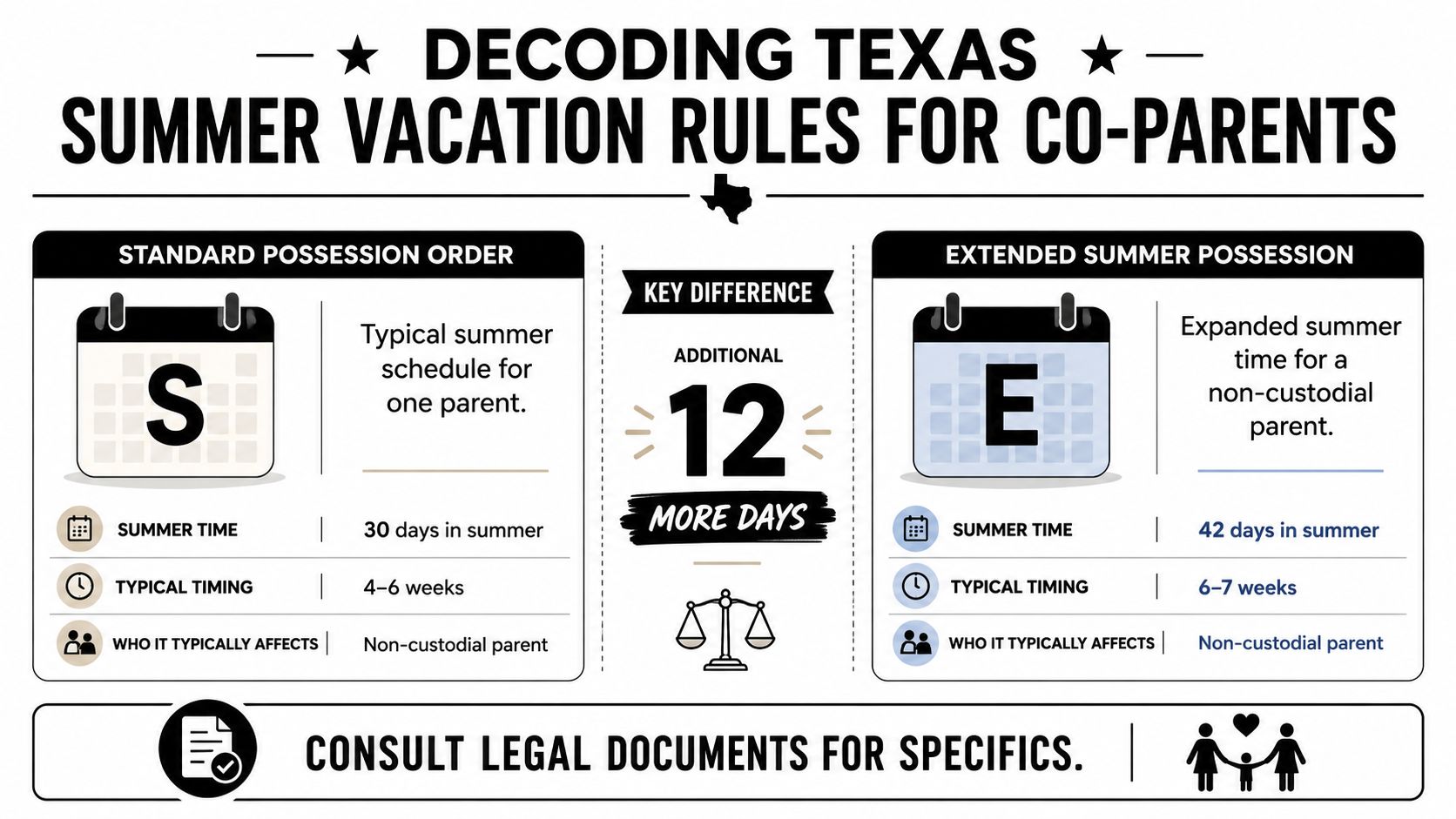
Under the Standard Possession Order, summer possession usually depends first on how far apart the parents live. If the parents live within 100 miles of each other, the noncustodial parent generally receives 30 days of extended summer possession. If they live more than 100 miles apart, that period generally increases to 42 days, as explained in this summary of Texas summer possession rules.
The reason is practical. Long-distance parents often cannot rely on frequent weekend exchanges, so summer possession carries more weight. That also means mistakes about dates, notices, and default periods tend to have bigger consequences.
The April 1 deadline causes more conflict than the vacation itself
The administrative rule that causes the most trouble is the April 1 written notice deadline.
If your order allows you to choose your summer dates, you usually must make that election in writing by April 1. For parents entitled to 30 consecutive days, failure to give timely written notice can trigger the default schedule of July 1 through July 31 at 6:00 p.m., according to this discussion of Texas summer possession schedules.
For parents living more than 100 miles apart, missing the same deadline can trigger the default 42-day summer period instead of the dates the parent had in mind.
This is the trap. Parents focus on camps, airline prices, family reunions, and work schedules. The order focuses on notice. If the notice is late, incomplete, or never sent in a way that can be proven later, the argument usually starts from the default dates, not from the vacation plan.
Good summer planning starts with the calendar and the notice requirement, not the travel booking.
Summer time may be split, but only if the order and notice support it
Some parents assume summer possession has to be taken in one continuous block. Some orders allow more flexibility. A parent may be able to divide summer possession into separate periods if the order permits it and the required written notice is given on time.
That can make a big difference for real families. One week with grandparents in June and a longer trip in July may work better than one uninterrupted stretch. But flexibility exists only if the paperwork is handled correctly. If a parent waits too long or sends a vague message that does not clearly designate dates, that option can disappear fast.
The other parent may have election rights too
Summer possession is not controlled by one parent alone. Depending on the order, the parent with the primary right to designate the child's residence may also have the right to choose certain weekends or limited time during the other parent's extended summer period, if that election is made properly and on time.
That is why I tell clients to build a written summer timeline every year. Mark the notice deadlines. State the exact dates requested. Send the notice in a way you can later prove. Save the message, the response, and the calendar entry.
Parents who handle those small administrative steps early usually keep the focus where it belongs, on the child and the trip, instead of on emergency motions after school lets out.
How Holiday Possession Overrides Your Regular Schedule
Holiday possession creates confusion because parents often look at a normal weekend calendar and assume it still controls. It usually doesn't. Under Texas law, holiday possession schedules supersede conflicting weekend periods, as explained in this overview of holiday possession and travel rules.
That means if your regular weekend and a holiday schedule collide, the holiday schedule wins.
Christmas is split at noon on December 28
Texas handles Christmas with a very specific dividing line. The holiday is legally split at noon on December 28. In even-numbered years, such as 2026, the noncustodial parent typically has possession from the time school dismisses for Christmas break until noon on December 28, and the schedule reverses in odd-numbered years, according to Texas holiday possession guidance.
That noon exchange catches parents off guard every year. Many assume Christmas possession runs to the end of winter break. It doesn't. The midpoint matters.
Spring Break and Thanksgiving follow their own rules
Spring Break also changes depending on distance. For parents living within 100 miles, Spring Break usually alternates by year. For parents living more than 100 miles apart, the noncustodial parent receives Spring Break every year, according to the same Texas holiday schedule guidance cited above.
Thanksgiving is also broader than many parents expect. It covers the school holiday period, not just the Thanksgiving Day meal.
If you're checking whether your 1st, 3rd, or 5th weekend survives a holiday, start with one question. Is there a holiday possession provision for that time? If yes, use that first.
Texas Holiday Possession Schedule Even vs. Odd Years Under 100 Miles
| Holiday | Possession in EVEN-Numbered Years (e.g., 2026) | Possession in ODD-Numbered Years (e.g., 2027) |
|---|---|---|
| Christmas first half | Possessory conservator from school dismissal until noon on Dec. 28 | Managing conservator from school dismissal until noon on Dec. 28 |
| Christmas second half | Managing conservator from noon on Dec. 28 until 6 p.m. the day before school resumes | Possessory conservator from noon on Dec. 28 until 6 p.m. the day before school resumes |
| Spring Break | Possessory conservator | Managing conservator |
| Thanksgiving break | Rotates by year under the order | Rotates by year under the order |
For clients with demanding work schedules, business travel, or children in multiple activities, holiday planning usually works best when you map out the entire school calendar well before the season arrives. Mediation is often the right place to build custom holiday language if the standard framework doesn't fit your family.
Proper Notice and Travel Permission Rules
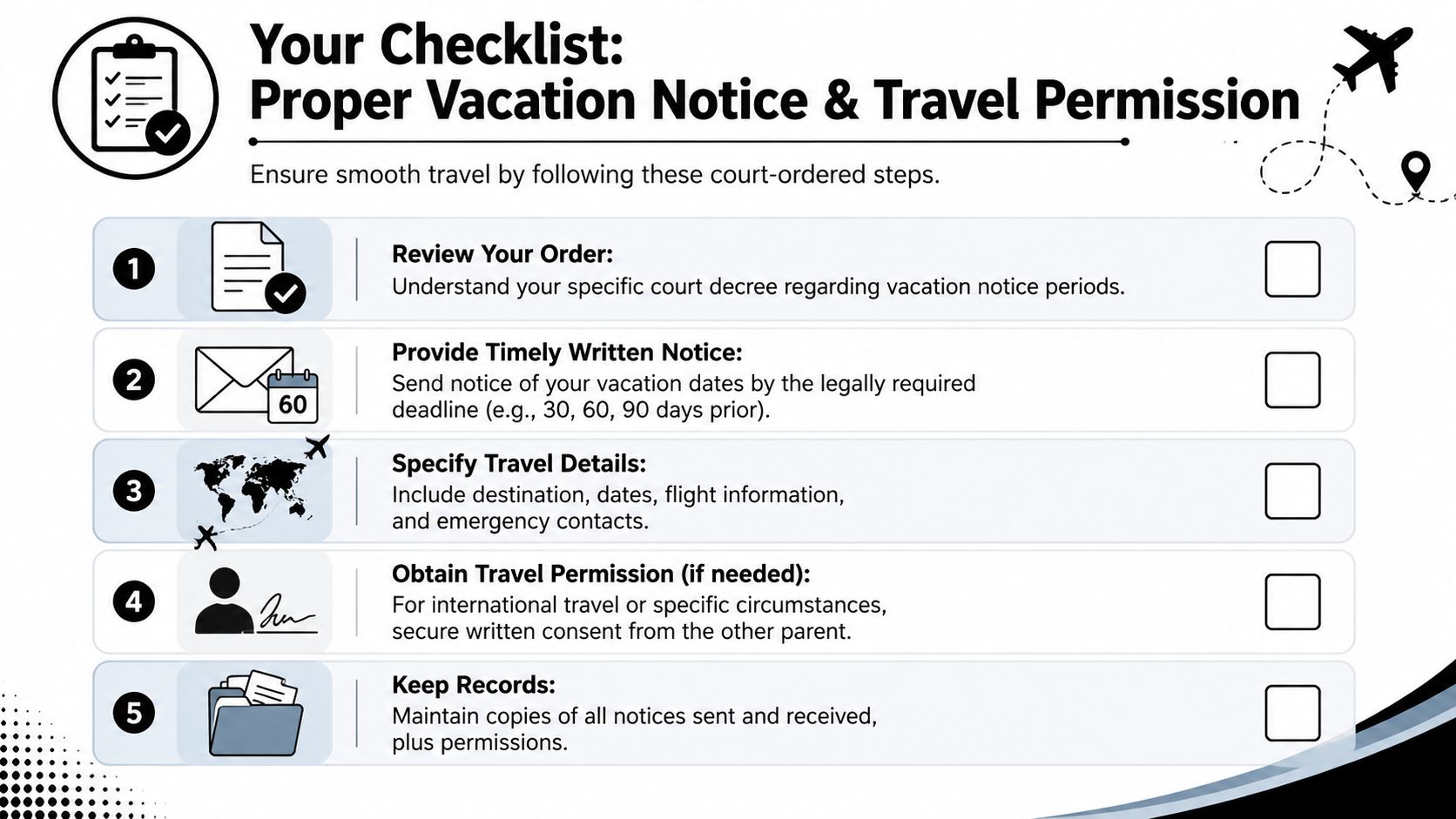
A valid vacation plan isn't just about picking dates. It's about giving notice the way your order requires and keeping a record that proves you did it.
What proper notice should include
Your order controls the exact wording, but good written notice usually includes:
- Your selected possession dates: State the start and end dates clearly.
- Exchange details: Include pickup and return times and locations.
- Travel basics: Give destination information if your order requires it.
- Contact information: Provide a phone number and emergency contact.
- A clear delivery method: Send it in a way you can later prove, such as email, a co-parenting app, or another written method allowed by your order.
Parents get into trouble when they rely on casual texts, verbal conversations, or half-finished plans. If a dispute later lands in court, clarity matters more than good intentions.
Can you travel without the other parent's permission
Texas law recognizes that a parent with court-ordered possession generally has the right to travel with the child during that period, but the order may require advance itinerary and contact information, especially for longer trips, as described in the holiday and travel guidance cited earlier. The important distinction is this: possession gives you authority to use your time, but your order may still impose notice rules.
That means you shouldn't assume silence in a text thread equals consent, and you shouldn't assume travel is unrestricted if your order says otherwise.
Use written agreements when plans change
Sometimes families need flexibility. Flights move. Reunions get rescheduled. A child gets invited to camp during your period of possession. When both parents agree to a temporary adjustment, put it in writing. A Rule 11 agreement in a Texas divorce is one formal tool lawyers use to memorialize agreements so there's less room for later disputes.
Written notice protects both sides. It protects the traveling parent from false claims, and it protects the other parent from being left without basic information.
For international travel, passport access, consent language, and destination-specific restrictions often require a closer reading of the order. If your decree is vague, get it reviewed before you book.
Common Vacation Disputes and Proactive Solutions
You book the beach house in March. In May, the other parent says your July week does not work because camp is already paid for, and your split summer notice was never sent on time. That is how a routine vacation turns into a possession dispute.

The April 1 trap in real life
The fight I see most often is not about whether a trip is good for the child. It is about whether a parent followed the order early enough to protect that trip.
If a parent wants to divide summer possession into separate periods, the written notice rules matter. So does the deadline. Miss April 1, and a parent may lose the right to choose those separate blocks and fall back into the default schedule discussed earlier. By then, money may already be spent on flights, rental homes, camp deposits, or time off work.
That is why this deadline causes so much conflict. One parent plans based on assumptions. The other parent plans based on the order. The order usually wins.
Other friction points that show up every year
Vacation disputes also grow out of small administrative mistakes that feel minor at the time.
- Camp and travel get booked in the wrong order. A parent signs the child up for activities before confirming who has possession on those dates.
- Notices are sent informally or too late. A casual text is easy to miss, dispute, or misread later.
- Parents leave transportation vague. Pickup time, airport return, and who handles delays should be settled before the trip starts.
- One parent changes plans without updating the other. Even if permission is not required, failing to provide information required by the order creates avoidable suspicion.
- Verbal side deals replace the decree. They work until someone gets upset.
These cases rarely begin with dramatic misconduct. They begin with poor documentation and late planning.
What actually works
The parents who preserve their vacation time usually treat possession like a deadline-driven process, not a loose family understanding.
Start with a calendar review early in the year. Put every election deadline, notice date, holiday override, exchange time, and camp registration cutoff in one place. If you wait until school lets out, you are already behind.
Use writing that can be saved and produced later. Email and co-parenting apps are better than phone calls for schedule changes. Keep the message simple. State the dates, cite the part of the order if needed, and ask for written confirmation when an agreement changes the default schedule.
It also helps to make one decision at a time. First confirm who has the dates under the order. Then book the trip. Then send any itinerary details the order requires. Families get into trouble when they reverse that sequence.
If the other parent is already refusing to honor clear vacation periods, review the process for filing a motion to enforce a Texas divorce order. If the problem is recurring but both parents are still trying to cooperate, a tighter order may solve more than repeated arguments ever will.
A good vacation plan is usually less about winning a fight and more about preventing one. The parents who do this well are not always more flexible. They are more organized.
When to Enforce or Modify Your Vacation Rules
If the other parent refuses to honor the vacation schedule, you may need enforcement. If the schedule no longer fits your family's real life, you may need modification. Those are different remedies, and choosing the right one matters.
Enforcement is for a broken order
Enforcement is the path when a valid order exists and one parent doesn't follow it. That might mean denying your summer possession, refusing the holiday exchange, or withholding the child during your court-ordered period.
Your first steps should be practical:
- Save the order: Keep the exact signed version handy.
- Preserve proof: Save emails, texts, app messages, and notices you sent.
- Write down the missed exchange: Dates, times, locations, and witnesses can matter.
- Act promptly: Delay can make proof harder.
If you need to pursue that route, this overview of how to file a motion to enforce in a Texas divorce case explains the basic process.
Courts enforce clear orders more effectively than vague ones. Precision in your decree is not paperwork for paperwork's sake. It is what gives your rights practical value.
Modification is for a schedule that no longer works
Modification is different. You seek modification when the current order no longer fits the child's best interest or family circumstances have materially changed. A move, a major shift in school or activity needs, or a work schedule that consistently disrupts exchanges can all raise modification issues.
The process usually involves filing a petition, serving the other parent, exchanging information, negotiating, attending mediation if ordered or agreed, and presenting unresolved issues to the court. For families with substantial assets or complex careers, thoughtful modifications often matter just as much as property terms because travel and parenting time directly affect work and household stability.
In some cases, courts may also restrict possession if there is credible evidence of abuse or other safety concerns. Texas Family Code §153.004 allows restrictions and supervised visitation in certain circumstances, as summarized in this explanation of supervised visitation in Texas family law cases.
Frequently Asked Questions About Texas Vacation Rules
Who pays for vacation travel expenses
Your order may address travel costs directly. If it doesn't, parents often need to negotiate those expenses or seek clarification in mediation or court. Don't assume the other parent must reimburse airfare, gas, hotels, or passport-related costs unless your order says so.
Can you take your child out of state
Often, yes, during your period of possession if your order doesn't prohibit it. The safer approach is to read the travel language carefully and provide itinerary details when required. Out-of-state travel is usually much easier than international travel, but notice terms still matter.
Do you need the other parent's consent for international travel
Sometimes you do, especially if the child needs passport access, written consent, or your order includes special restrictions. International travel should never be treated like an ordinary weekend trip. Review the decree before booking anything.
What if your vacation falls on the other parent's birthday or a special family event
Unless your order gives that event legal priority, the written schedule controls. Parents can always agree to a trade, but voluntary flexibility is different from a legal obligation.
Can summer camp override your possession time
Not automatically. Camps, sports, and enrichment programs often create conflict because both parents may believe the activity is best for the child. If the camp falls during your court-ordered time, the order still matters. When possible, address camp schedules early and confirm any agreement in writing.
What if your spouse hasn't answered the divorce, but you still need summer rules set
That issue often comes up in pending divorces. If no final order exists yet, temporary orders may be needed to establish who has possession and when. Without a clear court order, vacations become much harder to manage.
Your Key Takeaway Navigating Your Vacation with Confidence
Texas vacation possession rules are manageable when you treat them like deadlines and logistics, not guesswork. The biggest problems usually aren't dramatic. They're administrative. A missed notice date. An unclear email. A trip booked before the order was checked.
You protect your time with your child by doing three things well. Read the order closely. Give notice in writing. Put changes in writing too. If your schedule no longer fits your family, ask whether modification makes more sense than repeated arguments. If the other parent is violating the order, consider enforcement before the pattern gets worse.
You don't have to sort this out alone. Clear legal advice can save you from preventable conflict and help you protect both your parenting time and your peace of mind.
If you're dealing with a vacation dispute, unclear possession terms, or a divorce that still needs workable parenting provisions, you can schedule a free consultation with Law Office of Bryan Fagan, PLLC. A consultation can help you review your order, understand your deadlines, and decide whether negotiation, mediation, enforcement, or modification is the right next step.