Skip to content
You may be living in the same house, sharing the same bills, and trying to parent your children while every small disagreement turns into a major fight.
One spouse says the mortgage will be paid. The other assumes the joint account can still be used for groceries. A weekend possession schedule gets changed by text, then denied later. During a Texas divorce, that kind of uncertainty wears people down fast. The final decree is still ahead, but real life keeps moving now.
You don't have to wait until the end of the case to create some order. Texas procedure gives you a way to turn negotiated solutions into something more dependable while the divorce is pending. That tool is a Rule 11 agreement. Used well, it can calm conflict, protect access to money or property, and set temporary expectations so you can get through the case with fewer surprises.
An Introduction to Agreements in Divorce
Most divorces don't begin with a courtroom battle. They begin with a series of tense, practical questions.
Who will pay the car note this month? Who stays in the house? Can one parent take the children to a family event on the other parent's weekend? What happens if one spouse controls most of the cash flow? These aren't abstract legal issues. They're the day-to-day problems that make divorce feel unmanageable.
A lot of people think the only choices are to either trust informal promises or rush into a hearing. In many cases, there is a middle ground. If you and your spouse can reach agreement on a specific issue, Texas law may let you formalize that deal in a way the court can recognize.
That matters because temporary stability changes the tone of a case. When the bills are assigned, access to funds is clear, and a parenting exchange is written down, you spend less energy fighting over logistics and more energy making good decisions.
The most useful agreements in divorce often aren't dramatic. They're the ones that stop recurring arguments before they start.
For many families, a Rule 11 agreement becomes a conflict-management tool. It can address a narrow issue without forcing you to resolve the entire divorce at once. That makes it especially useful in contested cases, high-stress co-parenting situations, and divorces involving businesses or complicated finances.
If you're asking what a Rule 11 agreement in Texas divorce really does, the short answer is this. It helps you create enforceable structure while your case is still in progress.
What a Rule 11 Agreement Is and Why It Matters
A spouse agrees to cover the mortgage until the temporary orders hearing. The other spouse relies on that promise, then the payment is missed and the argument shifts from the mortgage to whether any agreement existed at all. That is the problem Rule 11 is designed to solve.
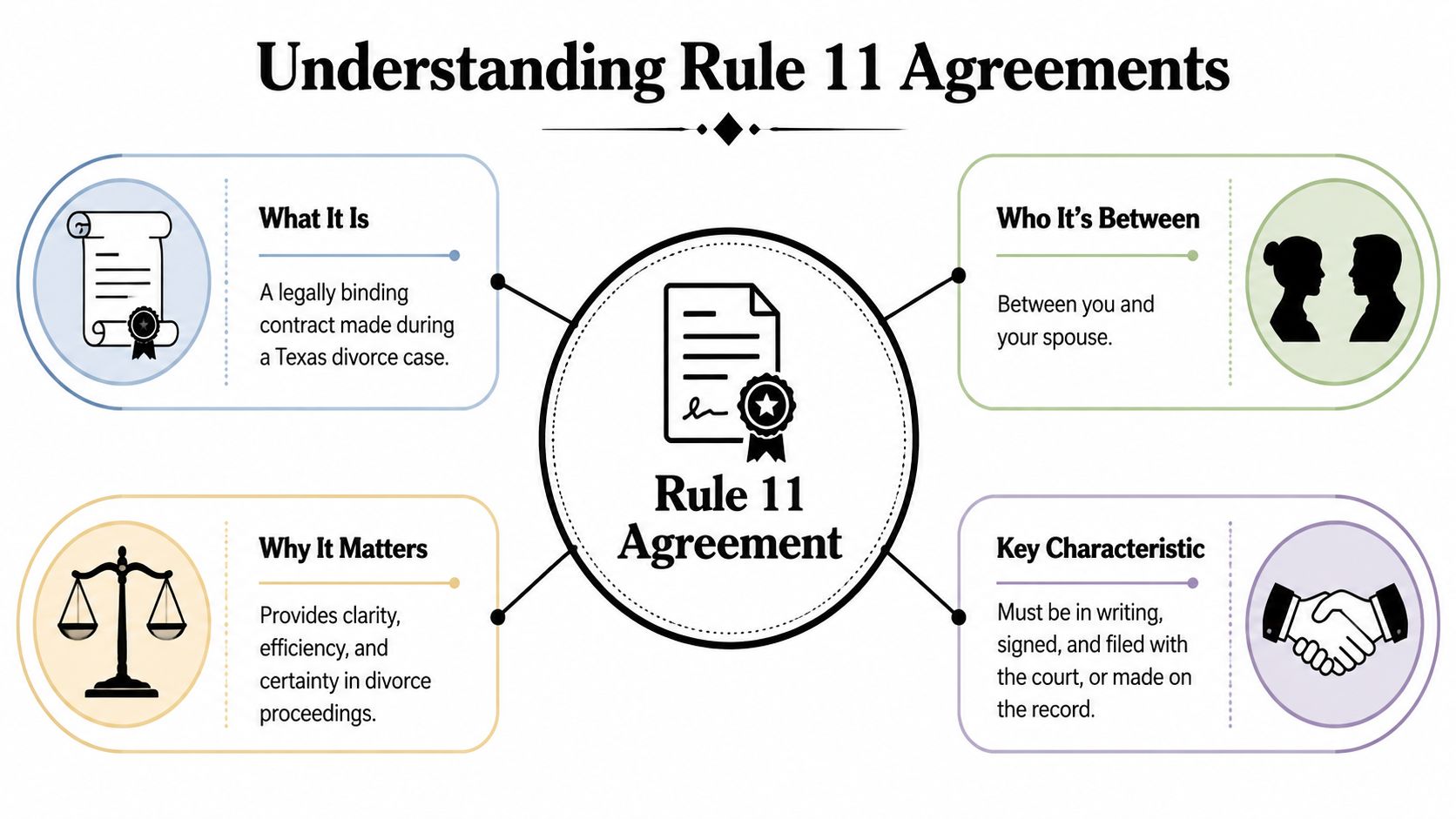
A Rule 11 agreement comes from Texas Rule of Civil Procedure 11. In a divorce case, it is the formal method for turning a negotiated deal into something a court can recognize and, in the right circumstances, enforce.
What makes it different from a promise
In practice, the difference is formality and proof. A hallway conversation, a phone call, or a vague text exchange may reflect good intentions, but those communications often fall apart when one person remembers the terms differently or decides the deal no longer works.
A Rule 11 agreement gives the court a clear record of what was agreed. That distinction matters because divorce negotiations happen in stages. Spouses may be able to resolve one pressure point today without resolving the entire case. If that limited agreement is documented correctly, it can reduce conflict right away instead of leaving both sides to argue over whether a promise was ever real.
The term settlement agreement also causes confusion. A Rule 11 agreement can be part of a broader settlement, but it is often narrower and more tactical. It may cover one issue for a short period of time, or set ground rules while larger disputes remain open. For broader context, review this guide to a Texas divorce settlement agreement.
Why families use them during a pending divorce
Many of the most useful Rule 11 agreements are not final settlements. They deal with temporary parenting schedules, responsibility for monthly bills, access to joint funds, pickup and drop-off details, or the handling of a house or business while the case is pending.
That is where Rule 11 becomes a case-management tool, not just a settlement device. Used well, it can prevent a minor dispute from turning into an emergency hearing. It can also narrow what must be argued in court, which saves time, legal fees, and stress.
That makes them closely related to Temporary Orders During a Texas Divorce, which address how the court sets the rules while the divorce is pending. Sometimes a Rule 11 agreement replaces the need to fight over a short-term issue. Sometimes it effectively locks down the points both sides can live with so the hearing focuses only on what is still contested.
Practical rule: If one recurring issue keeps causing conflict, it may be specific enough for a Rule 11 agreement even when the rest of the divorce is far from resolved.
So if you are asking what a Rule 11 agreement in Texas divorce does, the better answer is practical. It creates enforceable structure for the parts of the case that need immediate order, even while the larger divorce remains unsettled.
The Essential Requirements for a Valid Agreement
A Rule 11 agreement only works if it is done correctly. Families often lose time and their strategic advantage because they rely on something informal that never became enforceable.
The two valid paths
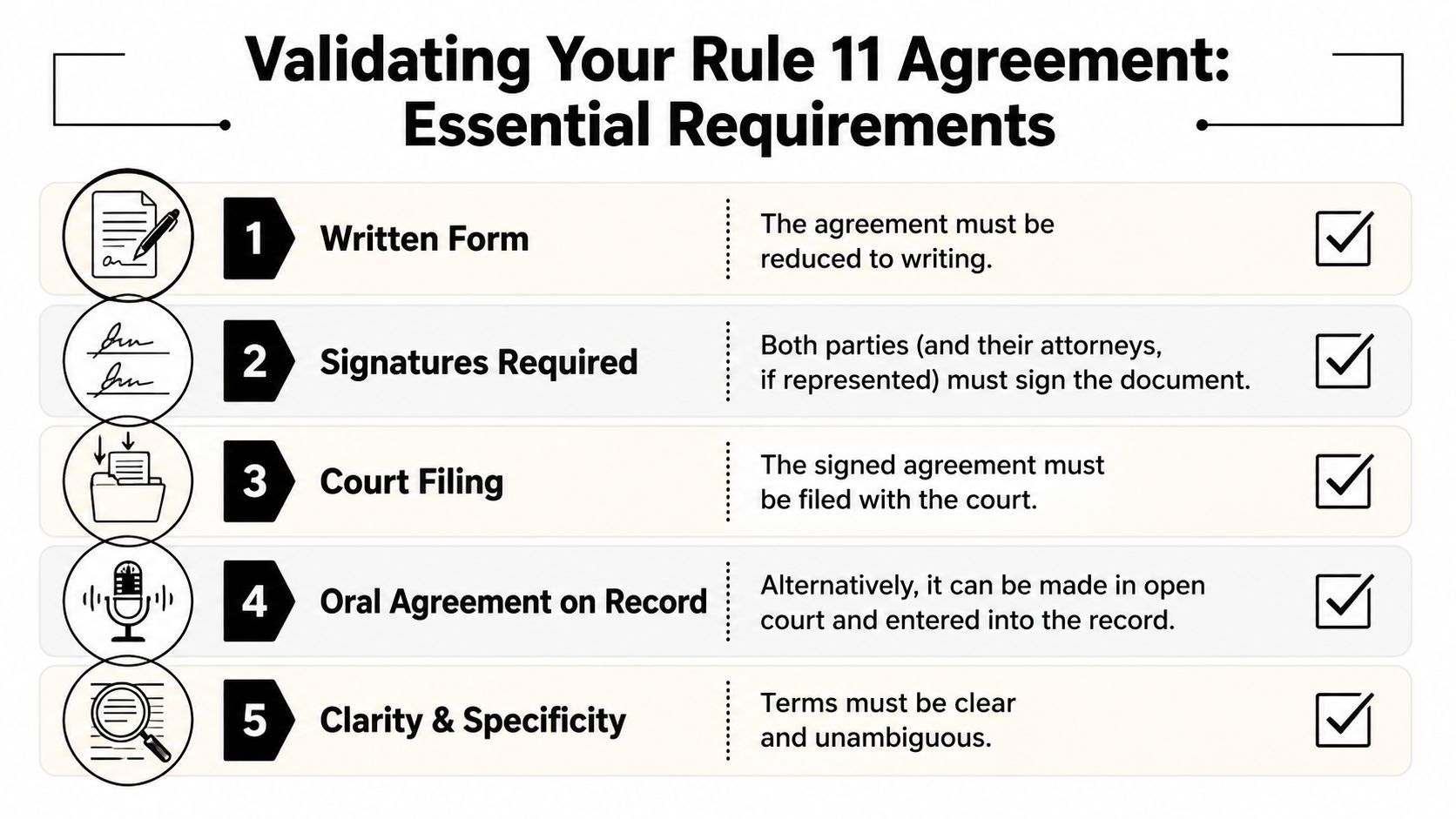
Texas recognizes two basic ways to make this kind of agreement enforceable.
- Written agreement. The agreement is put in writing, signed by the parties or their lawyers, and filed with the court.
- Open-court agreement. The terms are stated in open court and entered into the record.
If neither of those happened, you may have an understanding, but you likely do not have a Rule 11 agreement the court can treat as such.
What those requirements mean in real life
A few points matter in practice:
- Writing matters: The terms should be written clearly enough that a stranger could read them and understand exactly what each person must do.
- Signatures matter: The signatures show that the parties, or their attorneys, assented to the exact terms on the page.
- Filing matters: Filing puts the agreement into the court file instead of leaving it in someone's inbox.
- The record matters: If the agreement is spoken in court, it must become part of the official record.
- Specificity matters: Vague terms invite new conflict.
Texas Law Help also notes that an email can sometimes qualify if it clearly serves as a Rule 11 agreement, but a casual email alone isn't enough unless it is expressly treated that way. That is one reason many lawyers are careful about how digital agreements are prepared and preserved. If you're trying to understand the basics of securing your digital agreements, that resource is a useful companion on what makes a document legally binding in the first place.
A quick validity check
Use this short checklist before you rely on any deal:
| Question | Why it matters |
|---|---|
| Is every key term written out? | Courts can't enforce guesses |
| Did the right people sign it? | Assent has to be clear |
| Was it filed, or put on the record in court? | Procedure is what gives it force |
| Are dates, duties, and limits specific? | Specific terms are easier to enforce |
A handshake can reduce tension for a day. A properly prepared Rule 11 agreement can give you a usable legal tool.
Strategic Ways to Use a Rule 11 Agreement in Your Case
You have a hearing set for next week. The fight is not about the final property division yet. It is about who stays in the house, who pays the mortgage on Friday, how the children will get to school on Monday, and whether one spouse is about to clean out an account before anyone can stop it. That is where a Rule 11 agreement often has the most practical value.
Temporary parenting and household issues
In many Texas divorce cases, the smartest use of a Rule 11 agreement is to stabilize daily life while the larger disputes are still being fought. A narrow agreement can set pickup and drop-off times, holiday swaps, school notice rules, and how parents will handle activities, medical appointments, or travel during the case. That kind of structure does not solve every parenting disagreement, but it can stop the same argument from erupting every few days.
The same is true for household finances.
A Rule 11 agreement can assign temporary responsibility for the mortgage, rent, utilities, car payments, insurance, and routine child expenses. It can address who keeps a vehicle, who has temporary use of the marital home, and whether either spouse may draw from a joint account for ordinary bills. In cases where one spouse has handled all the money, getting these terms in writing can prevent pressure tactics and last-minute surprises.
Business owners and high-asset cases
High-conflict property cases often need guardrails before they need a final deal. If a spouse owns a business, manages rental property, controls investment accounts, or has access to large lines of credit, informal promises are not enough. A Rule 11 agreement can create short-term operating rules while appraisals, tracing, or forensic review continue.
Examples include:
- Business operations: No unusual distributions, no asset sales outside the ordinary course, and no new debt without notice.
- Real estate management: Who pays taxes, insurance, and maintenance, and who can access the property for inspections or showings.
- Document exchange: Deadlines for profit-and-loss statements, tax returns, payroll records, bank statements, and loan documents.
- Use of major assets: Temporary possession of a home, vehicle, boat, account, or business records until a hearing or mediation.
These agreements are useful because they control risk. They preserve the status quo, reduce the chance of gamesmanship, and give the case a workable structure while the hard issues are still under review.
A short explanation of the court process can help if this feels abstract:
Discovery and case management
Rule 11 agreements are also effective case-management tools. Lawyers use them to set deadlines, extend response dates, schedule inspections, coordinate document production, and narrow what has to be argued in court. That matters because divorce litigation gets expensive fast when every scheduling problem turns into a motion.
Used well, a Rule 11 agreement can help both sides exchange information in an orderly way without giving up their core positions. One spouse may need extra time to gather business records. Both sides may want a specific format for financial production. Counsel may agree to postpone a hearing if updated records will make settlement talks more productive. Those are strategic uses, not signs of weakness.
The trade-off is straightforward. A broad agreement can create breathing room, but it can also give the other side more time, more access, or more control than you intended if the language is loose. I usually advise clients to use Rule 11 agreements to solve defined operational problems, with clear deadlines and clear limits, rather than trying to paper over the entire case with one rushed document.
That is how this tool helps control conflict. It turns recurring disputes into written rules the court can recognize, and it lets the case keep moving while the bigger decisions are still ahead.
Enforcing the Agreement and Avoiding Common Mistakes
You sign an agreement to solve one problem in the case. A week later, the other side reads it differently, ignores a deadline, or claims the language was only part of settlement talks. That is usually when people learn the hard lesson. A Rule 11 agreement helps only if a judge can read it, identify the obligation, and see exactly what was broken.
When enforcement becomes necessary
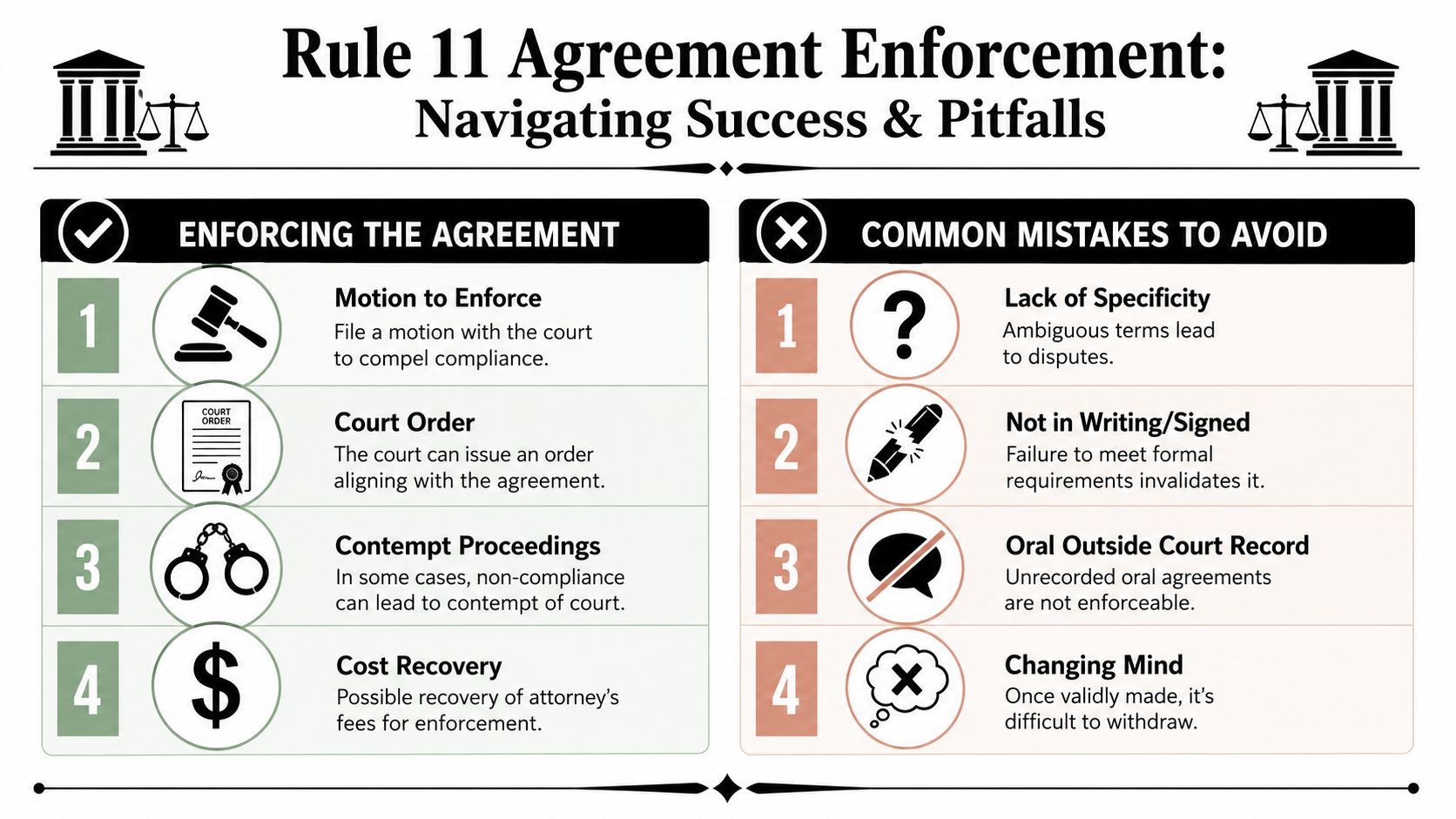
If a spouse fails to do what the agreement requires, the remedy depends on what the agreement says, how it was documented, and whether the court already adopted it into an order. In many cases, the next practical step is filing a motion to enforce a Texas divorce order or agreement.
That process gets much easier when the agreement is specific. Courts can enforce a payment due on a certain date, a document production deadline, or a pickup time stated down to the hour. Courts have a much harder time with loose promises, side understandings, and language that sounds cooperative but says very little.
Some Rule 11 agreements are better used as pressure points for compliance or as a basis to request temporary orders, rather than as the final word on a disputed issue. That is a strategic judgment. The right choice depends on whether the term is concrete enough to enforce and important enough to put in front of the judge immediately.
Mistakes that create expensive fights
The biggest problems usually start before anyone files an enforcement motion. They start in the drafting.
Here are the mistakes I see most often:
- Vague terms: Phrases like “reasonable possession,” “timely reimbursement,” or “access to funds as needed” invite a second dispute over meaning.
- Incomplete Rule 11 formalities: If the agreement is not signed, filed, or made in open court and entered of record, enforcement can become much harder.
- Trying to settle child-related issues too casually: Terms involving conservatorship, possession, child support, or medical support often require closer court review and should be drafted with that in mind.
- Using a Rule 11 agreement for a job it should not do: It works well for temporary arrangements and procedural disputes. It is often a poor vehicle for broad, permanent family law rights unless the language is carefully converted into enforceable orders.
- Treating email negotiation as a final deal: An email chain may show progress. It may also show only ongoing negotiation. Those are not the same thing.
One more mistake deserves attention. Parties sometimes agree to broad language to keep the peace for the moment. In practice, broad language often creates the next emergency. If the case is high conflict, precision matters more than politeness.
What stronger drafting looks like
A judge needs specifics, not context clues.
| Weak term | Stronger term |
|---|---|
| “Dad gets the kids this weekend” | “Father shall have possession from Friday at 6:00 p.m. until Sunday at 6:00 p.m., with pickup at Mother's residence” |
| “Wife can use money for bills” | “Wife may withdraw funds from account ending in 1234 solely for mortgage, utilities, and groceries pending further order” |
| “Husband won't sell assets” | “Husband shall not transfer, encumber, or sell the boat, investment account, or business equipment without written agreement or court order” |
The pattern is straightforward. Strong terms identify the person, the act required, the deadline, and the limit. They also leave less room for either side to claim later that everyone “understood” something that never made it onto the page.
A court can enforce concrete instructions. It struggles with intentions, assumptions, and shorthand.
That is why legal review matters. A poorly drafted Rule 11 agreement does not reduce conflict. It shifts the fight from the original issue to a new dispute over what the agreement required.
How to Draft and Finalize a Rule 11 Agreement
A workable Rule 11 agreement usually looks simple on the surface. The strength is in the details.
What the document should include
At minimum, the draft should identify the case and state the terms with precision. In practice, most agreements should include:
- Case information: The style of the case, court, and cause number.
- The exact parties: Full identification of who is agreeing.
- Clear terms: Who does what, by when, and under what limits.
- Signatures: The parties or their attorneys, depending on how the agreement is being handled.
- Filing step: A plan to get the signed agreement into the court record.
For some families, the next step after a Rule 11 agreement is to convert the agreed terms into temporary orders or final orders. In final stages of an agreed divorce, that may connect with the court process used at a Texas divorce prove-up hearing.
A simple example
If the issue is temporary use of the marital home, stronger language usually sounds like this in substance:
“Wife shall have temporary exclusive use of the residence located at [address] until further agreement or court order. Husband shall continue paying the mortgage directly to the lender. Wife shall pay routine utilities during that period. Neither party shall remove furniture or household furnishings except personal clothing, toiletries, and work-related items without written agreement.”
That sample works better than “Wife keeps the house for now” because it addresses possession, payment duties, and limits on removal of property.
Finalizing it without loose ends
Once the terms are settled, don't leave the document sitting in draft form. A signed agreement that never reaches the court file can create false confidence.
Use this sequence:
- Draft the terms carefully
- Review for missing details
- Confirm signatures
- File it with the clerk, or place it on the record in court
- Consider whether a formal order should follow
If you have counsel, your lawyer can handle the filing and make sure service and recordkeeping are done correctly. If you don't, be cautious. The filing step is not clerical fluff. It is part of what gives the agreement legal effect.
The Law Office of Bryan Fagan, PLLC handles Texas family law matters involving divorce, custody, support, mediation, and enforcement, which is why many clients use counsel to prepare narrow temporary agreements before they become larger disputes.
Frequently Asked Questions About Rule 11 Agreements
Can an email count as a Rule 11 agreement
Sometimes, but not just because the conversation happened by email. Texas Law Help notes that a written agreement can be an email if it clearly serves as a Rule 11 agreement. A casual email exchange usually creates risk, especially if the terms are incomplete or nobody treats it as a formal court-filed agreement.
Is a Rule 11 agreement the same as a mediated settlement agreement
No. They are different tools. A Rule 11 agreement is often used to document negotiated terms inside the lawsuit, especially for temporary or procedural issues. A mediated settlement agreement is a separate settlement device with its own legal framework and is often used for broader resolution.
Can a Rule 11 agreement finalize the whole divorce
It can address significant issues, but that doesn't mean it is always the best way to handle every final term. In many cases, Rule 11 agreements work better for narrower operational issues than for permanent rights, especially where parenting conflict is high or the property issues are complex.
What if we agreed but never filed it
That is a common problem. If the agreement was never properly filed with the court, or never stated in open court and entered into the record, you may not have an enforceable Rule 11 agreement.
Can we use one for child-related issues
You can address child-related matters carefully, but those terms need added attention. Parenting, child support, and medical support are not areas for vague drafting. Courts scrutinize these issues closely because children's interests are involved.
When is this tool most useful
Usually when one practical issue keeps derailing the case. Temporary parenting schedules, bill payment, access to funds, interim use of property, and discovery logistics are common examples. That is where the agreement often adds the most value.
Key Takeaways and How We Can Help
A Rule 11 agreement gives you a way to create order during a Texas divorce before the final decree is entered. Its real strength is not just definition. It is function. It can turn a narrow agreement about parenting time, bills, property access, or case procedure into something more dependable.
The biggest trade-off is also the biggest risk. A Rule 11 agreement is useful because it is flexible, but that flexibility can tempt people into drafting vague, incomplete, or overly ambitious terms. In family law, especially where children or high-conflict issues are involved, precision matters.
Keep these points in mind:
- Use it for real problems: The best candidates are temporary or procedural disputes.
- Get specific: Dates, duties, limits, and account or property identification matter.
- Complete the formal steps: Signing and filing are part of the legal force.
- Know when to use stronger tools: Some issues belong in formal orders or broader settlement documents.
If you're dealing with a divorce that feels chaotic, the right agreement can give you traction. It won't solve every issue, but it can give you control over the issue that's hurting you right now.
If you're considering a Rule 11 agreement, or you're worried that an informal deal with your spouse won't hold up, talk with the Law Office of Bryan Fagan, PLLC. You can schedule a free consultation to discuss your divorce, custody dispute, temporary orders, or enforcement concerns and learn what steps may help protect your rights, your finances, and your parenting relationship while your Texas case is pending.