Skip to content
You can work for years to build a compensation package, then one divorce filing turns those promised shares into a fight over timing, taxes, and fairness. If your RSUs won't vest until long after the divorce is final, you need a decree that does more than say “split the stock.” It has to track what Texas law treats as community property, what stays separate, and how to enforce the division when the shares finally hit your account.
Why Unvested RSUs Complicate Your Texas Divorce
A lot of people first learn the hard way that restricted stock units are not the same as a paycheck. Salary shows up, bonus money lands in your account, and the math is simple. RSUs are different, because the value may exist on paper long before you can touch a single share.
That creates a painful surprise during divorce. You may be staring at an award that looks like a major asset, but the company won't let it vest for years. Texas still has to classify it, divide it, and write it into a decree that works in real life, not just on a spreadsheet.

Why this catches people off guard
RSUs often come packaged with long vesting schedules, clawback risk, and employer restrictions that make them hard to value on the date of divorce. If you want a plain-English primer on the legal label “restricted,” the discussion of restricted securities under Rule 144 is useful background, because it helps explain why some shares can't be transferred like cash.
Practical rule: If the decree is vague, the fight moves from divorce court to post-divorce enforcement.
That's why I tell clients to treat unvested RSUs as a drafting problem, not just a valuation problem. You are not only deciding who gets what. You are deciding how the shares will be tracked, when they will be divided, and what happens if your employer changes the plan before vesting.
Texas lawyers also have to keep the broader property rules in view. If you want the bigger framework, the Texas just-and-right division standard is laid out in How Property Is Divided in a Texas Divorce, and RSUs have to fit inside that system.
The issue feels personal because it is personal. One spouse often sees future upside, the other sees unfairness, and both are usually reacting to the same thing, a compensation package that is still unfolding while the marriage is ending.
How Texas Law Classifies RSUs as Community or Separate Property
Texas starts with a community-property presumption. In plain terms, property in divorce is usually treated as community unless a spouse proves otherwise. For RSUs, the key question is not whether the units exist. It is when they were granted, earned, and vested.
The timing controls the label
Texas courts look at the employment agreement and the vesting schedule, not just the headline value of the grant. Compensation earned during marriage is generally community property, while compensation earned before marriage or after divorce is separate property. That is why RSUs can be partly community and partly separate, depending on the timeline.
A simpler way to view the grant is as a pie sliced by time. The slice earned while you were married belongs to the community estate. The slice earned when you were single belongs to you alone. That direct time-based approach is more useful than trying to force a one-size-fits-all answer onto a complicated award.
The tracing issue matters too. Texas law does not treat post-divorce vesting as automatic equal ownership. When RSUs or stock options were granted before marriage but vest after divorce, the separate-property fraction can include the time before marriage and the time after divorce, measured against the whole grant-to-vest period. That is a tracing exercise, not guesswork, and the detailed tracing approach is explained in the Texas resource on tracing separate property in divorce.
The right question is never just “whose name is on the account.” It is “what part of the award was earned during the marriage?”
That distinction keeps people out of trouble when the decree is drafted. A spouse who ignores the timing rules can walk into a settlement thinking the award is all community, only to find that part of it is separate property under the vesting timeline.
A simple way to think about it
If the grant was made during the marriage and keeps vesting after divorce, Texas courts often use a time-based fraction. If the grant began before marriage and continues after divorce, the separate-property portion can cover the pre-marriage and post-divorce periods. The decisive issue is the same in both situations, the award is divided by the period it was earned, not just by the market price on divorce day.
For a broader property-division overview, How Property Is Divided in a Texas Divorce is the right companion read when you are trying to place RSUs inside the broader estate.
Calculating the Community and Separate Shares of Your RSUs
The Texas method is straightforward once you stop overthinking it. Courts look at the grant-to-divorce period and compare it to the grant-to-vest period. The portion earned during the marriage is community, and the rest follows the separate-property timeline.
The basic time rule
The core formula used in Texas is this, community share equals the time from grant to divorce divided by the time from grant to vest. A simple four-year grant with divorce at the two-year mark produces a 50 percent community share and a 50 percent separate-property share, which is why Texas courts often divide post-divorce vesting by percentage rather than by a fixed dollar amount. That approach is discussed in the Texas guide on dividing income streams after divorce, including RSUs, at How Are Additional Streams of Income Divided in Divorce.
That formula makes sense because the value is tied to service over time, not just the day the judge signs the decree. A spouse who worked through half the vesting period earned half the community share. A spouse who stayed employed after divorce earned the rest as separate property.
A second example with pre-marriage and post-divorce service
Texas also traces separate-property portions when the award started before marriage but vested after divorce. In that setting, the separate-property fraction can include the period before marriage plus the period after divorce, divided by the total grant-to-vest period. In a 48-month award where 12 months occurred before marriage and 12 months occurred after divorce, 24 of 48 months, or 50 percent, may be classified as separate property, leaving the remaining 50 percent in the community estate.
That is the practical reason you should never settle RSUs as if they were cash in hand. The market price at divorce matters far less than the vesting schedule. Texas courts can award the non-employee spouse a deferred percentage or number of shares payable only when the RSUs vest or are exercised, which preserves tax and liquidity consequences until actual settlement.
RSU Community vs Separate Property Calculation Examples
| Scenario | Grant to Divorce | Grant to Vest | Community Share | Separate Share |
|---|---|---|---|---|
| Four-year grant, divorce at two-year mark | 2 years | 4 years | 50% | 50% |
| 48-month award, 12 months before marriage, 12 months after divorce | 24 months inside community period out of 48 total months | 48 months | 50% | 50% |
If the decree uses the wrong label, the later vesting event becomes a dispute, not a routine transfer.
That's why your lawyer should map the RSUs to dates, not feelings. Dates tell the court what was earned during the marriage. Dates also tell you whether the future share should be delivered by percentage, by deferred transfer, or by some other method that fits the award.
Drafting Decree Language That Protects Both Spouses
A good decree should read like an instruction manual, not a wish list. Vague language creates the exact problems people spend years trying to fix later. If the decree only says “the parties will divide RSUs equitably,” you have almost guaranteed an enforcement problem.
What the decree needs to say
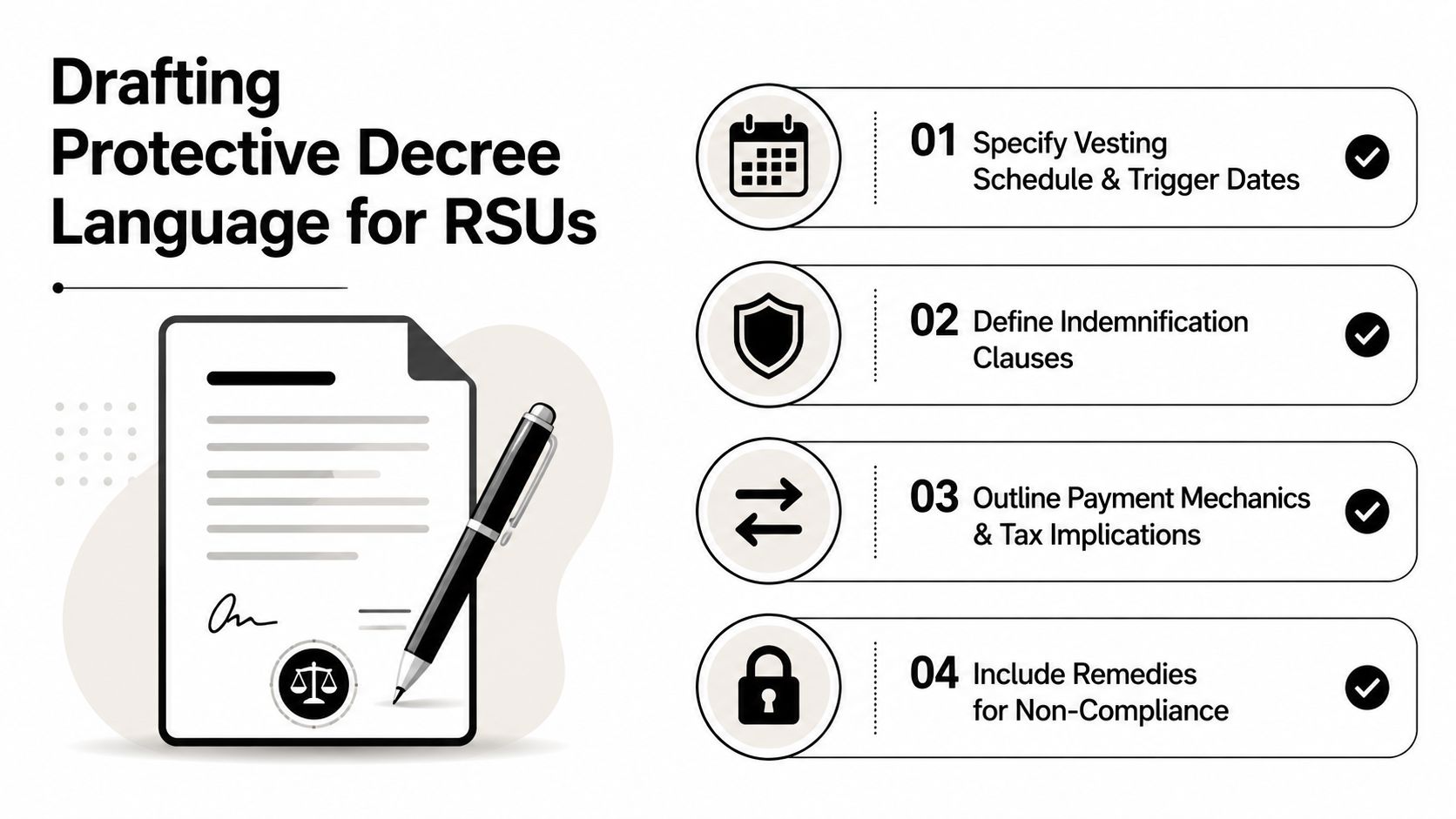
The decree should define the non-employee spouse's interest with precision. It should say whether that spouse receives a percentage of each vesting tranche, a fixed number of shares, or an offset in other property. It should also spell out what happens if employment ends before vesting, because forfeiture risk is real and the decree has to account for it.
The decree should also address future company events. Stock splits, mergers, acquisitions, and plan changes can all affect what finally lands in the account. If you do not cover those possibilities, the employer's paperwork can drift away from the divorce judgment, and that is where enforcement gets messy.
I also want notification language in the decree. The non-employee spouse should have a clear right to be informed when a vesting event happens, so they can verify the transfer was done correctly. Without notice, the employee spouse controls the whole timeline, and that is too much room for error.
The Law Office of Bryan Fagan, PLLC regularly handles property-division drafting in Texas divorces, including complex asset language that needs to hold up after the final decree is signed.
Language that works better than vague promises
A strong decree usually does three things.
- Defines the share: It states the exact percentage or number of shares tied to each vesting event.
- Sets the timing: It says the transfer happens when the RSUs vest, not at some unclear later date.
- Builds in enforcement: It identifies remedies if a spouse refuses to cooperate with transfer paperwork.
You also want indemnification language if one spouse's conduct causes a tax or transfer problem. That protects the other spouse from being stuck with avoidable losses caused by delay or noncompliance.
For a related discussion of settlement structure in Texas divorces, settlement agreement language matters just as much here as it does with house equity or retirement accounts.
Precise decree language saves money later because it tells the employer, the ex-spouse, and the court the same story.
A decree that handles RSUs well does not try to be clever. It is specific, mechanical, and built for the long haul. That is what protects both spouses when the shares do not vest until years after the marriage is already over.
Choosing the Right Division Method for Your Situation
Texas divorce lawyers usually work through three practical methods for RSUs. None is perfect in every case. The right answer depends on how large the award is, how cooperative the spouses are, and whether the employer's plan allows transfer.
The deferred percentage method
This is the cleanest option in many cases. The non-employee spouse receives a set percentage of each future vesting event, and the transfer happens only when the shares vest. That works well when the RSUs are not transferable before vesting and when the value is too uncertain to pin down today.
The downside is ongoing contact. The spouses stay connected until the last tranche vests, and that can be uncomfortable if the divorce is already contentious.
The offset method
Here, the employee spouse keeps the RSUs, and the other spouse receives different community assets of equivalent value. This often fits better when there is enough home equity, cash, or retirement value to make a clean trade.
The advantage is closure. The divorce is over, and nobody has to track future vesting dates. The problem is valuation risk, because you are swapping a future asset for present property, and the assumptions behind that swap need to be realistic.
The constructive trust approach
This method treats the employee spouse as holding the community share in trust until vesting. It can be useful when a court wants extra protection against misuse or dissipation. It also gives the non-employee spouse a stronger equitable claim if the award is later paid.
For a related Texas equity-compensation discussion, dividing stock options in Texas divorce is worth reviewing because the same practical questions often show up there too.
Methods for Dividing Vested RSUs in Texas
| Method | Best For | Main Tradeoff |
|---|---|---|
| Deferred percentage | Untransferable awards, future vesting | Ongoing contact after divorce |
| Present value offset | Couples with enough other property to trade | Harder valuation, more assumptions |
| In-kind transfer | Plans that allow share transfer | Requires clean paperwork and timing |
Which one usually makes the most sense
If the employer's plan blocks a clean transfer before vesting, deferred percentage is often the most realistic. If the couple has enough other assets to balance the books, an offset can end the issue faster. If the decree needs strong equitable protection, constructive trust language may be the better fit.
The best method is the one your decree can actually enforce without dragging both of you back to court.
That is the standard you should use, not abstract fairness. A division method that sounds elegant but fails in practice helps nobody.
Navigating Tax Consequences and Enforcement Challenges
RSU settlements go sideways when the decree is vague. The shares vest later, the employee spouse gets the paycheck consequences first, and the other spouse is left arguing about who should absorb the tax hit and whether the division was carried out correctly.
Tax timing matters
When RSUs vest, the taxable event usually runs through the employee spouse because the shares are tied to compensation and payroll processing. The decree needs to say how that tax burden is handled before the first vesting date hits. If it stays silent, the employee spouse may pay the tax and then come back later asking for a different net split.
Records matter just as much as the tax language. Vesting notices, payroll summaries, plan statements, and transfer confirmations are the paper trail that proves what happened and when. If the transfer is ever challenged, those documents carry the case.
Enforcement has to be built in
Texas courts can use contempt when a spouse ignores the decree, and they can also use equitable remedies like a constructive trust in the right situation. That only works when the decree is drafted for enforcement from the start. A court can punish noncompliance, but it cannot rescue an order that never told the parties what to do.
The usual drafting mistakes are predictable. Lawyers and spouses forget to update beneficiary designations. They leave the RSUs out of the property division entirely. Or they use stock-option language for an RSU award, which creates confusion the moment the plan administrator reads it. Those errors turn a clean property issue into a post-divorce fight that should never have happened.
Mediation can still narrow the dispute before trial or before a post-decree enforcement hearing. Families dealing with property disputes and parenting issues at the same time often benefit from reviewing divorce mediation in Texas and child custody in Texas, because one fight rarely stays isolated from the others.
Document first, argue later. That is how you protect yourself when the vesting date is years away.
Keep the grant documents, the vesting schedule, the payroll records, and the decree language together. If the order is unclear, the evidence disappears fast, and enforcement gets harder with every passing year.
Your Next Steps for Protecting Your Financial Future
Start with the paperwork. Gather the grant agreement, vesting schedule, employer plan documents, and every statement that shows what has vested and what hasn't. If you can't prove the timeline, you're already behind.
Next, decide how you want the shares handled. Some couples need a deferred percentage, some need an offset, and some need stronger protective language in the decree. The right answer depends on the vesting schedule, the rest of the estate, and how much trust still exists between the two of you.
A good outside resource can help you manage the emotional side too. The divorce category guide from Be Your Best Self & Thrive Counseling, PLLC can be useful if the stress of property division is spilling into your day-to-day life.
What to do next
- Collect the RSU records now: Get the vesting schedule and grant documents before they disappear into an HR portal.
- Review the decree language carefully: Make sure it states who gets what, when transfers happen, and how future vesting is handled.
- Ask about enforcement before you sign: A decree that can't be enforced is a problem waiting to happen.
If your divorce involves RSUs, business interests, custody, support, or mediation, you need counsel that knows how Texas courts handle all of it together. You do not have to sort through this alone.
The Law Office of Bryan Fagan, PLLC helps Texans handle divorce property division, including RSUs that vest after divorce, with clear decree drafting and practical enforcement planning. If you're trying to protect your share or make sure a settlement is workable, visit Law Office of Bryan Fagan, PLLC and schedule a free consultation to talk through your situation.