Skip to content
You expected the decree to end the chaos. Instead, you're still chasing money, property, signatures, or basic cooperation.
That situation wears people down fast. One missed payment becomes a pattern. One ignored deadline turns into a months-long standoff over a car title, retirement funds, or the house. If you're living that reality, stop treating it like a private dispute you just need to “work out.” A Texas divorce decree is a court order. If your ex won't comply, the court can step back in and force the issue.
Your Divorce Is Final But the Fight Isn't Over
Many individuals walk out of divorce court believing the hard part is over. Then the true frustration often begins.
Your decree says your ex must transfer an account, refinance a loan, turn over property, or pay what the court ordered. Instead, you get excuses, silence, delay, or outright refusal. You send texts. You resend the decree. You try to stay calm. Nothing changes.
That kind of noncompliance creates real damage. Bills keep coming. Credit gets exposed. Children feel the tension. If business interests or high-value assets are involved, delay can put records, control, and advantage at risk. The longer this drags on, the more the other side starts acting like the decree was optional.
It wasn't.
Your Final Decree of Divorce is the document that controls what each party must do after the case ends. If you need a refresher on why that document matters so much, read what a Final Divorce Decree is and why it matters. In an enforcement case, that decree is the starting point for everything.
You're not asking for a favor. You're asking the court to require compliance with an order already signed by a judge.
I tell clients this all the time. Don't wait around hoping repeated reminders will suddenly create respect for a court order. If your ex has shown a pattern of ignoring clear obligations, you need to shift from emotional negotiation to organized enforcement. That starts with reading the decree carefully, identifying the exact violation, and preparing proof.
You do have options. Strong ones. But Texas courts expect precision, not general complaints.
What Makes Your Decree Enforceable
A decree is only as strong as its wording. That's a truth not commonly known until enforcement is needed.
If the order clearly tells a person what to do, when to do it, and what property or payment is involved, enforcement is much easier. If the language is vague, the court may still help in some situations, but the fight gets harder and more expensive.

Clear orders win
A judge can enforce a command. A judge cannot enforce a wish.
Compare these two ideas:
| Decree language | Likely result |
|---|---|
| “The parties will divide household items fairly.” | Hard to enforce because it lacks specific instructions |
| “John shall deliver the dining table, washer, and dryer to Sarah by Friday at 5:00 p.m.” | Much easier to enforce because it identifies the act and deadline |
The same principle applies to money. “Pay your share” is weak. “Pay $X by this date” is enforceable if the decree includes that exact obligation. The same goes for refinancing debt, signing transfer documents, turning over titles, or dividing retirement funds.
What judges look for
When I review a decree for enforcement, I look for three things first:
- Specific action. Does it say exactly what your ex must do?
- Specific property or obligation. Is the asset, debt, or payment identified clearly?
- Specific timing. Does the decree give a deadline or a triggering event?
If one of those pieces is missing, the court may need to clarify the order before it can compel compliance. But here's the limit that matters. An enforcement case isn't a second chance to rewrite the property division. The court can compel performance and clarify what the decree already requires. It cannot use enforcement to award you a different deal.
Practical rule: If a stranger could read your decree and know exactly what must happen next, you probably have enforceable language.
This is one reason careful drafting matters during the divorce itself. Temporary Orders During a Texas Divorce deal with how the court sets the rules while the divorce is pending. Final decrees need the same level of clarity if you want meaningful remedies later. Mediation can also help produce detailed terms, but only if those terms are written with precision before the case is finalized.
Common trouble spots
Some decree provisions create enforcement problems more often than others:
- Property turnover when the items were never listed clearly
- Debt refinance provisions when the decree sets an obligation but no real deadline
- Business interests when records, control rights, or valuation language stayed too general
- Reimbursement claims when nobody kept receipts, proof of payment, or written demands
If your decree uses loose language, don't assume you're stuck. But do stop guessing. A good enforcement strategy starts with the exact words on the page.
Your Legal Toolkit for Enforcing the Decree
A lot of people make the same mistake here. They rush to court before they have a clean plan, then file for the wrong remedy or ask for relief the judge cannot grant. That wastes time, money, and credibility.
Start by matching the violation to the remedy. Then do one smart thing before filing. Send a short written demand that quotes the decree, identifies the missed deadline, and gives a firm date to comply. Sometimes that written record fixes the problem. If it does not, you have already started building a stronger case.
Texas gives you several tools. In property cases, the main one is an enforcement action. As noted earlier, deadlines matter, and the court can enforce or clarify the decree's existing terms. It cannot rewrite the property division after the fact. Texas Law Help has a useful overview in its guide to enforcing property division after divorce.
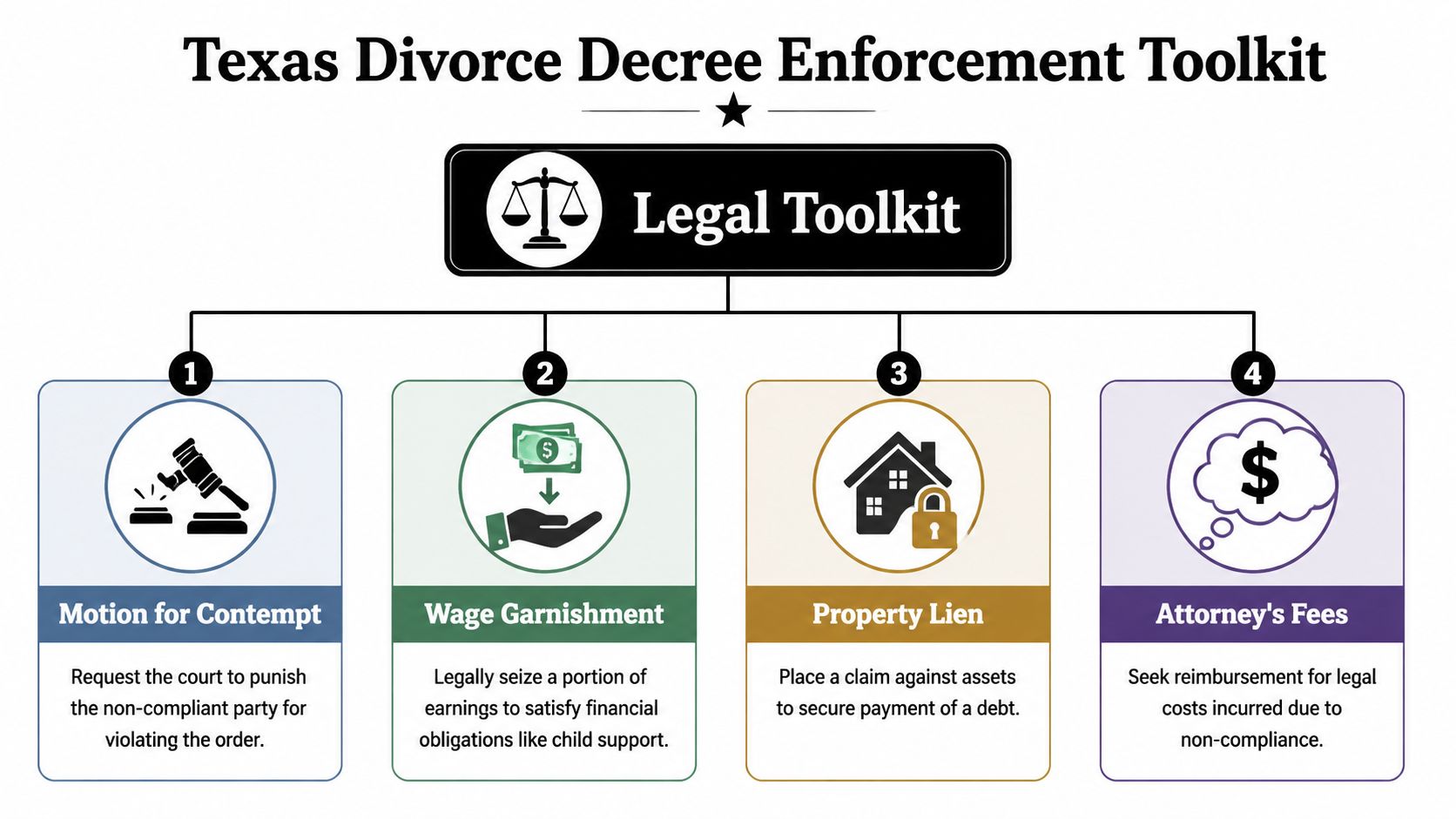
Motion to enforce
This is the standard tool in most decree enforcement cases.
A motion to enforce tells the court what the decree required, how your ex failed to comply, and what you want the judge to order now. If the dispute involves a property transfer, a required signature, reimbursement, or a decree-based financial obligation, this is usually where you begin. For a closer look at the procedure, review how a motion to enforce works in Texas family court.
Use it when your ex has failed to:
- Transfer awarded property such as a vehicle, account, or personal property
- Sign required documents tied to title, refinance, or sale
- Pay decree-based obligations that can be reduced to a money judgment
- Follow a specific property division term already spelled out in the decree
Before you file, gather the exact decree language, the deadline, and proof that you asked for compliance. Judges expect that level of organization. It also puts practical pressure on the other side, because they can see you are no longer complaining loosely. You are preparing a record.
Contempt
Contempt is a punishment tool. Use it when the order is clear and the violation is willful.
This remedy gets attention because the court is not just telling your ex to comply. The court is addressing direct disobedience of a prior order. But contempt requires precise wording in the decree and precise pleading in your motion. If the order is vague, this request can fall apart fast.
Use contempt when the pattern is obvious. Repeated refusal. Clear deadlines. No real excuse.
If your ex is flatly ignoring a specific order, say that clearly. Judges respond to documented defiance far more than broad claims that your ex has been "difficult."
Money judgments and collection tools
Some cases need more than another command to comply. They need a collectible judgment.
If your ex was ordered to pay money, reimburse you, or turn over funds and still has not done it, the next move may be to reduce that obligation to a money judgment. That can open the door to collection remedies allowed under the law, including liens or other judgment collection methods depending on the facts.
Pre-filing preparation matters. Find the account statements, payment records, payoff letters, sale documents, or proof of loss before you file. If you can show the amount owed in a clean, organized way, your request becomes much harder to dodge.
Attorney's fees and practical pressure
Attorney's fees can change the economics of delay.
If your ex forced you back into court without a valid reason, the court may order fees in the right case. That matters. A party who ignored the decree to stall or wear you down may end up paying for that decision.
One option for handling the case is working with a Texas family law firm that regularly files and litigates enforcement actions, such as Law Office of Bryan Fagan, PLLC, which handles divorce, custody, support, and post-decree enforcement matters.
Match the tool to the problem
Do not throw every remedy into every case. Be deliberate.
- Property not transferred. Use enforcement first, and add contempt if the decree language is specific enough.
- Debt not refinanced or paid as ordered. Use enforcement, seek a money judgment when appropriate, and document the financial harm.
- Support-related nonpayment. Use the collection and enforcement remedies designed for unpaid obligations.
- Refusal to sign documents. Ask for targeted relief that compels the signature or allows the transfer to happen another lawful way.
Your goal is simple. Pick the remedy the judge can grant, back it with proof, and make sure your pre-filing paper trail shows your ex had a fair chance to comply and chose not to.
Building Your Case Documenting Every Violation
The strongest enforcement cases usually don't start in the courthouse. They start at your kitchen table with a folder, a timeline, and proof.
Judges don't enforce frustration. They enforce evidence. If you say your ex didn't pay, didn't transfer property, or didn't sign required documents, you need records that show the order, the deadline, and the failure.

Build a violation file
Create one folder for the case and separate subfolders by issue. Keep it simple. The goal is speed and clarity.
Start with these categories:
- The decree pages. Save the exact pages that contain the violated order.
- Communications. Keep texts, emails, letters, and app messages where your ex refuses, delays, or admits noncompliance.
- Financial records. Save bank statements, payment histories, invoices, receipts, and screenshots showing what was or wasn't paid.
- Property proof. Use photos, title records, account statements, or inventory lists to show the asset still hasn't been transferred.
- Witness support. If someone saw the refusal or participated in the exchange, write down their full name and what they know.
Make a clean timeline
This step gets ignored far too often. Don't dump documents on your lawyer or the court and expect them to piece together the story.
Create a chronological list with short entries:
- Date of decree requirement
- Deadline in the decree
- What your ex was required to do
- What occurred
- What proof supports that entry
That timeline often becomes the backbone of your motion, your exhibits, and your hearing prep.
A messy case can still be strong. But a well-organized case is easier for a judge to trust.
Try one focused written demand
Before filing, it often makes sense to send one calm, direct written demand. Not ten. One.
State the decree provision, the missed obligation, what you want done, and a short deadline to cure. Keep emotion out of it. Don't threaten things you won't do. Don't argue over old divorce issues. The purpose is practical. You may resolve the problem without court, or you may create helpful evidence showing the other side got clear notice and still refused.
Special advice for high-asset cases
If your decree involves a business, investment accounts, retirement assets, or real estate, preserve records early. Download statements. Secure account snapshots. Save closing documents and communications with banks, brokers, or title companies. Delay can create missing records, moving targets, and new excuses.
If children are involved, document schedule violations separately from financial ones. Don't mix everything into one emotional narrative. Courts respond better to clean categories and exact proof.
The Court Process What to Expect When You File
Once you file, the case becomes a formal enforcement action. That alone changes the tone. Your ex can ignore your calls. They can't safely ignore a court filing.
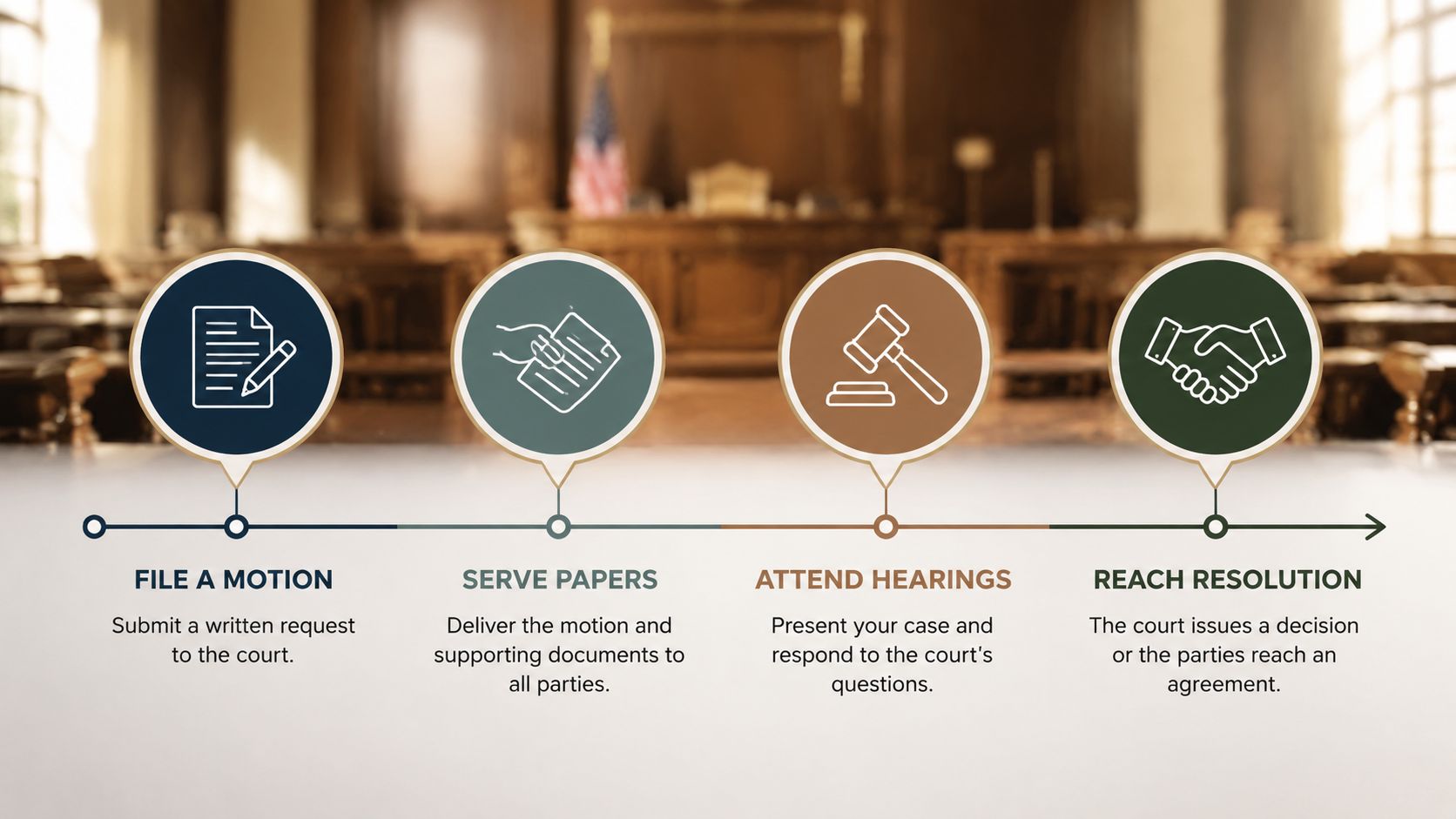
Filing and service
The motion gets filed in the court that issued the divorce decree in most situations. Then your ex must be served according to the applicable rules. That matters because enforcement isn't informal. Notice and procedure count.
After service, your ex may file a response. Sometimes that response denies the violation. Sometimes it offers excuses. Sometimes it suddenly proposes compliance because court pressure finally got their attention.
That doesn't mean you back off automatically. If delay has already cost you money, damaged your credit, or disrupted access to property, you need to think beyond “fine, they'll do it now.” Enforcement often needs to address the harm caused by the delay itself.
The hearing
At the hearing, the judge compares the decree against the evidence; your documentation then earns its value.
You or your attorney will present the order, identify the exact violation, and offer proof. That may include account records, communications, photos, timelines, and witness testimony. Your ex then gets a chance to respond.
The judge is looking for straightforward answers:
- What did the decree require
- Was the order clear
- Did your ex fail to comply
- Was the violation willful
- What remedy fits the violation
If you're preparing for the contempt side of enforcement, read how contempt of court issues are handled in Texas family law cases.
A short video can also help you get familiar with the process and mindset involved before your hearing:
Possible outcomes
Texas enforcement has teeth. A Texas family law source explains that civil contempt sanctions may include a fine of up to $500 and confinement in county jail for up to six months for willful violations. The same source explains that unpaid obligations can be converted into money judgments, which may lead to wage garnishment, liens, or asset levies. Review the consequences of not following a divorce decree in Texas.
A judge may also order practical relief, depending on the facts:
| Court response | What it can do for you |
|---|---|
| Order to comply | Forces a specific transfer, signature, payment, or other act |
| Clarifying order | Removes ambiguity so the original decree can be carried out |
| Money judgment | Converts unpaid obligations into collectible amounts |
| Attorney's fees award | Shifts some of the cost created by the other party's noncompliance |
Go into court prepared for two goals. First, prove the violation. Second, ask for a remedy that actually solves the problem.
What the process feels like
Clients usually expect one dramatic hearing where everything gets fixed. Sometimes that happens. Often, the process is more measured.
There may be negotiation before the hearing. There may be a partial resolution on one issue and a contested fight on another. If your ex senses you're organized and ready, the case may settle before the judge rules. If not, the judge decides.
Either way, your position strengthens the moment you stop arguing and start proving.
What to Do Next Protecting Your Rights and Your Future
You don't need to accept ongoing noncompliance just because the divorce is over. In many ways, your discipline matters most at this point.
People lose enforcement cases for predictable reasons. They wait too long. They don't preserve proof. They rely on phone calls instead of records. Or they walk into court with a decree they haven't studied closely enough to understand. All of that is fixable if you act now.

Start with these moves
If your ex won't comply, do these things in order:
- Pull the decree immediately. Highlight the exact provisions that were violated.
- Gather proof before confrontation. Save records first, then communicate.
- Send one clean written demand. Keep it factual and tied to the decree.
- Separate issues by category. Property, support, reimbursement, and parenting problems need their own evidence sets.
- Talk to a Texas family lawyer quickly. Enforcement is procedure-driven, and weak filing choices can damage a good case.
When you should stop trying to handle it alone
Some situations justify immediate legal action instead of more back-and-forth:
- Your credit is at risk because your ex didn't refinance or pay a debt assigned in the decree
- An asset can disappear such as sale proceeds, business funds, or movable property
- You have repeated violations after multiple promises to comply
- The decree involves complex property like retirement funds, business interests, or real estate transfers
- You suspect intentional obstruction rather than confusion
If any of those apply, your problem isn't communication. It's enforcement.
Why legal help matters in these cases
Enforcement looks simple from the outside. It isn't. The court needs exact pleadings, a clear tie between the decree and the violation, admissible proof, and a remedy the judge has authority to grant. Clients who try to improvise often focus on what feels unfair instead of what is enforceable.
A good enforcement lawyer does three things quickly. First, they test the decree's wording. Second, they identify the strongest remedy. Third, they package the evidence so the judge can act without guesswork.
That's especially important if you own a business, receive irregular income, hold retirement assets, or have children caught in the middle of ongoing conflict. In those cases, every delay carries financial and personal consequences.
Key takeaway
Your decree only protects you if you use it.
If your ex won't comply, stop hoping they'll suddenly become reasonable. Preserve evidence. Get organized. Move fast enough to protect your rights. And if the issue involves money, property, debt, or repeated defiance, treat it like the legal problem it is.
The court already told both of you what must happen. Enforcement is how you make that order mean something.
If you're dealing with a former spouse who won't follow the decree, schedule a free consultation with Law Office of Bryan Fagan, PLLC. You can get a clear review of your decree, an honest assessment of your enforcement options, and a practical plan for protecting your property, support, and peace of mind.