Skip to content
The hearing is over, the judge has signed, and you're standing in that strange space between relief and worry, wondering what this stack of papers means for your life tomorrow.
The Final Step in Your Texas Divorce Journey
Many people expect the last day of divorce to feel simple. It usually doesn't. You may feel lighter because the marriage is legally ending, but you may also feel unsettled because real life starts immediately after the courtroom does.
In Texas, the document that matters most at that moment is the Final Divorce Decree. It isn't just paperwork. It is the official court order that ends your marriage and sets the rules both of you must follow going forward.
Think about a common scene. You and your spouse spent months dealing with filings, temporary schedules, financial disclosures, mediation, and hard conversations about children, debt, and property. Then the judge signs the final order. From that point on, the decree becomes the rulebook for your separate lives.
Practical rule: If a term matters to you after divorce, it needs to be in the signed decree. If it isn't in the decree, you may have trouble enforcing it later.
That matters because divorce doesn't end with the hearing. After the decree is signed, you may need to transfer title to a house, divide retirement accounts, update school records, set up child support payments, and change beneficiaries on insurance or financial accounts. If you're a parent, the decree may control when your children are with you. If you own a business, it may define who keeps what interest and who pays which obligations.
Texas law treats the final decree as the court's binding judgment in your divorce case. In plain English, that means it has legal force. It isn't a rough draft, a memo, or a handshake deal.
If you've been asking what is a Final Divorce Decree and why it matters, the short answer is this. It's the document that closes one chapter and gives you the legal roadmap for the next one.
What a Final Divorce Decree Actually Is
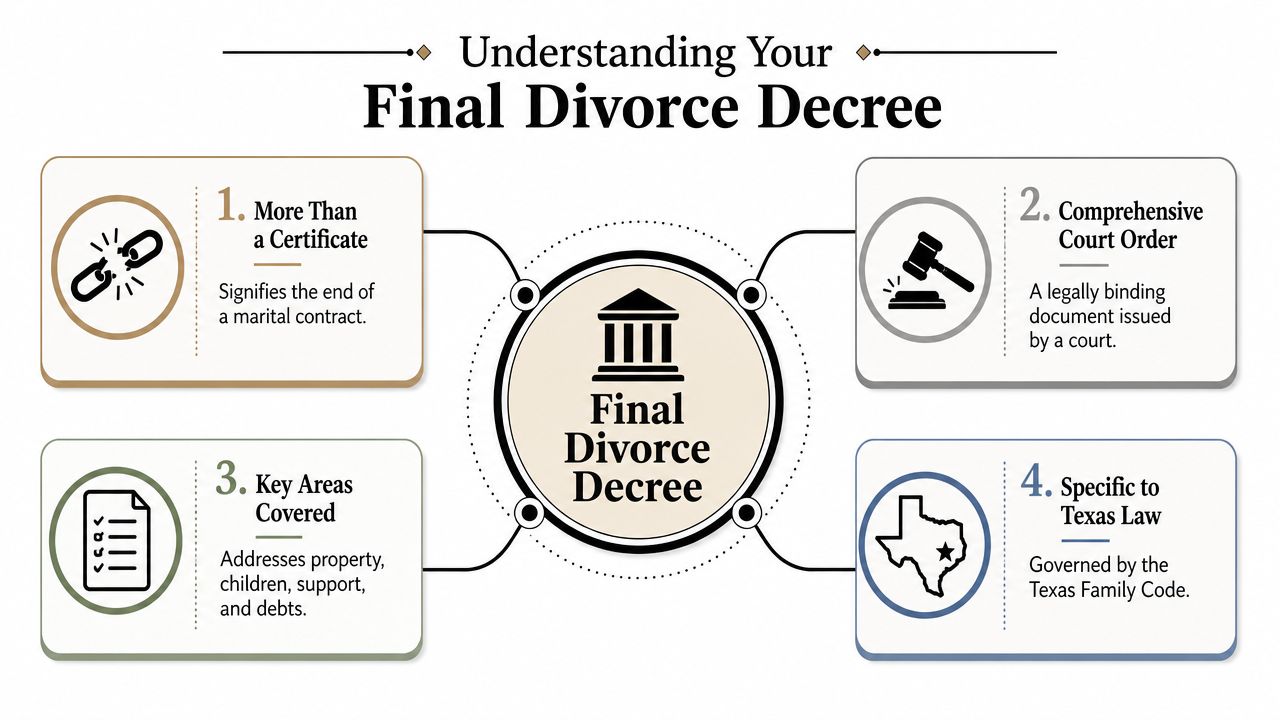
A Final Divorce Decree is the court's written set of instructions for life after the divorce is over. It ends the marriage, but it also does much more than that. In practice, this is the document you will return to when you need to divide accounts, transfer property, follow parenting rules, or prove what the court ordered.
A lot of people confuse the decree with a divorce certificate. The difference matters. A divorce certificate is usually a short government record showing that the divorce happened, while the decree contains the actual terms of the court's judgment, as noted in the U.S. Census Bureau explanation of marriage and divorce records.
The easiest way to understand it is this. The certificate confirms your status. The decree gives the instructions.
What you will usually find inside
In Texas, the decree usually gathers every final ruling that affects your day-to-day responsibilities after divorce. Depending on your case, it may include:
- Language ending the marriage
- Property division terms for a house, vehicles, bank accounts, retirement benefits, business interests, and personal property
- Debt allocation showing who must pay credit cards, loans, taxes, or other obligations
- Orders involving children such as conservatorship, possession, access, and decision-making rights
- Child support terms including payment details and medical support
- Spousal maintenance or contractual alimony terms
- Name change language restoring a prior name, if requested
If you are a parent, this section often causes the most confusion because Texas uses words like conservatorship, possession, and access where many people would say “custody” or “visitation.” If you own property with your former spouse, the decree should also say what must happen next, not just who gets what. For example, it may require a deed, a vehicle title transfer, a Qualified Domestic Relations Order for retirement funds, or a deadline to refinance a mortgage.
That practical piece is what people often miss.
Your decree is not only a summary of what the judge decided. It is the post-divorce toolkit you use to carry out those decisions in practice. Banks, title companies, retirement plan administrators, schools, and insurance carriers often need the decree, or a related follow-up document referenced in it, before they will act.
That is why I tell clients to read the decree like a checklist, not just a courtroom form. Ask: What does this require me to sign, transfer, pay, update, or calendar?
You may need your decree when you:
- Refinance or sell a home
- Retitle a vehicle
- Divide a retirement account
- Change your name with government agencies and employers
- Update insurance, payroll, and beneficiary records
- Show the exact parenting terms that control exchanges, holidays, or school decisions
- Enforce a missed payment or missed transfer later
If you are trying to organize the records that matter after a major legal event, a broader 2026 guide to legal paperwork can help you sort out which documents deserve a permanent place in your files. And if you want a Texas-specific checklist focused on what to handle once the decree is signed, After Your Texas Divorce Is Final: Next Steps is directly on point.
The decree answers the question, “What do I need to do now, and what can I make the other person do if they do not follow the order?”
From Temporary Orders to Final Judgment
During a Texas divorce, many families live under temporary orders. Those are short-term rules the court puts in place while the case is pending. They may cover who stays in the house, who pays certain bills, when each parent has the children, and whether temporary support will be paid.
When the judge signs the final decree, that final order becomes the controlling document.
Why the change matters
Temporary orders are built to stabilize a difficult situation. A final decree is built to close the case and define the long-term legal terms. If there was something in your temporary orders that you wanted to continue, it should have been carried into the final decree with clear language.
That is one reason review matters so much before signing. A detail that felt understood during mediation or a hearing can create problems later if it wasn't written into the final order.
For a closer look at how these early court orders work during a Texas divorce, this guide to temporary orders hearings in a Texas divorce gives useful context.
Temporary Orders vs. Final Divorce Decree
| Aspect | Temporary Orders | Final Divorce Decree |
|---|---|---|
| Purpose | Manage daily life while the divorce is pending | End the marriage and state the final rights and duties of both parties |
| Duration | Short-term, until replaced or the case ends | Ongoing, unless a modifiable part is later changed by court order |
| Legal effect | Enforceable while active | Enforceable as the final judgment in the case |
| Property use | May control temporary use or possession | Divides ownership and responsibility on a final basis |
| Parenting rules | Creates an interim schedule | Sets the final parenting terms that apply after divorce |
| Support | May require temporary support | Sets final child support and any spousal support obligations |
| What happens after signing | Usually no longer controls once superseded | Becomes the document everyone must follow |
A mistake I see often
A parent will say, “We already had that schedule during the case, so I assumed it stayed in place.”
Sometimes it does. Sometimes it doesn't. The answer depends on what the final decree says.
Courts enforce signed orders, not assumptions. Read the final language line by line before you leave the divorce process behind.
The Binding Legal Power of Your Decree
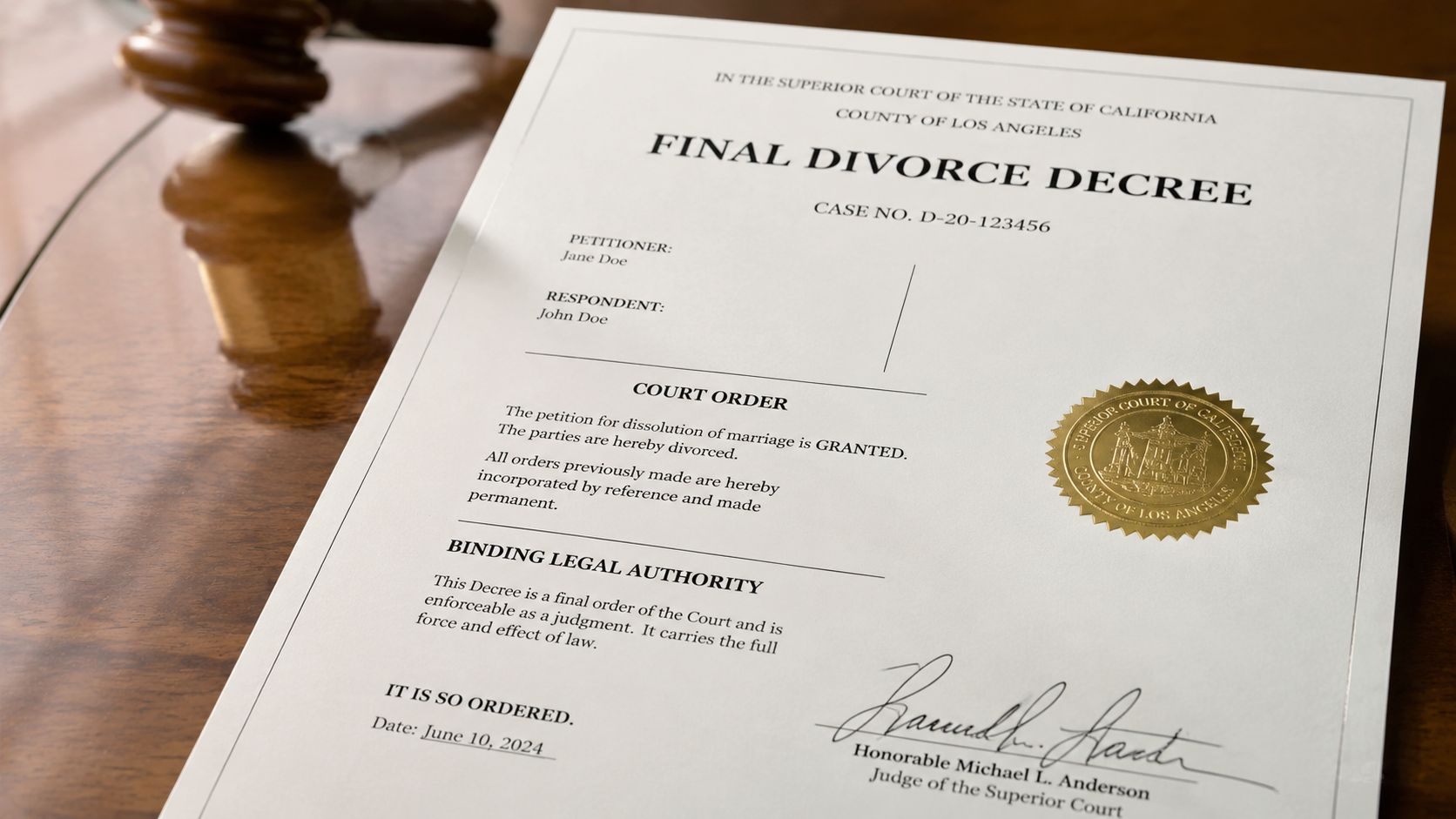
The reason this document matters so much is simple. Your decree is enforceable because it is a court order.
That legal force is important in a very practical way. According to the divorce statistics summary from WF Lawyers, there were 630,505 divorces in the United States in 2020, reflecting a rate of 2.3 per 1,000 people. In that same source, the decree is described as the primary legal tool for enforcing the division of assets, liabilities, and support payments. That gives you a sense of how many families depend on a clear, enforceable final order each year.
Property and debt provisions
For many Texans, the biggest issue is property. Your decree may award a house, retirement funds, business interests, vehicles, investment accounts, or personal property. It may also assign debts.
Under the Texas Family Code, the court addresses division of the marital estate in the final order. Once that division is final, the decree becomes the document you use to transfer title, close accounts, or prove who is responsible for a debt. If your former spouse doesn't sign the documents required by the decree, the court may be able to step in through enforcement procedures.
If you own a business or have a high-value estate, precision matters even more. Vague terms create expensive disputes. Specific language about ownership interests, valuation-related terms, account transfers, and deadlines gives you a stronger path to compliance.
Custody and parenting enforcement
For parents, the decree often includes the final conservatorship and possession provisions. In everyday terms, this is the schedule and decision-making structure for your children.
That means the order can answer questions like:
- When do exchanges happen
- Who decides educational issues
- Who carries health insurance
- How holiday time is divided
- What each parent must do when plans change
If one parent refuses to follow those terms, the decree gives the court something concrete to enforce.
Support obligations
Child support and, in some cases, spousal support become legal duties once included in the decree. Those duties are not optional. If someone falls behind or ignores payment requirements, the other party may ask the court for enforcement.
If you're dealing with a former spouse who is ignoring the order, this resource on contempt of court in a Texas divorce explains how courts can respond when a party refuses to comply.
Enforcing and Modifying Your Divorce Decree
Divorce decrees are final, but they are not all final in the same way. Many people often misunderstand this distinction.
Some parts of the decree are usually fixed. Other parts can change if life changes enough.
What can usually be enforced
If your former spouse doesn't do what the decree requires, Texas law gives you a path back to court. Enforcement cases often involve missed child support, failure to transfer property, refusal to follow possession orders, or nonpayment of obligations assigned in the decree.
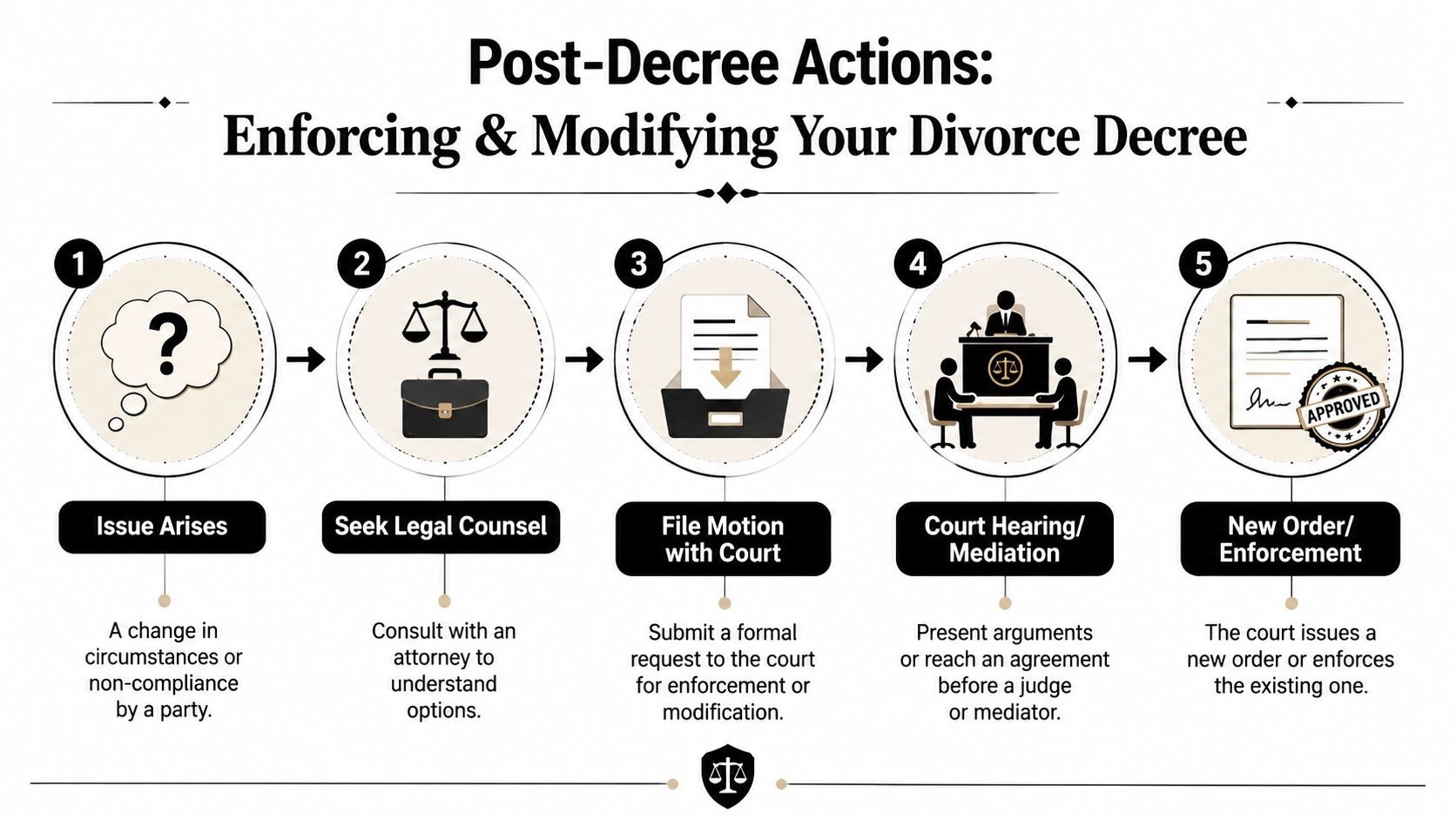
A basic enforcement path often looks like this:
Read the order carefully
Courts enforce the words that are in the decree. The first question is whether the order is specific enough to enforce.Gather proof
Keep payment records, messages, calendars, account statements, and copies of the decree. Dates matter.Identify the violation clearly
“He never cooperates” is not enough. “She failed to return the child at the court-ordered time on these dates” is much stronger.File the proper motion
In Texas, enforcement usually requires a formal filing in the court that issued the order.Attend hearing or mediation if required
The court may hear evidence, review records, and decide what remedy fits the violation.
What can usually be modified
A critical feature of the decree is its division into modifiable and non-modifiable components. While property division is typically final once the appeal window closes, ongoing obligations like child custody and support can be changed later if circumstances significantly change, making the decree a long-term governance tool, as explained in this discussion of divorce decree modifiability.
In practical terms, Texas courts may consider modification when there has been a material and substantial change in circumstances. That can arise in situations like:
- A parent relocates and the current possession schedule no longer works
- A child's needs change in a meaningful way
- Income changes significantly, affecting child support analysis
- One parent's schedule changes so much that the old order no longer fits real life
Property division is different. Once final, it is usually not something you can reopen just because you regret the deal or wish the outcome had been different.
If your concern is about children or support, modification may be possible. If your concern is about who got the house or a retirement account, the answer is usually enforcement, clarification, or appeal-related analysis, not a new division.
How to think about the choice
Ask yourself one question first. Is the order being violated, or has life changed so much that the order no longer fits?
If the problem is noncompliance, think enforcement.
If the problem is a major life change, think modification.
That distinction can save you time, money, and frustration.
Your Practical Checklist After the Decree Is Signed
The judge signs your decree. You walk out of court with a sense of relief. A week later, practical questions start. Who refinances the car loan? How do you get your name off a joint credit card? Does your child's school need a copy of the possession schedule?
That is why your Final Divorce Decree matters after court. It works like the instruction manual for your post-divorce life. It tells you what must be transferred, paid, updated, signed, delivered, and tracked. If you put it in a drawer and never use it, small administrative problems can turn into expensive legal problems.
Start with the documents
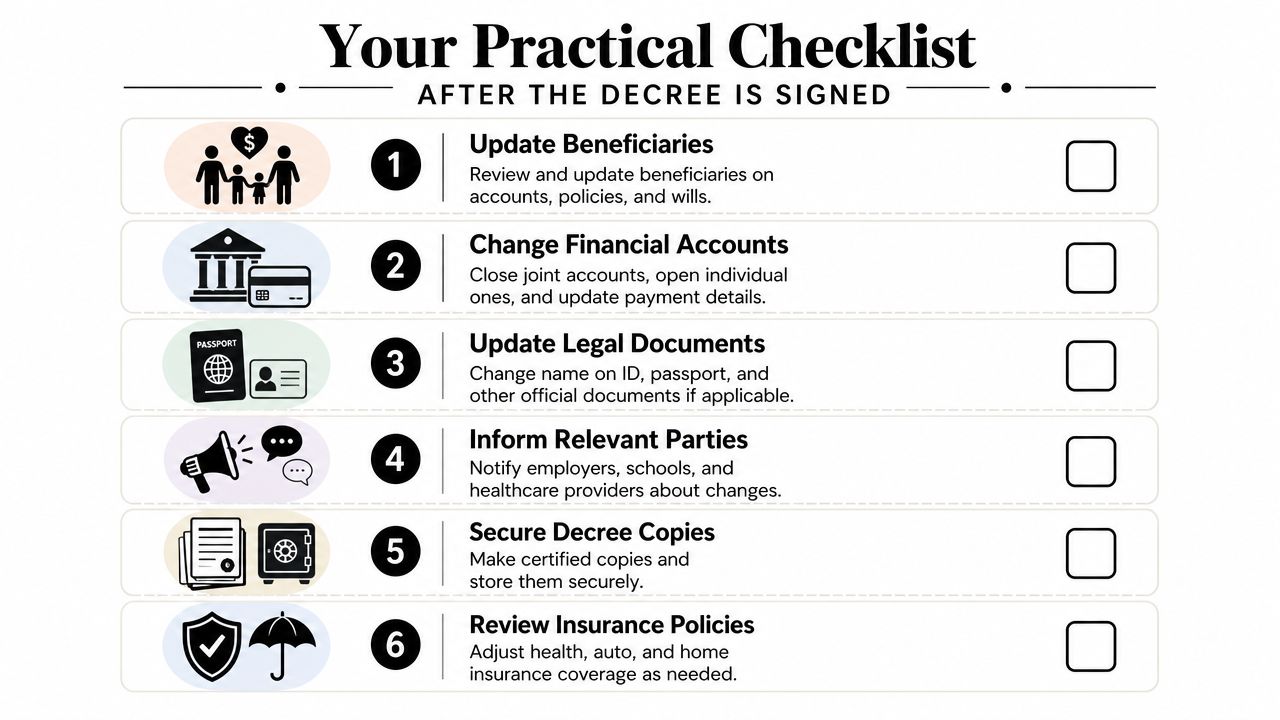
Get several certified copies of the decree and keep both paper and digital versions in a secure place. You may need them for title work, retirement transfers, school enrollment questions, name changes, passport updates, or lender requests.
Then read the decree from start to finish with a pen or highlighter. Mark every deadline, every transfer requirement, and every step that depends on a separate document, such as a deed, vehicle title transfer, or retirement division order. Many people assume the decree does all the work by itself. In practice, the decree often tells you what still needs to be done.
If your prior name was restored, start updating your records promptly. That usually includes your driver's license, Social Security information, passport, payroll records, bank accounts, and insurance records.
Then handle money, property, and debt
This part deserves careful attention. A decree may assign responsibility for a debt, but the lender is not bound by your divorce case if both spouses signed the original contract. In plain terms, your decree tells your former spouse who is supposed to pay. It does not automatically remove your name from the account.
Work through the property and debt terms line by line:
- Close or separate joint accounts to stop new charges and avoid confusion
- Retitle vehicles and real estate as ordered
- Refinance debts if the decree requires one party to remove the other from liability
- Follow up on retirement division if a QDRO or other separate order is still needed
- Update autopay settings tied to old joint accounts
- Save proof of each completed step such as receipts, confirmations, statements, and filed documents
If debt is part of your post-divorce stress, a general family debt management guide may help you build a plan for reorganizing obligations after the case ends.
Here's a practical video overview many Texans find useful during this stage:
Do the follow-through that many people miss
Some of the most important tasks are easy to overlook because they are not dramatic. They are administrative. They still matter.
Review beneficiary designations on life insurance, retirement accounts, and other financial accounts. Check your will, powers of attorney, medical directives, and emergency contact information. If your decree awards the house to one spouse, confirm that deed work, mortgage notices, homeowners insurance, and tax mailing addresses all match the new arrangement.
If you have children, give the right people the right information. Schools, daycare providers, doctors, counselors, and activity programs may need updated emergency contacts, pickup permissions, and copies of the relevant possession or conservatorship terms. A parenting plan only works if the adults around your child know what it says.
Build a post-decree file
Create one folder for everything related to compliance with the decree. Include certified copies, emails, payment records, screenshots, refinancing updates, transfer documents, and notes of conversations. If the other party fails to do something required by the decree, this file can become the foundation for an enforcement case. Good records save time and reduce disputes about who did what.
You should also calendar review dates. One review in 30 days, another in 90 days, and another around tax season can catch missed items before they grow into bigger problems.
If you want a fuller Texas-specific roadmap for post-divorce tasks, this guide on what happens after a divorce is final in Texas is a good next read.
What to do next
Use your decree as a working checklist. Read every page. Track every deadline. Keep proof of what you completed and what your former spouse still owes under the order.
If your case involves a business, retirement assets, real property, or ongoing custody concerns, post-decree legal work may matter as much as the divorce itself. The Law Office of Bryan Fagan, PLLC handles Texas family law matters including divorce, custody, support, mediation, enforcement, and post-divorce modification.
If you have questions about your Final Divorce Decree, or you're worried that your order is incomplete, being ignored, or no longer fits your family's needs, schedule a free consultation with the Law Office of Bryan Fagan, PLLC. You deserve clear answers, practical next steps, and a plan that protects your children, your property, and your peace of mind.