Skip to content
Your divorce may be over on paper, but the problems that follow often aren't. A parenting schedule stops working, support no longer fits the budget, or your former spouse ignores the property terms in the decree and acts like the order is optional.
That's usually when people ask, can a divorce decree be changed after it's final? In Texas, the honest answer is: sometimes, but it depends on what you're trying to change. Issues involving children and some future support obligations may be modified. Property division usually can't be rewritten once the decree is final, though the court may still enforce or clarify what the decree already says.
If your divorce involved betrayal or hidden behavior that affected the marriage, it can also help to understand the broader infidelity and divorce implications before deciding whether your concern is really about post-divorce modification, enforcement, or a more serious challenge to the original judgment.
The Finality of a Divorce Decree and When Life Intervenes
A final divorce decree is a court order. It is meant to bring closure, set rules, divide rights and duties, and let you move forward. That finality matters because people need to know they can rely on court orders.
But family life doesn't stay frozen. Your work hours may change. A child may develop new educational or medical needs. One parent may relocate. A former spouse may stop following the property terms altogether. What felt workable at the end of the divorce may stop working later.
That doesn't mean the whole case starts over.
In Texas family law, the first question isn't whether you're unhappy with the decree. The question is what kind of problem you have. If the issue involves children or future support, modification may be the right path. If the issue involves a spouse refusing to do what the decree already requires, enforcement or clarification may be the answer. If the original decree was affected by fraud, mistake, or another serious defect, a direct challenge may be necessary.
Practical rule: A final decree is binding, but some parts of it are designed to respond to changing circumstances. Other parts are designed to stay final.
That distinction is where many people get stuck. They try to “change” something the law treats as fixed, or they file for enforcement when what they really need is a modification. Both mistakes cost time.
You're in a better position when you sort your problem into the right legal lane early. That starts with understanding the three basic paths available after a decree is final.
Modification Enforcement or Appeal Understanding Your Options
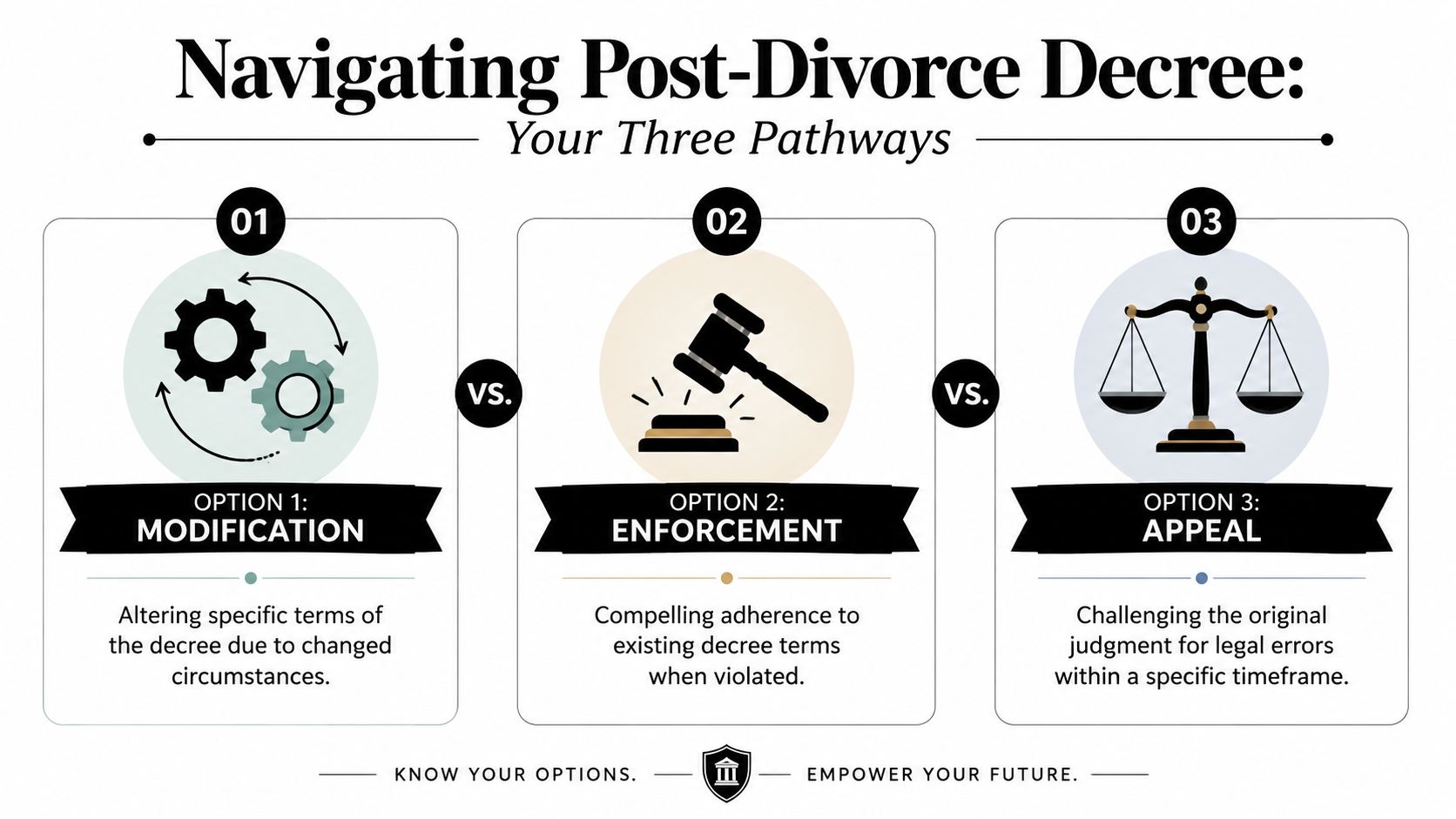
If you're dealing with a post-divorce dispute, think in terms of a decision tree. Are you trying to change future terms, force compliance with existing terms, or attack the validity of the original judgment? Those are very different actions.
Modification
A modification asks the court to change certain obligations going forward because circumstances have materially changed. Across family-law jurisdictions, the basic rule is that only some parts of a final decree are modifiable, usually when there has been a material or substantial change in circumstances. Courts commonly reconsider child custody, visitation, child support, and spousal support, while property division is usually not reopened except in narrow situations such as fraud, misrepresentation, or clerical error, as explained in this discussion of when a final divorce decree may be modified.
Examples include:
- Parenting problems: The possession schedule no longer fits the child's school or activity schedule.
- Income changes: A parent loses a job or has a major shift in earnings.
- Support issues: Ongoing support terms no longer fit current circumstances.
Enforcement or clarification
An enforcement case does not ask the court to rewrite the decree. It asks the court to make the other party follow it. That matters most in property disputes. If your former spouse won't transfer title, won't turn over retirement funds, won't refinance debt as ordered, or won't deliver property awarded in the divorce, enforcement may be the proper remedy.
A clarification order can also help when the decree's wording is too vague to carry out, but the court still isn't supposed to make a new property division under the guise of “clarifying” the old one.
For a closer look at what that process can involve, review this guide on how to enforce a divorce decree in Texas.
Appeal or setting aside the judgment
An appeal or a request to set aside part of the judgment is different from both modification and enforcement. This route is about the validity of the original order itself. People usually consider it when they believe the decree was affected by serious legal error, fraud, misrepresentation, duress, incapacity, or a clerical mistake.
This path is more limited and more time-sensitive than generally assumed. It's not a second chance because you regret the bargain you made. Courts care about finality, especially in property division. A disappointed party usually needs more than “the result feels unfair.”
Here's the shortest way to sort your situation:
| Problem | Likely path |
|---|---|
| Child schedule no longer works | Modification |
| Support amount no longer fits present reality | Modification |
| Ex won't obey the decree | Enforcement |
| Decree language is too unclear to carry out | Clarification |
| Original judgment was affected by fraud or serious error | Appeal or setting aside |
The right filing depends less on your frustration and more on the legal character of the problem.
What Parts of a Texas Divorce Decree Are Modifiable
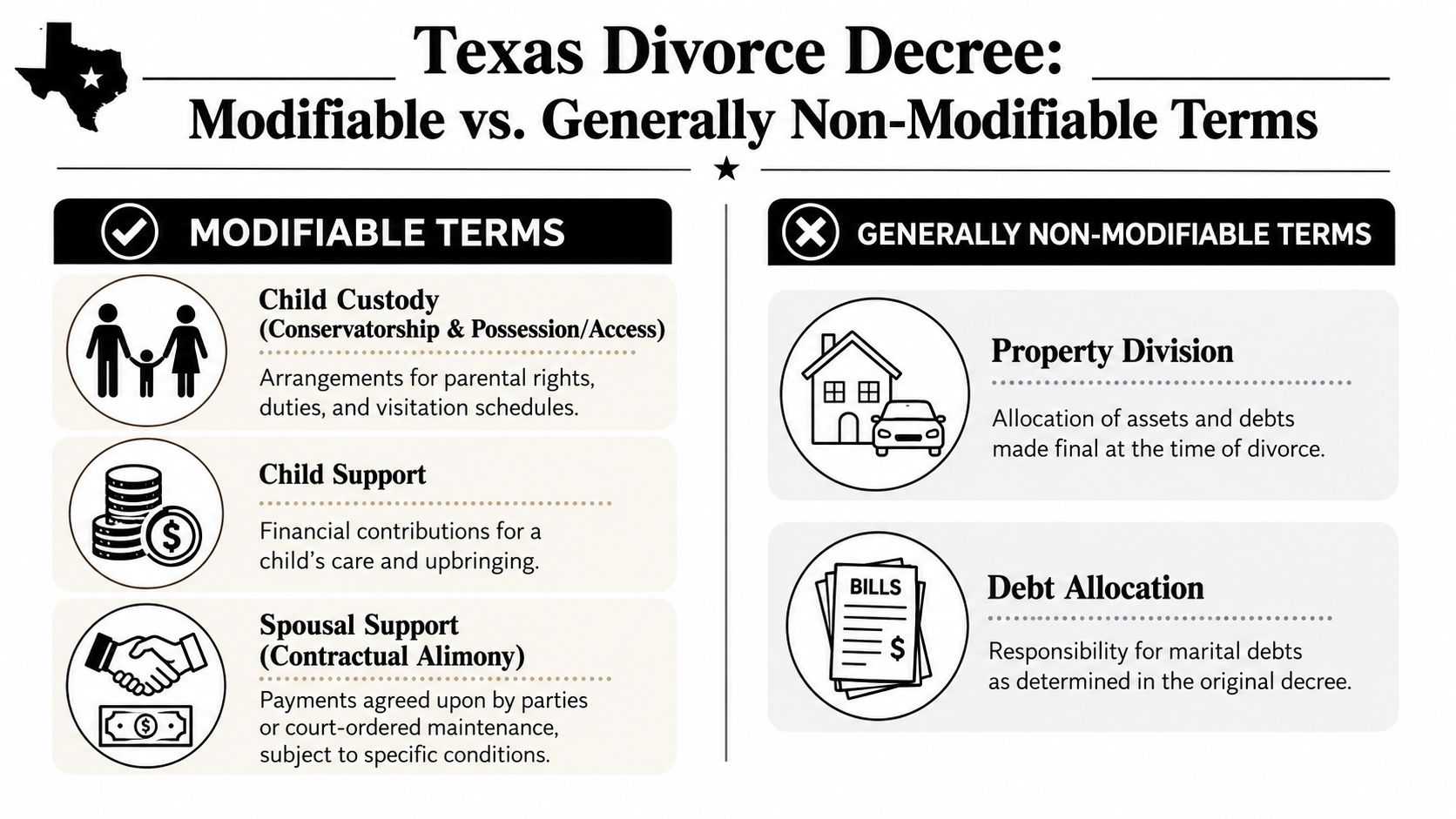
Most post-divorce confusion comes from treating every part of the decree the same way. Texas law doesn't. Some terms are built around ongoing family needs. Others are intended to stay settled.
Child custody and possession
Orders involving conservatorship, possession, and access are often the most realistic candidates for change. Children grow up. School schedules shift. Transportation problems develop. Safety concerns can arise. A parenting plan that made sense at the time of divorce may stop fitting the child's best interests later.
Texas courts focus heavily on whether the requested change serves the child, not whether one parent merely prefers a different arrangement. A workable request usually identifies a real change in the child's life or the parents' circumstances and connects that change to a concrete parenting need.
Common examples include:
- Relocation concerns: One parent moves far enough away that exchanges and school attendance become difficult.
- Developmental changes: A very young child's schedule no longer fits an older child's school and activity demands.
- Health or safety issues: New concerns affect the child's wellbeing.
- Chronic conflict: The existing order creates repeated breakdowns that harm stability.
If your concern centers on parenting time, conservatorship, or visitation, this resource on how to modify a custody agreement in Texas is a useful starting point.
Child support
Child support is also often modifiable because it addresses an ongoing obligation, not a one-time division of assets. When a parent's financial circumstances shift in a meaningful way, or a child's needs change, the support order may need to be revisited.
The focus is current reality. The court wants to know what is happening now, whether the change is ongoing, and how the requested adjustment affects the child.
A practical way to consider this:
| Situation | What the court usually wants to see |
|---|---|
| Income dropped | Evidence the change is real and continuing |
| Income increased | Reliable proof of current earnings |
| Child needs changed | Records showing the new need is genuine |
| Payment problems built up | A prompt request, not delay and hope |
Spousal maintenance and related support
Some support terms can be changed, but these cases are usually narrower and more fact-specific than people expect. The key issue is whether the obligation is one the law allows to be revisited and whether there has been a meaningful ongoing change in circumstances.
A court generally looks forward, not backward. As explained in this overview of modifying a final divorce decree for future obligations, final decrees are usually modifiable only as to future obligations, while courts generally won't retroactively rewrite past-due amounts or reopen the property split.
Client-side reality: Waiting too long can make a support problem harder. Even when relief is possible, courts often focus on what should happen next, not on undoing what already came due.
Property division and debt allocation
Many people find the news unwelcome: Property division is generally not modifiable after the decree is final. If the decree awarded the house, retirement account, vehicle, business interest, or debt responsibility in a certain way, the court usually won't later revisit that division just because one party now thinks it was a bad deal.
That rule matters a great deal for:
- Business owners dealing with entity interests, records, and transfer obligations
- People with high-value estates who divided retirement accounts, real property, or investment assets
- Spouses assigned debt who later discover the other party won't cooperate
In those cases, the better question usually isn't “Can I modify this?” It's “Do I need enforcement, clarification, or a direct challenge based on fraud or another serious defect?”
Proving a Substantial Change in Circumstances
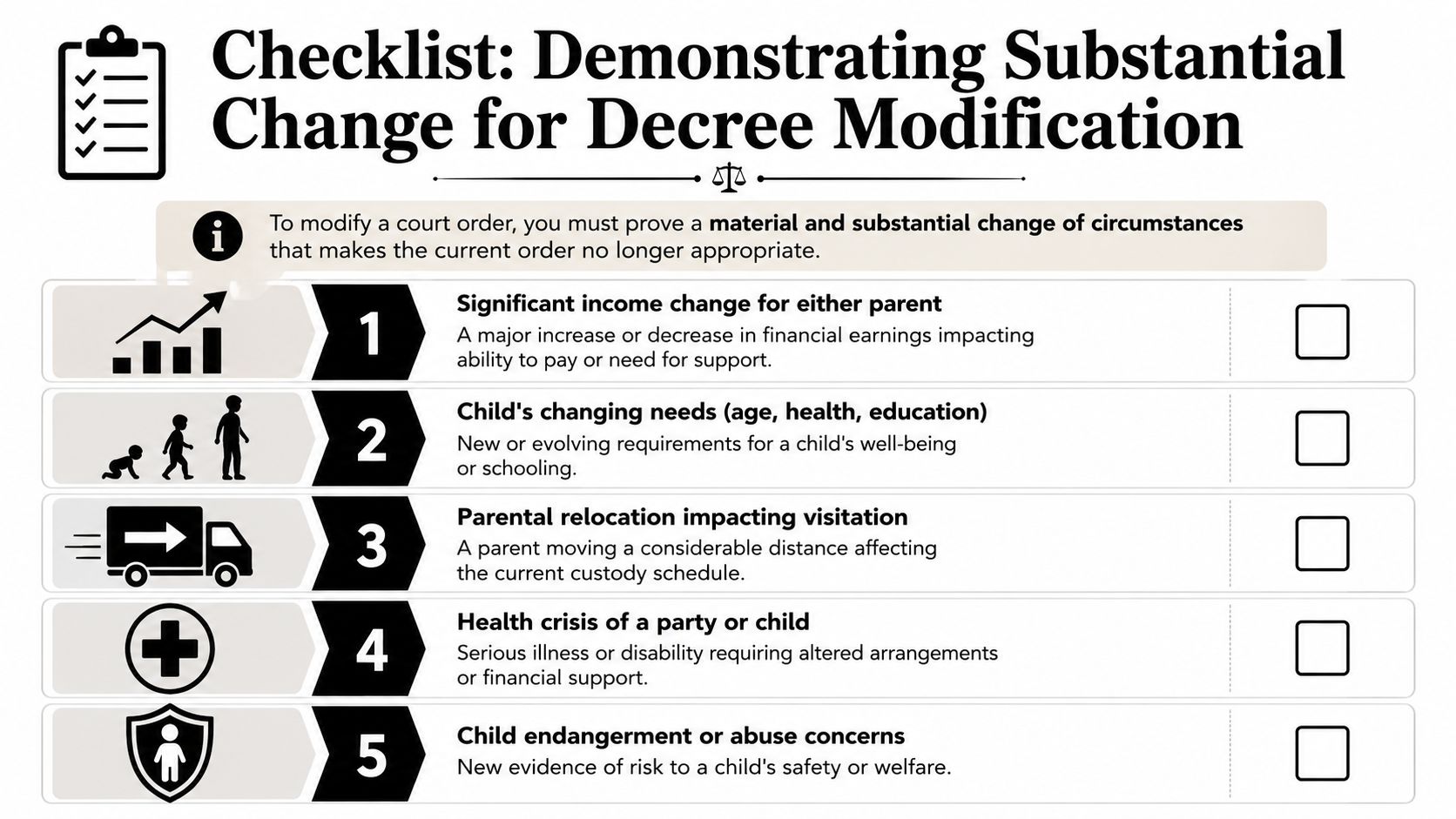
Most modification requests rise or fall on one phrase: material and substantial change in circumstances. In plain English, that means the facts have changed enough, and for long enough, that the current order no longer works fairly or practically.
A temporary inconvenience usually isn't enough. Judges look for a change that is ongoing, meaningful, and supported by evidence.
What courts often consider important
The main trigger for post-decree relief is a continuing, material change that makes the original order unworkable. Examples commonly include job loss, major income shifts, disability, relocation, or changed child needs. The burden is on the moving party to file the request and prove the change with evidence, as outlined in Justia's discussion of modification of final divorce judgments.
That standard becomes clearer when you translate it into day-to-day situations:
- Employment disruption: You lost your job, changed industries, or had your hours cut, and the reduction isn't just a short-term setback.
- Major earnings change: Your former spouse's income has changed enough to affect support fairness.
- Relocation: A move now interferes with exchanges, school attendance, or the child's routine.
- Medical developments: A parent or child now has a health condition that changes care needs or financial needs.
- Changed child needs: Tutoring, counseling, school issues, or other developments make the old order outdated.
For a Texas-focused explanation of how lawyers and courts evaluate this standard, read more about material circumstances in Texas family law.
What evidence usually helps
Judges don't modify orders because someone feels frustrated. They modify orders because evidence shows that the facts have changed.
Useful proof often includes:
- Income records: Pay stubs, tax returns, termination notices, or disability paperwork
- School records: Attendance issues, schedules, behavior reports, or academic documentation
- Medical records: Diagnoses, treatment plans, or cost-related records
- Communication history: Messages that show repeated schedule breakdowns or refusal to cooperate
- Calendar evidence: A detailed log of missed visits, changed exchanges, or actual parenting time
Bring documents, not just conclusions. “Things are worse” is an opinion. A timeline, records, and messages give the court something it can act on.
What usually doesn't work well
Some requests fail because the change is too vague or too self-created. Courts often look skeptically at claims based on ordinary irritation, avoidable financial decisions, or short-lived disruptions.
These examples often create trouble:
- A brief dip in income with no proof it will continue
- Voluntary underemployment without a strong explanation
- General conflict with the other parent that doesn't affect the child in a meaningful way
- Buyer's remorse about the original decree
The strongest cases are specific. They show what changed, when it changed, why it matters, and what new order would solve the problem.
The Process for Changing Your Decree in Texas
Once you know which path applies, the process becomes more manageable. A modification case is a lawsuit. An enforcement case is also a lawsuit. Each requires the correct filing, the right evidence, and attention to deadlines.
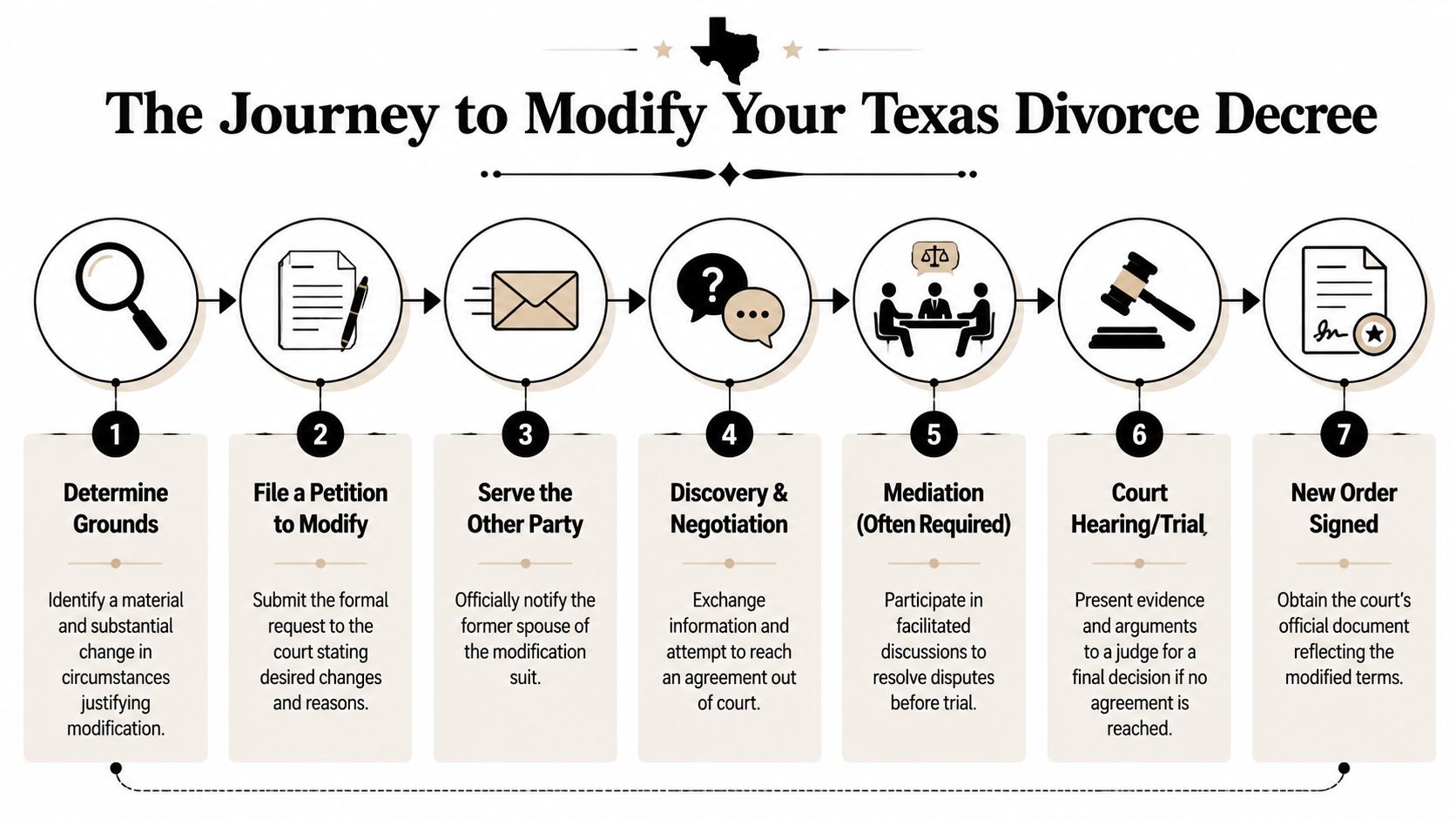
A visual overview can help before diving into the steps.
Start with the right legal request
The first job is matching the facts to the proper pleading. If you need to change conservatorship, possession, child support, or another future obligation, you generally file a modification request. If your former spouse isn't carrying out property terms already ordered, you generally pursue enforcement or possibly clarification.
That distinction matters a great deal in Texas property cases. Texas Law Help explains that a final divorce decree cannot be changed through enforcement, and that an enforcement order cannot alter, amend, or modify the original division of property. The same resource explains that Texas gives a 2-year statute of limitations for filing most suits to enforce a property division, measured from the date the decree is signed or becomes final after appeal, whichever is later, and that a party generally must wait at least 30 days after the decree is signed before seeking enforcement. It also notes that court costs and reasonable attorney's fees may be available in enforcement actions. Review those rules in this guide to enforcing the property division in a Texas divorce.
File, serve, and gather evidence
After the case is filed, the other party must be formally served unless service is waived in a legally valid way. Then comes the practical work: gathering documents, updating financial records, organizing communication history, and identifying witnesses if needed.
Many people underestimate this phase. The paperwork often decides whether a case settles or reaches a hearing. If you're a business owner, that may mean gathering compensation records, profit distributions, and documents showing whether an income change is temporary or ongoing. If you're a parent, it may mean school records, medical updates, or transportation logs.
This overview may also help if you want a plain-language walk-through of the court process:
Expect negotiation and often mediation
Texas courts often expect parties to try to resolve family-law disputes before trial. In many counties, mediation is a regular part of the process. It can work well when both parties understand the legal limits and have enough documents to negotiate from reality instead of emotion.
Mediation is especially useful when:
- The dispute is narrow: You only need to adjust a few parenting terms.
- Communication still functions: You and your former spouse can negotiate with structure.
- You want more control: A mediated agreement often gives you more flexibility than a trial result.
The Law Office of Bryan Fagan, PLLC handles both modification and enforcement matters, which means clients who are trying to change future terms or compel compliance with an existing decree usually need a strategy built around the correct filing first, not just a general request for “help after divorce.”
If settlement fails, the judge decides
When no agreement is reached, the court hears evidence and makes a ruling. That hearing may be short and focused, or it may look more like a trial depending on the issues involved.
The judge will want clear answers to basic questions:
- What exactly are you asking to change or enforce?
- What facts changed, if modification is requested?
- What proof supports your position?
- Why is your requested relief legally allowed?
People who do best in these hearings usually keep their requests narrow, their records organized, and their expectations realistic.
What to Do Next Taking Control of Your Post-Divorce Future
Post-divorce problems feel personal because they are personal. Your finances, your time with your children, and your ability to move on are all tied to what that decree says and whether it still works.
The good news is that you don't have to guess your way through it.
Key takeaways
A final decree in Texas is final in an important sense, but not every part of it is untouchable. The practical rule is simpler than it first appears:
- Child-related terms and some future support obligations may be changed if there has been a meaningful change in circumstances.
- Property division usually stays final, even when one party later regrets the outcome.
- Enforcement is not modification. If your former spouse is ignoring the decree, the solution is often to compel compliance, not rewrite the property terms.
- Evidence matters more than frustration. Courts respond to records, timelines, and specific facts.
The most effective next step is usually not filing quickly. It's identifying the right legal path before you file.
A short checklist before you act
Start with your documents. Pull together the final decree, any later court orders, financial records, school records, medical documents, and written communications with your former spouse.
Then write down two things in plain language:
- What changed
- What result you want
That exercise sounds simple, but it often reveals whether you're asking for a modification, an enforcement action, or advice about whether the original judgment itself should be challenged.
If children are involved, keep your focus on stability and wellbeing. Many parents benefit from outside guidance on the emotional side of transition too. This integrative guide for parents offers helpful perspective on supporting children through divorce-related change.
Why legal advice matters here
These cases often go wrong for one reason: people choose the wrong remedy. They ask to modify property division, try to enforce terms that are too vague to enforce cleanly, or wait too long to protect their rights.
A calm legal review can help you answer the questions that matter most:
- Is your issue modifiable?
- Do you have enough proof?
- Are you still within the relevant deadline?
- Would negotiation or mediation solve this faster than a hearing?
If you're asking whether a divorce decree can be changed after it's final, you're really asking a more useful question. What can I still do, and what's the smartest next move in my specific case?
You don't have to sort that out alone. If your custody order no longer fits your child's life, your support terms need review, or your former spouse isn't following the decree, schedule a free consultation with Law Office of Bryan Fagan, PLLC. You can get a clear assessment of whether your situation calls for modification, enforcement, or another form of post-divorce relief under Texas law.