Skip to content
It’s beyond frustrating when your ex-spouse treats your legally binding divorce decree like a list of optional suggestions. You went through the difficult court process, hoping for closure and a clear path forward, only to have the judge's final orders completely ignored. Thankfully, a Texas divorce decree is an enforceable court order, not a request, and you have powerful legal tools at your disposal to demand compliance.
What Happens When Your Ex Ignores the Divorce Decree

The feeling of powerlessness that comes with a non-compliant ex can be overwhelming. You may have spent months, or even years, finalizing your divorce, hoping the final decree would bring stability. Instead, you're left dealing with missed payments, broken promises about visitation, and constant disruption to your life.
You are not helpless. The Texas Family Code provides a specific and powerful way to handle these exact problems. Your divorce decree is a court order, and a judge has the authority to make sure its terms are followed.
Introducing the Motion for Enforcement
The primary legal tool you'll use to hold your ex-spouse accountable is called a Motion for Enforcement. This is a formal legal document you file with the same court that granted your divorce. In plain English, it spells out exactly how, when, and where your ex has violated the decree.
Filing this motion officially starts a legal process that can lead to a finding of contempt of court divorce Texas. Think of it as formally telling the judge, "The rules we all agreed to are being broken, and I need your help to fix it." The goal isn't just to point fingers; it's to compel your ex to comply with their legal obligations and restore order for you and your family.
What Can Be Enforced?
A Motion for Enforcement is a versatile tool that can be used to address violations across nearly every part of your divorce decree.
- Financial Obligations: This is one of the most common issues. It covers everything from unpaid child support and spousal maintenance to a failure to pay off a specific debt or correctly divide a retirement account as ordered.
- Property Division: If your ex is refusing to sign over a car title, won't cooperate with selling the marital home, or refuses to hand over personal property that was awarded to you, this motion forces the issue.
- Parenting and Custody: This is crucial for your children's stability. An enforcement action can address situations where your ex denies your court-ordered visitation, fails to return the children on time, or makes major decisions without consulting you in violation of your custody order.
Once you understand that your divorce decree carries the full weight of the law, you can shift from a position of frustration to one of empowered action. This process is your path to ensuring the agreements from your divorce are honored.
Understanding Contempt of Court in a Texas Divorce
It’s a gut-wrenching feeling when your ex-spouse simply ignores the court orders that were meant to bring stability to your new life. That divorce decree is the official rulebook for how your post-divorce life is supposed to work, and contempt of court is the consequence for intentionally breaking those rules.
When you file a Motion for Enforcement, you are formally asking a judge to hold your ex accountable for failing to follow the court's orders. To build a strong case, you first need to understand the two different kinds of contempt a Texas judge can use: civil contempt and criminal contempt. Each has a different goal, and knowing the distinction will help you and your attorney choose the right strategy.
Civil Contempt Aims to Force Compliance
The main purpose of civil contempt isn't to punish your ex for past wrongdoing. Instead, it’s all about compelling them to do what they were ordered to do right now. Think of it as a tool to force compliance.
For example, let's say your divorce decree awarded you the family car, but your ex is refusing to sign over the title. A judge can find them in civil contempt and order them to jail until they sign the paperwork. The moment they comply, they are released. The keys to the jail cell are, quite literally, in their own hands.
A finding of civil contempt is the court’s way of saying, "You will follow this order, and we will keep applying pressure until you do." It’s an incredibly effective tool for enforcing specific actions like property transfers or making a particular payment.
This forward-looking approach works best for clear-cut violations where a single action can fix the problem. While overall divorce rates have seen a slight dip, enforcement actions remain a staple of family court dockets. You can review Texas family law statistics here for more on these trends.
Criminal Contempt Punishes Past Defiance
On the other hand, criminal contempt is all about punishment. It’s not meant to force future compliance; it’s designed to penalize your ex for their past, willful disobedience of a court order. This type of contempt looks backward at what they have already done wrong.
For example, imagine your ex has repeatedly and intentionally blocked your court-ordered weekend visits with your children. A judge can find them in criminal contempt and hand down a punishment like a fixed jail sentence or a specific fine for each time they violated the order. Unlike civil contempt, serving the time or paying the fine is the end of the punishment for that past act.
What Is a "Willful Violation"?
To successfully have your ex held in contempt—whether civil or criminal—you must prove three key things to the judge:
- There was a clear and unambiguous court order in place.
- Your ex-spouse knew about the order.
- Your ex-spouse had the ability to follow the order but deliberately and intentionally chose not to.
That "willful" element is the heart of any contempt case. It's not enough to show your ex didn't do something. You have to prove they could have done it but made a conscious choice not to. This is why gathering solid evidence is so crucial—it demonstrates that their non-compliance was a deliberate act, not just an unfortunate circumstance.
Common Violations That Lead to Contempt Charges
It’s one thing to understand the legal theory behind contempt of court. It’s another to see how it applies to the real-world problems you’re facing. A divorce decree is filled with specific, legally binding instructions, and when your ex ignores them, it can throw your life into financial and emotional chaos. Recognizing these violations for what they are—acts of contempt—is the first step toward holding them accountable.

In a Texas divorce, most contempt actions fall into three main categories: financial, property-related, and child-related. Each one requires clear proof that your ex knew what the order said and intentionally chose to defy it.
Financial Violations
Few things cause more immediate stress than when your ex fails to meet their court-ordered financial duties. These violations directly impact your ability to pay your bills and provide for your children.
Common examples include:
- Failure to Pay Child Support: This is by far the most common violation. Whether payments are consistently late, only partial, or have stopped completely, any deviation from the court-ordered schedule and amount is grounds for enforcement.
- Non-payment of Spousal Maintenance: If your decree awarded you spousal maintenance (alimony), your ex is legally required to make those payments on time and in full.
- Ignoring Medical Support Orders: This can mean failing to keep the children on their health insurance policy or refusing to reimburse you for their share of out-of-pocket medical, dental, or vision expenses.
- Refusing to Pay Ordered Debts: Was your ex ordered to pay off a joint credit card or the loan on a car they kept? If they’ve stopped paying, you can seek enforcement to protect your own credit and financial standing.
Property Division Violations
After the exhausting process of dividing your assets, it is infuriating when an ex refuses to follow through on the final property orders. These actions often feel like a deliberate attempt to keep you financially tangled with them.
Think of your divorce decree’s property section as a legal checklist for separating your financial lives. When your ex refuses to check off their boxes, a contempt action is the tool you use to force them to complete the task.
Key examples of property violations that can lead to a contempt of court divorce Texas finding include:
- Refusing to Sign Over a Title: This is a classic issue with vehicles or the family home. If your ex won't sign the documents needed to transfer ownership, they are violating the order.
- Failure to Refinance a Mortgage: If your ex was ordered to refinance the marital home to get your name off the loan and hasn't, it leaves you financially liable and puts your credit at risk.
- Not Dividing Retirement Accounts: An order to divide a 401(k) or pension isn't complete until the Qualified Domestic Relations Order (QDRO) paperwork is done. Failing to cooperate with this process is a clear violation.
- Withholding Personal Property: This includes everything from furniture and artwork to sentimental items that were specifically awarded to you in the final decree.
Child-Related Violations
For most parents, violations involving their children are by far the most painful. These actions don't just disrespect a court order; they disrupt your child's stability and directly interfere with your fundamental right to be a parent. You are not expected to just tolerate it. Withholding visitation is a particularly serious issue, and you can learn more in our guide on what to do if your ex is withholding visitation in Texas.
Common parenting plan violations include:
- Denying Possession and Access: Consistently refusing to allow your court-ordered parenting time for any reason not related to the child's immediate safety.
- Failing to Return Children on Time: Chronic lateness when returning the children from a visit is not just an annoyance; it's a violation that cuts into your time and disrupts your child's routine.
- Making Unilateral Decisions: Making major decisions about schooling, non-emergency medical care, or religious upbringing without consulting you when the order requires joint decision-making.
- Relocating Without Permission: Moving with the child outside of the geographic area specified in your order without getting court approval or your consent first.
How to File a Motion for Enforcement in Texas
Filing a Motion for Enforcement is the formal step you take to ask a judge to make your ex-spouse follow the rules of your divorce decree. It sounds serious because it is. This is where you stop making requests and start demanding accountability. Let's walk through the roadmap, turning that frustration into a focused legal plan.
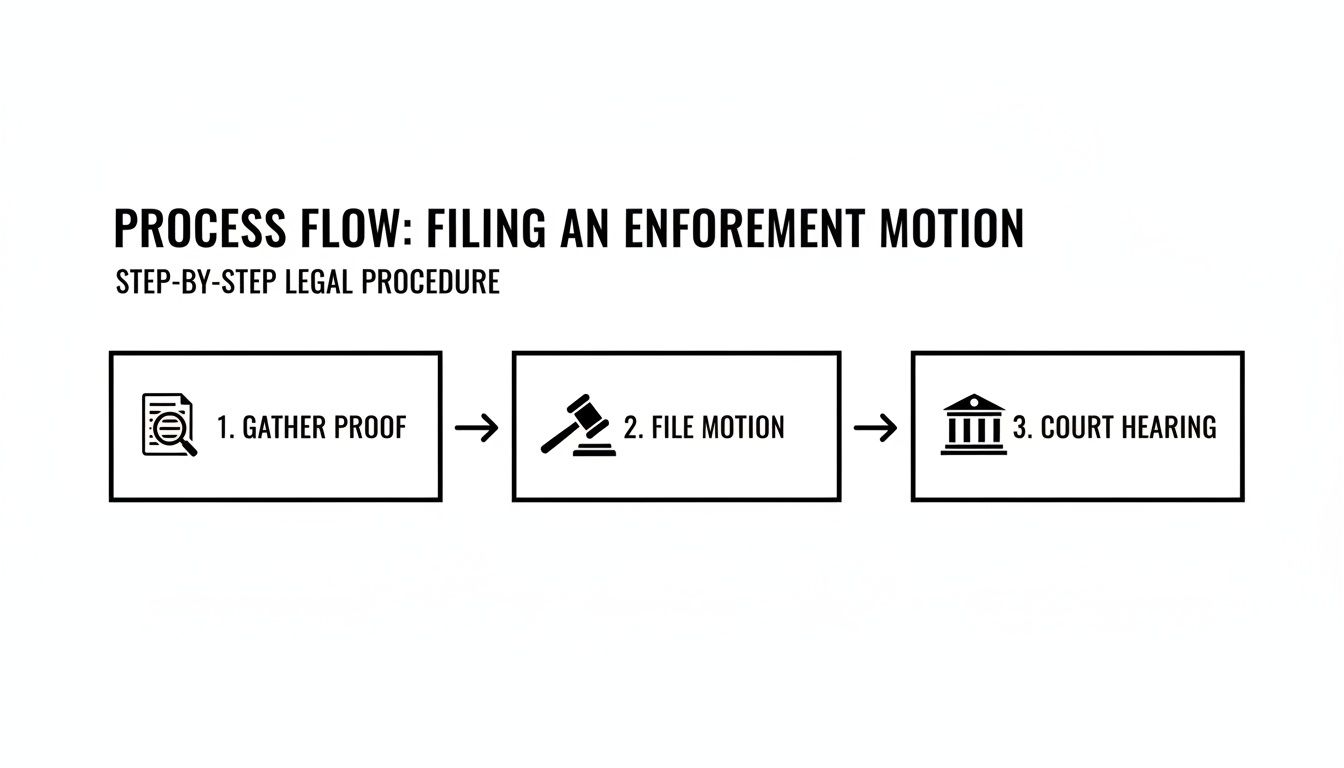
Step-by-Step Breakdown
Step 1: Gather Your Proof
Before you file anything, you need to build your case with solid evidence. A judge needs to see proof of the violations. Your goal is to create a clear timeline of every single infraction.
Your evidence should include:
- Specific dates and times of each violation.
- All communications about the violation (screenshots of texts, saved emails, call logs).
- Financial records that tell the story, like bank statements showing missed payments or credit card bills for debts your ex was supposed to pay.
- A log of any witnesses who saw what happened, such as a family member who witnessed a missed pickup.
The more detailed your records are, the stronger your case for contempt of court becomes.
Step 2: Hire an Experienced Family Law Attorney
While you can technically file an enforcement motion yourself, it's not recommended. The Texas Family Code has incredibly specific requirements for these motions. A small error in how you word the violation or the relief you're asking for can get your entire case dismissed.
A seasoned family law attorney knows exactly how to draft a motion that is both precise and powerful. They will take your evidence and transform it into a compelling legal argument that clearly shows what part of the decree was violated and what the court needs to do about it.
Step 3: File the Motion and Serve Your Ex
Once the motion is ready, your attorney will file it with the clerk of the same court that granted your divorce. This gets your case on the court's calendar and secures a hearing date.
Next comes a critical step called "service." Your ex-spouse must be legally notified that you've filed a lawsuit against them. A neutral third party—usually a sheriff's deputy or a private process server—has to personally deliver a copy of the motion and a citation to appear in court. This ensures your ex can't later claim they never knew about the hearing.
Step 4: Prepare for Your Day in Court
With a hearing scheduled, you and your attorney will prepare to present your case. This involves organizing all your proof, going over your testimony, and planning for any excuses your ex might try to use.
Your attorney will help you tell your story to the judge clearly and confidently. Disobeying orders can lead to serious consequences, including fines, wage garnishment, or even jail time. These penalties can fundamentally alter the dynamics of your post-divorce settlement.
The judge needs to be convinced of three things: the court's order was clear, your ex knew about it, and they had the ability to follow it but deliberately chose not to. Your preparation is all about proving those three points without a doubt.
Following this structured process is your path to making the court's order a reality. It's how you take back control and ensure the decree you fought for is finally respected.
Penalties for Contempt and Potential Defenses
Understanding the possible consequences for your ex—and the defenses they might try to use—is key to managing your expectations and building a solid case. When a court order has been willfully ignored, a Texas judge has significant power to set things right.
The Power of the Court: What a Judge Can Order
If a judge finds your ex-spouse in contempt, the penalties are far more than a simple slap on the wrist. The Texas Family Code gives the court broad authority to punish past violations and ensure future compliance.
These penalties are designed to be serious enough to make your ex think twice before ever ignoring the order again. A judge can impose:
- Fines: The court can order your ex to pay a fine of up to $500 for each violation. If they’ve missed 10 child support payments, that could quickly add up.
- Jail Time: A judge has the power to sentence a non-compliant person to jail for up to six months for contempt.
- Payment of Your Attorney's Fees: The court can—and frequently does—order your ex-spouse to pay all the attorney's fees and court costs you incurred. This ensures you aren't financially punished for simply asking the court to enforce its own order.
Beyond these direct penalties, the court has other powerful tools. They can order wage garnishment for unpaid support, place liens on property, and even suspend your ex's driver's, professional, or recreational licenses.
Common Defenses Your Ex Might Use
When you file a Motion for Enforcement, your ex has the right to present a defense. It’s smart to be prepared for the arguments they might make, as this allows you and your attorney to gather the right evidence to refute them.
Common defenses include:
- Inability to Pay: For money-related violations, your ex might claim they didn’t have the funds. This is an "affirmative defense," which means the burden is on them to prove it. They must show the court they were truly unable to pay through no fault of their own—like an involuntary job loss, not just quitting.
- Ambiguous Order: They could argue the original divorce decree was too vague for them to understand what was required. This defense is a perfect example of why having a skilled attorney draft your initial decree is so important.
- Lack of Knowledge: Though rare, an ex might claim they were never properly served or made aware of the court order they're accused of violating.
Being accused of contempt is a serious matter. If your ex-spouse has filed an enforcement motion against you, it is critical to seek legal counsel immediately to understand your options.
Navigating these accusations demands a strategic approach. If you find yourself on the other side of this issue, you can learn more about how to protect your rights when accused of contempt of court in a Texas divorce. By anticipating these potential defenses, you and your attorney can build a proactive case that leaves little room for excuses.
Feeling trapped when your ex-spouse ignores your divorce decree is a heavy burden. But your final court order is a powerful legal document, and you have clear options to enforce it. You don’t have to accept ongoing violations that disrupt your life and your children's stability. Taking swift, decisive legal action is the most effective way to protect your financial security and your rights as a parent.
Frequently Asked Questions About Divorce Enforcement
Once the judge signs the final decree, the divorce might feel over—but what happens when the other party doesn’t hold up their end of the deal? This is a frustratingly common part of post-divorce life. Here are some straightforward answers to the questions we hear most often.
How Long Do I Have To File for Enforcement in Texas?
This is a critical question because Texas has strict deadlines, called statutes of limitation. If you wait too long, you could lose your right to enforce the order. The timeframe depends on what part of the decree is being violated.
- For Property Division: According to the Texas Family Code, you generally have two years from the date the divorce decree was signed to file a motion to enforce the division of tangible personal property.
- For Child Support: The law gives you much more time to collect unpaid child support. You can file an enforcement action at any point before the child turns 18, and for four years after that. This allows you to go after the full amount of back child support, or "arrearages," that you are owed.
- For Visitation (Possession and Access): When you're being denied court-ordered time with your child, you need to act fast. While you can file an enforcement motion at any time, addressing it right away helps establish a clear pattern of non-compliance for the judge.
Can We Just Agree To Change the Order Ourselves?
It’s understandable to want to make informal agreements with your ex, especially if you’re trying to co-parent amicably. However, a "handshake" deal is not legally enforceable and does not actually change the court's order. Your original divorce decree remains in full force until a judge formally signs a new order.
This means if your ex suddenly stops following your verbal agreement, you have no legal power to make them comply. Even worse, if you are the one not following the written order—even with verbal permission—your ex could file an enforcement action against you for contempt. Always protect yourself by getting any permanent changes approved by the court through a formal modification.
What Evidence Do I Need To Prove Contempt?
In a Texas courtroom, your word alone isn't enough. The judge needs to see clear evidence that the violation was willful. It’s your job to build that case.
Here’s a checklist of evidence you should start gathering:
- Financial Records: Bank statements showing missed payments, credit card bills with charges your ex was supposed to cover, and receipts for expenses you paid.
- Written Communication: Save everything. That means screenshots of text messages, emails, and conversations in co-parenting apps where the violation is discussed.
- A Detailed Log: Get a journal and document every violation with the date, time, what was supposed to happen, and what actually happened.
- Witness Testimony: Statements from neutral third parties can be incredibly persuasive.
Gathering this proof is the foundation of a successful Motion for Enforcement. It gives your attorney the ammunition they need to show the judge that these violations weren't simple mistakes—they were deliberate choices.
What to Do Next: Take Action with Confidence
Your divorce decree isn't a suggestion; it's a command from the court. Enforcing it is not about seeking revenge—it's about demanding the respect, stability, and peace of mind you and your family deserve under the law.
Our experienced attorneys are here to help you navigate the process of filing a motion for contempt of court divorce Texas. We understand the stress and uncertainty this situation creates. We are committed to helping you enforce your court order and restore order to your life. For a deeper look into the process, you can find valuable information on how to enforce a divorce decree in Texas.
If you are ready to take the next step and ensure your rights are protected, The Law Office of Bryan Fagan, PLLC, is here to stand with you. Schedule a free, confidential consultation with one of our compassionate attorneys today. We will listen to your story, explain your options in plain English, and help you create a solution-focused plan to move forward with confidence. Visit us at https://texasdivorcelawyer.us to book your appointment.