Skip to content
In Texas, the 10-year rule means a marriage of at least 10 years may make a spouse eligible to ask for spousal maintenance, but it does not mean the court will automatically order payments. If maintenance is awarded, the amount is capped at the lesser of 20% of the paying spouse's gross monthly income or $5,000 per month, and the maximum duration is 5 years for marriages of 10 to 20 years, 7 years for 20 to 30 years, and 10 years for marriages over 30 years.
If you're reading this while worrying about how you'll pay rent, cover groceries, or rebuild after a long marriage, you're not alone. Many people hear “the 10-year rule” from friends, social media, or even a spouse during an argument, and they come away with the wrong idea. The actual rule is narrower, more technical, and far more dependent on proof than many expect.
That can feel frustrating, but it can also be clarifying. Once you understand what the court looks for, you can make better decisions about your case, your finances, your children, and your next steps.
Facing Divorce After a Long Marriage
A long marriage often creates a very specific kind of fear. You may have spent years raising children, supporting your spouse's career, managing the home, helping with a family business, or putting your own earning power on hold. Then divorce enters the picture, and suddenly one question becomes urgent: Will I have any financial support after this is over?
For many Texans, that question leads straight to the phrase “10-year rule.” It sounds simple. If you've been married for 10 years, you get alimony. If you haven't, you don't.
That isn't how Texas law works.
Consider a common example. A spouse has been married for over a decade, stayed home with the children for several years, and now works only part time. They assume the court will order support because the marriage crossed the 10-year mark. But Texas judges don't treat 10 years as an automatic payout. They treat it as one part of a larger legal analysis.
A long marriage may open the door to maintenance. It doesn't carry you through that door by itself.
That distinction matters because it changes how you prepare. Instead of relying on the length of the marriage alone, you need to focus on documents, budgets, earning ability, property issues, and the practical details of daily life after divorce.
Why this rule causes so much confusion
People often mix up three separate ideas:
- Spousal maintenance means post-divorce support one spouse may be ordered to pay the other.
- Property division means dividing what the spouses own or owe.
- Child support is money paid for the children's needs, not the other spouse's.
Texas handles each of these differently. The 10-year rule applies to spousal maintenance, not to your share of community property and not to child support.
Why this matters early in a case
If you're a parent, business owner, or someone with significant assets, this issue can affect nearly every part of your divorce strategy. It can influence settlement talks, mediation positions, temporary orders, and even the documents you gather at the very start. That is especially true when one spouse earns much more than the other, or when one spouse has limited recent work history.
What the 10 Year Rule Actually Means for Spousal Maintenance
A common scenario looks like this. A couple has been married for 12 or 15 years. One spouse assumes the court will award monthly support because the marriage lasted longer than a decade. Texas law does not work that way.
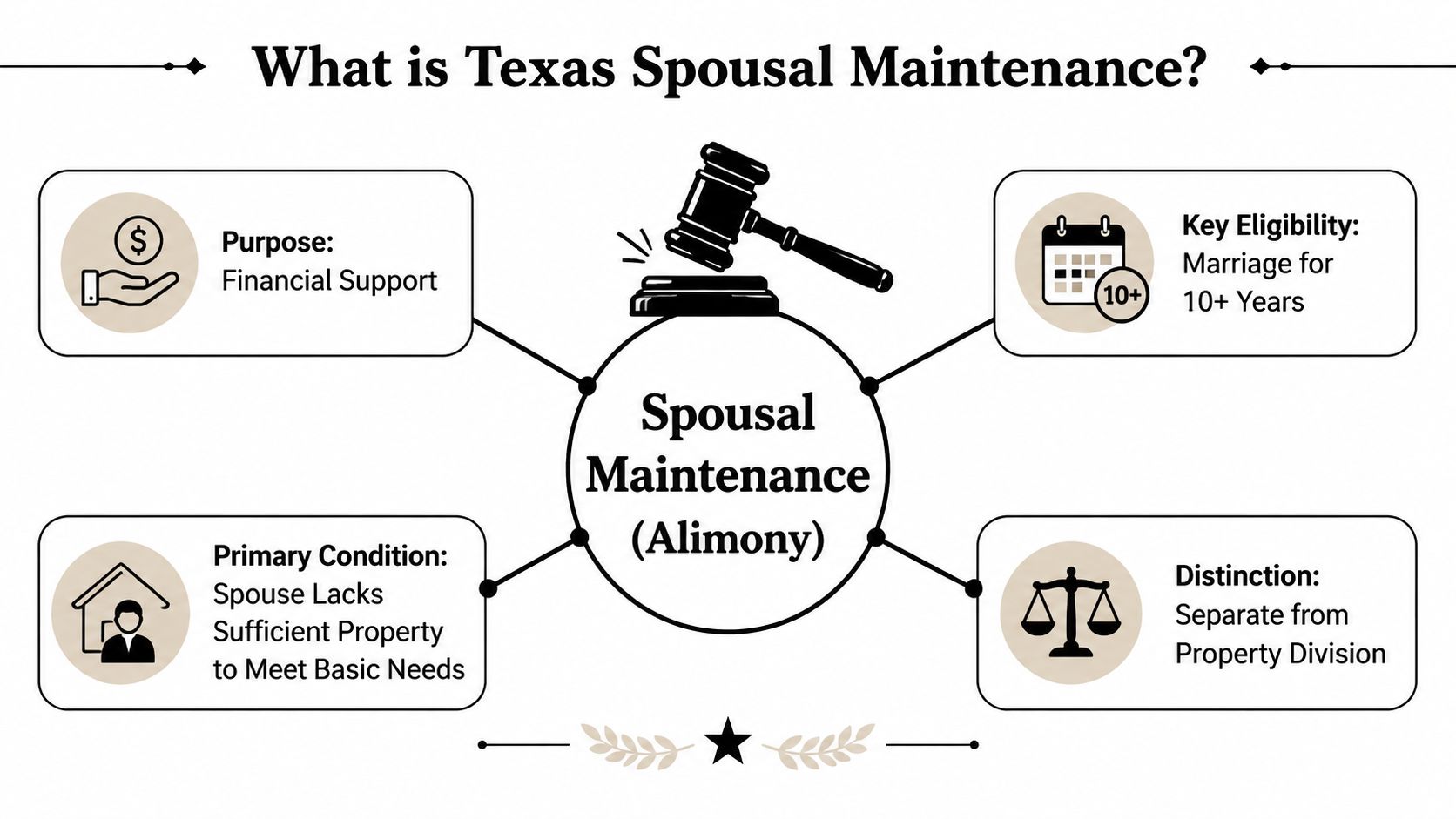
The clearest answer to “What is the 10 year rule for divorce in Texas?” is that it sets the minimum marriage length that can make a spouse eligible to ask for post-divorce maintenance in one category of cases. It does not create an automatic right to receive payments.
That distinction matters because many people hear “10-year rule” and stop their analysis there. The precise legal question is narrower: after a marriage of at least 10 years, can the spouse asking for maintenance also show that they lack enough property to meet their minimum reasonable needs and cannot presently earn enough to meet those needs? For a fuller explanation of spousal maintenance eligibility in Texas, it helps to look at the exact requirements courts apply.
Texas courts treat spousal maintenance as limited support. Its purpose is to help a qualifying spouse cover basic living expenses for a period of time while working toward self-support, when the law allows it. That is very different from a guaranteed share of the other spouse's future income.
The 10-year mark opens the maintenance question
Crossing the 10-year mark puts you in the category of spouses who may ask the court to consider maintenance under Texas Family Code Section 8.051. It does not answer whether the court should grant it.
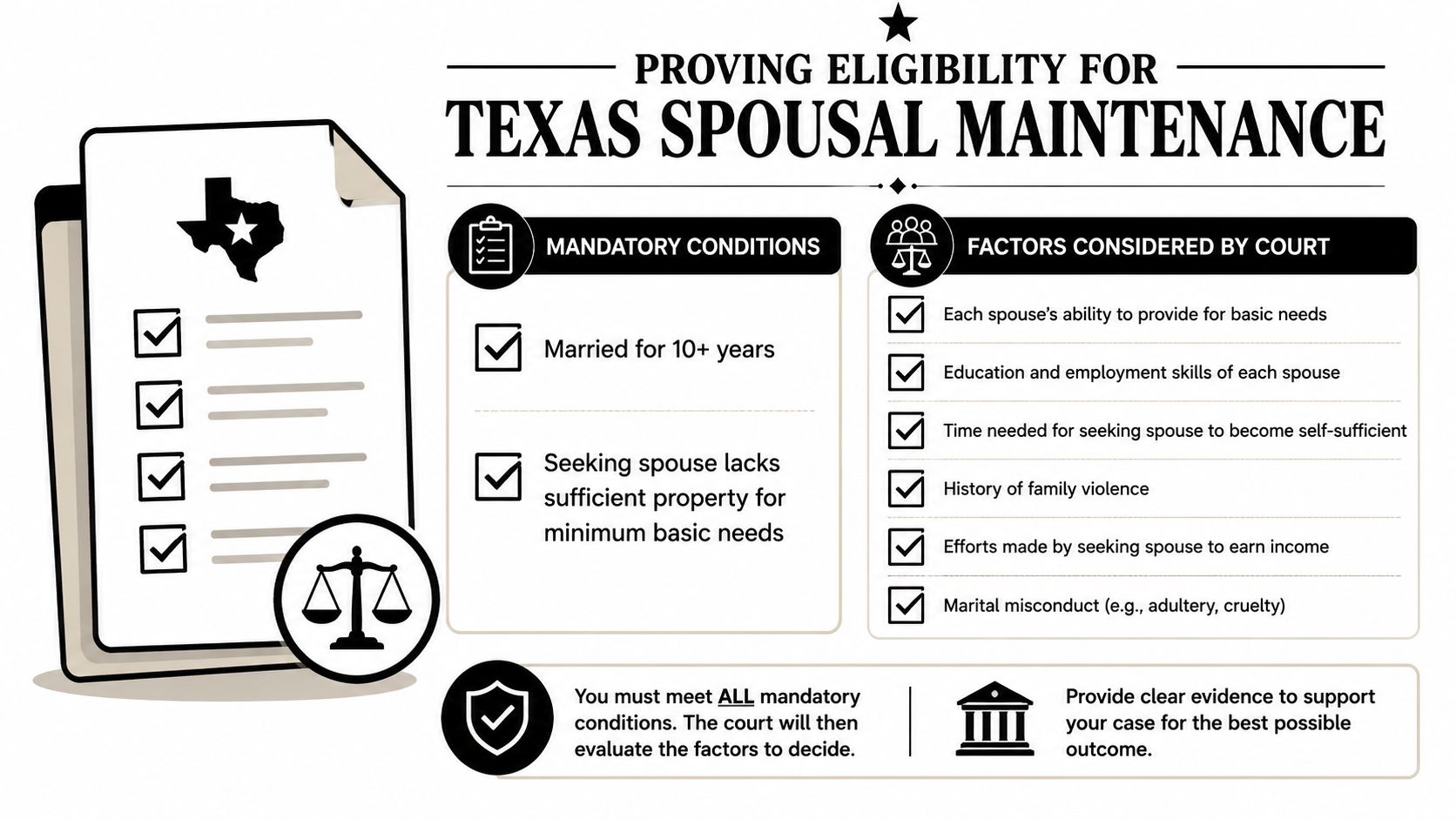
In practical terms, the court usually needs to see both of these points:
- The marriage lasted at least 10 years
- The spouse requesting maintenance cannot meet minimum reasonable needs after divorce despite available property and earning ability
If one piece is missing, the request may be denied. That is why the 10-year rule is best understood as an eligibility threshold. It gets the issue before the court, but it does not decide the outcome.
What maintenance covers, and what it does not
This rule applies to spousal maintenance only. It does not decide how community property will be divided. A spouse in a short marriage may still receive a substantial share of community assets, and a spouse in a long marriage may still be denied maintenance if the property division and earning capacity are enough to cover basic needs.
It also does not control child support. Child support serves the children's needs. Spousal maintenance addresses whether one former spouse meets the legal standard for limited post-divorce support.
For a practical overview of how courts treat support after divorce, Spousal Maintenance in a Texas Divorce explains the situations in which Texas courts may order it.
Why the rule is so often misunderstood
The confusion usually comes from the word “rule.” It sounds like a payoff triggered by an anniversary date. In reality, judges still examine the requesting spouse's finances, work history, education, health, and ability to become self-supporting within a reasonable period.
A simple way to picture it is a filing threshold. Meeting it allows the court to consider maintenance. The court still has to decide whether the facts justify it.
That nuance is easy to miss, but it changes how you prepare for the case. A spouse who focuses only on proving the marriage lasted 10 years may overlook the harder part, which is showing present financial need under the statute.
Beyond 10 Years Proving You Qualify for Maintenance
A 10 year marriage gets you to the courthouse door on maintenance. It does not carry you through it.
That distinction matters because many spouses spend months proving the marriage lasted long enough, then get blindsided by the key question the judge asks next: can you meet your minimum reasonable needs with the property, income, and earning ability available to you after the divorce?
Texas courts look at present need in a practical way. The issue is not whether life will feel tighter after divorce. For many families, it will. The issue is whether the spouse requesting maintenance can cover basic, reasonable living expenses without ongoing support, or whether a real shortfall remains after looking at income, assets, and the property division.
What “minimum reasonable needs” means in real life
This phrase can sound vague, so it helps to bring it down to household level. Courts usually focus on the bills that keep a person housed, fed, insured, and able to function day to day.
That often includes:
- Housing expenses such as rent, mortgage, and basic home costs
- Utilities and groceries needed for ordinary living
- Transportation costs for work, school, or medical appointments
- Medical care and insurance
- Necessary child-related expenses that affect a parent's ability to work
A useful comparison is a bare-bones monthly budget, not the standard of living you may have enjoyed during the marriage. A judge is usually asking, "What does this person reasonably need to stay afloat?" not "What would it take to preserve the marital lifestyle?"
What proof usually matters most
Maintenance cases are won or lost in the paperwork.
A judge will usually want to see specific records that make your financial picture easy to follow. General statements like "I can't make it on my own" are much less persuasive than documents that show your monthly shortfall in black and white.
Helpful evidence often includes:
- A detailed monthly budget
- Bank statements and account balances
- Pay stubs, tax returns, or other income records
- Proof of job applications or job search efforts
- School or training records if more education is needed before returning to work
- Medical records if a health condition limits employment
For a fuller explanation of how courts evaluate these requirements, see this guide to Texas spousal maintenance eligibility.
Why some 10 year cases still fail
This is the part many articles skip. A long marriage can support eligibility to ask for maintenance, but it does not guarantee an award.
For example, a spouse may have been married for 15 years and still be denied maintenance if the divorce property award, savings, and current earning ability are enough to cover basic needs. Another spouse may have fewer immediate resources, limited work history, and health concerns, which makes the request much stronger even if both marriages lasted well over 10 years.
That is why preparation matters. The marriage length opens the conversation. Your evidence answers it.
Exceptions that can apply before 10 years
Some spouses may qualify without reaching the 10 year mark. Texas law recognizes other paths to maintenance, including certain cases involving family violence, disability, or the need to care for a child whose condition limits the caregiver's ability to earn enough income.
These cases often require a different type of proof. A spouse with a disabling medical condition may need records showing how that condition affects work capacity. A parent caring for a disabled child may need to show why the caregiving schedule makes full-time employment unrealistic.
Situations that need extra attention
Some cases deserve closer financial analysis because the numbers are less straightforward.
If you are a parent with primary caregiving duties, your available work hours may be limited in ways that are easy to underestimate. If one spouse owns a business, reported income may not tell the whole story, and business records may need careful review. If the marital estate includes significant assets, the court may ask whether the property awarded in the divorce itself is enough to cover your reasonable needs.
In other words, the question is rarely just, "Were you married for 10 years?" The better question is, "After this divorce is finished, what resources will you have, and will they be enough?"
How Texas Courts Decide the Amount and Duration of Payments
Qualifying for maintenance answers only the first question. The harder question is the one clients usually ask next: what will the court order?
A helpful way to look at it is this. Texas gives judges an outer fence, then asks them to decide what fits inside that fence. The law sets maximum limits on amount and duration, but those limits are ceilings, not standard awards. A spouse who clears the 10 year threshold has reached the starting line for this discussion, not the finish line.
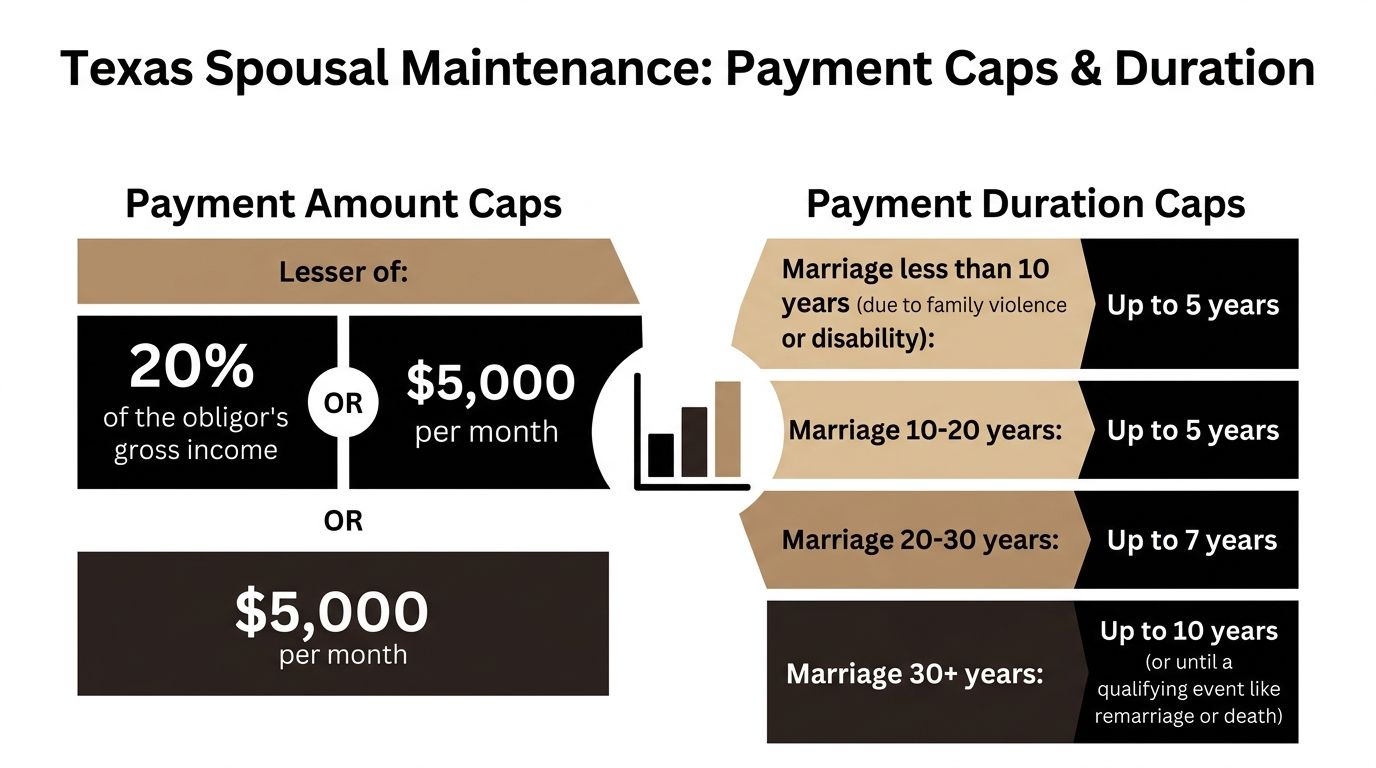
Texas courts may not order more than the lesser of $5,000 per month or 20 percent of the paying spouse's average gross monthly income. The maximum duration also depends on the facts of the marriage and the legal category the case falls into. In many long-marriage cases, the outside limits often look like this:
Maximum duration is only the cap
| Marriage length | Possible maximum duration |
|---|---|
| 10 to 20 years | Up to 5 years |
| 20 to 30 years | Up to 7 years |
| Over 30 years | Up to 10 years |
The phrase "up to" matters. A court is supposed to order maintenance for the shortest reasonable period that allows the receiving spouse to earn enough income to meet minimum reasonable needs, if that goal is realistic. So even in a marriage that lasted decades, the judge may order less time, less money, or both.
That is one of the most misunderstood parts of the 10 year rule.
For example, a spouse may prove eligibility after a 14 year marriage, yet still receive a modest amount for a limited period because the property division gives that spouse usable assets, the spouse has marketable skills, or retraining can happen fairly quickly. Another spouse in a shorter-payment category may receive a stronger claim for the full period because age, health, or caregiving duties make self-support much harder.
What judges look at beyond the cap
Judges do not use a single formula. They weigh the specific facts in front of them, including:
- each spouse's ability to provide for reasonable needs independently
- education and employment skills
- how long it may take to get training or work
- age, health, and physical or emotional condition
- employment history and earning ability
- property each spouse receives in the divorce
- contributions as a homemaker
- one spouse's contribution to the other's education or career
- marital misconduct, in some cases, such as cruel treatment or adultery
If the marriage involves a service member, allegations of adultery can also carry military consequences separate from Texas maintenance law. Those issues are different from spousal support, but they may still affect the broader divorce picture. This overview of the consequences of UCMJ Article 134 explains that separate military framework.
Here's a short video that helps explain how these issues can play out in a Texas divorce.
Why the property division matters so much
Clients are often surprised by this part. Spousal maintenance is not decided in isolation. The judge also looks at what each spouse receives from the marital estate.
A simple example helps. If one spouse receives liquid savings, retirement funds, or a debt-light home with equity, the court may decide those resources reduce the need for monthly support. If the spouse receives property that looks valuable on paper but does not produce income or cannot easily be sold, the analysis may look very different.
That is why estimating maintenance without reviewing the full financial picture can be misleading. For a practical comparison of the limits and typical ranges, see how much alimony is ordered in Texas.
How this usually plays out in a case
Some spouses agree on maintenance terms in mediation. Others ask the court to decide. Either way, the same basic question drives the result: after the divorce is final and the property is divided, does one spouse still need support to meet minimum reasonable needs, and if so, for how long?
That focus keeps the discussion grounded. The court is not handing out a reward for staying married past 10 years. It is making a limited, fact-specific decision about need, ability to pay, and the shortest fair path toward greater financial independence.
The Special Case The 10 Year Rule and Military Divorce
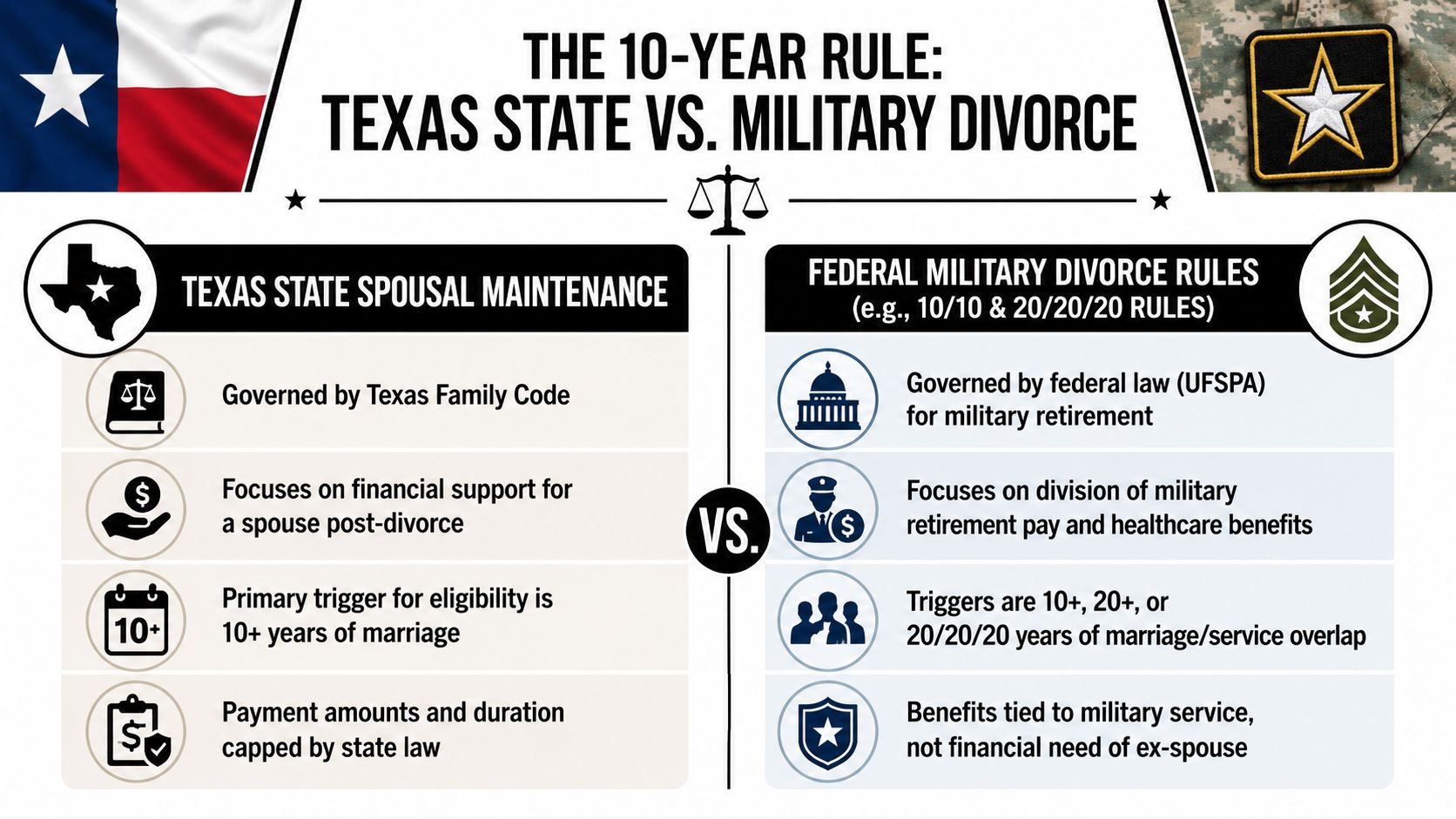
A military divorce can create a very specific kind of confusion. A spouse hears “10-year rule” and assumes one rule controls everything. In reality, military families often have two separate 10-year rules in play, and they answer two different questions.
One rule comes from Texas law and relates to possible spousal maintenance. The other comes from federal law and affects how a share of military retired pay may be paid. Those are separate issues. That distinction matters because the Texas 10-year rule is only an eligibility threshold for maintenance. It does not guarantee monthly support, and it does not automatically control military retirement payments either.
State maintenance and federal retirement rules are not the same
Texas spousal maintenance is governed by state family law. The court looks at the same core question discussed earlier. After the divorce and property division, can the requesting spouse meet minimum reasonable needs? A marriage lasting 10 years or more may allow that spouse to ask for maintenance, but the spouse still has to prove need and satisfy the other legal requirements.
Federal law works differently. Under the Uniformed Services Former Spouses' Protection Act, the “10/10 rule” deals with direct payment administration. It generally refers to whether DFAS can send a qualifying former spouse's share of military retired pay directly, based on at least 10 years of marriage overlapping with 10 years of creditable military service. That rule does not decide whether the former spouse is entitled to a share in the first place. It also does not create Texas spousal maintenance. For a Texas-specific overview, see this guide to military divorce laws in Texas and the federal materials from the Defense Finance and Accounting Service on the USFSPA.
A simple comparison helps:
| Topic | Texas rule | Federal military rule |
|---|---|---|
| Main purpose | Possible spousal support after divorce | Direct payment of a retirement share |
| Source of law | Texas Family Code | Federal law under USFSPA |
| What 10 years affects | Eligibility to request maintenance in some cases | Whether DFAS may send payment directly |
| What it does not do | Guarantee maintenance | Create maintenance or decide need |
That difference can change settlement strategy. For example, a spouse may qualify to ask a Texas court for maintenance after a long marriage but still not qualify for direct DFAS payment because the marriage and service did not overlap long enough. The reverse misunderstanding happens too. A couple may meet the federal 10/10 rule for direct payment logistics, yet the spouse seeking maintenance still may not receive maintenance without proof of need.
When military misconduct issues also appear in the divorce
Some military divorces include allegations of adultery or other extramarital conduct. In Texas, those facts may matter in the divorce for reasons such as fault allegations or settlement pressure. In the military system, the same conduct can raise separate concerns under military law. If that issue is part of your case, this resource on the consequences of UCMJ Article 134 explains how the military may evaluate that conduct apart from the Texas family court process.
The key point is simple. In a military divorce, the phrase “10-year rule” does not tell you who gets paid, how they get paid, or whether payment is guaranteed. You have to identify which law you are talking about first.
Common Myths and Misconceptions About the 10 Year Rule
A spouse walks into mediation after a 12 year marriage convinced support is automatic. The other spouse is equally sure no support can be ordered because the property division will end the discussion. Both can be wrong.
The 10 year rule causes confusion because people treat it like a prize you receive for staying married long enough. Texas law treats it more like a gate. Reaching 10 years may allow a spouse to ask for maintenance in certain cases, but the spouse still has to prove the rest of the claim. The Texas State Law Library's overview of spousal maintenance explains that maintenance is limited and tied to specific legal requirements.
Myth 1: If we were married 10 years, I automatically get alimony
Marriage length is only one part of the analysis.
A spouse usually must show that, after the divorce, they will lack enough property to meet minimum reasonable needs. Then the court looks at facts such as earning ability, work history, health, disability, caregiving duties, and what steps the spouse has taken to become self-supporting. If those facts are weak, maintenance can be denied even after a long marriage.
That is the point many articles miss. Ten years is often an eligibility threshold, not a payment guarantee.
Myth 2: Crossing the 10 year mark means the judge must order large or permanent payments
Texas courts do not treat spousal maintenance as an open-ended income stream in the ordinary case. The goal is usually short-term support that helps a spouse meet basic needs while working toward greater independence.
A useful comparison is a temporary bridge, not a lifetime pension. The court may order support for a limited period and within statutory caps, depending on the facts of the case.
Myth 3: The 10 year rule decides property division too
Property division is a separate question. A court divides community property under the just and right standard, and that analysis does not turn on whether the marriage crossed the 10 year line for maintenance eligibility.
This distinction matters in settlement talks. A spouse may have a stronger claim to property and still a weak claim for maintenance, or the reverse, depending on need and available assets after division.
Myth 4: A stay-at-home parent always qualifies for maintenance
A history of staying home with children can matter a great deal, especially if it limited education, training, or recent employment. Even so, the court still asks a practical question. Can this spouse meet minimum reasonable needs with available property, present income, and realistic earning capacity?
Sometimes the answer is yes. For example, a spouse may have substantial assets from the division or a clear path back into the workforce. In that situation, maintenance may be limited or denied.
Myth 5: The 10 year rule in a military divorce means DFAS will pay support directly
This is a common mix-up. In military divorces, people often hear another 10 year rule and assume it does the same thing as Texas spousal maintenance law.
It does not. Federal rules about direct payment through DFAS deal with payment processing and overlap between marriage and military service. Texas rules on spousal maintenance deal with whether a spouse qualifies for support under state law. Those are different questions under different legal systems. A spouse can meet one rule and still fail the other.
Myth 6: Judges decide all of this at trial, so there is no point preparing early
Many maintenance disputes are resolved before trial through negotiation or mediation. Good preparation still matters because realistic budgets, medical records, job history, and proof of monthly need often shape the outcome long before a judge hears testimony.
Clear expectations usually lead to better decisions. Myths do the opposite.
Your Next Steps Navigating Spousal Maintenance in Texas
If you're trying to protect your future, the most useful thing you can do right now is move from worry to preparation.
Under Texas Law Help's divorce process overview, the Texas divorce process formally begins by filing an Original Petition for Divorce and has a mandatory 60-day waiting period before a final decree can be granted, as per Texas Family Code Section 6.702. Navigating this process correctly is essential for protecting your rights, including any claim for spousal maintenance.
What to do next
Confirm the marriage timeline
Get clear on your actual marriage date and the likely filing date. Small timing details can matter when you are close to a threshold issue.Gather your financial records
Pull bank statements, pay stubs, tax records, debt information, monthly bills, and documents tied to any separate or community property issues.Build a realistic monthly budget
Focus on necessities. Judges often pay close attention to whether your numbers are grounded in daily living rather than guesswork.Think about work capacity accurately
If you can work, what can you realistically earn now? If you need training, how long might that take? If health issues limit you, what records show that clearly?Prepare for mediation and temporary orders
Temporary arrangements can shape the tone of the case. Parents should also think through custody schedules, support, and household expenses from the start.
Why legal guidance matters
Texas maintenance law looks simple from the outside, but cases often turn on details. The same marriage length can produce very different outcomes depending on property division, earning ability, parenting demands, health, military status, or the strength of the evidence.
If you're looking for a practical overview of the filing sequence, How to File for Divorce in Texas: Step by Step outlines the process from petition to final decree. If your case may settle outside of court, mediation can also be an effective way to address support, custody, and enforcement issues in one structured setting.
The Law Office of Bryan Fagan, PLLC handles Texas family law matters involving divorce, child custody, property division, mediation, and spousal maintenance, which can be relevant when you're comparing legal options and deciding how to move forward.
Key takeaway
The 10-year rule doesn't promise money. It gives some spouses the right to ask the court for maintenance if they can also prove financial need and inability to meet minimum reasonable needs. If that issue may affect your case, preparation matters as much as eligibility.
If you're facing divorce and you're unsure whether the 10-year rule applies to you, a free consultation can help you get clear answers about maintenance, property division, custody, mediation, and your next legal steps. The attorneys at Law Office of Bryan Fagan, PLLC work with Texas families who need practical guidance, plain-English explanations, and a strategy suited to their specific situation. Schedule a free consultation to talk through your case and understand what options may be available to you.