Skip to content
Facing a court-ordered schedule for your children can feel impersonal and overwhelming. You're not just dealing with legal documents; you're trying to figure out what life will look like for your family, and that uncertainty is tough. The starting point for this new chapter is often the Texas Standard Possession Order (SPO), which is the state's default roadmap for how children will split time between parents after a divorce or separation. Think of it as a predictable schedule designed to ensure your children maintain a strong, consistent relationship with both of you.
What a Standard Possession Order Means for Your Family
As you navigate your custody case, you’ll encounter terms like "custodial" and "non-custodial" parent. While these labels can feel cold, they simply define roles to create a predictable routine. The Standard Possession Order (SPO) is the schedule a Texas court will most likely implement if you and the other parent cannot agree on a custom plan.
Every custody decision in Texas is guided by one core principle: what is in the best interest of the child. The law presumes that the SPO’s predictable structure provides the stability children need while ensuring both parents remain deeply involved in their lives.
Defining Your Parental Roles
To create a consistent routine for your kids, the SPO gives each parent a specific role. The legal labels are formal, but their functions are straightforward and designed for clarity:
- Custodial Parent: This is the parent who has the right to determine the child's primary residence (usually within a specific geographic area). You will typically receive child support and manage the child's day-to-day life, especially during the school week.
- Non-Custodial Parent: This parent has guaranteed, clearly defined periods of possession with the child. You will typically pay child support and have the child for designated weekends, holidays, and a portion of the summer.
It's crucial to understand that these titles do not make one parent more important than the other. In most Texas cases, both of you will share joint legal custody, meaning you have the shared right and responsibility to make significant decisions together about your child’s health, education, and general welfare.
The Standard Possession Order is the default custody arrangement in Texas, often resulting in a possession split that is close to 60/40. The non-custodial parent typically has the children on the first, third, and fifth weekends of the month. You can learn more about the different Texas custody schedules and how they are structured.
This schedule isn't just a calendar—it's a tool designed to minimize conflict by making the rules clear from the start. It gives you and your co-parent a solid foundation, reducing the arguments that can arise from ambiguity and stress. From here, you can either adopt the standard plan or use it as a starting point to create a custom schedule that better fits your family’s unique needs.
How the Standard Possession Order Schedule Works
Trying to map out how an entire year will be split between two homes can feel like piecing together a complicated puzzle. Fortunately, the Texas Standard Possession Order (SPO) is designed to give you a clear, predictable roadmap. It acts as a default calendar covering weekends, holidays, and summer vacation, giving both you and your co-parent a reliable structure to build upon.
The entire system is built on creating a consistent, predictable rhythm for your child. The law first establishes two key roles—the custodial parent (who establishes the child's primary home) and the non-custodial parent (who has a set visitation schedule). This foundation is what the rest of the schedule is built upon.
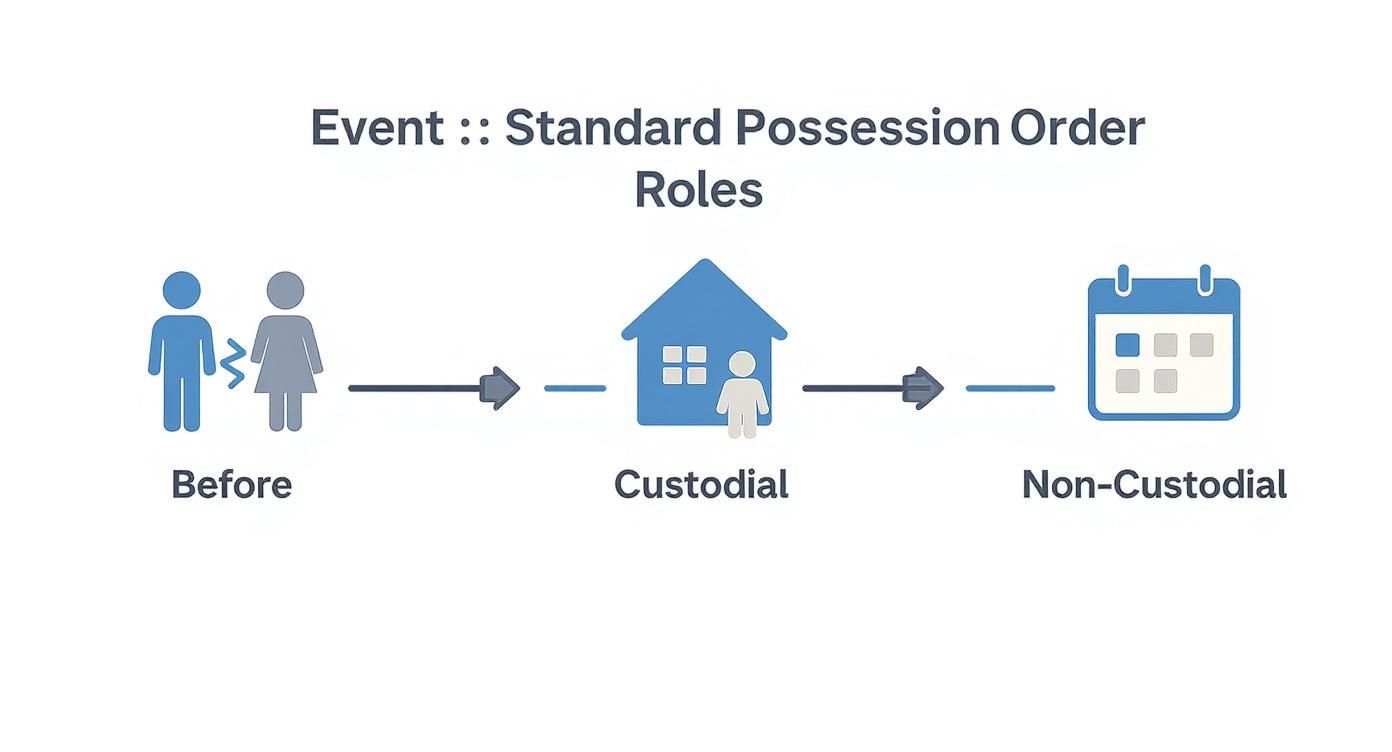
As you can see, while one parent provides the child's primary residence, the other is guaranteed a clear and consistent schedule for possession. This ensures both parents stay meaningfully involved in their child's life.
The Foundation: Weekends and Weekdays
At its core, the SPO gives the non-custodial parent a repeating monthly schedule. But the exact details hinge on one crucial factor: how far apart you and the other parent live. The Texas Family Code has different rules for parents who are neighbors versus those who live a few hours away.
One of the biggest points of confusion for parents is the phrase "first, third, and fifth weekends." This doesn't mean the first, third, and fifth calendar weekends of a month. Instead, it refers to the first, third, and fifth Fridays of any given month. Your possession weekend begins on that Friday and concludes on the following Sunday.
This distinction is incredibly important for planning. It means some months you'll have three weekends with your child, and other months you'll only have two. Understanding this from the start is key to planning accurately and avoiding conflict.
How Distance Changes Everything
The mileage between your home and the other parent's home is a game-changer. It's the factor that determines which version of the SPO applies to your family. The law recognizes that what works for parents in the same town just isn't practical when there's a long drive involved.
Here’s a practical breakdown of the two main scenarios:
- Parents Living 50 Miles Apart or Less: This is the most common setup. The non-custodial parent gets possession on the first, third, and fifth weekends of the month. You'll also typically have the child for a few hours on Thursday evenings during the school year.
- Parents Living Over 100 Miles Apart: When frequent travel is a major hurdle, the schedule adapts. The non-custodial parent can still take the first, third, and fifth weekends. Alternatively, you can elect to have one specific weekend per month, provided you give the other parent proper notice. The Thursday weeknight visits are typically eliminated in these long-distance situations.
The goal is always to foster a strong parent-child bond, and the law provides flexibility in the schedule to make that possible, regardless of geography.
To make this easier to visualize, here's a quick summary of the default schedule when you and the other parent live relatively close to each other.
Standard Possession Schedule At-a-Glance (Parents Under 50 Miles Apart)
| Possession Period | Typical Schedule Details |
|---|---|
| Weekends | The non-custodial parent has the child on the 1st, 3rd, and 5th Friday of each month. |
| Weekdays (School Year) | The non-custodial parent typically has possession on Thursday evenings. |
| Holidays | Major holidays like Thanksgiving and Christmas are alternated on a yearly basis. |
| Summer | The non-custodial parent gets possession for 30 days, which can be used all at once or split up. |
This table provides a snapshot, but remember that holidays and summer vacation have their own specific rules that can temporarily override this base schedule.
Splitting Up Holidays and Summer Break
Holidays are precious times for creating family memories, and the SPO ensures these special occasions are shared fairly. It divides major holidays between parents, usually on an alternating yearly basis.
A critical rule to remember: holiday possession always overrides the regular weekend schedule. As outlined in the Texas Family Code § 153.314, if your regular "first weekend" happens to fall on a holiday assigned to the other parent, the holiday schedule takes precedence.
Here's how the major holidays and summer typically break down:
- Thanksgiving: The non-custodial parent has the child for the Thanksgiving holiday in odd-numbered years (2023, 2025, etc.). The custodial parent gets Thanksgiving in even-numbered years (2024, 2026, etc.).
- Christmas/Winter Break: This long break is split in half. In even-numbered years, the non-custodial parent gets the first half (from when school lets out until noon on December 28th). In odd-numbered years, you get the second half (from noon on December 28th until school resumes).
- Summer Vacation: When parents live 100 miles apart or less, the non-custodial parent gets 30 days of possession. If you live over 100 miles apart, that time is extended to 42 days. You must give the other parent written notice of your desired dates by April 1st.
Understanding the Expanded Standard Possession Order
Facing the reality of a court-ordered schedule for time with your child is one of the toughest parts of any custody case. The good news is that Texas law has evolved, recognizing just how valuable it is for both parents to be deeply involved in their children's lives. This led to a major update in possession schedules.
This evolution created what’s known as the Expanded Standard Possession Order (ESPO). For most parents who live within 50 miles of each other, this is now the new default—the schedule a judge is expected to order unless there's a good reason not to. It’s a direct response to what we now know for sure: kids thrive when they have consistent, routine contact with both of their parents.

Think of the ESPO as more than just a small adjustment. It fundamentally reshapes the rhythm of the co-parenting week, giving the non-custodial parent significantly more time. It's designed to shift that parent's role from a weekend visitor to an integral part of the child's daily school life.
Key Changes in the Expanded Order
So, what exactly makes the ESPO different from the traditional schedule? It introduces two major changes that add a significant amount of time to the non-custodial parent's calendar. For parents living within 50 miles of each other, these adjustments are now presumed to be in your child’s best interest.
The two cornerstone features of the Expanded Standard Possession Order are:
- Overnight Thursday Visits: The short evening visit during the week becomes an overnight stay. You'll pick your child up from school on Thursday and be the one to get them back to school on Friday morning.
- Extended Weekend Possession: Your first, third, and fifth weekends no longer end with the "Sunday night dread." Instead, you keep your child through Sunday night and are responsible for the school drop-off on Monday morning.
These changes might seem small on paper, but in practice, they add up to a substantial increase in parenting time. This extra time means you're there for homework help, bedtime stories, and the morning routine—all the small, essential moments that strengthen your bond with your child.
Why the ESPO Is Now the Default
The shift to the ESPO as the presumed standard reflects a broader change in how Texas family law views parenting. Courts now operate on the firm belief that consistent contact is critical for a child's emotional and psychological well-being. By making the ESPO the default, the law actively encourages a more balanced, hands-on approach from both parents.
This was driven by updates to the Texas Family Code that specifically prioritized enhancing the non-custodial parent's access rights. Adding the Thursday overnight and extending weekends from Sunday evening to Monday morning provides meaningful, in-person time that aligns with modern expectations of parental involvement.
A judge will order the Expanded Standard Possession Order unless one parent specifically opts out or the judge determines the schedule is not in the child's best interest. A judge might deviate for reasons like unworkable distances or if a parent has a history of not being actively involved in the child’s day-to-day life.
Ultimately, this modern schedule helps create a more equitable division of parenting responsibilities. It ensures the non-custodial parent isn't just the "fun weekend" parent but is deeply engaged in the everyday realities of raising a child.
Practical Implications for Your Family
Making the ESPO work requires solid coordination and communication. The handoffs now often happen at school, which can simplify logistics by creating a neutral drop-off and pick-up point. On the flip side, it means you have to be ready for the real responsibilities of a school night—managing homework, packing lunches, and making sure your child gets to school on time.
This increase in possession time can also have financial implications. Because the non-custodial parent has the child for more overnights, it can sometimes be a factor in calculating child support payments. It’s a practical consideration that highlights why it's so important to understand the full impact of your possession schedule.
What to Do Next
- Review Your Proximity: First, determine if you and the other parent live within 50 miles of each other, as this is the main factor for the ESPO.
- Assess Your Schedule: Be realistic about how overnight Thursdays and Monday morning school drop-offs will fit into your work life and daily routines.
- Communicate with the Other Parent: Talk about whether you both agree to the ESPO. If one of you plans to request the traditional SPO instead, it's better to know sooner rather than later.
Facing a new custody schedule can feel overwhelming, but understanding your rights under the Expanded Standard Possession Order is a powerful first step. If you have questions about how this schedule would work for your family or need help advocating for the right possession order, our team is here to help. Schedule a free consultation with The Law Office of Bryan Fagan, PLLC, to get clear, compassionate guidance for your case.
When a Judge Might Not Use the Standard Order
It's a common fear for parents: the idea that a standard, one-size-fits-all schedule will be forced on their unique family situation. While the Texas Standard Possession Order (SPO) is the starting point for most families, it is not a rigid mandate. The court’s primary duty is to protect the best interest of the child, and a judge has the full authority to customize a schedule if the standard version isn't appropriate or safe.
This flexibility allows the legal system to adapt to the complex realities of family life. A judge can and will deviate from the standard order when evidence clearly shows that a different arrangement is needed to protect a child's well-being.
Exceptions for Children Under Three
One of the most common reasons to create a custom schedule is the age of the child. The standard possession order was designed with children three years of age and older in mind. For infants and toddlers, the developmental need for frequent, consistent contact with both parents is critical.
A judge will create a specialized, step-up possession schedule for a child under three. This plan looks quite different from the SPO and often includes:
- Shorter, more frequent visits: Instead of long weekends, the schedule might involve several shorter visits throughout the week to maintain the parent-child bond.
- No overnight stays initially: For very young infants, overnights are often phased in gradually as the child gets older and more comfortable with transitions.
- A "stair-step" approach: The schedule is designed to expand automatically as the child reaches key age milestones (like 18 months or 3 years), eventually transitioning into a standard order.
This approach ensures the child can form a strong, secure attachment to both parents without the stress of long separations that can be difficult for very young children.
Serious Circumstances Requiring a Custom Order
Beyond a child's age, a judge will significantly alter or restrict a possession order if a parent's behavior poses a potential risk. The court's primary responsibility is to ensure the child's physical and emotional safety, and it will not hesitate to act when there are legitimate concerns.
Serious issues that can lead to a heavily customized or restricted possession order include:
- A history of family violence: If there is a documented history of domestic abuse, a judge will take immediate protective measures.
- Substance abuse issues: A parent's ongoing struggle with alcohol or drug addiction is often grounds for supervised visitation.
- Chronic neglect: Evidence that a parent has consistently failed to provide basic care for the child will lead to a non-standard order.
- Severe mental health concerns: If a parent's mental health condition impairs their ability to safely care for a child, the court may impose necessary restrictions.
According to the Texas Family Code § 153.004, a court has the power to limit a parent's possession or access if it finds that the parent has a history of family violence. This could mean ordering that all visits be supervised by a neutral third party to ensure the child's safety is never compromised.
In these situations, the court’s goal isn’t to punish the parent—it's to protect the child. If you have serious concerns about your child’s safety with the other parent, you may need to act quickly. In some cases, you might need to seek an emergency custody order in Texas to put immediate protections in place while the court works toward a long-term solution. Understanding your options is the first step toward advocating for your child's well-being.
Exploring 50/50 Custody as an Alternative
Many parents entering a custody case hope for a schedule that splits time equally. If you're wondering whether a true 50/50 possession schedule is an achievable goal in Texas, the answer is yes, it's possible. While the Standard Possession Order (SPO) is the court's default, it is not your only option. You can absolutely pursue a more balanced arrangement.
The most straightforward path to a 50/50 schedule is through mutual agreement. If you and your co-parent can work together to create a schedule that gives you each equal time and present it to the judge, the court is very likely to approve it. The judge's main concern is that the plan is stable, practical, and in your child's best interest.
Making the Case for Equal Possession
If you cannot reach an agreement, you can ask the judge to order a 50/50 schedule instead of the standard possession order. To be successful, you will need to present a strong argument showing that this arrangement truly serves your child’s best interests. Judges will carefully consider several practical factors before deviating from the standard.
Key elements that strengthen a case for equal possession time include:
- Close Proximity: Living in the same school district and a short drive from one another is often the most critical factor.
- A History of Cooperation: Showing that you and the other parent can communicate effectively and co-parent without conflict is crucial.
- Active Parental Involvement: You must demonstrate that you have both been consistently and deeply involved in the child’s daily life—from school and doctor visits to extracurriculars.
- The Child's Age and Maturity: Equal possession schedules are often more suitable for older children who can adapt more easily to moving between two homes.
The Realities of a 50/50 Schedule
Even with a strong case, some judges remain hesitant to order a 50/50 split over a parent’s objection, often favoring the perceived stability of the SPO. They might worry about the constant transitions disrupting a child's routine.
The good news is that societal norms have evolved, and courts are more open to 50/50 arrangements than ever before, for both mothers and fathers. However, to succeed, you must prove logistical feasibility and a stable history of involvement, especially since challenges can arise if children are very young or travel is disruptive.
Pursuing a 50/50 schedule requires a realistic and child-focused approach. Whether you hope to achieve this through agreement or in court, understanding the factors a judge will weigh is the first step. For a deeper dive into how these arrangements work, you can explore our comprehensive guide on shared custody in Texas.
What to Do Next
- Assess Your Co-Parenting Relationship: Be honest about your ability to communicate and cooperate with the other parent. A 50/50 schedule demands a high level of teamwork.
- Evaluate the Logistics: Map out the distance between your homes, your work schedules, and how school transportation would work.
- Talk to a Lawyer: An experienced family law attorney can help you determine if a 50/50 schedule is a realistic goal for your family and help you build the strongest possible case for it.
If you believe an equal possession schedule is the right path for your family, we are here to provide the guidance and advocacy you need.
How to Change or Enforce Your Possession Order
Life doesn't stand still, and neither should your possession order. What worked perfectly when your kids were toddlers might feel completely unworkable now that they're teenagers with jobs and social lives. It's a common frustration, but the good news is that a Texas possession order isn't set in stone.
On the other hand, it’s incredibly painful when the other parent simply refuses to follow the schedule. When your planned weekend is taken away, you are not powerless. The law provides clear pathways for both changing an outdated order and holding the other parent accountable.
Modifying Your Possession Order
To ask a judge to change your current order, you must first prove a “material and substantial change in circumstances” has occurred since the last order was signed. This is the legal standard you have to meet. It means the change needs to be significant, not just a minor inconvenience or disagreement.
Common situations that may qualify include:
- A major job change for either parent, such as a new work schedule that directly conflicts with the current possession times.
- One parent relocating far enough away that the existing schedule becomes impractical.
- The child’s own needs and wishes changing, especially as they get older. A judge will often consider the preference of a child who is 12 or older.
- A parent's lifestyle changing in a way that negatively impacts the child's well-being, such as new struggles with substance abuse.
If your situation meets this standard, the next step is to file a Petition to Modify the Parent-Child Relationship. From there, you can attempt to negotiate a new schedule through mediation. If you cannot find common ground, a judge will make a decision based on what is in your child's best interest.
A word of caution: A casual verbal agreement to change the schedule isn't legally binding. To protect yourself, any permanent changes must be formalized in a new court order and signed by a judge.
Taking Action When the Order Is Violated
It’s one of the most frustrating experiences a parent can face: you show up for your scheduled time, and your child isn’t there. If the other parent is not following the standard possession order Texas courts put in place, you have the right to take action by filing a Motion for Enforcement.
This legal tool asks a judge to compel the other parent to follow the order. To be successful, you must prove they knowingly violated a specific, clearly written provision of the order.
Your first move should always be to document everything. Keep a detailed log of every missed visit, including:
- The exact date and time the violation occurred.
- The reason given for the denial (if any was offered).
- Copies of texts, emails, or other communications about the missed time.
With this evidence, your attorney can file the enforcement action. A judge has the authority to order make-up possession time, require the other parent to pay your attorney's fees, and, in more serious cases, issue fines or even jail time for contempt of court. Using a clear child custody agreement template from the start can help prevent the kind of vague language that leads to these violations.
Frequently Asked Questions About Texas Possession Orders
When you're trying to make a new custody schedule work, it's natural for very specific questions to pop up. Here, we've gathered some of the most common concerns we hear from Texas parents and provided direct, no-nonsense answers to help you move forward with confidence.
What Is the Right of First Refusal in a Custody Order?
The "right of first refusal" is a specific clause you can include in your possession order. It means that before a parent arranges for childcare or asks a relative to watch the children, they must first offer that time to the other parent.
The goal is to maximize the time each parent spends with the child. If one parent is unavailable during their designated time, the other gets the first opportunity to step in. We can help you decide if this clause makes sense for your family and ensure the language in your order is clear to prevent future disputes.
What Should We Do About Disagreements Over the Schedule?
Disagreements are almost inevitable in co-parenting, but how you handle them is what matters. Your first step should always be to try and communicate directly and calmly with the other parent. Often, a simple conversation can resolve a misunderstanding before it escalates.
If direct communication fails, mediation is an excellent next step. A neutral third party can help you find common ground without the stress and expense of returning to court. If you still cannot agree, your final options are to ask the court for clarification or file a motion to enforce the order.
A critical piece of advice: Always document every disagreement and your attempts to resolve it. Keep texts, save emails, and jot down the dates and times of your conversations. If you ever end up in front of a judge, this paper trail is absolutely priceless.
Can My Child Decide Which Parent to Live With?
This is a significant question, especially as children become teenagers. In Texas, a child who is 12 years of age or older has the right to speak with the judge in private about their preference for which parent they want to live with primarily. This conversation happens in the judge’s chambers, away from both parents.
However, it is crucial to understand that the child’s preference is not the final word. A judge will listen carefully and give the child's wishes serious consideration, but the ultimate decision is always based on the child’s overall best interest. The child's preference is just one of many factors the court will evaluate.
What to Do Next
Navigating the details of a Texas Standard Possession Order can feel complex, but you don't have to do it alone. The key is to understand your rights, communicate clearly, and focus on what is best for your children. Whether you are establishing a new order, seeking a modification, or need to enforce your current schedule, having a knowledgeable advocate on your side makes all the difference.
If you have more questions or need help with a custody issue, the experienced attorneys at The Law Office of Bryan Fagan, PLLC are here to provide the compassionate, authoritative guidance you need. Schedule a free, confidential consultation with us today to discuss your case and learn how we can protect your family's future.