Skip to content
When you and your co-parent decide to go your separate ways, figuring out how to share time with your kids can feel like the toughest puzzle you'll ever have to solve. In Texas, what most people call "shared custody" has a specific legal name: Joint Managing Conservatorship. It's the arrangement Texas courts prefer because it's built on the belief that children thrive when both parents stay actively involved in their lives. But it's important to understand that this doesn't automatically mean a 50/50 time split—the reality is a bit more nuanced.
What Shared Custody Really Means in Texas

When you hear "shared custody," your mind probably jumps straight to the calendar, mapping out weekends and holidays. While the possession schedule is a massive piece of the puzzle, the Texas Family Code actually starts with something more fundamental: sharing the rights and responsibilities of raising your child.
This legal framework, Joint Managing Conservatorship, is founded on the idea that children do best when both parents have a real, meaningful role. In fact, the court automatically presumes that appointing both of you as joint managing conservators is in your child's best interest.
Beyond the Calendar: Shared Rights and Responsibilities
So, what does being a joint managing conservator actually look like day-to-day? In simple terms, it means you and your co-parent will likely share the power to make critical decisions together. These are the big-picture choices that shape your child’s health, education, and future.
Your court order will spell out exactly which rights are shared, which might be exclusive to one parent, and which simply require you to consult with the other.
This table gives you a clear snapshot of the major parental rights and duties that are often shared. Think of it as your co-parenting playbook, outlining the key areas where you'll need to work as a team.
| Your Shared Rights and Duties as Joint Managing Conservators |
| :— | :— |
| Parental Right or Duty | What It Means for You |
| Education | You'll work together on big decisions like school enrollment or the need for special tutoring. |
| Healthcare | Making non-emergency medical and dental choices for your child becomes a joint effort. |
| Psychological Care | Both parents must typically agree on any mental health treatment or counseling for the child. |
| Religious Upbringing | You share the responsibility of guiding your child's moral and religious training. |
| Access to Records | Both parents have the right to access the child's school, medical, and dental records. |
| Consent to Marriage/Military | Agreeing to let your child get married under 18 or enlist in the armed forces is a shared decision. |
This collaborative approach is designed to keep communication lines open and ensure that even though you're no longer a couple, you remain a united front for your child.
Dispelling the 50/50 Myth
It’s really important to get this straight: Joint Managing Conservatorship is not a guarantee of a 50/50 split of physical time with your child.
While Texas law has come a long way in recognizing the benefits of more equal parenting time, the court’s number one priority is always the child’s best interest—not a rigid, mathematical division of days. According to the Texas Family Code, every decision is based on what will provide the most stable and supportive environment for the child. You can find more details in our post about Texas custody statistics and legal standards.
The core idea behind Texas custody law is that your child deserves the love, support, and guidance of both parents. A Joint Managing Conservatorship provides the legal structure to make that happen, focusing on shared decision-making power first and foremost.
Ultimately, the goal is to create a stable, predictable, and loving environment that spans two homes. Once you understand that "shared custody" is really about shared responsibility, you're in a much better position to co-parent effectively right from the start.
How Courts Decide the Child's Best Interest
Every single decision a judge makes about your family boils down to one guiding principle: the best interest of the child. While that phrase sounds simple enough, it’s a complex legal standard that forces a court to look at the total picture of your child's life. It isn't about what’s fair to you or what feels equitable to your co-parent; it’s about what will truly foster your child's physical and emotional well-being, both now and in the future.
To give this idea real-world structure, Texas courts lean on a set of criteria known as the "Holley Factors." These factors, established in a landmark Texas Supreme Court case, provide a framework for judges to evaluate each family's unique situation. Think of them as a checklist the court uses to see the world through your child’s eyes.
The Holley Factors Explained
When a judge is weighing a shared custody arrangement, they aren't just looking at one or two things. They are piecing together a complete puzzle of your child's world, and the Holley Factors are the guideposts they use along the way.
Here are some of the key questions a judge will be asking:
- Emotional & Physical Needs: What does this child need to feel safe, loved, and supported? This covers everything from a stable home environment to emotional encouragement. A court will look at which parent has historically been the primary caregiver and seems most in tune with the child's daily routines and emotional state.
- Parental Abilities: How capable are you of meeting your child's needs? This goes way beyond just financial stability. It includes your ability to co-parent respectfully, communicate without conflict, and consistently put your child's needs ahead of your own feelings about the other parent.
- Stability of the Home: A judge wants to ensure your child has a consistent and predictable environment. They’ll consider the stability of your proposed home, looking at things like your work schedule, living arrangements, and who is available for the day-to-day grind of parenting.
- The Child's Wishes: If your child is 12 years or older, the judge will likely interview them privately to hear their preference about where they want to live. This is an important piece of the puzzle, but it is not the deciding factor. The judge has to weigh the child's maturity and their reasons against everything else.
- Any Dangers to the Child: The court has an absolute duty to consider any immediate or future physical or emotional danger. This includes any history of domestic violence, substance abuse, neglect, or serious instability from either parent.
A judge’s goal is to craft an order that creates the most positive, stable, and nurturing environment possible for the child. The core of a successful custody case is proving that you are the parent best equipped to provide that.
Seeing It from the Judge's Perspective
Let's make this practical. How do these factors actually play out in a real courtroom?
Imagine you have a demanding career that requires frequent, last-minute travel. Even though you are a loving and involved parent, a judge might weigh that unpredictable schedule against the other parent’s more stable routine when deciding who should have the right to determine the child’s primary residence.
Or, consider a situation where one parent constantly bad-mouths the other in front of the children. A judge sees this as actively undermining the child's relationship with the other parent—a major red flag when they're evaluating parental abilities. For a deeper dive, you can learn more about the guiding principles for the best interest of the child in Texas in our detailed article.
Understanding how a judge thinks allows you to build a much stronger case. By focusing on demonstrating stability, your consistent involvement in your child's life, and your commitment to positive co-parenting, you can show the court that you are prepared to provide the secure foundation your child truly deserves.
Understanding Texas Standard Possession Orders
Trying to translate a legal document into a real-world calendar for your family can feel like learning a new language. When it comes to co-parenting in Texas, the courts have a default template designed to make things easier for you: the Texas Standard Possession Order (SPO).
Think of it as the starting point for creating a predictable, stable routine for your kids, especially when you and your co-parent live within 100 miles of each other.
The whole point of the SPO is to give both of you consistent, meaningful time with your children. It clearly lays out who has the kids and when, which helps take the guesswork—and a lot of potential conflict—out of your day-to-day life. Getting a handle on how it works is the first step toward figuring out if it’s the right fit for your family, or if you need to build a more custom plan.
This infographic breaks down the core factors Texas courts look at, which really highlights why having a structured plan like the SPO is so important for showing stability.
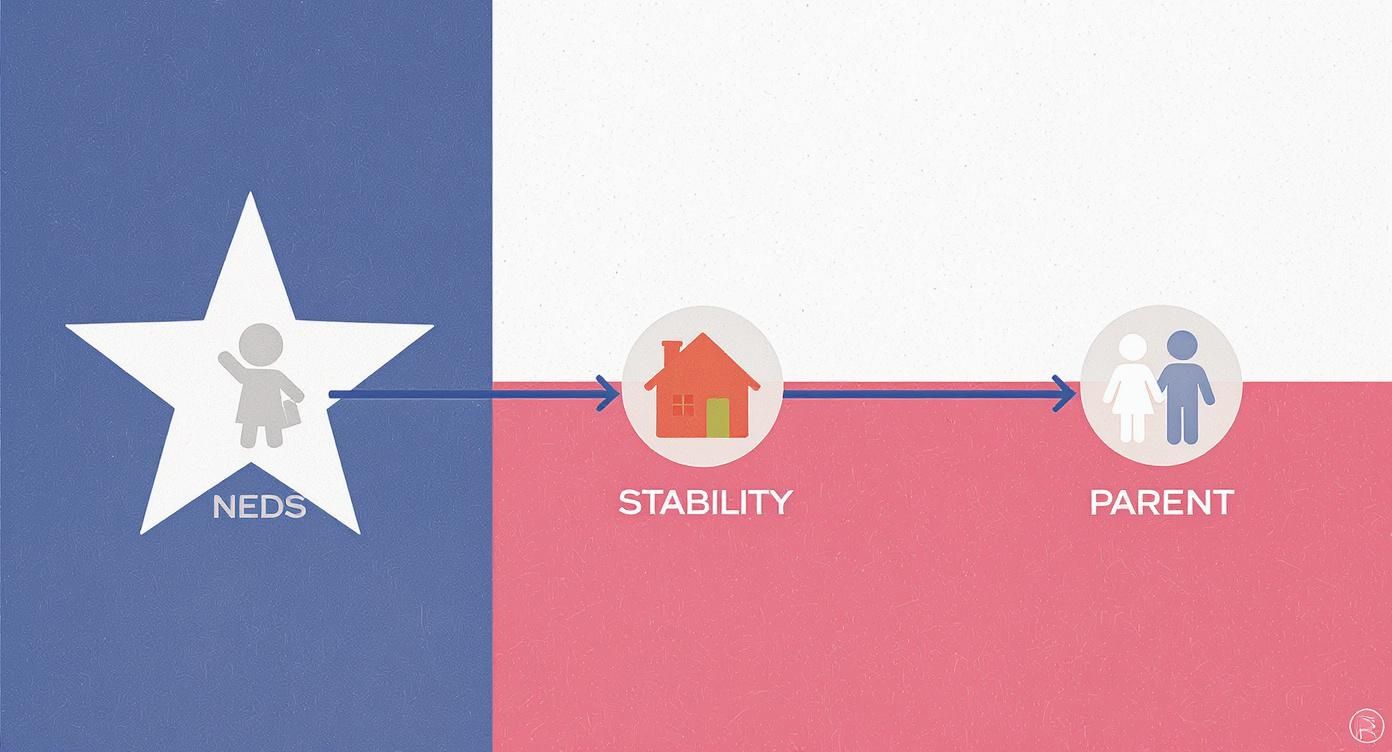
As you can see, a child's needs, each parent's ability to care for them, and the stability of the home are front and center in every custody decision. This is exactly why a clear, consistent schedule matters so much.
The Nuts and Bolts of the Standard Schedule
So, what does a Standard Possession Order actually look like on your calendar? The parent who doesn't have the right to decide where the child lives (often called the non-primary conservator) typically gets the children on a clear, repeating schedule.
Here’s the general breakdown:
- Weekends: You will have the children on the first, third, and fifth weekends of any given month.
- Holidays: Major holidays like Thanksgiving and Christmas are split between the parents. Usually, you’ll alternate these holidays each year, making sure both of you get to create those special memories. For example, you might have the kids for Thanksgiving in even-numbered years, and your co-parent gets them in odd-numbered years.
- Summer Vacation: The SPO carves out an extended period for summer possession, which is usually 30 days. This time can often be broken up into shorter visits if that works better for everyone.
This structure is the court's go-to option because it's presumed to be in the child's best interest. It provides a predictable rhythm that kids can settle into and rely on.
The Expanded Standard Possession Order
Texas law also provides a really important variation called the Expanded Standard Possession Order (ESPO). In fact, it's become so common that judges are now required to order the expanded version unless it’s proven not to be in the child's best interest or a parent's location makes it unworkable.
The ESPO is all about giving the non-primary parent more time with the kids during the school week.
An Expanded Standard Possession Order is now the default presumption in Texas. It's designed to give you more opportunities to be involved in your child's daily school life, from checking homework to reading bedtime stories.
Under an ESPO, your time with the kids gets extended. Instead of returning them on Sunday evening, you would typically keep them until you drop them off at school on Monday morning. Your Thursday evening visit also becomes an overnight, with you taking them to school on Friday morning.
This expansion provides that crucial midweek contact that so many parents find essential for maintaining strong bonds. It lets you be more than just a "weekend parent" and keeps you plugged into the day-to-day school routine.
Is the Standard Order Right for You?
The SPO gives you a solid, court-approved foundation to build your co-parenting plan on. It works well for a lot of families, especially those with traditional 9-to-5 work schedules who live relatively close to each other. It establishes clear rules of the road and cuts down on the need for constant negotiation, which is a huge source of conflict for many.
But let's be real—a one-size-fits-all approach doesn't work for every family.
If you or your co-parent work unconventional hours, live far apart, or just genuinely believe a different schedule would better serve your children, you have other options. The law absolutely allows you to agree on any possession schedule that works for you. If you can hammer out a custom plan through an agreement or mediation, a judge will almost always sign off on it.
Understanding the SPO is your first step. It gives you a baseline to measure against, helping you decide whether to stick with the standard or build a custom schedule that truly fits your family’s unique life.
Creating a Custom 50/50 Parenting Plan
The standard possession schedule works for many families, but your family isn't standard—it’s unique. While Texas law doesn't have an official "50/50 custody bill," the good news is that courts are more open than ever to equal parenting time, especially when you and your co-parent agree it’s what's best for your children.
Building a custom 50/50 parenting plan puts you in the driver's seat. It gives you the power to design a schedule that fits your family’s real-world needs, from demanding work commitments to your kids' school schedules and activities.

This whole process is about collaboration. Instead of letting a judge impose a one-size-fits-all solution, you can work together—either through direct agreement or mediation—to craft a plan that truly prioritizes your children's stability and well-being.
Exploring Popular 50/50 Schedules
When you decide to craft a shared custody arrangement that aims for an even split, you aren't starting from scratch. Several well-established models provide excellent frameworks that you can tweak to fit your specific situation. The goal is to find a rhythm that minimizes disruptions for your kids while maximizing quality time with each of you.
Here are a few of the most common 50/50 possession schedules we see:
- Week-On, Week-Off: This is one of the simplest arrangements out there. Your child spends one full week with you, then one full week with the other parent. It's easy to track and cuts down on the number of exchanges, which can be a huge plus for older kids and teenagers who can handle a full week away from one parent.
- The 2-2-3 Schedule: With this rotation, the child is with you for two days, your co-parent for two days, and then back with you for a three-day weekend. The following week, it flips. This schedule is fantastic for younger children who need more frequent contact, ensuring they never go more than a few days without seeing each parent.
- The 2-2-5-5 Schedule: This plan offers incredible consistency during the school week. You might always get Monday and Tuesday, while your co-parent always has Wednesday and Thursday. You then simply alternate a three-day weekend (Friday-Sunday). That kind of predictability can be a game-changer for school-aged kids and makes planning extracurriculars so much easier.
Choosing the Right Schedule for Your Family
There’s no magic bullet here—the single "best" 50/50 schedule simply doesn't exist. The right one depends entirely on your family's unique circumstances. A schedule that works beautifully for a family with teenagers might feel chaotic and disruptive for toddlers.
As you weigh your options, think through the critical factors.
The most successful parenting plans are those built with flexibility and a deep understanding of the child's developmental needs. Your ability to communicate and cooperate with your co-parent is the single most important factor in making any 50/50 schedule work.
To help you decide what might be the best fit, let's compare the pros and cons of some popular options. A comprehensive child custody agreement template can also be an invaluable starting point for mapping out your preferences and getting on the same page.
Comparing Popular 50/50 Possession Schedules
A 50/50 parenting schedule aims to give children equal time with both parents, but the way that time is divided can look very different from one family to the next. Below is a quick comparison of the most common structures to help you see what might work for your children's ages and your family's lifestyle.
| Schedule Type | How It Works | Best For |
|---|---|---|
| Week-On, Week-Off | Children alternate homes on a weekly basis, typically exchanging on a Friday or Sunday. | Older children and teenagers who can handle longer periods away from one parent; parents who want fewer exchanges. |
| 2-2-5-5 Rotation | Parent A has Mondays/Tuesdays; Parent B has Wednesdays/Thursdays. Weekends (Fri-Sun) alternate between parents. | School-aged children who thrive on a predictable weekly routine; parents who want consistent weekdays with their kids. |
| 2-2-3 Rotation | Children are with one parent for 2 days, the other for 2 days, then back with the first parent for a 3-day weekend. The schedule then flips. | Younger children who benefit from seeing both parents frequently throughout the week; co-parents who live very close to each other. |
Ultimately, the best schedule is the one you can both commit to consistently, as routine and predictability are what help children feel secure.
How Child Support Works in Shared Custody

This is hands down one of the biggest misconceptions we hear from clients: "If we split time 50/50, nobody pays child support, right?" It seems like common sense, but Texas law doesn't quite see it that way. The courts treat possession schedules and child support as two completely separate issues.
The state’s number one goal is making sure your child's needs are met consistently, no matter whose house they're sleeping at. Since parents rarely have identical incomes, child support acts as an equalizer to balance the financial resources available to the child in both homes. That's why even with a perfectly equal 50/50 schedule, one parent is almost always ordered to pay child support to the other.
Calculating Child Support in Texas: A Step-by-Step Guide
Texas courts don’t guess when it comes to child support. There’s a specific formula laid out in the Texas Family Code, and it all starts with the net monthly resources of the parent who will be paying (the "obligor").
Here is the step-by-step process the court follows:
- Figure Out Gross Income: First, the court totals up all your income sources—salary, commissions, bonuses, rental income, you name it.
- Calculate Net Resources: Next, they subtract specific deductions like federal income taxes, Social Security and Medicare taxes, and the cost of your child's health insurance premiums. This gives them your net monthly resources.
- Apply Guideline Percentages: Finally, a set percentage is applied to that net monthly resource figure based on how many children need support.
For example, the guideline for one child is 20% of the paying parent’s net monthly resources. That percentage goes up with each additional child.
The Impact of Income and New Laws
Even in a 50/50 split, the court will designate one parent as the primary conservator, at least for administrative purposes. Typically, the other parent is the one ordered to pay support, calculated based on their income.
It's also critical to keep up with changes in the law. Texas rolled out some major family law updates effective September 1, 2023, that directly impact how custody and support are handled. A key change was raising the income cap for child support calculations from $9,200 to $12,000 in monthly net resources. This can make a significant difference in the final amount ordered. You can read more about these updates and how they might affect your case.
Can the Support Amount Be Adjusted for 50/50 Custody?
Yes, it can—but it's not a given. The guideline formula is just the starting point. A judge has the authority to deviate from it if there's solid evidence showing the standard amount would be unfair or not in the child's best interest.
In a 50/50 shared custody arrangement, your possession schedule can be a strong reason to ask the court for a child support amount that is lower than the standard guideline calculation.
If you have a true 50/50 schedule, you'll need to present evidence of the significant costs you cover when the kids are with you. Think about what you spend on food, housing, clothing, and other daily needs. The judge has the discretion to order a lower amount, but the burden is on you to prove that a deviation is justified.
Modifying or Enforcing Your Custody Order
A court order is a snapshot of your family's life at one specific moment, but life rarely stands still. As your job changes, your kids get older, and circumstances evolve, the custody order that worked perfectly a year ago might not fit your reality today. Understanding how to adapt your agreement—or what to do when your co-parent isn't following it—is crucial for maintaining stability for your children long-term.
Whether you need to tweak the possession schedule or address a consistent pattern of non-compliance, Texas law provides clear pathways. These processes are designed to protect your parental rights and, most importantly, ensure the order continues to serve your child's best interests.
When Can You Change a Custody Order?
You can’t just head back to court over a minor disagreement or a one-time scheduling conflict. To formally modify your custody order, you must prove to the judge that there has been a material and substantial change in the circumstances of the child or one of the parents.
That’s the legal standard, and it’s a high bar to clear. The change can’t be a small inconvenience; it has to be significant enough to impact your child's life and make the current order unworkable or no longer in their best interest.
So, what kind of situations might qualify? Here are a few common examples:
- You or your co-parent needs to relocate for a new job, making the current possession schedule impossible to follow.
- A major job change for one parent that completely alters their availability for the children.
- The evolving needs of your child, especially as they become teenagers and express a desire to spend more time with one parent.
- A parent's living situation becomes unstable or unsafe, putting the child's well-being at risk.
If you believe your situation meets this threshold, your next step is filing a formal Petition to Modify the Parent-Child Relationship. To get a deeper look at the process, you can learn more about how to change your Texas custody agreement in our detailed guide.
What Happens When Your Co-Parent Violates the Order?
It is incredibly frustrating when your co-parent decides the court's orders don't apply to them. But a signed custody order isn't a suggestion—it's a legally binding document with real teeth. If the other parent is constantly late for exchanges, denying you rightful possession time, or ignoring other terms of the decree, you have legal options.
The most powerful tool for addressing non-compliance is filing a Motion for Enforcement. This is a formal request asking the court to step in, hold the other parent accountable, and force them to follow the existing order.
When you file an enforcement action, you have to be specific. Your motion needs to list every single violation with the date, time, and the exact provision of the order that was broken. This gives the judge a clear picture of the problem and the authority to act.
The consequences for ignoring a court order can be serious, including:
- Ordering the non-compliant parent to pay hefty fines.
- Requiring them to pay for your attorney's fees.
- Granting you make-up possession time to compensate for the periods you lost.
- In severe or repeated cases, ordering jail time for contempt of court.
This is why keeping detailed records is absolutely essential. Document every violation—write down dates, times, and save any texts or emails you have with the other parent about their failure to comply. This evidence will be the backbone of your case in court.
What to Do Next
You’ve already done some of the hard work. By reading this guide, you’ve armed yourself with a solid understanding of how shared custody works in Texas. But knowing the rules of the game is one thing; building a winning strategy for your unique family is another.
Every family’s story is different. The details of your situation—your relationship with the other parent, your children's needs, your financial picture—all play a huge role. A misstep at this stage, whether in negotiations or in court, can create problems that last for years. You don’t have to figure this all out on your own.
Take Control of Your Family's Future
The decisions you make in the next few weeks and months will shape your life for years to come. This isn't the time to leave things to chance or hope for the best. The best way to protect what matters most is to be proactive, armed with a clear plan and strong legal advice from someone who lives and breathes Texas family law.
An experienced and compassionate attorney can help you:
- Analyze your specific circumstances to map out the smartest legal strategy.
- Gather the right evidence to build a strong case for your custody goals.
- Negotiate from a position of strength in mediation to hammer out a fair deal.
- Advocate for you powerfully in the courtroom if a trial becomes unavoidable.
Your Path Forward Starts Here
Getting to a stable, predictable co-parenting future begins with one simple, decisive action. Think of a consultation with a family law attorney as an investment in your peace of mind and your child's well-being. It’s your chance to get straight, honest answers and walk away with a concrete game plan.
Your family's story is important, and the outcome of your custody case will define its next chapter. Our primary goal is to make sure that chapter is one of stability, security, and positive co-parenting. We're here to help you get there.
We invite you to take that first step. At The Law Office of Bryan Fagan, PLLC, our dedicated family law attorneys are ready to help you protect your family and your future. We will listen to your story, answer your questions, and help you create a clear path toward achieving your custody goals. Schedule your free, confidential consultation today and let us provide the guidance and support you deserve.