Skip to content
Navigating a custody case without being married can feel like you've been handed a puzzle with half the pieces missing. In Texas, the law starts with one simple, but incredibly important, rule: when a child is born to unmarried parents, the mother automatically has sole legal and physical custody.
This means that if you are a father, your parental rights simply do not exist in the eyes of the law until you take specific legal steps to establish them. Understanding this is the first step toward building a stable, secure future for you and your child.
The Starting Line for Unmarried Parents in Texas

When you and your partner aren't married, the Texas Family Code makes no assumptions about the father's identity or role. This is why it grants the mother initial, full authority. This isn't about being "fair" or "unfair"—it’s a practical measure to create legal clarity from the moment your child is born. A mother's connection is biologically and legally undisputed. The father’s connection, however, must be legally proven.
This default setup creates a shaky foundation for everyone. For you as a mother, it places the entire legal burden on your shoulders, often without a straightforward way to get court-ordered child support. For you as a father, it means you have no enforceable rights to see your child or have a say in major decisions about their life.
You might have a great informal agreement that works for a while, but it offers zero legal protection the moment a disagreement pops up. This uncertainty can be stressful and damaging for both you and your child.
Default Legal Status for Unmarried Parents at Birth
To make it crystal clear, this table breaks down where you and the other parent stand legally the day your child is born if you aren't married. Understanding this is the first step to securing your rights and creating stability for your child.
| Parent | Automatic Legal Rights at Birth | Required Action to Gain Rights | Key Outcome of Action |
|---|---|---|---|
| Mother | Full legal and physical custody. | None. Rights are automatic. | Can make all decisions for the child; responsible for the child's care. |
| Father | None. No legal rights to custody or visitation. | Must legally establish paternity. | Gains the right to seek custody, visitation, and decision-making authority. |
This legal framework is designed to protect the child by ensuring someone has clear authority from day one, but it requires both of you to be proactive. Without a court order, your rights and responsibilities are ambiguous and, most importantly, unenforceable.
This means:
- As a father, you have no legal right to visitation.
- As a mother, you cannot legally force the father to pay child support.
- Neither of you has a clear, court-ordered schedule to rely on when life gets complicated.
The only way to move from this uncertain default position to a stable, legally protected co-parenting relationship is by taking formal legal action. This is the foundation for creating a predictable future for your child.
Beyond the immediate legal steps, it's also wise to start thinking about long-term financial planning for babies and their future. Getting a handle on the financial side of things early can create a bedrock of stability for your child, no matter what your relationship status is.
The goal is to replace uncertainty with a clear, enforceable plan. The following sections will walk you through exactly how to do that, starting with the most critical first step for fathers: establishing paternity.
Establishing Paternity: Your Gateway to Parental Rights

For an unmarried father in Texas, learning you have no automatic legal rights to your child can be a shock. But this is not a permanent roadblock; it's simply the first legal hurdle you need to clear. The entire process of gaining your parental rights begins with one critical step: establishing paternity.
Think of it this way: paternity is the legal key that unlocks the door to your rights for custody, visitation, and making decisions for your child. Without it, you are a biological father but not a legal one, leaving you powerless to enforce your role in your child's life.
For mothers, establishing paternity is just as crucial. It's the necessary first move to get a court to order child support. It is the legal foundation upon which everything else—custody, possession schedules, and support—is built.
In Texas, there are two main paths to legally establish that you are a child's father. Which one you take depends entirely on your unique circumstances.
The Acknowledgment of Paternity (AOP)
The simplest and most direct route is signing an Acknowledgment of Paternity (AOP). This is a powerful legal document where both you and the mother voluntarily agree, in writing, that you are the child's biological father.
Most often, you can sign an AOP at the hospital right after your child is born. It's free, quick, and makes your fatherhood official from day one. Once the AOP is filed with the Texas Vital Statistics Unit, it carries the same legal weight as a judge's order.
But signing an AOP is a serious, lifelong commitment.
- It’s Binding: Once signed and filed, an AOP is incredibly difficult to rescind. You are legally accepting all the rights and responsibilities of a parent, including the duty to pay child support.
- Only Sign if You Are 100% Certain: If there is even a shadow of a doubt about who the biological father is, you should not sign an AOP. The next option—a paternity suit—is the right way to resolve any uncertainty.
Signing an Acknowledgment of Paternity is far more than putting your name on a form. Under the Texas Family Code, it is a legal declaration that creates a parent-child relationship for life, with all the rights and duties that come with it.
The Court-Ordered Paternity Suit
When you and the other parent cannot agree on paternity, or if there's any uncertainty, the next step is to file a paternity suit. This is a formal legal action where you ask a judge to make an official ruling on who the father is.
This process is more involved than signing a form, but it delivers a definitive, legally binding answer. Here is a step-by-step breakdown of the process:
- Filing the Suit: You or the other parent file a petition with the court to establish paternity.
- DNA Testing: The judge will almost always order genetic (DNA) testing to get a scientific answer. It's a simple and painless process, usually just a cheek swab from the mother, child, and the man believed to be the father.
- Court Order: If the DNA test confirms the man is the father with a 99% probability or higher, the judge will sign an order legally declaring him the father.
Once that order is signed, the father's name is added to the birth certificate. You finally have the legal standing you need to ask the court for specific custody and visitation rights. It also clears the way for the mother to request a formal child support order. For a more detailed look at this legal process, you can explore the specifics of Texas paternity laws and your rights.
What Happens After Paternity is Established?
Establishing paternity is the essential first step, but the job is not done. It gives a father the right to ask for custody, but it does not automatically create a parenting schedule or a child support arrangement.
Once you are legally recognized as the father, the next move is to get a formal court order that spells out everyone's rights and duties. This is done through a Suit Affecting the Parent-Child Relationship (SAPCR), which we’ll cover next. That order becomes the official rulebook that will govern your co-parenting relationship for years to come.
Using a SAPCR to Create a Formal Custody Order
Establishing paternity is a huge first step, but it doesn't actually give you a roadmap for co-parenting. It just confirms who the child's legal parents are. To nail down each parent's specific rights, duties, and time with your child, you need a formal, enforceable court order. In Texas, you achieve this by filing a Suit Affecting the Parent-Child Relationship (SAPCR).
Think of an informal parenting agreement like a handshake deal—it only works as long as everyone is getting along. A SAPCR, on the other hand, is like a legally binding contract enforced by a judge. It becomes the official blueprint that protects your rights and gives your child a clear, stable structure, especially when disagreements arise.
What Does a SAPCR Accomplish?
Filing a SAPCR (often pronounced "sap-sir") lays the legal foundation for your entire future as co-parents. It's the single court case that tackles all the critical aspects of raising a child in separate homes. A final SAPCR order will clearly define:
- Custody (Conservatorship): This determines your rights to make key decisions for your child, like where they go to school, what non-emergency medical care they receive, and their religious upbringing.
- Visitation (Possession and Access): This lays out a specific calendar for when your child will be with each of you. It covers everything—weekdays, weekends, holidays, and summer vacation.
- Child Support: The order will establish a monthly child support obligation based on Texas guidelines, making sure your child's financial needs are consistently met.
- Medical and Dental Support: It also spells out which parent is responsible for providing health insurance and how out-of-pocket medical bills are divided.
This comprehensive order replaces guesswork with certainty. It gives both of you a clear set of rules to follow, which is absolutely essential for creating consistency and stability for your child.
The Journey From Filing to Final Order
The process of getting a SAPCR order moves through several key stages. While your family's situation is unique, the general path is designed to reach a fair and just outcome. If you’re thinking about taking this step, our firm has a detailed guide on how to file for custody in Texas that breaks down all the practical details.
Here’s a step-by-step breakdown of what you can expect:
- Filing the Petition: One parent (the "Petitioner") starts the case by filing the initial SAPCR petition with the court.
- Serving the Other Parent: The other parent (the "Respondent") must be formally notified of the lawsuit. This is called "service of process."
- Temporary Orders Hearing: If there are immediate issues—like who the child lives with or how bills get paid—the court can hold a hearing to put temporary rules in place while the case moves forward. This often happens within weeks of filing.
- Discovery: This is the information-gathering phase. Both sides exchange documents and evidence, like financial records, to build their respective cases.
- Mediation: Before you ever see a courtroom for a final trial, most Texas courts require parents to attend mediation. It’s a confidential meeting with a neutral mediator who helps you try to negotiate a settlement you can both live with. The vast majority of custody cases get resolved right here, in mediation.
- Final Trial: If you can’t reach an agreement, your case will be presented to a judge. They will hear testimony and review evidence before making a final decision for you.
- Final Order: The judge signs a Final Order containing all the legally binding decisions on custody, visitation, and support. This is the document that governs your co-parenting relationship from that day forward.
At every stage of this process, a Texas judge's decision is guided by one overarching principle: the "best interest of the child." This legal standard, found in the Texas Family Code, requires the court to prioritize your child's physical and emotional well-being above everything else. Factors like your child’s needs, each parent's ability to provide a stable home, and the existing parent-child bond all play a massive role in the final outcome.
Understanding Conservatorship and Possession Orders
Walking into a Texas family court can feel like learning a new language. You won’t hear terms like "legal custody" or "physical custody." Once you understand the Texas-specific vocabulary, however, you'll have a much clearer picture of your rights.
After a SAPCR is filed, the judge’s job is to create a court order that defines your co-parenting relationship using two key concepts: conservatorship and possession orders.
This infographic breaks down how a single lawsuit—the SAPCR—branches out to cover both the parenting plan (custody) and the financial side of things (support).
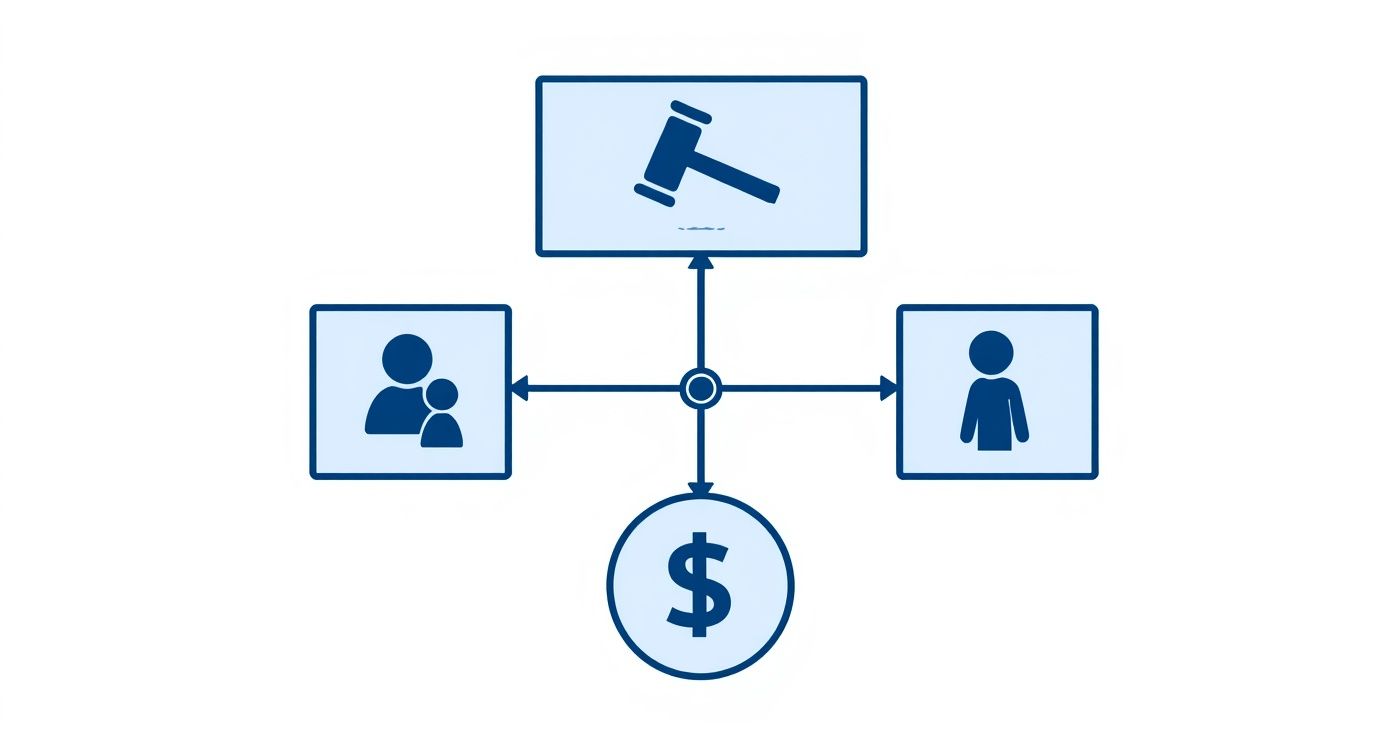
Think of the SAPCR as the main vehicle. It’s what gets you to court to establish all the critical orders that will shape your co-parenting life from here on out.
Conservatorship: Your Parental Rights and Duties
In Texas, we don't say "legal custody." We talk about conservatorship. This is simply the legal term for the collection of rights and responsibilities you have as a parent. It’s all about who gets to make the big decisions for your child—things like medical care, education, and religious upbringing.
Texas law begins with a powerful presumption: it is in a child's best interest for both parents to be named Joint Managing Conservators (JMCs). For unmarried parents, this is by far the most common outcome.
Being JMCs means you and the other parent share decision-making power. It doesn’t mean everything is a 50/50 split, though. Usually, one parent is given the exclusive right to decide where the child lives, although it's often restricted to a specific geographic area (like the current county and its neighbors). This parent is often called the "primary parent."
In some rare and serious situations—such as family violence, neglect, or substance abuse—a judge might name one parent the Sole Managing Conservator. This gives that parent the exclusive power to make most major decisions for the child.
Possession and Access: Your Parenting Time
The other side of the coin is possession and access. This is what most people mean when they say "physical custody" or "visitation." It’s the actual, court-ordered schedule that lays out when your child will be with each of you.
To keep things consistent and predictable, Texas law provides a Standard Possession Order (SPO). The SPO is the default parenting schedule that judges use in the vast majority of cases because it's legally presumed to be in the child's best interest.
For the non-primary parent, the SPO generally looks like this:
- Weekends: You get the child on the first, third, and fifth weekends of any given month.
- Holidays: Major holidays like Thanksgiving and Christmas are split, with you and the other parent alternating years.
- Summer: The non-primary parent gets a solid block of time in the summer, usually 30 days.
This schedule is designed for parents who live less than 100 miles apart. If you live farther away, the court will adjust the SPO to make travel more practical. For example, instead of frequent weekend visits, you might get every spring break and a longer summer possession period.
For an unmarried father just starting the process, securing a standard schedule isn't always immediate. The path to visitation rights often involves a "step-up" or graduated plan, especially with very young children. Your initial time with your toddler might start with short, supervised visits for a few hours. Over several months, that time gradually expands into the full Standard Possession Order.
At the end of the day, the goal of a conservatorship and possession order is to create stability. It provides a clear set of rules that you can both rely on, ensuring your child can maintain a strong, healthy relationship with each of you.
How Texas Calculates Child Support
Figuring out how you’ll financially support your child can feel like a huge weight on your shoulders. The good news is that in Texas, the process for calculating child support is surprisingly straightforward and designed to be predictable. The state uses a clear, percentage-based model, which helps ensure your child receives consistent financial support.
This system takes a lot of the guesswork out of the equation. Instead of arguing over an arbitrary number, the court simply applies a specific formula based almost entirely on the non-primary parent’s income.
What Counts as Income
First, the court must determine the paying parent's net monthly resources. This isn't just your take-home pay. It includes nearly every dollar you receive from all sources, such as:
- Wages, salary, commissions, and tips
- Self-employment income
- Overtime pay and bonuses
- Rental income
- Retirement benefits, social security, and disability payments
From this total gross income, the court subtracts specific deductions like federal income taxes, Social Security taxes, Medicare taxes, and the cost of the child's health insurance. The number you're left with is your net monthly resources, and that is the figure used to calculate child support. For a detailed worksheet and a deeper dive, our firm has a helpful guide on how to calculate child support in Texas.
The Guideline Percentages
Once your net monthly resources are calculated, the Texas Family Code applies a set percentage based on how many children are involved in this specific case.
The standard guidelines are:
- 1 Child: 20% of net monthly resources
- 2 Children: 25% of net monthly resources
- 3 Children: 30% of net monthly resources
- 4 Children: 35% of net monthly resources
- 5 or more Children: 40% of net monthly resources
These percentages can be adjusted if you are already legally obligated to support other children from a different relationship.
It is important to remember that these are the guideline amounts. While courts stick to them in the vast majority of cases, a judge can deviate if there's compelling evidence that it’s in your child's best interest. A common example is when a child has significant special needs that require more financial support than the guidelines provide.
Health Insurance and Medical Expenses
Beyond the monthly payment, the court order will also map out who handles healthcare. A judge will order one parent—usually the one paying support—to provide health and dental insurance for the child.
The cost of those insurance premiums is factored into the support calculation itself. On top of that, the court order will spell out how any out-of-pocket medical expenses are split. Co-pays, deductibles, and prescription costs are typically divided 50/50 between you and the other parent.
Getting a handle on the real-world numbers, like the typical cost of having a baby in Texas with insurance, can help put these support considerations into perspective. This kind of financial clarity helps you plan for your child's well-being for years to come.
What to Do Next to Protect Your Parental Rights
Navigating Texas custody laws when you aren't married can feel overwhelming, but taking clear, decisive action is the only way to protect your family's future. The moves you make now will build the legal foundation for a stable and predictable life for your child.
The path forward boils down to a few essential goals. For fathers, the journey begins with legally establishing paternity. For both parents, it means getting a formal Suit Affecting the Parent-Child Relationship (SAPCR) order. This is the only way to create an enforceable agreement for custody, visitation, and child support that will stand up in court.
Your Action Plan Checklist
It's completely normal to feel lost about where to even begin. Use this simple checklist to organize your thoughts and prepare for the road ahead. This is not just about legal strategy; it's about defining the future you want for your child.
- Gather Your Documents: Start collecting important papers. This includes your child's birth certificate, any Acknowledgment of Paternity (AOP) you may have signed, and proof of your income like recent pay stubs or tax returns.
- Define Your Ideal Parenting Plan: Think about what you genuinely believe is best for your child. What kind of possession schedule makes the most sense for everyone's routine? Who should have the final say on big decisions about school and healthcare?
- Consider Your Child's Needs: Always frame your requests around the "best interest of the child." This is the standard the judge will use. Be ready to explain why your proposed plan supports your child's emotional stability and physical well-being.
- Consult with an Experienced Attorney: Your family's situation is unique. There is no substitute for discussing the specifics of your case with a family law attorney—it's the single most important step you can take to protect your rights.
You do not have to walk this emotional and complex path alone. The decisions you make now will shape your child's life for years to come, and getting them right is crucial.
Your role as a parent is invaluable. The Law Office of Bryan Fagan, PLLC, is here to help you protect that role with confidence and compassion. We invite you to schedule a free, confidential consultation with our experienced family law attorneys to build a strategy that protects what matters most—your child and your future together.
Common Questions About Unmarried Parent Custody
Going through a custody case can feel like you're being hit with a wave of questions you just don't have the answers for. That uncertainty is overwhelming, but getting clear, direct answers is the first step toward regaining control. Here are some of the most common questions we hear from unmarried parents trying to make sense of Texas custody laws.
Does Being on the Birth Certificate Give a Father Legal Rights?
This is easily one of the biggest myths in Texas family law. It’s a logical assumption, but it’s incorrect. While putting your name on the birth certificate creates a legal "presumption" that you are the father, it does not grant you any enforceable legal rights to custody or even visitation.
To actually secure those rights, you as an unmarried father must take one of two steps:
- Sign a formal Acknowledgment of Paternity (AOP) with the mother, or
- Get a court order that officially establishes your paternity.
Without one of those two things, a father's name on a birth certificate is just a name on a piece of paper. It is not enough to secure your role as a legal parent with rights you can enforce in court.
Can the Mother Move Out of State With Our Child if We Have No Custody Order?
Potentially, yes. If there is no court order in place, the mother is considered to have sole legal and physical custody by default in Texas. In that scenario, she may be able to relocate with your child without getting your permission first.
However, the moment you establish your paternity and file a SAPCR, that all changes. A court can immediately issue temporary orders to stop the child from being moved out of the county or the state while the case is ongoing. The final order will almost always include a geographic restriction that nails down where your child's primary home must be, protecting both your access to the child long-term.
An informal handshake deal or a verbal parenting agreement is not legally enforceable in Texas. If the other parent wakes up one day and decides to stop following the plan, you have zero legal power to make them comply.
A formal court order is the only way to lock in a stable, predictable, and legally binding arrangement for custody, visitation, and child support. It turns your verbal promises into enforceable rights and gives you the ultimate protection for your relationship with your child.
Figuring out these complex issues requires a clear head and a solid strategy from someone who has been there before. The decisions you make right now will shape your family’s future for years to come. At The Law Office of Bryan Fagan, PLLC, we’re here to give you the answers and support you need to protect your rights and your child. Schedule a free, confidential consultation with us today to talk about your situation and learn how we can help.