Skip to content
You may be hearing “Rule 11” in the middle of a tense divorce or custody dispute and thinking the hard part is over, only to learn later that the agreement you trusted may not protect you the way you assumed.
The Handshake Deal That Isn't a Handshake at All
You and your spouse finally agree on something. Maybe it's who stays in the house, who pays certain bills, or how the kids will spend the next few weeks. Someone says the deal can be put into a Rule 11 agreement, and that sounds reassuring.
It should be reassuring, but only if you understand what that phrase means.
In Texas family law, a Rule 11 agreement is often used to put a negotiated agreement into a form the court can recognize. That can be useful in divorce cases, custody disputes, temporary arrangements, and practical issues that come up while the case is still pending. It can help you avoid unnecessary hearings and create a written record of what was decided.
But many individuals often find themselves blindsided. A Rule 11 agreement sounds final. It often feels final. In practice, it may be much less final than you think.
Why people misunderstand Rule 11
Most clients hear the word “agreement” and assume “court order.” Those are not the same thing. A Rule 11 can be an important legal tool, but it has strict procedural requirements and real limits.
If you are asking, what is the Rule 11 in Texas family law, the short answer is this: it is a formal way for parties in a lawsuit to document an agreement so the court can recognize it, but it is not automatically the same as a signed court order.
A Rule 11 can solve a problem quickly, but if it is drafted poorly or handled casually, it can create a new problem just as fast.
Where it comes up in real family cases
You may see Rule 11 used for issues such as:
- Temporary parenting arrangements: A short-term plan while the case moves forward.
- Property access: Agreements about the house, vehicles, accounts, or documents.
- Scheduling matters: Hearing resets, deadlines, or exchanging information.
- Interim financial issues: Who pays what while the divorce is pending.
Texas divorce procedure still moves from filing to final decree, even when side agreements happen along the way. If you need a clear view of that larger process, How to File for Divorce in Texas: Step by Step walks through the full sequence from petition to final decree.
What a Rule 11 Agreement Is (And What It Is Not)
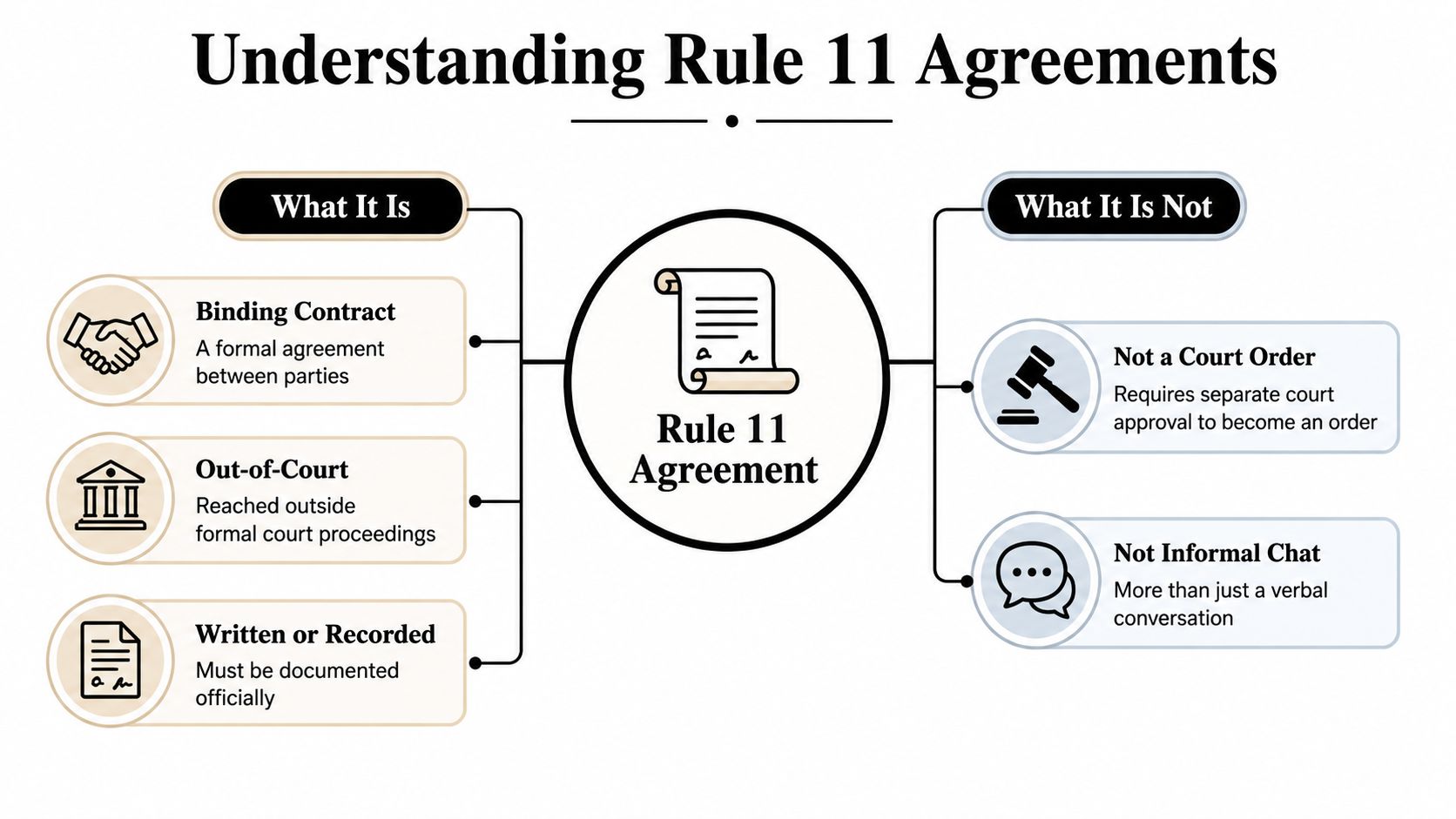
A Rule 11 agreement is a formal agreement between the parties in a pending lawsuit. In family court, that usually means you, your spouse, and often your attorneys are putting a negotiated term into a format the law will recognize.
It is not a casual text exchange. It is not “we talked and shook on it.” It is not enforceable just because both sides sounded sincere on the phone.
The formal rule in plain English
Rule 11 of the Texas Rules of Civil Procedure is mandatory. It requires that an agreement touching a pending lawsuit will be enforced only if it is in writing, signed by the parties or their lawyers, and filed with the court papers as part of the record, or made in open court and entered of record. The rule states that “no agreement between attorneys or parties touching any suit pending will be enforced unless it be in writing, signed and filed with the papers as part of the record, or made in open court and entered of record,” and courts consistently treat failure to comply as fatal to enforcement, even when the agreement seemed reasonable and both sides originally consented, as discussed in this analysis of Texas Rule 11 enforceability requirements.
That is the first thing to remember. Form matters. If the procedure is wrong, the agreement may not hold.
What it is
A Rule 11 is best understood as a contractual agreement inside an active court case. It can address a narrow issue or a major one. In divorce, that might involve possession of the marital home, temporary parenting details, or a property-related arrangement.
It is comparable to a signed offer in a home sale. The document matters. It may reflect a serious meeting of the minds. But it is not the same thing as the final closing.
That distinction matters a lot when the house is one of the biggest divorce assets. If your case involves selling real estate during separation, practical resources like this guide with expert advice for divorce house sales can help you think through timing, possession, and logistics while your legal documents are being finalized.
What it is not
A Rule 11 agreement is not automatically a court order. The court can later incorporate the agreement into an order or final decree, but those are separate steps. Until that happens, you should not assume you have the same enforcement power you would have with a signed judicial order.
For a fuller look at this distinction in the divorce context, this article on what a Rule 11 agreement means in a Texas divorce is a useful companion.
If you sign a Rule 11 and walk away believing the judge has already locked it in, you may be trusting paperwork that hasn't yet become the protection you need.
How to Create a Valid Rule 11 Agreement
The law gives you only a limited number of ways to create a valid Rule 11 agreement. If you miss the required steps, you can end up with a document that looks serious but is vulnerable when it matters most.

The written path
The most common method is a written agreement.
To make that work in practice, pay attention to each part:
Reduce the deal to actual terms.
Vague wording creates future fights. Spell out who does what, by when, and under what conditions.Make sure the right people sign.
The parties or their attorneys must sign.File it with the court record.
This is the step people skip. A signed document sitting in an email chain is not the same as a filed Rule 11.
The open-court path
The second option is to place the agreement on the record in open court.
That means the agreement is stated before the court and entered of record. This approach can work well when the parties are already before the judge and want the court reporter or official record to capture the exact terms.
A practical checklist
Before you treat any Rule 11 as solid, ask:
- Is it specific enough to enforce? Terms like “reasonable access” or “cooperate on sale” often need more detail.
- Has everyone who must sign signed? Missing signatures can create avoidable disputes.
- Was it filed or entered of record? If not, you may not have a valid Rule 11 at all.
- Does it match the larger case strategy? A quick agreement can conflict with your long-term goals on custody, support, or property.
Sample language
Here is the kind of plain, direct wording attorneys often aim for in a property-related Rule 11:
The parties agree that Wife will have exclusive use and possession of the marital residence pending further orders. Husband will continue making the mortgage payment due during that period. Neither party will list, transfer, refinance, or encumber the property unless both parties later agree in writing or the court orders otherwise.
That is only a sample. Real language should fit your facts, your deadlines, and your risk level.
Why drafting matters so much
A valid Rule 11 should work with the rest of your divorce process, not float outside it. If you are early in the case, this is one reason many people benefit from understanding Temporary Orders During a Texas Divorce, because temporary orders often become the stronger tool when you need clear rules while the case is pending.
Rule 11 Agreements vs Mediated Settlement Agreements
These two tools get mixed up all the time, and that confusion can lead to expensive mistakes.
A Rule 11 agreement and a mediated settlement agreement can both come from negotiation. They can both address major divorce issues. They are not interchangeable.
The difference that changes strategy
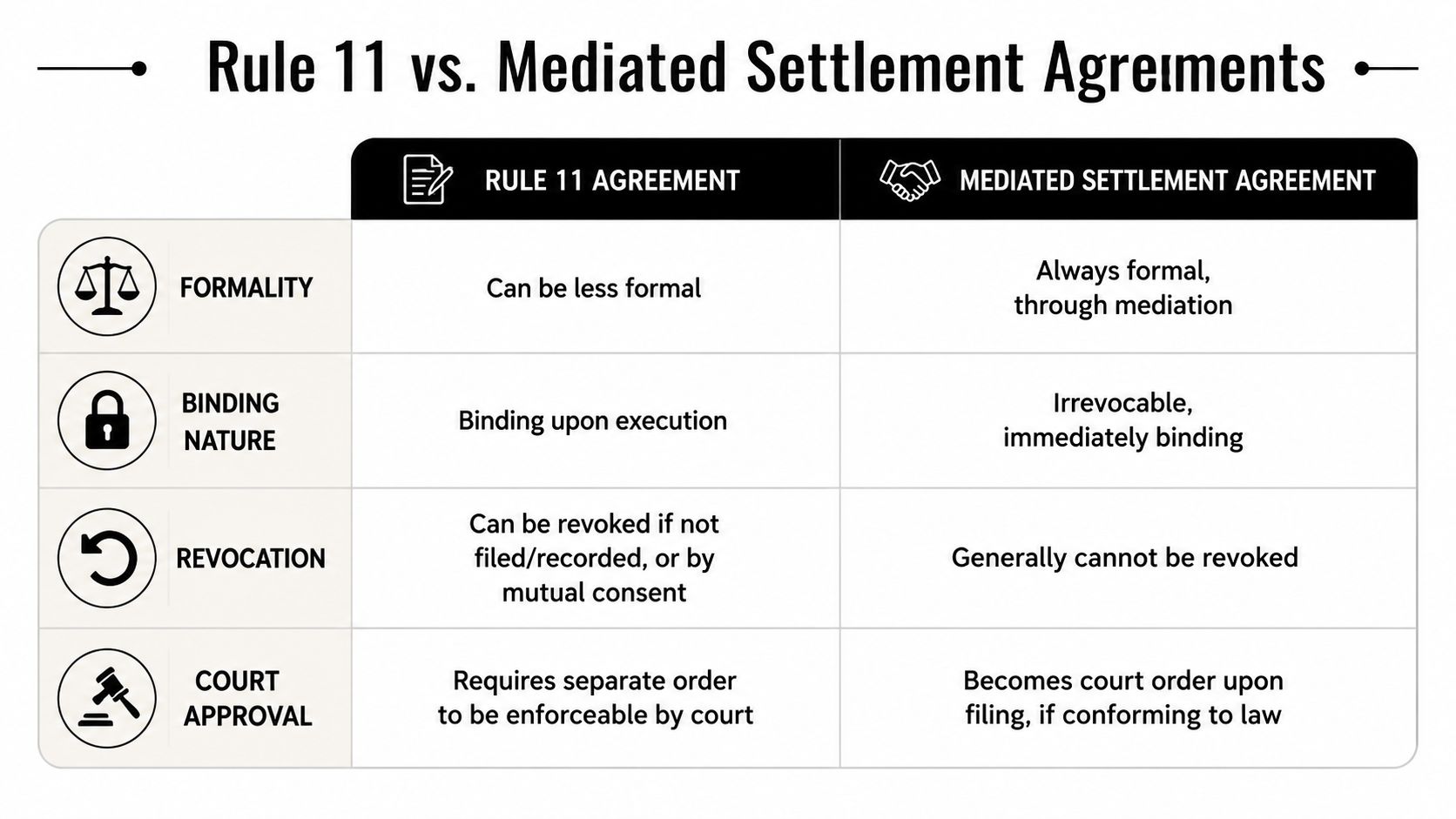
The key distinction is revocability.
A Rule 11 may help document an agreement reached during the case. A mediated settlement agreement, when properly done under Texas family law, is often the better choice when trust is low and you need more certainty.
If you are weighing those options, understanding the role of mediation in Texas divorce helps you choose the right tool for the level of conflict in your case.
Side-by-side practical comparison
| Issue | Rule 11 Agreement | Mediated Settlement Agreement |
|---|---|---|
| How it is often used | To formalize an agreement during an active case | To resolve issues through mediation in a more structured setting |
| Speed and flexibility | Often quicker for narrow or urgent issues | Better for broader settlement work |
| Level of protection | Depends heavily on timing, drafting, and later court action | Usually stronger when a final settlement framework is needed |
| Best fit | Limited disputes, practical interim issues, cooperative parties | High-conflict cases, major property division, durable settlement terms |
Which works better in real life
If you and the other side are trying to solve a small procedural problem, a Rule 11 can be efficient. It lets lawyers document an agreement without turning every dispute into a hearing.
If you are dividing a business, negotiating a complex parenting plan, or trying to settle a case with fragile trust, many attorneys will push for a more durable structure.
Use a Rule 11 for the right problem. Don't use it as a substitute for the stronger settlement vehicle your case actually needs.
For business owners and clients with high-value estates, that choice matters even more. A quick agreement may feel productive, but if the dispute involves valuation, reimbursements, control of accounts, or future sale terms, you need drafting that anticipates conflict, not drafting that merely records temporary optimism.
The Hidden Dangers Common Pitfalls of Rule 11 Agreements
Rule 11 creates the most confusion and the most frustration.
A Rule 11 can look complete, signed, and settled. You may leave the negotiation believing the issue is over. Then the other party changes position before final judgment, and the agreement you trusted no longer gives you the simple path you expected.

The revocation problem
A major limitation in Texas family law is that Rule 11 agreements are revocable before the trial court renders final judgment. A party can back out before the agreement becomes a valid court order, and even after filing, it can be modified until judgment is entered. In child-related matters under Texas Family Code Chapter 153, the court must also approve the agreement based on the best interest of the child before it becomes enforceable, even if both parents agreed, as explained in this discussion of revocation and child-related approval under Texas Rule 11 practice.
That means your signed agreement may still be vulnerable at the exact moment you need certainty.
What happens if the other side backs out
This is the trap many people never see coming. Existing coverage often skips over the practical consequence. A Rule 11 may be enforceable as a contract, but it does not carry the force of a court order until it is codified. If a spouse revokes consent before judgment, the family court cannot directly enforce it as an order, and the injured party may be left pursuing a separate breach of contract lawsuit instead of a family court enforcement action, as outlined in this explanation of the gap between a Rule 11 contract and an enforceable court order.
That changes everything about influence, timing, and cost.
Instead of filing a motion to enforce a clear court order in family court, you may be dealing with a separate civil dispute about contract enforcement. That is slower, more cumbersome, and often much less satisfying than people expect when they thought they had already “settled” the issue.
Child-related terms face another layer of review
Custody, visitation, and access are different from purely financial terms. Texas family courts do not automatically rubber-stamp parental agreements. The judge has an independent duty to look at the child's best interest.
That means even a carefully drafted Rule 11 can fail if the court believes the arrangement does not adequately protect the child.
Common danger signs
- One parent signs just to end the argument: Later, that parent withdraws consent before final judgment.
- The language is too loose: Parents agree to “work out pickup times,” which later becomes a new conflict.
- Property terms are incomplete: The deal says who gets the house, but not who pays the mortgage, insurance, taxes, or repairs before transfer.
- A business owner overlooks control issues: The agreement addresses ownership, but not management, records, distributions, or debt responsibility while the case is pending.
When a Rule 11 touches your children, your home, or your business, the legal risk usually isn't in the idea of settling. The risk is assuming the settlement is more final than it is.
What to Do Next Protecting Yourself and Your Agreement
You reach a deal on Thursday. By Friday, you are making plans around possession, support, or the house. Then the final order is not signed, the other side changes position, and you learn a hard truth about Rule 11 agreements in Texas family law. An agreement that looked settled may still be withdrawn before final judgment.
That risk should shape what you do next.
A Rule 11 can be useful for temporary issues, narrow disputes, and getting a case under control. It becomes dangerous when a party treats it like a finished result instead of an interim agreement that still needs careful drafting, follow-through, and, in many cases, a signed order.
What to do next
- Read it like you expect a future fight: If a term can be read two ways, assume it will be.
- Ask whether Rule 11 is the right tool at all: For a limited issue, it may work well. For a final property or parenting settlement, stronger options may make more sense.
- Set deadlines and mechanics: State who signs what, by when, how money is paid, when property is transferred, and what documents must be exchanged.
- Get it into an order quickly: Delay creates room for second thoughts, strategic withdrawal, and expensive motion practice.
- Treat child-related terms with extra care: A parent's agreement is not the only issue. The court still has to approve terms affecting the child.
- Have counsel review the language before you sign: A short agreement can still create long litigation if key details are missing.
Clients often ask whether they should sign now and “clean it up later.” In my experience, that is where avoidable problems start. If the agreement leaves out logistics, deadlines, release language, refinancing terms, inventory lists, or possession details, the cleanup phase often becomes the next dispute.
The right next step depends on what is at stake. Parents need precise terms for exchanges, decision-making, notice, travel, and extracurricular costs. Business owners need language covering records, control, distributions, payroll, debt service, and who can make major financial decisions while the case is pending. Families caring for both children and aging parents may also need practical outside support, including the Family Caregiving Kit for caregivers, while the legal issues are being handled.
Law Office of Bryan Fagan, PLLC handles divorce, custody, property division, mediation, and enforcement matters in Texas. That mix matters with Rule 11 disputes because the legal question is rarely just, “Do we have an agreement?” The real question is whether the agreement is enforceable, complete, and worth relying on before the final order is signed.
If the other side already broke what you believed was settled, review the difference between enforcing a court order and pursuing an agreement that may be treated as a contract. This explanation of a motion to enforce in Texas family court is a good place to start.
Key takeaway
Use a Rule 11 carefully. Draft it precisely. Convert it into enforceable orders as soon as possible.
The trap is not the idea of settlement. The trap is assuming a revocable agreement gives you the same protection as a final judgment.