 Skip to content
The so-called two-year cohabitation rule for creating a common law marriage in Texas is a myth. Texas does not require you to live together for two years, seven years, or any other set period to become married, but there is a very important two-year deadline after separation that can make proving an informal marriage much harder.
If you're separating after years together, this question can hit hard. You may be asking whether you were ever legally married, whether you need a divorce, and whether you could lose rights to property, support, or benefits if you wait too long. That uncertainty is stressful, especially when you're already dealing with a breakup, children, a home, or a family business.
A lot of Texans have heard some version of the same myth: live together long enough and the law treats you as married. That's not how Texas works. The primary issue isn't how long you lived together. The critical issue is whether your relationship met the legal test for an informal marriage, and if you've already separated, whether someone acts before the two-year post-separation deadline changes the proof rules.
When clients ask me what is the two-year cohabitation rule in common law marriage cases, I usually start with one simple correction. It isn't a rule for creating a marriage. It's a rule that can affect your ability to prove one after the relationship ends.
Introduction Are We Married or Not
You may have lived together for years, shared bills, raised children, and introduced each other as spouses, then suddenly one person moves out and everything changes. At that point, the legal question isn't academic. It affects whether you need to file for divorce, whether property may be divided, and whether one person can claim marital rights the other didn't expect.
Texas recognizes informal marriage, often called common law marriage. But Texas doesn't award married status because a couple crossed some time threshold. The idea that two years of cohabitation creates a marriage is false. So is the old seven-year myth.
What Texas does care about is conduct. Courts look at whether the legal ingredients of marriage were present at the same time. If they were, you may have a valid marriage even without a wedding or marriage license. If they weren't, living together for a very long time still won't create one automatically.
Practical rule: Time by itself doesn't create a common law marriage in Texas. Evidence does.
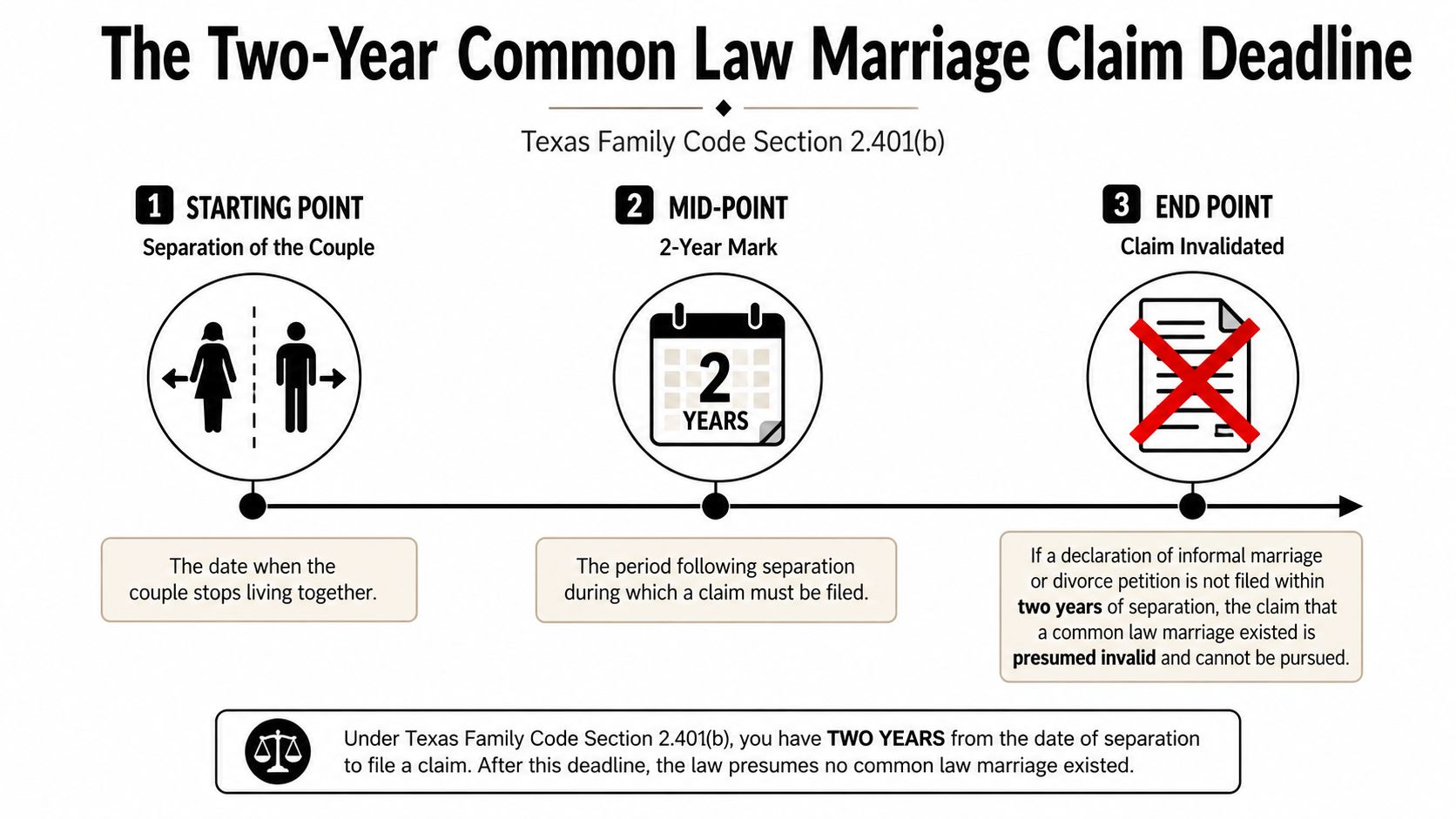
The confusion gets worse after separation. Many people hear "two-year rule" and assume it means they had to live together for two years. In reality, the key deadline comes after the breakup. If no one files a proceeding to prove the marriage within two years of separation and stopping cohabitation, Texas law creates a presumption against the marriage's existence under Texas Family Code Section 2.401(b).
That is where people get hurt. They wait because they're overwhelmed, hoping things will settle down. Then documents disappear, witnesses become less helpful, memories fade, and the legal burden gets heavier. If you're in that position now, clarity matters more than ever.
The Three Legal Elements of a Texas Common Law Marriage
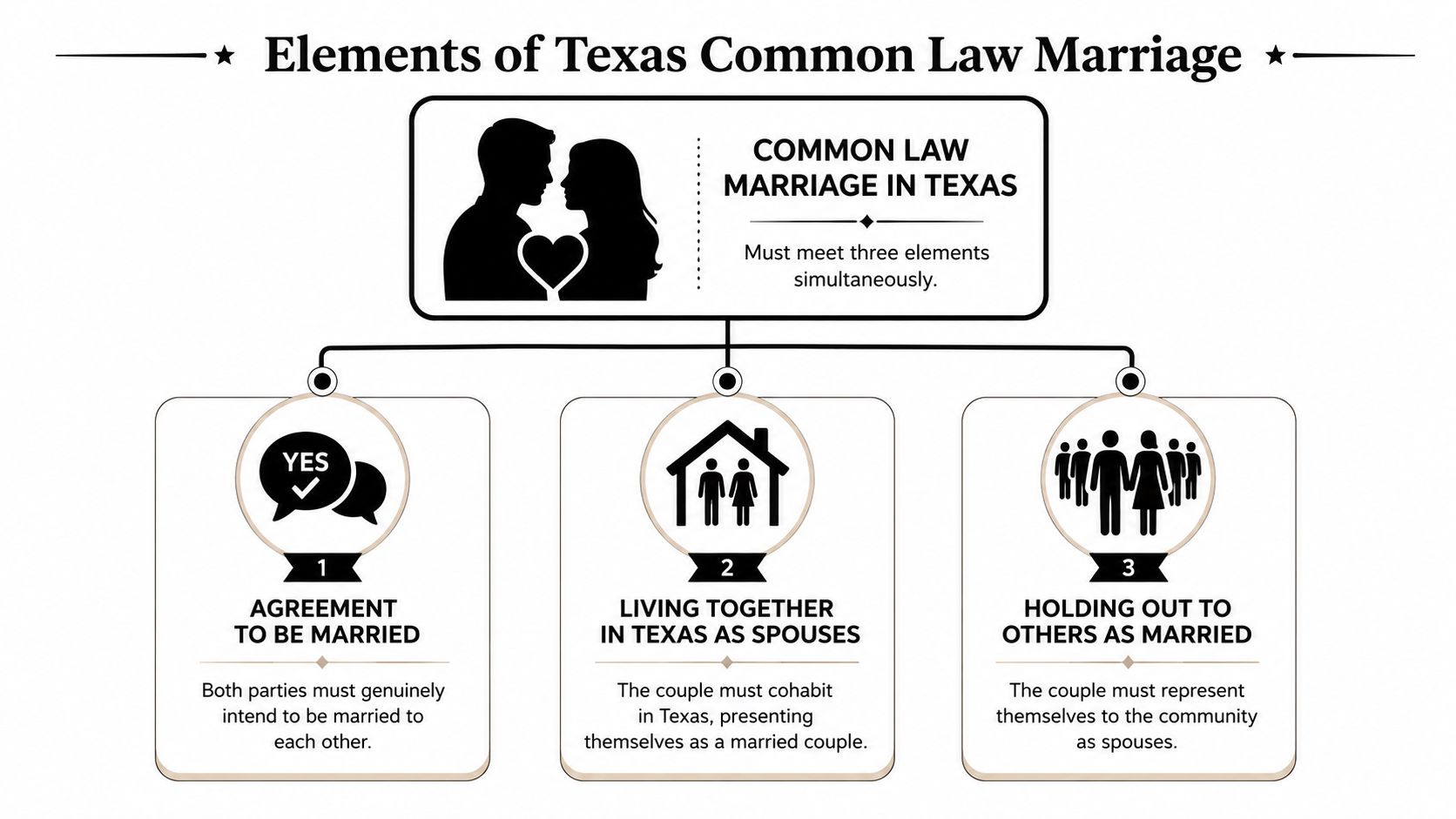
Texas law uses a simple framework. An informal marriage exists only if all three elements are present: agreement to be married, living together in Texas as spouses after that agreement, and representing yourselves to others as married. Duration alone never does the job, whether it's one year, seven years, or longer, as explained in this discussion of Texas common law marriage requirements and in Katie L. Lewis's explanation of the myth.
Agreement to be married
The first element is a present agreement to be married. That means you both intended to be married now, not someday in the future.
An engagement usually isn't enough by itself because it signals a plan to marry later. Courts look for facts showing both people believed they were already spouses. That can come from words, actions, paperwork, or the way the relationship functioned in daily life.
Examples that can help show agreement include:
- Joint tax treatment: Filing returns together can support the claim that you both treated the relationship as a marriage.
- Insurance choices: Listing one another as spouses or beneficiaries may matter.
- Shared legal documents: Some couples identify the other person as a spouse in applications or official forms.
Living together in Texas as spouses
The second element is cohabitation in Texas as spouses after the agreement. This isn't just about sharing an address.
A court will look at whether you were building a life in Texas in a way that resembled a marital household. Shared living arrangements, household responsibilities, and the way you organized day-to-day life may all matter. The focus is on whether the couple lived together as husband and wife or spouses, not merely as dating partners or roommates.
Holding out to others as married
The third element is often where cases are won or lost. Holding out means publicly representing yourselves as married.
Texas Law Help examples, discussed in the verified material above, include conduct such as using the same last name, filing joint tax returns, listing each other as spouses on insurance or public benefits, shared leases, health insurance beneficiaries, or naming a partner on life insurance policies. Courts may infer agreement and holding out from that kind of evidence.
When your private relationship and your public story don't match, common law marriage disputes become harder.
A short comparison helps:
| Element | What the court asks |
|---|---|
| Agreement | Did both of you intend to be married now? |
| Cohabitation | Did you live together in Texas as spouses? |
| Holding out | Did you present yourselves to others as married? |
If one element is missing, the claim can fail. That's why the law is more precise than the myth.
The Real Two-Year Rule You Cannot Afford to Ignore
The true two-year rule appears in Texas Family Code Section 2.401(b). It doesn't tell you how long to live together. It creates a rebuttable presumption against an informal marriage if no proceeding to prove the marriage is filed within two years after the parties separate and stop living together, as explained by Robbins Estate Law.
Early in this timeline, it helps to visualize what the law is doing.
What a rebuttable presumption means
A rebuttable presumption doesn't make a claim impossible. It makes it harder.
If you file within the two-year period, the case proceeds under the ordinary preponderance of the evidence standard described in the verified data. If you wait longer, the burden shifts. You may need clear and convincing evidence to overcome the presumption that no marriage existed.
That difference matters in real life. Common law marriage cases often depend on conduct, conversations, old forms, and witness memory. Once time passes, those cases become more fragile.
Why delay is risky
People often delay for understandable reasons. They're grieving the breakup. They're trying to co-parent. They hope they'll work things out privately.
But waiting can weaken your position. It can also affect whether you can pursue rights connected to divorce, including property issues that depend on proving there was a marriage in the first place. If you're unsure how the process unfolds from pleading through the final decree, How to File for Divorce in Texas Step by Step outlines the full sequence from petition to final decree.
This video gives a helpful overview before you decide your next move:
Bottom line: The two-year rule is a deadline problem, not a cohabitation requirement.
Another point matters here. Verified guidance confirms that an informal marriage can arise in a single day if the legal elements occur at the same time. So the law can recognize a marriage quickly, yet still punish delay after separation. That combination is exactly why these cases surprise so many people.
How to Prove or Defend Against a Common Law Marriage Claim
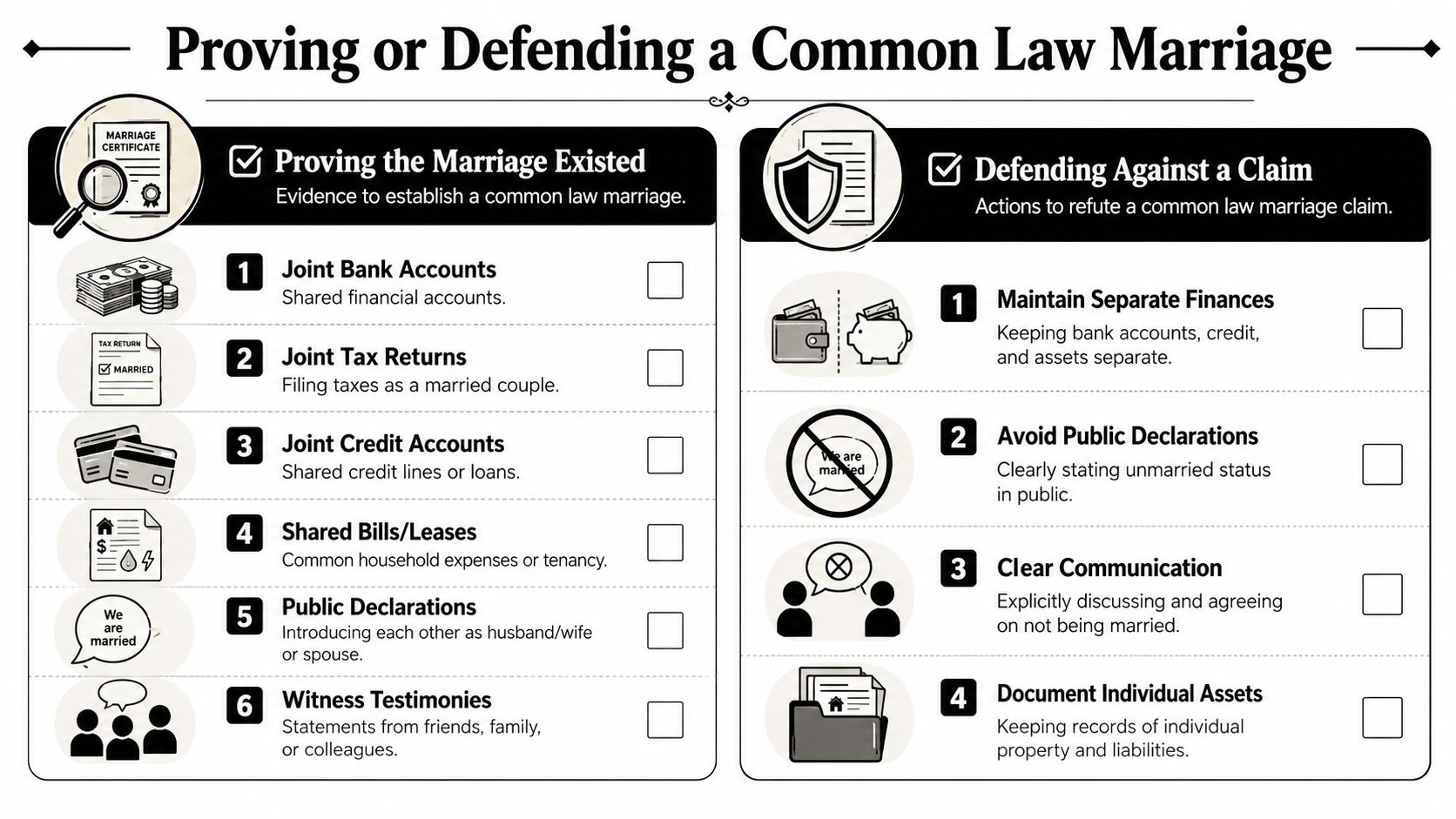
Once separation happens, the case usually turns on evidence. One side is trying to show the marriage existed. The other is trying to show at least one legal element never happened.
If you need to prove the marriage existed
The first practical move is preserving evidence fast. Under guidance on the Texas two-year filing deadline, the clock is generally stopped by filing a proceeding asserting the marriage, most commonly a Petition for Divorce that expressly alleges an informal marriage before the second anniversary of separation.
Useful evidence often includes:
- Tax records: Returns that reflect married filing status can be powerful.
- Housing documents: Leases, mortgage papers, or applications showing you lived together as spouses may help.
- Insurance and benefits forms: Listing the other person as a spouse can support both agreement and public representation.
- Affidavits and testimony: Friends, family, neighbors, or coworkers who heard you refer to each other as spouses may be important.
- Financial documents: Joint accounts, shared debts, or loan applications can show how the relationship operated publicly.
Some couples also choose to file a Declaration of Informal Marriage with the county clerk when they want certainty going forward. That doesn't fix every dispute about past conduct, but it can reduce ambiguity.
If you need to defend against the claim
Defense work usually focuses on identifying the missing element. You don't necessarily have to disprove everything. You may only need to show that one requirement was never met.
That can include facts like these:
- Separate public identities: You consistently identified yourself as single.
- No mutual agreement: One or both of you discussed marriage as a future possibility, not a present fact.
- Separate finances or residences: The relationship looked more like dating, roommates, or a long-term partnership than a marriage.
- Contradictory paperwork: Forms, applications, or tax filings may show unmarried status.
The strongest defense is usually consistency. If your documents, statements, and conduct all pointed away from marriage, that pattern matters.
For business owners and people with substantial assets, speed is especially important. Delay can blur what was separate property, what was earned during the claimed marriage, and how to trace ownership. If children are involved, you'll also need to separate the marriage issue from parenting issues. A child custody case can move forward even when adults dispute whether they were married.
Navigating a Common Law Divorce Property and Support
If an informal marriage is established, the divorce process works like any other Texas divorce. You don't get a shortcut because there was no ceremony, and you don't lose protection because there wasn't a marriage license. Once the marriage is recognized, the court treats it as a real marriage.
Property division follows Texas divorce rules
Texas is a community property state. In plain English, property and debt acquired during the marriage may be subject to division in a manner the court considers just and right. In a common law case, one of the first battlegrounds is often the marriage start date, because that can affect what falls into the marital estate. You can get a clearer overview in this guide to community property in a Texas divorce.
For business owners, tracing is often critical. If you started a company before the marriage but grew it during the marriage, the court may need detailed records to sort out separate and community interests. The same is true for retirement accounts, investment accounts, real estate, and bonuses.
Support, children, and court procedure
Spousal maintenance isn't automatic in Texas. But if a valid marriage existed, one spouse may ask the court to consider support under the same legal framework used in ceremonial divorces. Child custody and child support also follow the usual Texas standards. The court focuses on the child's best interest, parenting arrangements, and financial support, not whether the marriage started formally or informally.
Court procedure usually includes several stages:
- Filing: One party files a petition and states the legal basis for the case.
- Response: The other party answers and may deny the marriage, dispute property claims, or request relief.
- Temporary orders: The court may address possession of children, use of property, or temporary support while the case is pending.
- Discovery and negotiation: The parties exchange documents and evaluate settlement options.
- Mediation: Many Texas family courts strongly encourage mediation before trial.
- Final decree: If the case doesn't settle, a judge decides disputed issues and signs the final order.
If you're trying to organize documents and understand the practical side of case preparation, resources on understanding divorce legal support can help you think through document gathering and procedural support needs. For parenting disputes after filing, it's also wise to review custody, support, mediation, and enforcement materials so you understand how those issues may unfold alongside the marriage question.
Your Next Steps Protecting Your Future
A lot of Texans find out the hard way that uncertainty helps the other side. One person says, "we were basically married." The other says, "we were just living together." By the time that dispute reaches court, casual choices can look like legal evidence.
If your goal is to avoid an informal marriage claim, create a clear paper trail now. A written Texas cohabitation and property agreement can state that you are living together without agreeing to be married, identify who owns which property, and spell out how bills, purchases, and move-out issues will be handled. That kind of document does not fix every problem, but it gives a judge something concrete to look at if the relationship later falls apart.
Your day-to-day conduct matters too. Do not call each other husband and wife on tax forms, lease paperwork, insurance documents, school records, or benefit applications if that is not your intent. In these cases, small records often carry more weight than big speeches.
If you believe a common law marriage does exist, delay creates risk. The biggest mistake I see is waiting after separation and assuming the issue can be sorted out later. In Texas, the two-year problem is not "you lived together for two years, so you're married." The main danger is the deadline after separation. If that window is closing, you need case-specific advice quickly about whether to file and how to preserve evidence.
Some couples also need certainty while they are still together. In the right case, a Declaration of Informal Marriage can remove doubt. In the wrong case, it can create consequences one or both people did not fully consider. The answer depends on your property, your children, your benefits, and whether both of you are willing to take the same legal position.
The Law Office of Bryan Fagan, PLLC handles Texas family law matters involving divorce, custody, mediation, support, enforcement, and disputes over whether an informal marriage existed. If your status is unclear, get advice before the facts harden against you.
What to Do Next
- Check your timeline: Identify the separation date and whether the two-year deadline may be approaching.
- Gather documents now: Pull tax returns, leases, insurance forms, benefit records, bank statements, and messages that may support or defeat the claim.
- Protect children separately: If custody or support issues are involved, don't assume the marriage dispute puts parenting issues on hold.
- Look at settlement options: Mediation can help resolve property and parenting disputes even when the parties disagree about facts.
- Get legal advice early: Common law marriage cases often turn on details that seem minor until they are in front of a judge.
Frequently Asked Questions About Common Law Marriage
What if we moved out of Texas after living together there
This issue can become complicated fast. A valid out-of-state marriage may still be respected elsewhere, but the two-year separation presumption is Texas-specific, and it may not apply uniformly after a move, as discussed in this analysis of cross-state common law marriage issues.
If you moved after separation, don't assume the law of your new state wipes away Texas issues. Don't assume the opposite either. Cross-border family law questions often involve property rights, forum questions, and timing problems that need individual review.
Do common law spouses need a divorce
Yes, if a valid informal marriage existed, ending the relationship usually requires a formal divorce process. Moving out doesn't undo a marriage. That matters for property rights, support issues, and closure in the court record.
Can you be partially common law married
No. Texas doesn't recognize a halfway version. Either the legal elements were present and a marriage existed, or they weren't. Couples often have mixed facts, which is why these cases can be contested, but the court still has to decide the yes-or-no question.
Does common law marriage affect inheritance
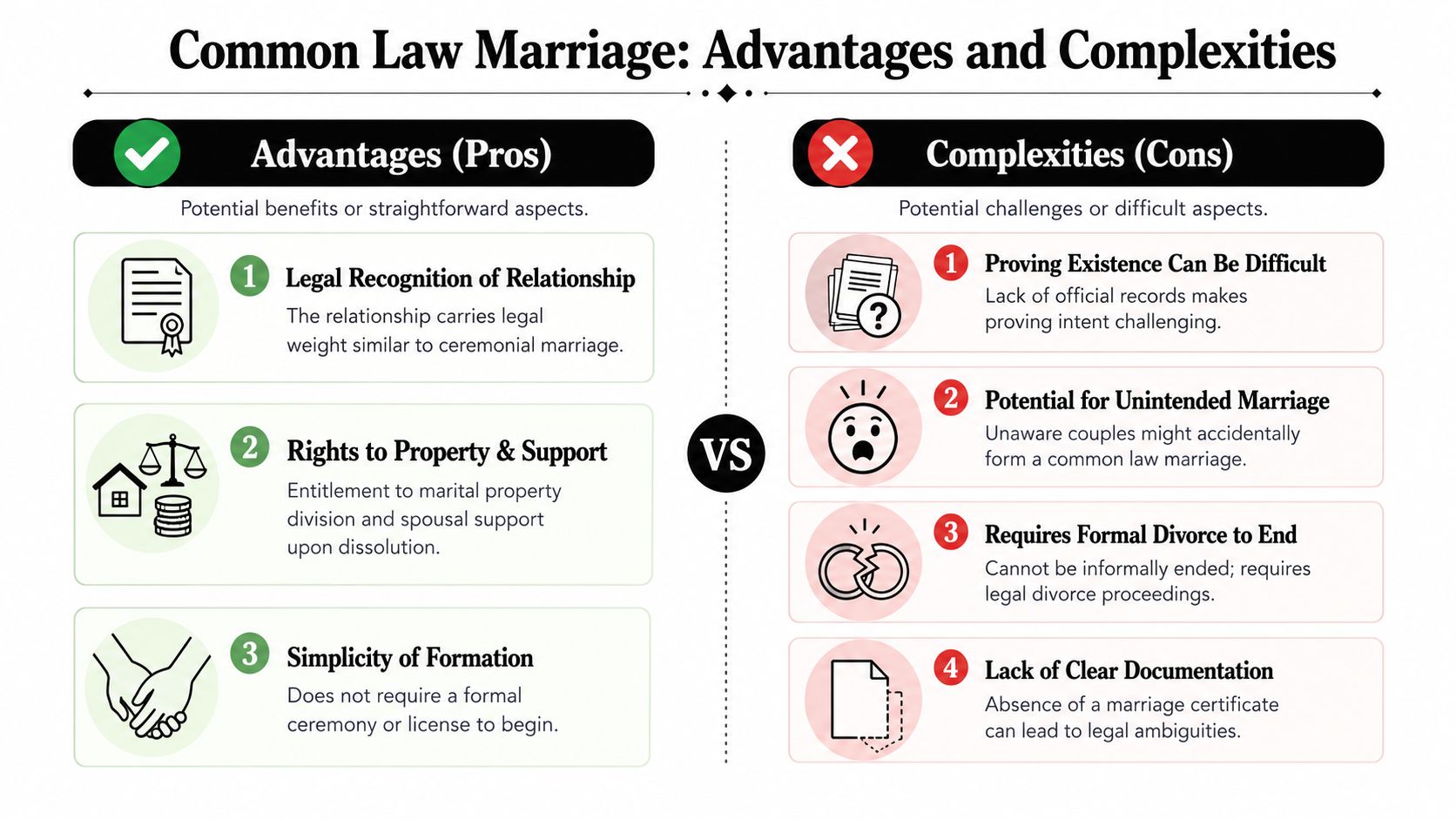
It can. If a valid marriage existed, surviving spouse rights may come into play in probate or estate disputes. But when there is no clear record, the fight often becomes a proof problem. That is one more reason not to leave important relationships legally ambiguous.
What if we have children together
Having children together does not by itself prove a marriage. Parenting rights and marital rights are separate legal questions. You may need orders about conservatorship, possession, and child support whether or not the court finds an informal marriage.
What evidence do courts usually care about most
Courts tend to focus on evidence that shows consistency across your words, documents, and public conduct. Tax filings, leases, insurance records, benefit elections, and witness testimony often matter because they show how you presented the relationship to the outside world.
If you're worried about whether you were common law married, or whether a former partner may claim you were, you don't have to sort it out alone. The attorneys at Law Office of Bryan Fagan, PLLC help Texans evaluate informal marriage claims, file for divorce when necessary, address custody and support issues, and protect property rights through negotiation, mediation, and litigation. Schedule a free consultation to get clear answers about your timeline, your evidence, and the next step that fits your situation.


