Skip to content
You may be trying to finish your Texas divorce efficiently, especially if you and your spouse already agree about the children, property, and support. But if you have a child who falls within Texas Family Code requirements, leaving the SAPCR out of the divorce can create a serious enforcement problem later, including a risk that the final judgment will be treated as void.
Why Divorce Involves More Than Just Ending the Marriage
You and your spouse may have already worked out where your child will live, how possession will work, and who will pay support. You may even be reviewing a written agreement together and thinking the remaining task is to obtain a divorce decree. That sense of progress is understandable, but Texas law treats the child-related part of the case as more than an attachment to the marriage case.

A SAPCR, or suit affecting the parent-child relationship, addresses the legal relationship between parents and children. It can cover conservatorship, possession and access, child support, medical support, and other child-related orders. In a Texas divorce involving children, those issues generally belong in the same proceeding as the divorce, property division, and other claims.
That matters even when the parents agree. An agreement still needs to become part of a properly structured court case. If you assume you can obtain the divorce now and handle custody or support in a separate case later, you may be relying on a procedure Texas law doesn't permit. The Texas child custody laws page can help you understand the broader custody framework, but the filing structure must be handled correctly from the beginning.
Why parents often miss the issue
Parents usually focus on practical questions:
- Where will the child spend school nights?
- How will holidays work?
- Who will pay expenses?
- Can you keep the divorce uncontested?
Those questions are important, but they don't replace the required pleading. The court must have authority to address the child issues and enter enforceable orders. Proper joinder creates one connected proceeding instead of leaving custody and support floating outside the divorce.
Practical perspective: Agreement can simplify a family-law dispute, but it doesn't eliminate the need to plead the correct legal claims.
Separation can also be emotionally difficult for children and parents. If your family needs support with communication, grief, or adjustment, a resource such as therapy for family issues may complement, but cannot replace, legal advice. The legal objective is to obtain a final decree that ends the marriage and clearly protects your child's future.
What Texas Family Code Section 6.406 Actually Requires
Texas Family Code § 6.406 establishes the mandatory joinder of a SAPCR with divorce when the statutory conditions apply. In plain English, the divorce petition must identify whether the spouses have children under the age of adulthood or children otherwise entitled to support. It must also address whether the spouses are parents of a child who isn't already under another court's continuing jurisdiction. Texas Family Code § 6.406 provides the statutory foundation for this requirement.
The filing analysis generally follows this sequence:
- Identify the children. The petition must state whether there are children under 18 or children otherwise entitled to support.
- Check existing court jurisdiction. Determine whether another court already has continuing jurisdiction over the child-related case.
- Join the SAPCR when required. If the spouses are parents of a child and no other court has the relevant continuing jurisdiction, the divorce action must include the SAPCR.
- Plead the necessary relief. The case should address conservatorship, possession, support, and related child issues rather than treating them as a future project.
What “joined” means
Joinder means the divorce and SAPCR proceed together in one case. The court isn't being asked to divide the marriage in one lawsuit and decide the children in an unrelated lawsuit. Instead, the court handles the connected family issues through the joined proceeding.
The rule dates back at least to related joinder provisions enacted by the 75th Texas Legislature in 1997, as reflected in the statutory history and later guidance. Texas appellate authority has treated the joinder as mandatory, not as an optional convenience. In practice, that means a divorce involving children also involves decisions about custody, visitation, support, and related parental rights.
The requirement can apply even when you and your spouse continue living together while preparing for divorce. Texas doesn't require spouses to live separately before filing. The practical point is addressed in Filing for Divorce While Living Together in Texas, which explains why living arrangements don't create a separation prerequisite.
The role of the initial petition
The original petition starts the procedural framework. If it omits the child-related issues or misstates the existing jurisdiction, later corrections may be necessary and may affect how the case proceeds. You can review general considerations for filing for custody, but a divorce with children requires careful coordination between the divorce pleadings and SAPCR requests.
The exception is important. If a prior order already gives another court continuing jurisdiction, § 6.406 generally doesn't require the parties to re-join the issues in the divorce. That exception depends on the actual court orders and jurisdictional history, so you shouldn't assume it applies merely because a prior case existed.
The Legal Risks of Skipping the Required Joinder
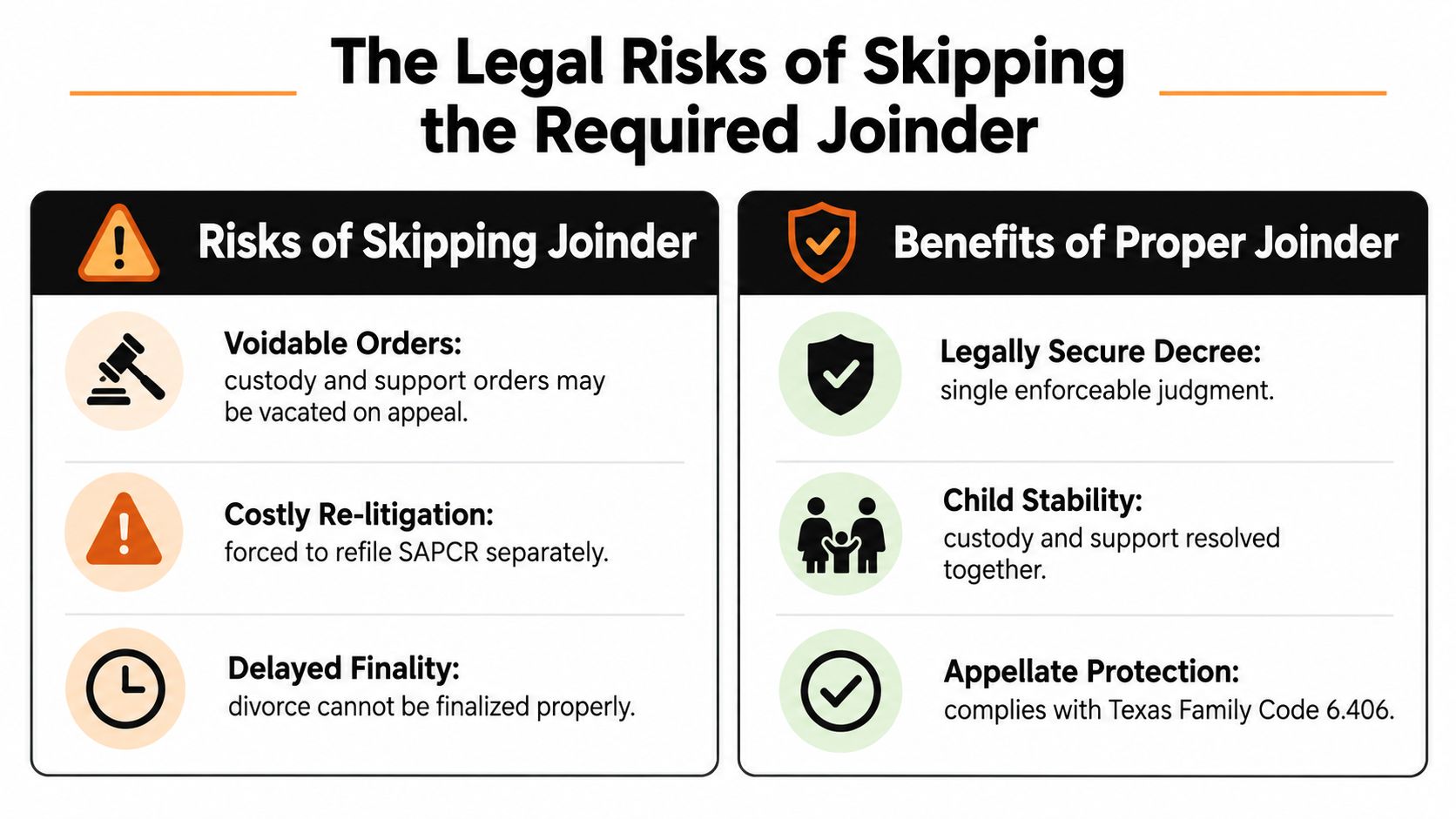
Skipping joinder isn't a harmless paperwork mistake. Texas appellate authority has described the joinder as mandatory, held that the divorce and SAPCR can't be severed, and stated that failure to comply can render the resulting judgment void. The governing appellate discussion is available in this Texas appellate opinion on mandatory joinder.
That consequence changes the way you should evaluate an apparently simple divorce. A decree may look complete on its face, but if the required SAPCR wasn't properly joined, a party may later challenge the validity of the child-related orders. A custody provision that cannot be enforced reliably doesn't provide the stability parents thought they had secured.
Why the problem often appears later
The problem may not surface when the decree is signed. It can appear when one parent seeks to enforce possession, collect support, modify conservatorship, or defend an order in a later proceeding. At that point, the other side may argue that the court never properly joined the SAPCR or lacked the procedural basis to enter the child-related relief.
The consequences can include:
- Enforcement uncertainty: A parent may struggle to enforce custody or support provisions that are later attacked.
- Additional litigation: The family may need to address the missing or defective SAPCR instead of moving forward under a stable decree.
- Venue and transfer complications: The merged posture of the case can affect which court should handle related matters.
- Finality concerns: The divorce may appear finished while the child-related orders remain vulnerable.
The law doesn't impose this structure to create needless complexity. Joining the claims allows the court to address the marriage, property, and children in a coordinated proceeding. It also reduces the risk that two courts will issue conflicting orders about the same family.
Protective step: Before signing an agreed final decree, confirm that the petition and judgment clearly include the required SAPCR relief and identify the court's jurisdiction over the children.
If you already have a final order and are concerned about an omission, don't assume the problem is minor or automatically fatal. The effect depends on the pleadings, orders, jurisdiction, and procedural history. You should also understand that a decree's ability to change later is a separate issue from whether it was valid when entered. A careful review of whether a Texas divorce decree can be changed after final can help frame that distinction.
When Joinder Is Required, Transferred, or Not Needed
The key question isn't only whether you have children. You must also determine whether another court already has continuing jurisdiction over the child-related case. That jurisdictional history controls whether the SAPCR must be filed with the divorce, transferred into the divorce case, or left under the existing court's authority.
| Your situation | General procedural result |
|---|---|
| You and your spouse are parents, and no other court has continuing jurisdiction | The divorce action must include the SAPCR |
| A SAPCR is already pending, and no other continuing jurisdiction applies | The SAPCR must transfer to the divorce court for consolidation |
| A prior order gives another court continuing jurisdiction | Re-joinder generally isn't required under § 6.406 |
When the SAPCR must be joined
If the spouses are parents of a child and the child isn't already under another court's continuing jurisdiction, the divorce suit must include the SAPCR. Texas practice materials describe the divorce, property division, and SAPCR claims as joined and inseparable. You can't treat the child case as an optional add-on or ask the court to sever it because the spouses agree about the marriage.
That means you should investigate prior orders before filing. Search your records for previous custody cases, support orders, temporary orders, and final orders. The name of the county alone may not answer the jurisdiction question. The actual order and the continuing jurisdiction language matter.
When a pending SAPCR is transferred
A SAPCR may already be pending when one spouse files for divorce. In that situation, Texas law requires the pending SAPCR to transfer to the court handling the divorce when no continuing exclusive jurisdiction already exists. Legislative history for § 6.406 describes that transfer requirement, and Texas practice treats the consolidation as mandatory rather than optional. The Texas legislative history for the joinder provisions provides background on that transfer-and-consolidation rule.
The practical benefit is one coordinated court file. You avoid asking different courts to decide overlapping questions about possession, support, and parental rights. You also give the court a clearer view of the family's complete situation.
When re-joinder may not be needed
If a prior order already gives another court continuing jurisdiction, § 6.406 doesn't require the divorce action to re-join the child issues in the same way. That doesn't mean the child orders disappear, and it doesn't mean every later filing belongs in the divorce court. It means the existing jurisdictional arrangement must be respected.
You should obtain legal advice before relying on this exception. A prior case may have involved the child without creating the continuing jurisdiction you assume exists. A wrong assumption at filing can affect venue, transfer, and enforceability.
How to Handle Pleadings, Timing, and Temporary Orders Correctly
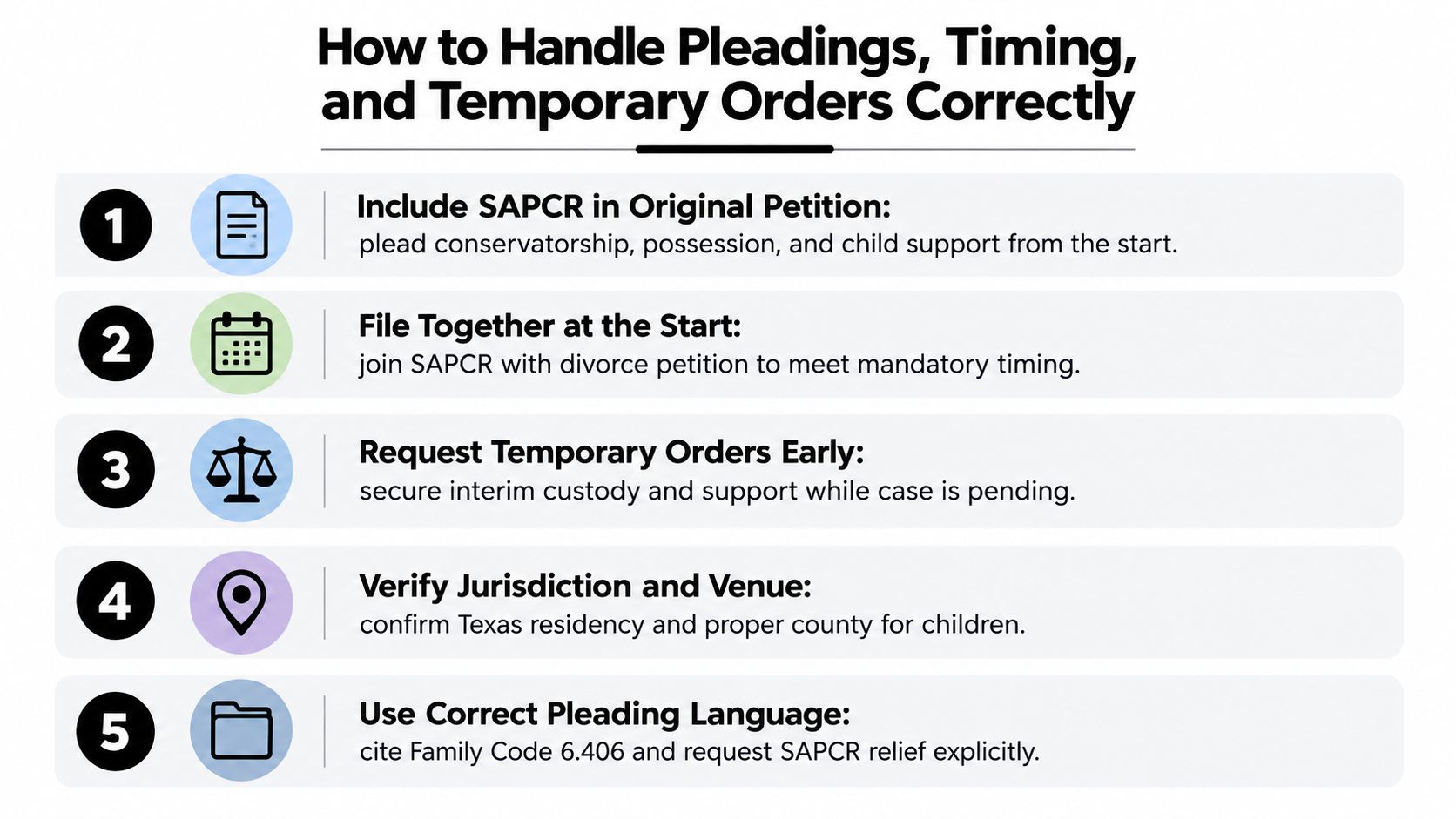
A properly joined case starts with accurate information, not a form selected because the divorce appears uncontested. You should identify every child who may be under 18 or otherwise entitled to support, locate prior orders, and decide what immediate relief your family needs while the case is pending.
Start with the correct pleadings
Your original petition should identify the children and request the SAPCR relief that fits your circumstances. That may include conservatorship, possession and access, child support, medical support, and other appropriate provisions. The pleading should also address the jurisdictional facts that determine whether joinder is mandatory.
Use a complete factual review before filing:
- Prior orders: Gather every custody, support, adoption, protective, or related order involving the children.
- Current arrangements: Write down where the children live, how possession currently works, and what problems need immediate attention.
- Financial information: Collect income records, business information, insurance details, debts, and property records that may affect support or division.
- Jurisdiction facts: Confirm the proper Texas court and county based on the children's case history and the parties' circumstances.
Request temporary orders when stability can't wait
Temporary orders can establish interim rules while the divorce proceeds. You may need temporary conservatorship provisions, a possession schedule, support arrangements, responsibility for bills, or protections concerning property and the children. Waiting until the final hearing can leave your family without clear rules during a stressful period.
The right timing depends on the facts. A cooperative household may need a negotiated temporary agreement, while conflict, safety concerns, financial control, or abrupt changes in possession may require an early court hearing. Mediation can be useful when both parents can negotiate safely and exchange enough information to make informed decisions. It isn't appropriate for every family, particularly where coercion or immediate safety concerns are present.
Keep the final decree consistent
The final decree should resolve the joined claims together. Before approval, compare the decree with the petition, any mediated settlement agreement, temporary orders, and financial terms. Parents, business owners, and people with high-value estates should be especially careful because child orders, property division, business interests, retirement assets, support, and tax-related provisions can interact.
For a fuller procedural overview, How to File for Divorce in Texas describes the sequence from petition through final decree. The central protection remains the same throughout the case: don't postpone child-related pleadings until after the divorce is finished.
Understanding Child Custody and Support in Your Texas Divorce
A divorce decree can look complete while leaving the family with an unusable custody order. If the SAPCR was not properly joined, a later challenge may reach the judgment's validity, not merely the wording of a possession schedule or support amount. That risk is why child-related claims require more than informal agreements between parents.
Conservatorship defines parental rights and duties. Possession and access sets parenting time. Child support assigns financial responsibility. These orders must fit together and remain enforceable after the divorce is signed. A parent who misses payments or violates possession terms needs a valid order that the court can enforce. If the underlying structure is defective, enforcement may become the first contested issue.
The practical review should continue after entry of the decree. Confirm that the final order identifies the children, states conservatorship and possession terms clearly, and includes workable support provisions. Check that the decree matches any signed agreement and that conflicting language has not carried over from earlier pleadings. Property division does not replace child support, and a parent's financial obligations should be read alongside the property terms rather than treated as settled by them.
Later changes generally require the proper modification process. A parent seeking a different possession schedule, conservatorship arrangement, or support amount must establish the applicable legal basis and obtain a new order. Informal changes may create confusion and leave the original terms subject to enforcement.
The safest course is to identify defects before signing the decree. Once the judgment is challenged, correcting a joinder problem can affect custody, support, and the finality of the divorce at the same time.
What to Do Next to Protect Your Family and Your Rights
If your Texas divorce involves children, treat § 6.406 as a filing requirement, not a technical detail. Confirm prior jurisdiction, include the SAPCR when required, request temporary orders when needed, and review the final decree for enforceable custody and support terms. Early guidance can prevent a later challenge to the judgment's validity.
Schedule a free consultation with The Law Office of Bryan Fagan, PLLC to review your divorce pleadings, prior custody orders, jurisdiction, property concerns, and parenting goals. You deserve a clear plan that protects your children and your rights.
The Law Office of Bryan Fagan, PLLC helps Texas families address divorce, SAPCR joinder, custody, child support, mediation, property division, and enforcement concerns. Visit Law Office of Bryan Fagan, PLLC to schedule a free consultation and discuss the procedural steps your case requires.