Skip to content
Facing a custody dispute can feel overwhelming, but understanding the language the court uses is the first step toward regaining control.
The most important thing you need to know is that Texas law doesn't really use the word “custody.” Instead, our courts talk about conservatorship, which is the legal term for your rights and responsibilities as a parent. Understanding this one term is the key to navigating your entire case with confidence.
Your First Steps in Understanding Texas Child Custody
When you’re facing a potential custody battle, the legal jargon can feel like a foreign language. Words like “conservatorship,” “possession,” and “access” are used instead of what most people call "custody." This isn't meant to confuse you; it's designed to be much more specific about the roles you and the other parent will play in your child's life.

The entire Texas Family Code is built on one core belief: your child benefits most from having a strong, healthy relationship with both parents. Because of this, the most common outcome by far is a Joint Managing Conservatorship.
Joint vs. Sole Conservatorship
In a Joint Managing Conservatorship, you and the other parent share the power to make important decisions for your child. Think of it as a business partnership, but for parenting. You'll need to work together on the big issues, such as:
- Making decisions about your child’s education.
- Consenting to non-emergency medical or dental care.
- Deciding where your child will live, which is often restricted to a certain geographic area.
Even in this joint arrangement, one parent is usually named the "primary" conservator. This parent has the exclusive right to decide the child’s main residence and is typically the one who receives child support payments.
The other parent is the "possessory" conservator and has a set visitation schedule, known as a possession order. This structure reflects a modern focus on shared parenting, moving away from older models toward a more cooperative approach after separation.
A Sole Managing Conservatorship is much rarer. It’s usually reserved for serious situations where one parent has a history of family violence, substance abuse, or neglect that could endanger the child.
As you begin this process, it helps to understand the moving parts of a legal case, including the tools essential for legal operations that keep a modern practice like ours running efficiently for clients like you.
To help you get comfortable with the language, we've broken down the key terms Texas judges use every day.
Decoding Key Texas Custody Terms
This table translates the legal terms Texas courts use to define parental roles into plain English.
| Texas Legal Term | What It Means for You | Common Parental Role |
|---|---|---|
| Managing Conservator | A parent with the right to make major decisions for the child. | Decision-Maker |
| Joint Managing Conservatorship | Both parents share decision-making rights and responsibilities. | Co-Parent |
| Sole Managing Conservatorship | One parent has the exclusive right to make most decisions. | Primary Decision-Maker |
| Possessory Conservator | The parent with visitation rights who does not determine the child's primary residence. | Non-Primary Parent |
| Possession and Access | The legal terms for visitation and the time each parent spends with the child. | Visitation Schedule |
Understanding this vocabulary is the foundation for everything that comes next. It’s how you’ll communicate your goals to the court and understand what the final orders really mean for your family.
Understanding the "Best Interest of the Child" Standard
In Texas family courts, every single decision a judge makes boils down to one guiding principle: the best interest of the child. This isn't just a vague feeling—it's the legal standard that governs every custody order. To effectively advocate for yourself and your children, you have to understand what this really means in a courtroom.
Years ago, the Texas Supreme Court laid out a list of factors to help judges figure out what's in a child's best interest. These are famously known as the "Holley Factors," and they create the framework for your entire case. Your ability to present evidence that speaks to these factors will directly shape the final outcome.
Think of it like a parenting report card. A judge will look at each of your strengths and weaknesses through this lens—focusing entirely on what will give your child stability and a chance to thrive, not on what’s most convenient for you or the other parent.
What the Court Actually Considers
The Holley Factors aren't a simple checklist where you can score points against the other parent. Instead, they’re a holistic guide the court uses to get the complete picture of your child's life. A judge weighs these elements together to make a final, informed decision.
Here are some of the most critical factors they'll look at:
- The emotional and physical needs of your child: This covers everything from providing a safe home and good meals to offering love, comfort, and emotional support. The court wants to see which parent is more tuned in to the child's day-to-day needs.
- Any emotional or physical danger the child may face: This is a huge one. The court will look hard at any history of family violence, substance abuse, neglect, or behavior that puts the child in unsafe situations.
- The parental abilities of each individual: This is an assessment of your skills and capacity to be a good parent. The court considers your experience, knowledge, and hands-on skills in raising a child.
- The stability of the proposed homes: Kids thrive on routine. A stable, predictable environment is considered vital for a child's development, so the court will compare the living situations each of you can offer.
- The plans each parent has for the child: This looks at your foresight. What are your plans for your child’s schooling, extracurriculars, and general upbringing?
- Acts or omissions that indicate an improper relationship: The court will look at whether your or the other parent's behavior has been harmful, set a poor example, or otherwise undermined the parent-child relationship.
Building Your Case Around the Best Interest Standard
Proving that you can meet your child's best interest takes more than just saying you're a good parent. You have to show it with clear actions and solid evidence. This can come from witness testimony, your own conduct during the legal process, and sometimes even professional evaluations.
A judge’s job is to create an environment that will allow your child to thrive. Your job is to show the court that the environment you provide is the one best suited to that goal. This means focusing on your child’s needs above your own.
In more complex cases, especially when concerns about a parent's mental or emotional state arise, the court might order a psychological evaluation to get an expert opinion. An experienced attorney can help you understand how these assessments are used to determine parental fitness.
Remember, your case is built piece by piece. Every decision you make and every action you take contributes to the overall picture the judge sees. Focusing on cooperation, stability, and your child's needs is always the most effective strategy.
Navigating the Texas Custody Court Process
The idea of going to court over your children is probably one of the most stressful things you can imagine. But knowing what’s coming, step-by-step, can take away a lot of that anxiety. The court system is a structured process designed to gather the facts and figure out what's best for your child.
Every custody case in Texas kicks off with a single, crucial document: the Original Petition in a Suit Affecting the Parent-Child Relationship (SAPCR). Think of this as the official starting point. It's the paperwork you or the other parent files to ask a judge to make legally binding orders about conservatorship, possession, and child support.
Once that petition is filed, the other parent must be officially notified. We call this "service," and it’s a non-negotiable legal step that ensures everyone gets a fair chance to respond and participate. After service is complete, the case heads toward its first major event: the Temporary Orders Hearing.
The Critical First Hearing: Step-by-Step
The Temporary Orders Hearing is arguably the most important day in your entire case. This is a mini-trial where the judge makes temporary rules that will stay in place while your case moves forward—a process that can easily take six months to a year.
These "temporary" orders will dictate your life for a significant time. At this hearing, the judge decides things like:
- Who gets to decide where the child lives (for now).
- What the temporary visitation schedule will be.
- Who pays temporary child support and keeps the child on their health insurance.
- Any other ground rules needed to keep things stable and safe for the kids.
Why is this so critical? Because these early orders create a status quo. When it's time to make a final decision, judges are often reluctant to upend a routine that seems to be working well for a child. What starts as temporary often has a way of becoming permanent.
The entire process generally follows a predictable path, from filing the first papers to standing before a judge.
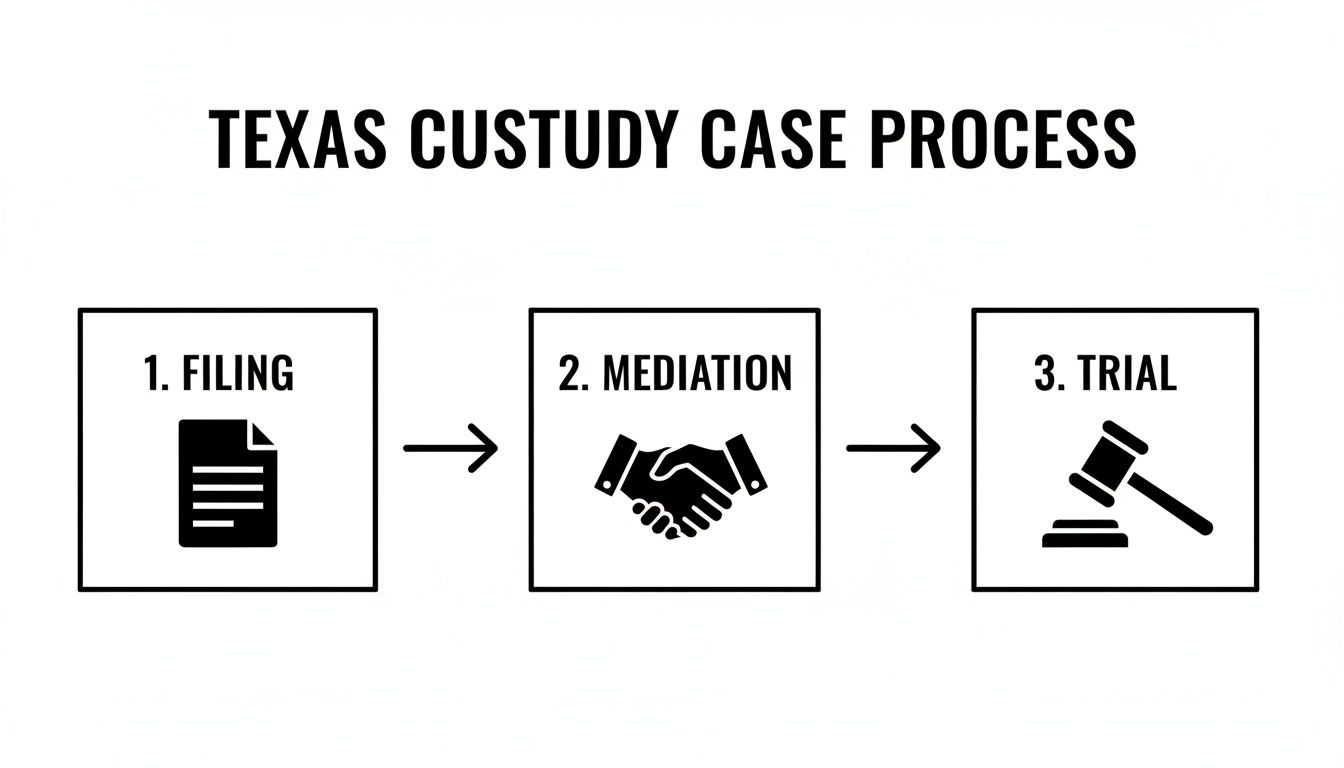
As you can see, a trial is the last resort. Before you ever get there, you'll have a prime opportunity to settle things on your own terms through mediation.
Gathering Evidence and Seeking Resolution
After the judge sets temporary orders, your case moves into the "discovery" phase. This is the formal legal process for gathering evidence. You and your attorney can request documents like text messages and financial records, or ask the other parent to answer questions under oath in a deposition. The whole point is to get all the facts out on the table.
The vast majority of Texas custody cases—well over 90%—settle out of court. Judges require parents to attend mediation for this very reason. It works.
Before you can get a final trial date, the court will almost always order you and the other parent to mediation. This is a confidential meeting where a neutral third-party mediator helps you try to negotiate an agreement. It is your single best chance to create a parenting plan that’s tailored to your family's unique situation, rather than having a judge who doesn't know you make the decision for you.
If you reach an agreement in mediation, your attorneys will draft it into a final order for the judge to sign, and your case is done. If you can’t agree on everything, your case will be set for a final trial, where a judge will listen to all the evidence and make the final call.
Crafting Your Possession Order and Parenting Plan
While it can feel like your entire world is being decided by strangers, you have more control than you might think over the day-to-day schedule your family will follow. In Texas, we don't call it a "visitation schedule"—it's a Possession Order. This is the practical, real-world calendar that spells out exactly when your child is with you and when they are with the other parent.
Working hand-in-hand with the Possession Order is your Parenting Plan. Think of this as the official rulebook for your co-parenting relationship. It defines specific rights and duties, answering critical questions like who makes medical decisions, who can consent to a child getting their driver's license, and—a big one—who has the exclusive right to decide where the child lives. Putting real thought into these documents is your opportunity to build predictability and stability for your child when they need it most.

The Standard Possession Order Explained
So where do courts begin? Unless there are unique circumstances, like a history of family violence, the Texas Family Code presumes that the Standard Possession Order in Texas (SPO) is in the child's best interest. This is the default schedule designed to give everyone a predictable routine.
The SPO is meant to be clear and consistent. For the non-primary parent (also known as the possessory conservator), it typically grants possession on:
- The first, third, and fifth weekends of a month.
- Alternating major holidays, like Thanksgiving and Christmas.
- An extended period during the summer, usually 30 days.
The specifics of the SPO can change based on how far apart you and the other parent live. If you live 100 miles or less from the other parent, the weekend pickups and drop-offs are designed for that proximity. Live over 100 miles apart? The schedule adjusts, often giving the non-primary parent every spring break and a longer, continuous summer possession to make up for less frequent weekend visits.
The Shift Toward Expanded Possession
Over the last several years, Texas has been moving toward giving non-primary parents more time with their kids. This shift led to the Expanded Standard Possession Order (ESPO), which is now the default option for parents who live within 50 miles of each other.
The ESPO is structured to create a schedule closer to a 50/50 split. The main differences from the standard schedule are significant:
- Weekend Possession: Instead of starting on Friday evening, weekends begin when school lets out on Thursday and end when school resumes on Monday morning.
- Holiday Possession: Holidays also start right after school is dismissed, giving that parent valuable extra time.
This expanded schedule allows the non-primary parent to be much more involved in the child’s weekday routines, from school drop-offs to homework help. It's a game-changer for parents who want more than just "weekend" time.
While a traditional SPO already gives the non-primary parent roughly 42-45% of the overnights in a year, the expanded schedule pushes families much closer to an even split, reflecting a clear trend toward more balanced parenting time in Texas.
Standard vs Expanded Possession Order Comparison
Let’s look at the key differences side-by-side. This table shows how the parenting time for the non-primary parent changes between the two default schedules.
| Parenting Time | Standard Possession Order (SPO) | Expanded Standard Possession Order |
|---|---|---|
| Weekend Pickup | Friday evening (usually 6:00 PM) | Thursday, when school is dismissed |
| Weekend Drop-off | Sunday evening (usually 6:00 PM) | Monday, when school resumes |
| Holiday Pickup | Friday evening (or the day before) | The day school is dismissed for the holiday |
| Holiday Drop-off | Varies by holiday, typically the evening before school resumes | The morning school resumes after the holiday |
As you can see, the ESPO adds two extra overnights per month and makes holidays longer, significantly increasing the non-primary parent's time and involvement in the child's daily school life.
Beyond the Standard Orders
The SPO and ESPO are just starting points. You and the other parent can absolutely agree to a completely custom possession schedule if you believe it’s what's best for your child. As long as it’s practical and safe, a judge will almost always sign off on an agreement made between parents.
Your Parenting Plan is where you'll hammer out all the rules that make your custom schedule work. This is where you outline agreements on communication, transportation for exchanges, and how you’ll handle disagreements down the road. A well-written plan can prevent countless arguments by setting clear expectations from day one.
Handling Special Circumstances in Custody Cases
Not every custody case is straightforward. When issues like family violence, substance abuse, military deployments, or even significant wealth are involved, the standard playbook goes out the window. Texas law has specific rules designed to handle these unique challenges, always with one primary goal: protecting your child.
If you're worried about your child's safety with the other parent, you need to know that the court will take your concerns seriously. These situations demand a careful, protective approach to ensure your child's well-being is the absolute priority.
Protecting Children from Harm
When a parent has a history of family violence, neglect, or substance abuse, the court's entire focus shifts to guaranteeing your child's safety. A judge won't hesitate to put firm limits on a parent's rights if there's credible evidence of behavior that could put a child in danger.
In these tough situations, the court has several powerful tools at its disposal:
- Protective Orders: A judge can issue a legally binding order that keeps a parent away from you and your child. Violating it can lead to immediate arrest and criminal charges.
- Supervised Visitation: If a judge believes unsupervised time is a risk, they can order that all visits happen with a neutral third party present or at a specialized, secure facility.
- Court-Ordered Counseling or Testing: A judge can make visitation contingent on a parent completing anger management, undergoing counseling, or submitting to regular drug and alcohol testing.
The gold standard is always the "best interest of the child." In cases involving potential harm, your child's right to be physically and emotionally safe is far more important than a parent's desire for unsupervised time.
These measures are safeguards designed to create a secure environment where your child might still have a relationship with a parent, but only if that relationship can be proven to be completely safe.
Unique Challenges for Military Families
If you or your child's other parent is an active-duty service member, your custody case has an extra layer of complexity. The Texas Family Code has specific provisions for military life, with its deployments and relocations.
For instance, a deployed parent can designate a trusted family member, like a grandparent or stepparent, to step in and exercise their possession time with the child. This ensures your child maintains those important family bonds while a parent is away serving our country. Courts can also craft flexible possession schedules that account for training cycles and deployments.
Custody and High-Net-Worth Estates
When a family has significant assets, it can affect both custody and child support. High-income earners are often ordered to pay child support that goes beyond the standard state guidelines to ensure the child can maintain a similar lifestyle in both homes. This usually requires a detailed review of both parents' finances to account for your child's specific needs, which might include private school tuition, elite extracurriculars, or international travel.
Texas’s Unique “Second Chance” Laws
Texas law also believes that people can change. In some specific cases, the state offers a path for a parent whose rights were terminated to potentially get them back. This isn't an easy road. A parent usually has to wait two years and must prove to the judge that the original problems are completely gone and that reuniting is truly in the child’s best interest now. You can learn more about how Texas empowers parents who have been previously deemed unfit to see if this unique law might apply to your situation.
How to Modify or Enforce Your Custody Order
Life doesn't stand still after a judge signs your custody order. The schedule that worked a year ago might become impractical or no longer serve your child’s best interests. On the other hand, you might be facing an ex-partner who refuses to follow the court-ordered rules. In either situation, you have legal options.

Seeking a Custody Modification
If you need to officially change your custody, visitation, or child support order, you must file a Petition to Modify the Parent-Child Relationship. A simple handshake agreement with the other parent isn't enough—without a new court order, the old one is still legally binding.
To convince a judge to approve a modification, you have to prove two key things:
- There has been a "material and substantial change in circumstances" since the last order was signed.
- The change you are requesting is in the child’s best interest.
What qualifies as a "material and substantial change"? It’s a high bar, but common examples include a parent relocating for a new job, a significant change in income, a child's evolving needs as they get older, or a parent's remarriage. The change must be something that significantly alters the family’s dynamic.
Enforcing Your Current Order
What happens when the other parent isn't following the rules? Maybe they consistently return your child late, miss child support payments, or wrongfully deny you possession. When this happens, you can file a Motion for Enforcement.
This is a serious legal action. An enforcement hearing is like a mini-trial where you present evidence—texts, emails, and witness testimony—to prove the violations. If the judge finds the other parent in contempt of court, the penalties can be severe.
A judge has the power to order the non-compliant parent to:
- Pay hefty fines for each violation.
- Serve jail time.
- Pay your attorney’s fees.
- Provide you with "make-up" possession time.
This legal tool is your way of holding the other parent accountable. You don't have to put up with repeated violations of your parental rights.
Frequently Asked Questions About Texas Custody
When you're facing a custody case, it feels like you're drowning in questions. Getting clear, straightforward answers is a lifeline. We've put together the questions we hear most often from parents just like you, cutting through the legal jargon to give you the practical information you need.
Can My Child Decide Who They Want to Live With?
This is one of the most common questions we get. Once your child is 12 or older, the judge is legally required to interview them in private to hear their preference. But—and this is a big but—the child's wish is not the final word.
A judge will consider your child’s maturity and their reasons for their preference. Think of it as just one important piece of a much larger puzzle. The ultimate decision will always come down to the child's overall best interest, weighing all the Holley Factors we discussed earlier.
Does a 50/50 Schedule Mean No One Pays Child Support?
Not necessarily. This is a major misconception. Even with a perfectly equal 50/50 possession schedule, a judge absolutely can—and often will—order one parent to pay child support.
If there's a significant difference in your incomes, the court will likely order the higher-earning parent to pay support. The goal is to ensure your child has a similar standard of living in both homes. It's about providing for the child, not just equalizing time.
What if I Want to Move Out of State With My Child?
Moving far away with your child is one of the toughest battles to win in a Texas court. The vast majority of custody orders contain a geographic restriction, which limits the child’s primary residence to a specific county and its neighbors.
To move outside that restricted area, you have two options: get the other parent's written agreement or file a modification lawsuit and convince a judge it's the right call. To win in court, you have to prove that the relocation is truly in your child's best interest—a very high legal bar to clear. The court will look extremely closely at how the move would impact your child’s relationship with the other parent.
What Is the Real Difference Between Joint and Sole Conservatorship?
Think of it as the difference between being co-captains of a team versus having one person with all the authority.
Joint Managing Conservatorship is the default in Texas because courts believe it's best for a child to have two involved parents. It means both of you share the rights and responsibilities of making major decisions for your child (like for school, medical care, and religion). Even in a joint arrangement, one parent is usually named the "primary" conservator and gets to decide where the child lives.
Sole Managing Conservatorship, on the other hand, is rare. It’s typically only ordered in very serious situations involving family violence, neglect, or substance abuse—cases where it’s simply not safe or appropriate for the other parent to share in decision-making.
Key Takeaway and What to Do Next
Navigating Texas child custody laws requires more than just information; it requires a strategic partner dedicated to protecting your family's future. Your first step is to get comfortable with the core concepts: conservatorship, possession orders, and the "best interest of the child" standard. Document everything and focus on creating stability for your children.
The team at The Law Office of Bryan Fagan, PLLC understands the emotional weight of these decisions and is committed to providing the compassionate, authoritative guidance you deserve. If you are ready to take the next step, schedule a free, confidential consultation with us today. Let us help you find clarity and confidence.